
This post may contain affiliate links, from which we earn an income. Click here to read our affiliate policy.
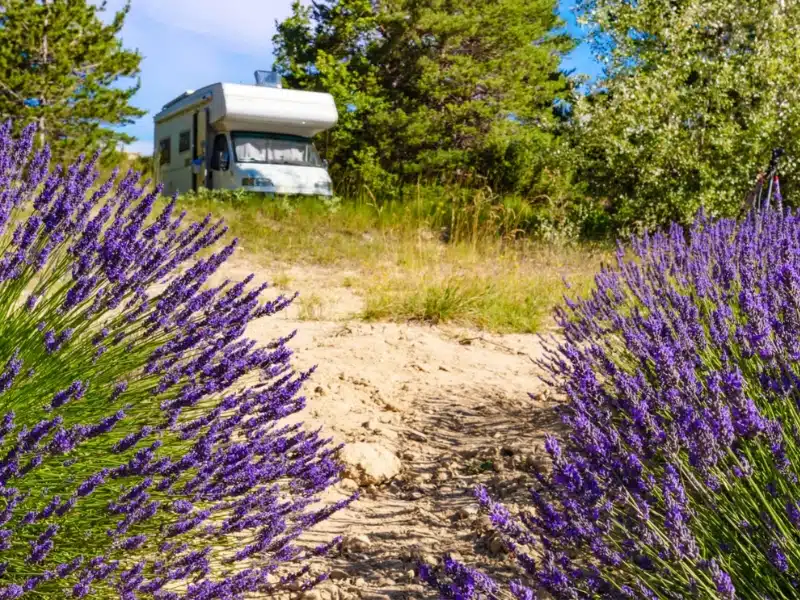
France is one of the easiest and most rewarding countries in Europe to explore by motorhome. With thousands of dedicated motorhome aires, excellent roads and everything from Atlantic beaches and Alpine passes to historic cities and rural villages, it’s a country made for touring.
We first travelled through France by motorhome in 2018, spending six months exploring the country as part of our first year on the road. Since then, we’ve returned many times in different motorhomes and our overland truck, travelling through France in every season and using everything from municipal aires and campsites to France Passion stops and off-grid parking.
In this guide, we share everything you need to plan a motorhome trip to France, including how to get there from the UK, driving rules, tolls and low-emission zones, where you can stay overnight, motorhome services and the best places to visit.
If you’re looking for a route rather than general touring advice, our France motorhome itinerary takes you through some of our favourite parts of the country and can be followed as a complete road trip or adapted to suit the time you have available.
Motorhoming in France Key Facts
What it is: The Gap Decaders’ guide to motorhoming in France covers getting there, driving rules, tolls, Crit’Air zones, motorhome aires, campsites, services and the best places to visit by motorhome.
Motorhome touring: France has an extensive network of dedicated motorhome aires, campsites and alternative overnight stops, making it one of the easiest European countries to tour by motorhome.
Trip planning: This guide covers practical touring information and routes through France, with a separate France motorhome itinerary for travellers planning a dedicated road trip.
First-hand experience: The Gap Decaders have toured France extensively by motorhome and overland vehicle since 2018, including a six-month trip and numerous return visits in different seasons.
Enjoy The Gap Decaders? Add us as a preferred source on Google.
Getting to France in a Motorhome
For UK motorhomers, France is one of the easiest European countries to reach. You can cross the Channel by ferry or LeShuttle, with routes ranging from the short Dover to Calais crossing to longer sailings into Normandy and Brittany.
Crossing the Channel
The quickest routes are Dover to Calais or Dunkirk by ferry, or Folkestone to Calais with LeShuttle. These are usually the best options if you’re heading towards eastern France, the Alps, Germany, Switzerland or Italy, as well as being a convenient starting point for a longer tour of France.
Longer ferry crossings from Portsmouth, Poole and Plymouth arrive at ports including Caen, Cherbourg, Le Havre, Saint-Malo and Roscoff. These can make more sense if you’re touring Normandy, Brittany or western France and want to avoid driving south from Calais.
Motorhomes are carried on all the main cross-Channel routes, although fares vary considerably according to vehicle length and height, season and how far ahead you book.
If you’re travelling from Ireland, direct ferries operate to several French ports, including Cherbourg and Roscoff, allowing you to bypass the UK altogether.
Compare motorhome ferry crossings to France with Direct Ferries and find the best route and price for your trip.
For routes, crossing options, costs and our tips for travelling across the Channel, see our complete guide to driving to France from the UK.
Hiring a Motorhome in France
If you don’t own a motorhome or want to avoid the Channel crossing and long drive south, flying to France and hiring locally is a convenient option.
Our recommended French motorhome and campervan hire company is Motorhome Republic, which compares rental options from a range of suppliers. With pick-up locations in Bordeaux, Lyon, Paris, Marseille, Nice and other major French cities, you can start your road trip in the part of France you want to explore.
Alternatively, you can hire a motorhome in the UK and drive it to France. Many UK hire companies permit European travel, including our recommended hirer, Spaceship Rentals. With a London depot, European travel options and fully equipped campers, it’s a good choice if you want to start and finish your trip in the UK.
Best Motorhome Routes Through France
France is a large country, and there can be a significant difference in distance, toll costs and driving experience depending on the route you choose. The autoroutes are generally excellent and make covering long distances easy, but tolls can quickly add up, particularly in a larger or heavier motorhome.
If you’re crossing from the UK, these are the main routes we use or consider when travelling through France.
Calais to South-East France
For the French Alps, Provence, the Côte d’Azur and onward travel into Switzerland or northern Italy, the quickest route generally follows the A26 from Calais towards Reims and Troyes before continuing via Dijon and Lyon.
This is the obvious choice when you simply want to cover ground. It is predominantly autoroute, straightforward to navigate and avoids Paris completely, but you’ll pay tolls for much of the journey.
A slower alternative is to leave the autoroute and use the parallel N and D roads. We’ve done both depending on how quickly we need to travel. The slower roads can save a considerable amount in tolls and give you far more choice of towns, supermarkets and aires for overnight stops.
South of Lyon, the A7 follows the Rhône Valley towards Orange and Provence. This is one of France’s major north-south holiday routes and can become extremely congested during the summer, particularly on Saturdays.
Calais to South-West France
For the Loire Valley, Dordogne, Bordeaux, western Pyrenees and northern Spain, a useful route heads from Calais towards Rouen, then south via Chartres, Orléans and Tours before continuing towards Poitiers and Bordeaux.
This avoids having to cross central Paris and gives you plenty of opportunities to break the journey at interesting places rather than treating France purely as a transit country.
If speed matters, you can use the autoroutes for much of the journey. If you have more time, this is also one of the easiest routes on which to mix autoroute driving with the excellent toll-free A10 road.
From Bordeaux, the A63 continues south towards Bayonne, Biarritz and the Spanish border at Irun, making this the natural route for San Sebastián and northern Spain.
Calais to the Mediterranean and Eastern Spain
For Languedoc, the Mediterranean coast, eastern Pyrenees and Spain’s Mediterranean coast, there are two main approaches.
The Rhône Valley route takes you south-east towards Lyon before following the A7 and A9 past Orange, Nîmes, Montpellier, Narbonne and Perpignan to the Spanish border. It’s fast and straightforward but involves substantial autoroute driving and tolls.
Our preferred alternative when the weather is suitable is to cross central France and pick up the A75 towards Clermont-Ferrand, Millau and Béziers.
The A75 is one of our favourite French roads. Much of the motorway is toll-free, with the notable exception of the Millau Viaduct, and the scenery through the Massif Central is superb.
There is a trade-off. The A75 climbs to more than 1,100 metres and includes long gradients, so weather and road conditions matter in winter and it can be harder work for an older or less powerful motorhome. The Rhône Valley route stays considerably lower.
Avoiding French Autoroute Tolls
You don’t need to use the autoroutes to cross France. The French N and D road network is extensive, and travelling on these roads can turn the journey south into part of the trip rather than something to get through as quickly as possible.
Set your satnav to avoid toll roads rather than avoid motorways completely. France has useful toll-free motorway sections, including much of the A75 and A10, which you don’t want your navigation system to exclude unnecessarily.
We often mix the two, using toll roads around cities or when we want to make progress and switching to ordinary roads when we have more time.
For heavier motorhomes, the difference in toll costs can be particularly significant because French autoroute charges depend on vehicle height, weight and axle configuration.
If France is simply part of a longer journey south, our driving to Spain from the UK guide compares the main routes, distances, driving times and toll costs.
France Motorhome Itinerary
If you’re planning to explore France rather than simply drive through it, we’ve put together a France motorhome itinerary based on our own travels around the country.
The route brings together some of our favourite French landscapes, roads and places to stop, with practical information for each stage including distances, driving times and recommended motorhome stopovers.
Our France motorhome itinerary includes a mapped route, day-by-day stops, driving information, things to see and do, and suggested places to stay with your motorhome and you can download a copy to print or store on a device and take with you.
Is this your first time visiting France? Get all the information you need in our France Travel Guide, including what to pack, the best time of year to go, getting there and practical tips to help you have the best trip!
France Motorhome Travel Rules
Since the UK left the EU, there are additional entry requirements for British travellers visiting France. Most are straightforward, but you need to consider passport validity, the Schengen 90-day rule, border systems and restrictions on what you can bring into the EU.
Passport and Schengen Rules
British citizens travelling to France must have a passport that meets the Schengen entry requirements. Your passport must have been issued less than ten years before the date you enter the EU and must be valid for at least three months after the date you plan to leave.
France is part of the Schengen Area, so time spent there counts towards the rule allowing most British visitors to spend up to 90 days in any rolling 180-day period across the Schengen Area.
If you’re planning a longer European motorhome tour, keep track of your days carefully, particularly if you’ll be travelling through several Schengen countries.
EES and ETIAS
The EU’s Entry/Exit System, or EES, records the entry and exit of non-EU nationals travelling to the Schengen Area for short stays. British travellers are included in the system.
ETIAS is a separate travel authorisation for visa-exempt visitors to participating European countries. Once operational, eligible British travellers will need to apply before travelling.
Because the implementation and transitional arrangements for both systems can change, check the latest official EU information before you travel.
GHIC and Travel Insurance
A UK Global Health Insurance Card (GHIC) gives eligible UK residents access to medically necessary state healthcare in France on the same basis as a French resident. Depending on the treatment, this may not always mean healthcare is free.
A GHIC is not a replacement for travel insurance. It does not cover things such as private medical treatment, repatriation to the UK, mountain rescue or many of the additional costs that can arise if you become ill or have an accident while travelling.
We use and recommend True Traveller for our own travel insurance. Their policies offer a wide range of activities as standard, cover travellers up to 75 years old, include long-term options of up to two years and can be started when you’re already travelling.
Take both your GHIC and appropriate travel insurance when touring France, and keep the details somewhere you can access easily in an emergency.
Taking a Pet to France
If you’re taking a dog, cat or ferret from Great Britain to France, you need to meet the EU pet travel rules.
For most pets travelling from Great Britain, you will need:
Since April 2026, people resident in Great Britain should no longer use an EU pet passport to enter the EU, even if the passport was originally issued in an EU country. EU pet passports are now intended for people whose main home is in the EU. GB residents should obtain an AHC for each trip from Great Britain to France.
Once you have entered the EU, your AHC can be used for onward travel within the EU and for re-entry to Great Britain for up to six months, provided your pet’s rabies vaccination remains valid.
You do not need tapeworm treatment before taking a dog into France from Great Britain. However, dogs returning to Great Britain must normally be treated for tapeworm by a vet no less than 24 hours and no more than five days before arrival, with the treatment recorded in the pet’s travel documentation.
When travelling by ferry or LeShuttle, check your operator’s pet arrangements before booking, as requirements and facilities vary between crossings.
Mobile Data and Roaming
EU roaming is no longer automatically included for UK mobile customers. Some UK networks still include European roaming in particular plans, while others charge a daily fee or impose data limits.
Check your allowance before travelling and be aware of fair-use limits if you’ll be touring France or Europe for an extended period.
For longer trips, an eSIM, local SIM or dedicated motorhome internet system can often be a better-value option.
Taking Food into France
There are restrictions on bringing certain food products from Great Britain into the EU. Meat and dairy products generally cannot be brought into France for personal consumption, with limited exceptions.
There are also limits and rules covering some plants, fruit, vegetables and other animal products, so check the current EU rules before stocking your motorhome for the journey.
When to Visit France in a Motorhome
France is a year-round motorhome destination, but for general touring we prefer late spring and early autumn. May, June and September usually offer the best balance of good weather, long enough days and fewer crowds, while July and August are considerably busier, particularly on the Atlantic and Mediterranean coasts.
December to February
Winter touring in France can be very quiet, but conditions vary enormously across the country. Northern and central France can be cold and wet, while the Alps, Pyrenees and other higher areas experience snow and winter driving conditions.
Many seasonal campsites close during winter, although year-round aires mean touring is still possible. If you’re heading into the mountains for skiing, make sure your motorhome is properly equipped for freezing temperatures and check the French winter tyre and snow-chain requirements before travelling.
March to May
Spring is an excellent time to tour France. Roads and popular destinations are generally quieter, days get progressively longer and seasonal campsites and attractions begin reopening.
By May, conditions can be ideal for touring much of the country, although mountain routes may still be affected by snow and the weather can remain changeable, particularly in northern France.
June to August
June is one of our favourite months for motorhoming in France, with long days and generally warm weather before the main summer holiday period gets underway.
July and August are peak season. Coastal resorts, major attractions, campsites and popular aires can be extremely busy, and temperatures in southern France can make sightseeing and sleeping in a motorhome uncomfortable during periods of very hot weather.
If you’re travelling during the French summer holidays, plan popular overnight stops ahead and expect heavier traffic on major routes, particularly around holiday changeover weekends.
September to November
September is another of our favourite months for touring France. The main summer crowds have gone, the Mediterranean and southern France can remain warm, and roads, aires and attractions are generally quieter.
As autumn progresses, days become shorter and more seasonal campsites begin to close. Mountain weather can also change quickly, but lower-level touring remains very rewarding well into autumn.
For our France motorhome itinerary, we’d choose late May to late June or early to mid-September for the best combination of weather, outdoor activities and manageable crowds.

Complete Guide to Motorhoming in Europe
Planning a motorhome tour of Europe? We’ve put everything we’ve learned from years on the road into one practical guide.
From planning routes and understanding tolls and low emission zones to finding places to stay, it’s packed with practical advice to help you tour Europe with confidence.
Driving a Motorhome in France
Driving a motorhome in France is generally straightforward. Roads are usually good, the autoroute network is excellent and outside major cities there is plenty of space. Once you leave the main roads, however, rural villages, mountain routes and historic town centres can become narrow, so always check your route carefully if you have a larger motorhome.
As in the UK, the rules that apply to you can depend on the weight of your motorhome, particularly if your vehicle has a maximum authorised mass over 3,500kg.
France Motorhome Speed Limits
Unless signs indicate otherwise, the standard speed limits for motorhomes up to 3,500kg are generally:
Lower limits apply in some areas and in poor weather, so always follow the posted limit.
Motorhomes over 3,500kg and up to 12,000kg that are registered as vehicles designed for carrying people are generally limited to 110km/h on autoroutes, 100km/h on qualifying dual carriageways with a central reservation, and 80km/h on other roads.
Different limits can apply to vehicles over 3,500kg that do not fall within this passenger-vehicle category, so owners of heavier or unusually registered motorhomes should check the classification shown on their vehicle documents.
Motorhomes over 12,000kg are subject to further restrictions, including a maximum of 90km/h on autoroutes.
Documents You Need to Drive in France
Carry the following documents when travelling in France:
A UK photocard driving licence is valid for driving in France and you do not need an International Driving Permit (IDP). If you have an old-style paper licence, different rules apply and you may need an IDP.
Your motorhome must also display the appropriate UK identifier. If your number plate already includes the UK identifier with the Union flag, you do not normally need a separate UK sticker.
RELATED POST: Motorhome Travel in France: What Do You Really Need? (+ Checklist)
Vehicle Safety Equipment
You must carry a warning triangle and reflective high-visibility vest for use in an emergency. Keep the hi-vis vest somewhere you can reach from inside the cab rather than buried in a locker.
Headlights must be adjusted so they do not dazzle oncoming traffic when driving on the right. Depending on your motorhome, this may mean changing the headlight setting or using beam converters.
Carrying a breathalyser is no longer a legal requirement in France.
Angles Morts Stickers
Motorhomes and other vehicles with a maximum authorised mass over 3,500kg must display French angles morts blind-spot warning stickers when driving in France.
The markings alert cyclists and pedestrians to the vehicle’s blind spots and must be displayed in prescribed positions on both sides and at the rear of the vehicle.
This applies to foreign-registered motorhomes as well as French vehicles, so if your motorhome is over 3,500kg you should fit the required markings before travelling.
Winter Tyres and Mountain Law
Between 1 November and 31 March, special winter equipment rules apply in designated mountainous areas of France.
In affected areas, vehicles must either have suitable winter tyres fitted or carry approved snow chains or snow socks, depending on the vehicle and current regulations. Road signs indicate where the mountain equipment rules apply.
If you’re touring the Alps, Pyrenees, Massif Central, Jura, Vosges or other mountainous regions during winter, check the requirements for your vehicle before travelling.
French Rules of the Road
In France, drive on the right and overtake on the left.
At some junctions, traffic approaching from the right has priority under the priorité à droite rule. Although priority roads and signs have reduced the number of places where this catches visitors out, it is still important to recognise the rule, particularly in towns and villages.
At roundabouts, traffic already on the roundabout usually has priority where you see a Cédez le passage sign on entry. Don’t assume every junction or roundabout works exactly as it does in the UK.
It is illegal to use a handheld mobile phone while driving, and restrictions also apply to devices worn in or on the ear, including headphones and earbuds.
France has strict drink-driving limits, with a lower limit for novice drivers. The safest approach when driving your motorhome is not to drink alcohol at all.
Motorway Breakdowns
If you break down on a French autoroute, you cannot simply call your usual breakdown company to send a recovery vehicle directly to you.
Autoroute recovery is controlled and must be carried out by an authorised operator. Use an emergency telephone where available or the official motorway emergency system to request assistance. Once you have been recovered to a safe location, you can contact your breakdown provider regarding onward assistance and cover.
Toll Roads in France
France has an extensive network of toll motorways, or autoroutes à péage. They are usually the quickest way to cover long distances, but toll costs can add up quickly on a motorhome tour.
French motorway tolls are based on your vehicle’s height, maximum authorised mass and number of axles. Most motorhomes fall into one of three classes:
Roof-mounted equipment such as satellite dishes and roof boxes is generally not included when measuring vehicle height for toll classification, although permanently fitted structures may be.
You can pay at most traditional toll booths by card, and some French autoroutes now use free-flow tolling, where there are no barriers. On these roads, cameras record your registration number and you must make sure the toll is paid within the specified period if you don’t have a compatible toll tag.
If you want to reduce costs, France also has an excellent network of toll-free N and D roads. We often use these when we’re touring rather than trying to reach somewhere quickly, and they can take you through some much more interesting parts of the country.
Crit’Air and Low Emission Zones
France uses the Crit’Air system to classify vehicles according to their emissions. Vehicles are given a numbered windscreen sticker, or vignette, based on their fuel type, Euro emissions standard and date of registration.
A Crit’Air sticker is required when driving in French low-emission zones, known as Zones à Faibles Émissions mobilité or ZFE-m, and may also be required when temporary restrictions are introduced during periods of high air pollution.
The rules apply to foreign-registered vehicles, including UK motorhomes.
Not every motorhome will qualify for a Crit’Air sticker. Older vehicles and some heavier motorhomes may fall outside the eligible emissions categories, which can prevent them from entering certain zones when restrictions apply.
If your route takes you into or around a French city, check the current ZFE rules before travelling. Restrictions can vary between cities and can change according to vehicle category and Crit’Air classification.
Order your Crit’Air sticker before travelling from the official French government Crit’Air website. Avoid unofficial websites charging significantly more for the same sticker.
Rear Loads and Bike Racks
France does not require the red-and-white warning panels used in Italy and Spain for ordinary rear-mounted bicycle racks.
However, if a load projects more than one metre beyond the rear of your motorhome, it must be marked with a reflective device. Additional red lighting is required during darkness or poor visibility.
Make sure your bicycles and carrier are securely attached and do not obscure the number plate or rear lights.
Parking in French Towns and Cities
Parking in French towns and cities is usually straightforward once you understand the signs and road markings. Motorhomes can use ordinary parking spaces unless signs indicate otherwise, although finding a space large enough can be difficult in historic centres.
Look out for these common markings and signs:
Some towns also operate alternating-side parking, known as stationnement alterné. Signs may prohibit parking on one side of the street from the 1st to the 15th of the month and on the opposite side from the 16th to the end of the month.
Parking rules and charges are often set locally, so don’t rely on the colour of the bay alone. Always check the nearest signs, particularly in town centres, coastal resorts and tourist areas.
With a larger motorhome, we generally find it easier to use a dedicated motorhome parking area or aire on the edge of town and walk or use public transport into the centre.
Motorhome Stopovers in France
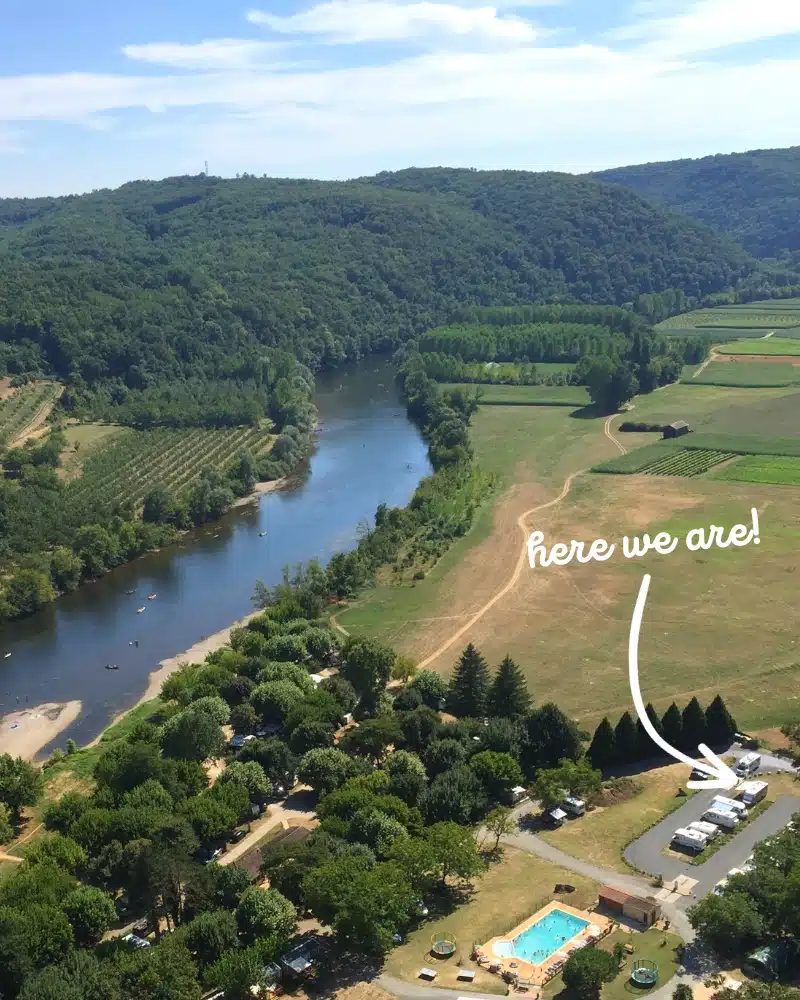
One of the reasons we love touring France is the huge choice of places to stay in a motorhome. Alongside traditional campsites, France has thousands of dedicated motorhome aires, commercial stopovers and farm and vineyard stays, making it one of the easiest countries in Europe for finding somewhere to stop for the night.
Motorhome Aires in France
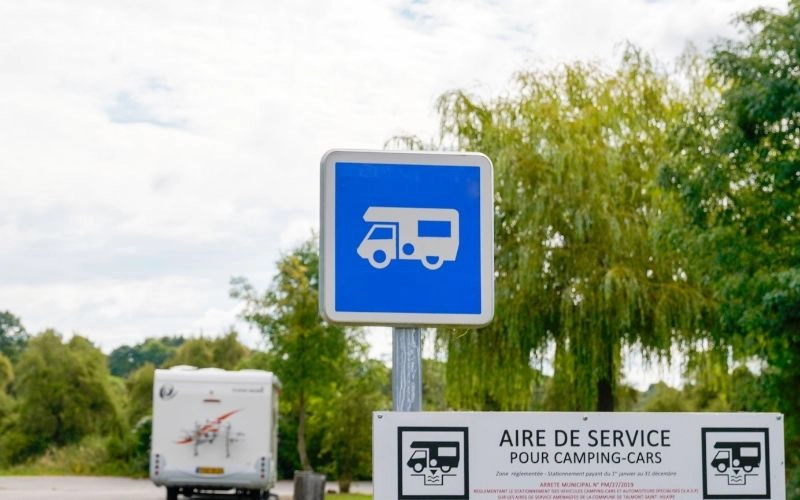
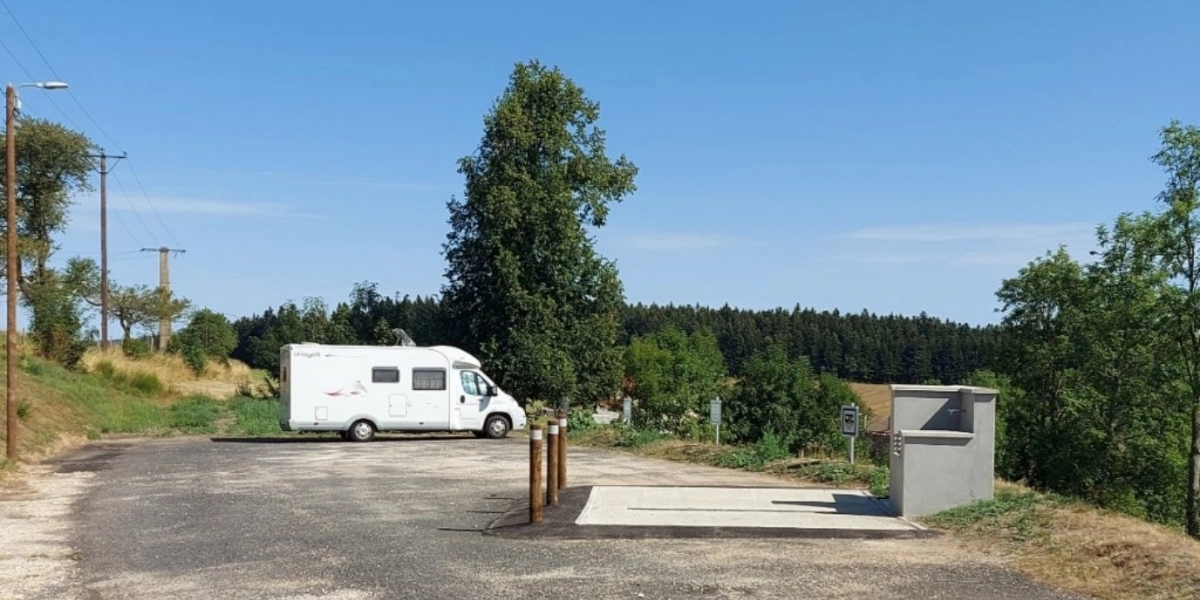
France has an excellent network of aires de camping-car, dedicated motorhome parking areas where you can usually stay overnight.
We’ve used hundreds of French aires since we started travelling in 2018. They range from a handful of free spaces beside a village to large purpose-built sites with electric hook-up, fresh water, waste disposal and secure barrier access.
Some aires are completely free, while others charge for parking, services or both. You’ll commonly find service points for fresh water and emptying grey and black waste, although facilities vary considerably.
Aires are generally intended for motorhomes rather than caravans, and they’re not campsites. On many traditional aires you’re expected to park rather than set up camp, so don’t assume you can put out awnings, tables, chairs and other camping equipment.
Municipal Aires
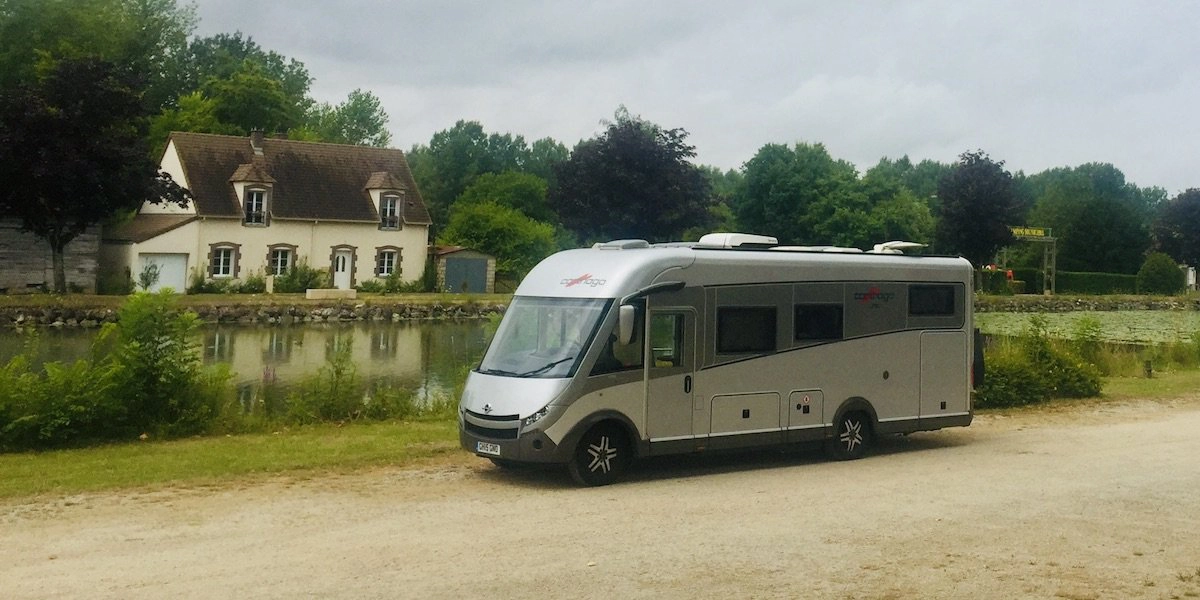
Municipal aires are provided by local towns and villages and are often our favourite places to stay. Many are within walking distance of the centre, making them ideal for exploring somewhere without having to take your motorhome into narrow streets or find town-centre parking.
Some are free because the local authority wants to encourage motorhomers to visit and spend money locally. Others charge a modest overnight fee or have a separate charge for water and electricity.
Facilities vary enormously. We’ve stayed on municipal aires that are simply marked parking bays and others with water, waste disposal, electric hook-up and landscaped pitches.
Camping-Car Park Aires
Camping-Car Park is a large commercial network of motorhome aires across France and elsewhere in Europe. You’ll see its distinctive barrier-controlled sites all over the country, and they’re particularly useful when you want predictable facilities or are travelling in a busy area.
The network operates using a digital pass or physical access card linked to your account. You can set up an account through the Camping-Car Park app, check current availability and add credit to your account. At the aire, you use your digital code or access card to operate the barrier, and payment is handled through your account.
Camping-Car Park aires are open for autonomous access 24 hours a day and typically provide services such as fresh water, waste disposal and electricity, although the exact facilities vary by location.
One of the biggest advantages is the ability to see availability before you arrive. You can also reserve pitches. Standard users can book shortly before arrival, while the paid Pack’Privilèges subscription allows advance reservations at eligible aires and guarantees your pitch for the reserved stay.
This can be particularly useful in popular destinations and during July and August, when the best-located aires can fill quickly.
Other Commercial Aires
You’ll also find independently operated commercial aires and smaller private networks throughout France. These range from simple overnight parking to sites that feel much more like small campsites, with electricity, showers, toilets and other facilities.
Prices are generally higher than basic municipal aires, but they can be useful in popular coastal areas and major tourist destinations where free or low-cost motorhome parking is harder to find.
RELATED POST: Motorhome Aires in France: All You Need to Know
Motorway Aires
French motorway service areas are also called aires, but don’t confuse these with aires de camping-car. Motorway aires are rest and service areas intended for drivers taking a break during their journey.
We don’t recommend staying overnight on French motorway aires. Although thousands of people use them without incident, thefts from vehicles do occur and we don’t consider them a good choice for an overnight motorhome stop.
If you need to rest, use the motorway aire for a break and then leave the autoroute to find a dedicated motorhome aire for the night. France has so many that there is usually an alternative without travelling far from your route.
Wild and Off-Grid Camping in France
Wild camping in France is more complicated than simply finding somewhere quiet and spending the night. There is an important distinction between legally parking a motorhome and camping outside an authorised site.
In many places you can park and sleep in your motorhome where ordinary vehicle parking is permitted, provided there are no local restrictions. Setting out chairs, tables, awnings or other equipment outside the vehicle is more likely to be regarded as camping and may not be permitted.
Restrictions are common in protected natural areas, on or near beaches, around historic sites and in popular tourist destinations, and local authorities can introduce their own rules. Always check signs when you arrive.
In rural areas and outside the main summer season, it can be easier to find suitable overnight parking away from busy tourist destinations. We use Park4Night to help find potential stops, but always check local signs and restrictions when you arrive.
France Passion
France Passion offers another excellent way to stay overnight away from conventional campsites and aires.
The scheme connects motorhomers with participating farms, vineyards, producers and other rural businesses across France. Members can stay overnight at participating properties, usually without a separate overnight charge, giving you the opportunity to stay in some beautiful rural locations and meet local producers.
There is no obligation to buy anything, although we usually think it’s good manners to support your host by buying some wine, cheese, produce or whatever they make if something appeals to you.
France Passion is particularly good if you enjoy slower travel and want to experience rural France rather than simply moving between tourist destinations.
Motorhome Campsites in France
France has an enormous choice of campsites, from simple municipal sites to large holiday parks with swimming pools, restaurants and entertainment.
Municipal campsites can be particularly good value and are often conveniently located close to towns and villages. At the other end of the scale, coastal and resort campsites can be expensive during July and August, particularly in the south of France.
We tend to use campsites when we want to stay somewhere for several days, need laundry or other facilities, or simply want a larger pitch where we can put out chairs and an awning and properly settle in.
ACSI CampingCard
If you’re touring France outside the main summer season, an ACSI CampingCard can save a considerable amount on campsite fees.
Participating campsites offer CampingCard ACSI members a fixed discounted nightly rate during specified low-season periods. The exact dates and rate vary between campsites, so check the listing before arriving.
France has a large number of participating campsites, which makes the card particularly useful if you’re travelling in spring, early summer or autumn and prefer campsites to aires.
We’ve found ACSI especially useful on longer European trips, when even a relatively small saving each night quickly covers the cost of the card.
Motorhome Services in France
France is one of the easiest countries in Europe for accessing everyday motorhome services. Aires, campsites, supermarkets and fuel stations mean you’re rarely far from water, waste disposal, fuel or LPG.
Fresh Water and Waste Disposal
Many French motorhome aires have a borne de services, or service point, where you can fill your fresh water tank and empty grey and black waste.
Services may be included in the overnight charge or paid for separately, and some municipal service points can be used even if you’re not staying overnight. Payment may be by card, token or occasionally coins.
Always check that a tap is marked as drinking water, usually eau potable, before filling your fresh water tank. Never use a tap intended for rinsing toilet cassettes.
Grey water should be emptied over the designated drain and toilet cassettes into the marked black-waste disposal point. Never empty either into roadside drains or onto the ground.
LPG and Gas Bottles in France
LPG is widely available in France and is usually called GPL (Gaz de Pétrole Liquéfié). If you have a refillable LPG system, you’ll find GPL pumps at many larger fuel stations and supermarket filling stations.
France uses the Dish connector for filling LPG, so UK motorhomes with refillable systems will normally need the appropriate adaptor.
Exchangeable gas bottles are also widely available, but French bottles and regulators are different from UK systems. You generally cannot exchange a UK Calor or other UK rental bottle for a French one.
If you’re spending a long time in France and rely on exchangeable cylinders, you may need to buy or pay a deposit for a French bottle and make sure you have the correct regulator or adaptor for your motorhome gas system.
If you’re travelling for several months or across multiple European countries, a refillable LPG system is considerably easier than managing different national exchange bottle systems.
Fuel in France
Diesel is gazole or gasoil in France, while petrol is usually labelled essence.
Fuel is widely available, and supermarket filling stations are often cheaper than motorway services. Large supermarkets such as Carrefour, E.Leclerc, Intermarché and Super U commonly have fuel stations, although access can occasionally be tight for very large motorhomes.
Many French fuel stations are automated outside staffed hours and require payment at the pump. UK debit and credit cards are generally accepted, but it’s sensible to carry more than one card in case a machine refuses one.
Be aware that automated pumps may temporarily authorise a larger amount on your card before you fill. The final amount is adjusted to the value of the fuel you’ve actually taken, although the temporary hold can sometimes remain visible on your account for a few days.
Motorway fuel is convenient but usually considerably more expensive, so we normally fill up at supermarkets or away from the autoroute.
AdBlue
AdBlue is widely available in France and is usually sold as AdBlue at filling stations.
Larger motorway services and supermarket fuel stations often have AdBlue pumps, while containers are readily available from filling stations, supermarkets and motor factors.
If you’re filling from a pump, check that it is suitable for your vehicle, as some high-flow pumps intended for HGVs may not be suitable for smaller motorhome AdBlue tanks.
Motorhome Laundry
Self-service laundries are easy to find throughout France. Alongside traditional laveries, you’ll often see outdoor washing machines and tumble dryers in supermarket and shopping-centre car parks.
These are particularly convenient when touring in a motorhome because there’s usually plenty of parking and you can do your shopping while the washing is running.
Search for laverie automatique if you’re looking for one locally.
Shopping and Supermarkets
France is very easy for stocking a motorhome. Large supermarkets and hypermarkets generally have spacious car parks, fuel stations and sometimes motorhome service points or laundries.
Carrefour, E.Leclerc, Intermarché, Super U and Auchan are widespread, while Lidl and Aldi are also common.
Smaller towns and villages often have excellent independent boulangeries, butchers and weekly markets, which we use whenever we can.
Opening hours can be more limited on Sundays, particularly away from tourist areas. Many supermarkets open on Sunday mornings but close around lunchtime, and smaller shops may close for part of the day during the week.
If you’re heading into a rural area or travelling on a Sunday, it’s worth stocking up beforehand rather than assuming you’ll find a large supermarket open when you arrive.
Motorhome Parts and Repairs
France has a huge motorhome and campervan market, so finding parts, accessories and repair services is generally straightforward.
Specialist motorhome dealers and accessory shops are widespread, particularly around larger towns and cities. Narbonne Accessoires has stores across France and stocks everything from electrical and water-system parts to toilet chemicals, LPG equipment, levelling ramps and camping accessories.
For mechanical problems, look for a garage that services the manufacturer of your base vehicle, such as Fiat, Peugeot, Citroën, Ford or Mercedes. Bear in mind that not every workshop has a lift or workshop entrance large enough for a motorhome, particularly if you have a heavier vehicle.
For habitation problems, search for concessionnaire camping-car or réparation camping-car to find a motorhome dealer or specialist repair workshop nearby.
If you need a specific part, having the make, model, year and chassis or VIN details of your motorhome with you can make finding the correct replacement much easier.
Best Places to Visit in France by Motorhome
France is made for road trips, with very different landscapes and experiences within a day’s drive of each other. We’ve toured extensively across the country, and these are some of our favourite areas to explore by motorhome.
The French Alps
The French Alps offer some of the most spectacular motorhome driving in France, with high mountain passes, turquoise lakes and dramatic valleys.
Summer is the best time for tackling the highest routes, including the legendary Route des Grandes Alpes, although you should always check pass conditions before setting off in a larger motorhome.
Outside the ski season, many mountain towns and resorts have dedicated motorhome aires, making the Alps surprisingly easy to tour.
Provence
Provence is classic motorhome country, with hilltop villages, vineyards, lavender fields, markets and some beautiful rural roads.
The Luberon and Verdon are particularly rewarding, although popular villages can be difficult for larger motorhomes. We generally stay at an aire or campsite outside the centre and explore on foot or by bike.
If lavender is the reason for your trip, you’ll usually need to visit from late June into July, with flowering times varying according to location and altitude.
The French Riviera
The Côte d’Azur gives you Mediterranean beaches, historic towns and glamorous resorts, but it isn’t always the easiest part of France for motorhomes.
Parking is limited in places such as Nice, Cannes and Monaco, and coastal roads can be extremely busy in summer. Staying inland or at a dedicated aire or campsite and using public transport to reach the coast is often much easier.
Visit outside July and August if you can.
The Pyrenees
The French Pyrenees are wilder and generally quieter than the Alps, with superb mountain roads, hiking and plenty of opportunities to get away from busy tourist destinations.
We’ve particularly enjoyed the area around Gavarnie and Cauterets, including the Cirque de Gavarnie and Lac de Gaube.
Some mountain roads and passes are unsuitable or closed in winter, so check conditions before travelling.
Dordogne
The Dordogne combines medieval towns, rivers, castles and some of France’s best food with excellent motorhome infrastructure.
Places such as Sarlat-la-Canéda make good bases for exploring, while the surrounding countryside is full of smaller villages, markets and riverside stops.
It’s particularly good in spring and autumn when the roads and main attractions are quieter.
Loire Valley
The Loire Valley is one of the easiest parts of France to explore by motorhome, with generally gentle roads and a huge choice of châteaux, historic towns and riverside landscapes.
Rather than trying to visit every château, choose a handful that interest you and take your time. Chambord, Chenonceau and Amboise are among the best-known, but there are dozens more.
Brittany
Brittany is ideal for slower motorhome touring, with a rugged coastline, fishing villages, historic towns and excellent seafood.
It’s also particularly convenient if you arrive by ferry into Saint-Malo or Roscoff, allowing you to start exploring almost as soon as you leave the port.
The coast becomes busy during the French summer holidays, but outside peak season Brittany is a fantastic place to wander without much of a plan.
Normandy
Normandy works brilliantly for a shorter France motorhome trip because it’s so accessible from the Channel ports.
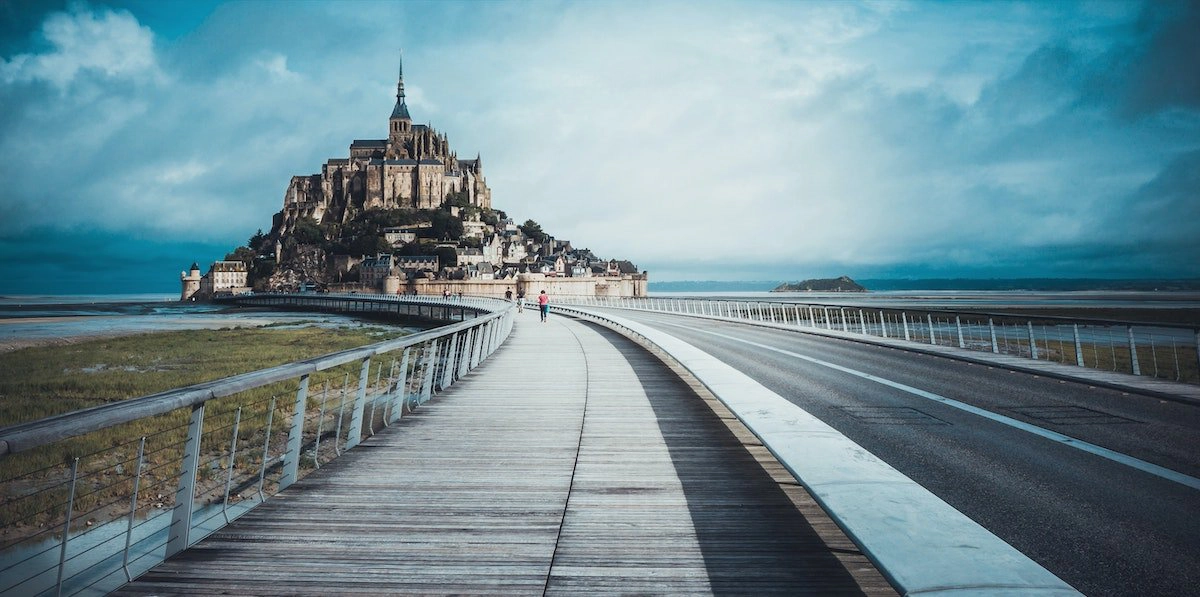
The D-Day landing beaches and memorials are a major draw, but there is much more to the region, including Honfleur, Bayeux, the Côte d’Albâtre and Mont-Saint-Michel on the border with Brittany.
There are plenty of motorhome aires, making it easy to move slowly along the coast.
Alsace & the Vosges
Alsace feels quite different from much of France, with colourful half-timbered towns, vineyards and a strong blend of French and German influences.
The Alsace Wine Route is ideal for a motorhome road trip, linking places such as Colmar, Riquewihr and Kaysersberg, while the nearby Vosges provide mountain scenery and quieter roads.
This is also one of our favourite parts of France in the run-up to Christmas, when towns and villages across Alsace hold traditional Christmas markets.
The Atlantic Coast
France’s Atlantic coast offers hundreds of kilometres of beaches, surf towns, pine forests and cycle routes stretching from Brittany towards the Spanish border.
The areas around La Rochelle, Île de Ré, Arcachon and the Landes are particularly popular with motorhomers.
July and August can be extremely busy, so we’d choose June or September if you want good weather without the peak-season crowds.
Occitanie and the Mediterranean
Occitanie stretches from the Mediterranean coast into the Pyrenees and offers a great mixture of beaches, historic cities, vineyards and mountain landscapes.
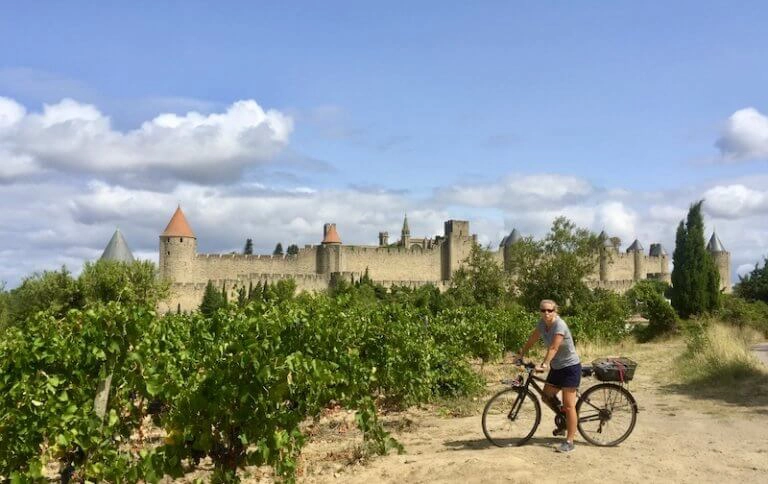
Carcassonne, the Canal du Midi and the coastline around Narbonne and Collioure are obvious highlights, while heading inland quickly takes you away from the busiest coastal resorts.
It’s also a natural area to explore if you’re travelling onwards towards Spain.
More France Travel Ideas


French Life
One of the pleasures of touring France slowly is getting into the rhythm of everyday French life. Shopping at local markets, stopping at the boulangerie in the morning and eating lunch when everyone else does are all part of the experience, but there are a few practical differences worth knowing about.
Shops and Opening Hours
Opening hours in France can catch you out, particularly in smaller towns and rural areas. Many independent shops close for lunch, sometimes for two hours or more, and Sunday opening remains limited outside larger towns and tourist areas.
Supermarkets are increasingly open on Sunday mornings, but many close at lunchtime. In smaller towns, Monday can also be a quiet day, with restaurants, shops and attractions closed after the weekend.
If you’re travelling through rural France, don’t leave shopping, fuel or LPG until late on a Sunday and assume somewhere will be open.
French Markets
Weekly markets are still a big part of French life and are one of our favourite ways to shop when we’re touring.
Most take place in the morning and you’ll find everything from fruit, vegetables, cheese and charcuterie to bread, seafood, clothes and household goods. Tourist offices and signs around towns usually advertise the local jour de marché.
Arrive early if you’re visiting a popular market. Parking can become difficult surprisingly quickly, particularly with a motorhome, so we often leave ours at the local aire and walk into town.
Eating Out in France
Lunch remains important in France, and you’ll often find excellent-value fixed-price formules or menus du jour in local restaurants at lunchtime.
Lunch service commonly runs from around midday until 2pm, and restaurants may not serve food continuously throughout the afternoon. Dinner also tends to start later than in the UK, although timings vary considerably between regions and tourist areas.
If there’s somewhere you particularly want to eat, check opening days before making a special journey. Restaurants in smaller towns may close one or two days a week, and those days aren’t necessarily Sunday or Monday.
Boulangeries and Everyday Food
A morning trip to the boulangerie quickly becomes part of motorhome life in France. Most towns and even small villages have somewhere to buy fresh bread, although opening days vary and many close for part of the afternoon.
A baguette tradition is made according to stricter rules than a standard baguette and is generally our choice when there’s one available.
For regional food, markets and small producers are worth seeking out as you travel. Cheese, charcuterie, wine, cider, seafood and local specialities change noticeably as you move around the country, which is one of the joys of touring France slowly.
Useful French for Motorhomers
You don’t need to speak fluent French to tour France in a motorhome, but knowing a few words makes signs, service points and aires much easier to understand.
More Motorhome Touring Guides to Explore

Motorhoming in Spain: Your Complete Touring Guide

Spain Motorhome Itinerary: The Ultimate 6-Week Road Trip

Motorhoming in Italy: Your Complete Touring Guide

Motorhoming in Germany: Your Complete Touring Guide

Italy Motorhome Itinerary: The Ultimate 3–4 Week Road Trip

Germany Motorhome Itinerary: The Ultimate 2 Week Road Trip
Love it? Pin it!


