If you’re planning a Scotland road trip, you’re in for one of the world’s great driving adventures. Scotland is made for the open road, with spectacular driving routes winding through the Highlands, along dramatic coastlines, past ancient castles, mirror-like lochs, and some of the UK’s most breathtaking scenery. Whether you’re looking for an epic Scotland itinerary, a short scenic escape, or the ultimate Scottish Highlands road trip, there’s a route here for you.
We’ve been visiting Scotland all our lives and have driven almost every inch of these routes, long before many of them became bucket-list road trips. From the North Coast 500 and Isle of Skye to quieter drives through the Borders and southwest coast, these are routes we know firsthand, with plenty of practical tips, honest advice, and personal recommendations to help you plan your trip.
Scotland Road Trips: Key Facts
Routes: The Gap Decaders features 8 Scotland road trips, including the North Coast 500, Isle of Skye, South West Coastal 300 and routes through the Scottish Highlands and Borders. Choose your route: Options range from shorter scenic drives to longer touring routes, with coastal, mountain and island itineraries to suit different trips. First-hand knowledge: We’ve driven almost every mile of these routes ourselves during many years of travelling in Scotland.
A Scotland road trip is about much more than getting from A to B. One minute you’re hiking a Munro, the next you’re spotting dolphins off the coast, exploring ruined castles, wild swimming in icy lochs, or pulling over yet again because the view is ridiculous. If you’re wondering which Scotland road trip itinerary is right for you, these are the best routes, highlights, and travel tips to help you plan an unforgettable adventure.
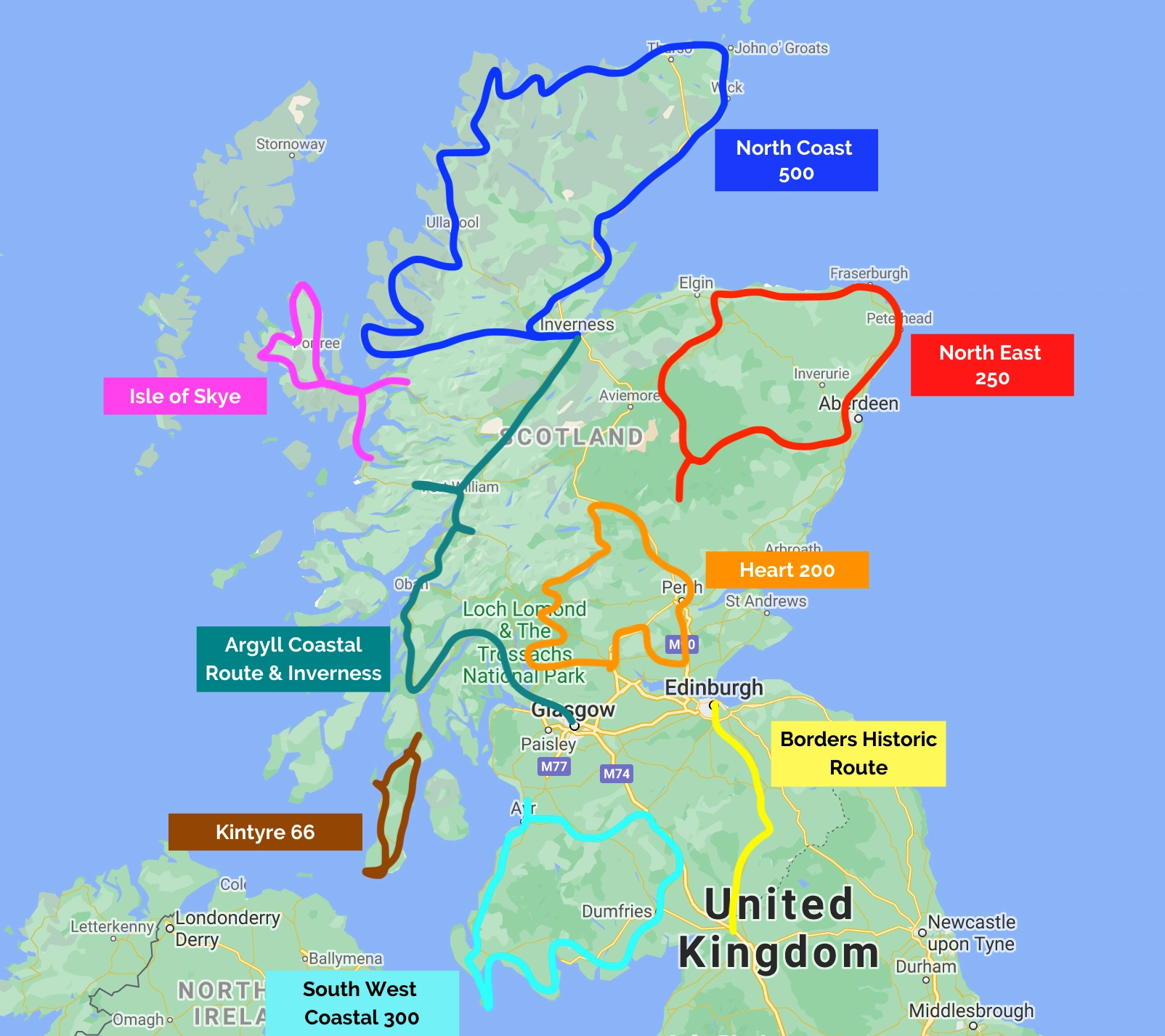
Scotland Road Trip Map
Enjoy The Gap Decaders? Add us as a preferred source on Google.
Find the best Scotland road trip for you…
For first-time visitors:Argyll Coastal Route, because it packs in lochs, mountains, castles, famous film locations, and classic Highland scenery in one trip.
For the ultimate bucket-list road trip:North Coast 500, because it delivers Scotland’s wildest coastal scenery, remote beaches, and dramatic mountain roads.
For dramatic landscapes:Isle of Skye, because nowhere else in Scotland crams in so many iconic viewpoints, hikes, waterfalls, and jaw-dropping scenery.
For whisky lovers:North East 250, because it combines Speyside distilleries with castles, coastline, and Cairngorm scenery.
For history lovers:Borders Historic Route, because it links abbeys, stately homes, clan history, textile heritage, and some of Scotland’s most overlooked stories.
For a quieter alternative to the NC500:South West Coastal 300, because you’ll get beautiful coastlines, empty beaches, and scenic driving without the crowds.
For a balanced all-round trip:Heart 200, because it combines lochs, mountains, historic towns, outdoor activities, and easier driving.
For getting off the beaten track:Kintyre 66, because it feels remote, rugged, and wonderfully under-visited, with beaches, ferries, wildlife, and whisky.
Planning tools we actually use for Scottish road trips
Route: Inverness – Wick – John o’Groats – Thurso – Durness – Lochinver – Ullapool – Gairloch – Applecross – Inverness Distance: ~ 516 miles Duration: 10-14 days Best time to go: May to September for the best weather and long daylight hours, or October for autumn colours and quieter roads Best for: Epic coastal scenery, remote beaches, wildlife spotting, and a classic Scottish Highlands road trip
For us, the North Coast 500 isn’t just one of the best road trips in Scotland; it’s an incredible journey through the Scottish Highlands. We’ve experienced its windswept beaches, explored ancient ruins, marvelled at historic castles, and soaked up the kind of breathtaking views you never forget. The North Coast 500 is often described as Scotland’s answer to Route 66.
While it’s possible to complete the NC500 in seven days, we’ve learned that slowing down is the best way to travel Scotland. To truly immerse ourselves in the rich history and wild beauty of this awe-inspiring region, we spent a month completing the route in our motorhome. But if you’re pushed for time, this route makes a great Scotland 10-day itinerary.
We started our adventure in Inverness and headed north along the east coast, so that’s the direction our itinerary follows, but you can tailor it to your own journey. Make time for detours along the way – you’ll find lots more to see and do than we’ve listed below.
And if you’re visiting in late autumn or winter, don’t miss Applecross, Lochinver, and Ullapool – some of the best places to catch a glimpse of the Northern Lights. Trust us, it’s a road trip you’ll never forget!
Love the sound of this iconic road trip? Get our complete North Coast 500 guide with hundreds of places to see and things to do along the route, plus recommendations for accommodation and lots of travel tips for Scotland. If you’re planning the route in a motorhome or campervan, we’ve got an NC500 guide just for you – it’s tailored for the size of your home on wheels as some of the roads along the route are not suitable for larger vehicles.
NC500 Route Highlights
Spend a day in Inverness, finding your feet and shopping for souvenirs. Highlights in the city centre include Inverness Castle, the 19th-century Inverness Cathedral, and the mostly 18th-century Old High Church. There is also a popular indoor Victorian Market and the contemporary Inverness Museum and Art Gallery that traces local and Highland history.
Take a boat trip with Loch Ness Jacobite Cruises and follow the age-old tradition of hunting the famous Loch Ness monster. Hire a boat and head out onto the water with a picnic and camera. You might not see Nessie, but you’ll enjoy stunning scenery, clear air, and space to unwind in one of Scotland’s most beautiful places.
Visit the haunting battlefield of Culloden, the site of the final and bloody confrontation of the Jacobite rising and the defeat of Charles Stuart’s army in 1746. You can learn more about this seminal time in the history of Scotland at the nearby Culloden Visitor Centre.
Love the challenge of bagging any of the 37 Munros (mountains over 914m) along the route. If they’re a little too high, try bagging one of the 43 Corbetts or 38 Grahams (mountains over 762m), or just enjoy viewing them from the winding roads.
Enjoy visiting and tastings at the whisky distilleries on the route, including Glenmorangie, famous for its single malt since 1843. You’ll find many more distilleries along the way, just one of the pleasures of touring the Scottish Highlands!
Admire the lofty grace of Dunrobin Castle, the historic home of the Earls and Dukes of Sutherland, which dates from around 1275.
Explore the various and fascinating brochs on the route. The broch is an imposing stone tower and ancient dwelling, built as early as 500 BCE, found only in Scotland. Dunbeath Broch and Nybster Broch are both excellent examples.
See the mysterious Hill O’Many Stanes, where 200 thin stones were laid out in a radiating pattern over 4,000 years ago …and no one really knows why.
Explore the dramatic 15th-century ruins of Castle Sinclair Girnigoe, perched high on a cliff above the steely North Sea.
Enjoy the sea air and a five-mile hike from John o’Groats to Duncansby Head, the most north-easterly point on the British mainland, and continue along the spectacular coastal path to see the two dramatic pointed sea stacks.
Visit the Castle of Mey, which was restored by The Queen Mother when she bought it in 1952 and saved it from abandonment. A fascinating glimpse into a castle that served as a holiday retreat for the royal family, and with wonderful gardens, this is a truly beautiful place.
Take (another) bracing walk in the wild and untamed landscape of Dunnet Head, the RSPB nature reserve and the most northerly point in mainland Britain. This is the perfect place to see puffins in this noisy seabird nature reserve, especially if you visit during the breeding season, from late spring to early summer.
Visit the beautiful beaches, bays, and coves of the north coast, including the most north-westerly point, the raw and wild Cape Wrath (only accessible by ferry or minibus) the Smoo Cave, a sea cave complete with its own waterfall, and Sandwood Bay (hike only, no vehicular access) for the incredible sight of the Am Buachaille sea stack, a remnant of when the Highlands and North America were connected, millions of years ago.
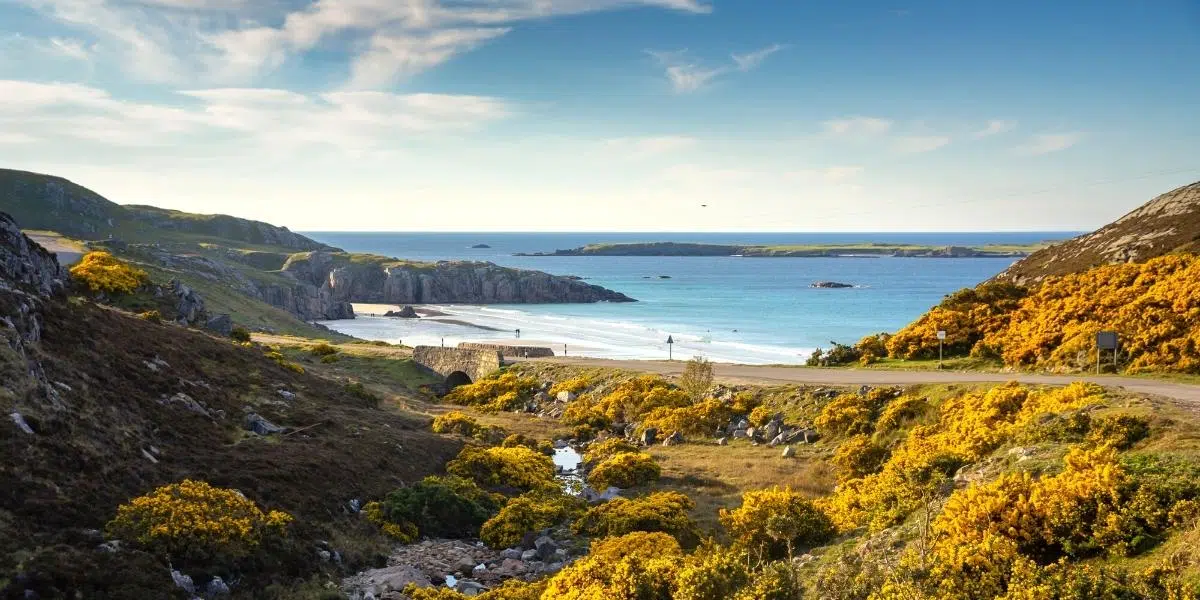
Visit the wild west coast beaches, of which there are many! Our favourites are Achmelvich Beach and Mellon Udrigle Beach – vast stretches of sand perfect for long walks and contemplating life!
Go whale watching from Gairloch; you might also see dolphins, porpoises, and sharks, as well as seals, otters, puffins, and perhaps even the white-tailed eagle. The best time to see whales on the west coast of Scotland is from mid-June to late September.
Drive the legendary Applecross Pass, one of the best and highest roads in Scotland. Bealach na Bà is a narrow slip of a road, with hairpin sharp bends and steep gradients – not one for the faint-hearted, but absolutely worth it!
Take to the sea in a kayak on one of the many lochs and inlets along the route. Enjoy a different perspective and get up close with the local wildlife.
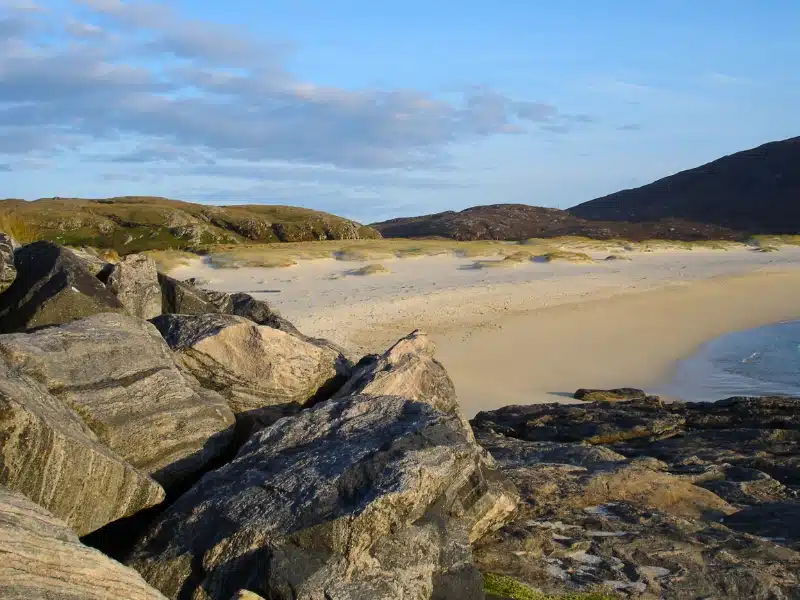
Discovering the beaches of the North Coast 500
Is this your first time planning a UK trip? Get all the information you need in our United Kingdom Travel Guide, including what to pack, the best time of year to go, getting there, and practical tips to help you have the best trip!
2. The North East 250
Route: Aberdeen – Peterhead – Fraserburgh – Portsoy – Spey Bay – Glenlivet – Braemar – Aberdeen Distance: ~ 259 miles Duration: 5-7 days Best time to go: May to September for coastal sunshine, wildlife spotting, and whisky distillery visits, or autumn for golden Cairngorm scenery Best for: Dramatic northeast coastline, dolphin spotting, whisky country, castle stops, and a mix of seaside villages and Highland scenery
If you have just one week in Scotland, the North East 250 is one of our favourites, offering a perfect blend of coastlines, mountains, and whisky trails. We’ve driven this route ourselves and found it to be a fantastic alternative to the more famous North Coast 500, especially if you want a slightly shorter but equally breathtaking adventure.
The Granite Coast route is designed to start from Aberdeen Airport, although we didn’t make it there! We picked it up just south of Aberdeen and joined the route heading north and anticlockwise.
One drive that really stuck with us is the Snowroads Scenic Route. The most stunning bit of this route is the stretch from Tomintoul to Blairgowrie along the highest public road in Britain. The Snowroads are made for slow exploration, with their steep hills, blind summits, and narrow single-track sections. If you’re in a motorhome, as we were on this trip, you’ll want to approach it with extra care and patience.
We found that the signposting along the route wasn’t always clear and relied heavily on our map and sat nav to find attractions and decide where to take a detour. Our personal recommendation? Start heading north from Aberdeen towards Peterhead, as we did, but feel free to adapt the route to suit your time and interests.
If you have a few extra days, adding the Perthshire Tourist Route from Pitlochry to Greenloaning is an amazing way to extend the adventure into more of Scotland’s stunning landscapes.
Route Highlights
Admire the powerful architecture of the glittering city of Aberdeen and its rich maritime history.
Enjoy the whisky distilleries along the NE250 route, including Tomintoul, Glenlivet, Royal Lochnagar, and Strathisla.
Partake in some dark tourism at the fascinating Peterhead Prison Museum, which was an operational prison until 2013.
Visit the truly brilliant Museum of Scottish Lighthouses at Fraserburgh, where you can tour Kinnaird Head Lighthouse, the very first lighthouse built on mainland Scotland in 1787.
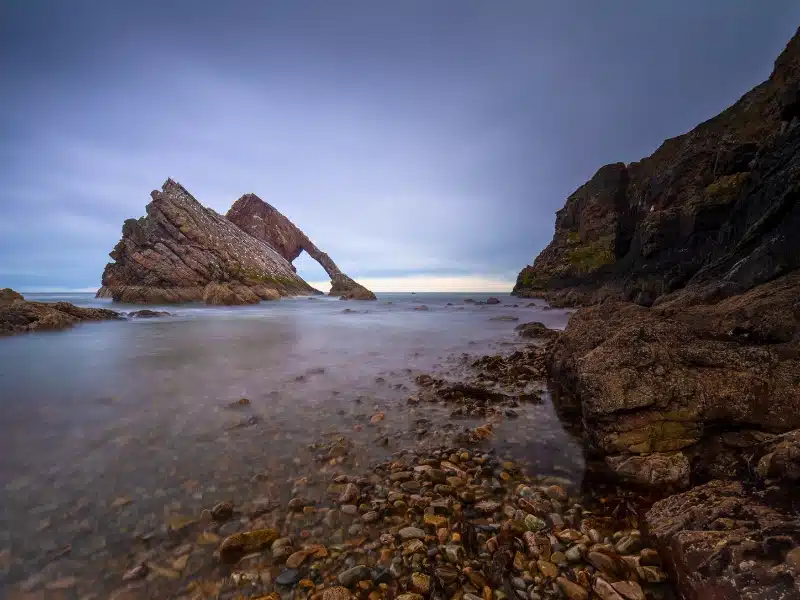
Enjoy the bracing air and dolphin spotting from the clifftops near Portknockie, where you can also see the iconic Bow Fiddle Rock and sometimes the Northern Lights.
Enjoy Cullen Skink in Cullen! The thick Scottish soup made of smoked haddock, potatoes, and onions is a delicious local speciality.
Visit the stunning ruins of Elgin Cathedral. Built in 1224 and known as the ‘Lantern of the North’, it was one of the most spectacular medieval cathedrals in Scotland.
Drive through the magnificent Cairngorms National Park, home to deer, eagles, and atmospheric Corgarff Castle.
Enjoy some of the best outdoor activities Scotland has to offer, including white water sports, climbing, hiking, cycling, and much more.
Spend a day at the splendid royal Balmoral Castle, a private royal residence since Queen Victoria and Prince Albert bought the estate in 1852.
The amazing Bow Fiddle Rock at Portknockie
3. The South West Coastal 300
Route: Prestwick – Ballantrae – Cairnryan – Isle of Whithorn – Kirkcudbright – Dumfries – Lockerbie – Moffat – Prestwick Distance: ~ 302 miles Duration: 5-7 days Best time to go: May to September for milder weather, coastal walks, and long daylight hours, or late spring for quieter roads and wildflowers Best for: Rugged coastline, quiet fishing villages, hidden beaches, scenic driving, and exploring one of Scotland’s most underrated regions
The South West Coastal 300 boasts stunning coastlines, lush forests that stretch over rolling hills, and dramatic moorlands. This quiet corner of Scotland will woo you until you fall in love with its gentle charms, just like we did!
This is a well-located road trip for those driving north from the rest of the UK and can be joined at Lockerbie, within a 20-minute drive of the Scottish border.
The route is also easily accessible from Glasgow Prestwick Airport or Glasgow International Airport if you fancy a few days in the cultural and welcoming city at the start or end of your visit to Scotland.
Our itinerary assumes you will travel south from Prestwick along the coast, but this route can be driven either way – in places it also crosses the Galloway Tourist Route that runs through the middle of Galloway Forest Park
Route Highlights
Dip into Galloway Forest Park, the only Dark Sky Park in Scotland, and a top spot to see the Aurora Borealis or Northern Lights.
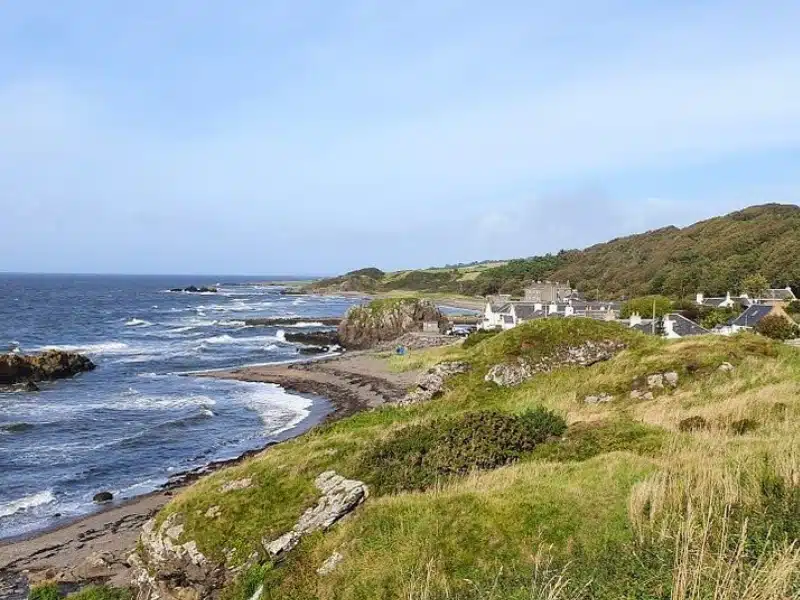
Our favourite beach on this road trip, the small but perfectly formed Dunure Beach, has dark sand and shingle with great rock pooling and stunning views of Ailsa Craig from the ragged ruins of Dunure Castle.
Admire the dramatic clifftop Culzean Castle, designed by Robert Adam in the late 18th century and full of treasures, opulence, and history.
Climb to the he Robert Stevenson-designed Mull of Galloway Lighthouse, at the southernmost tip of Scotland on the wild Rhins of Galloway peninsula. Go at dusk for spectacular sunsets.
Visit the charming Isle of Whithorn (no longer an island) to see the ruins of the chapel built by St Ninian, who founded the first Christian church in Britain around AD390.
Spend a day in lively Kirkcudbright (pronounced kir–coo–bree) and follow the Arts and Crafts Trail. Home to generations of creatives, ‘the artist’s town’ has a flourishing community of painters and craftworkers. You might also hear bagpipes here, as they have lots of parades.
Find your inner child at Moat Brae, the inspiration for JM Barrie’s famous character, Peter Pan. The author lived in Dumfries from 1873 to 1878 and called the gardens ‘enchanted lands’.
Head for Kirkbean to walk on the vast empty expanse of Southerness Beach, with breathtaking views across Solway Firth to the Lake District. Visit Southerness Lighthouse at the western end of the beach, one of the oldest in Scotland.
Stop off in Moffat for a spot of hiking on the scenic Southern Upland Way or the most northerly point on the Annandale Way, both of which pass through this pretty and historic town.
A deserted and unspoiled Dunure Beach
Scottish Motorhome Itinerary
Let us do the planning for you and grab our two-week Scotland motorhome itinerary, packed with campsites, off-grid spots, attractions, and insider tips from our own travels in Scotland.
Get up every day knowing your trip is planned with driving routes, overnight stops, and attractions marked on your interactive map.
Route: Glasgow – Tarbet – Inveraray – Lochgilphead – Oban – Glencoe – Fort William – Glenfinnan – Inverness Distance: ~ 263 miles Duration: 7-10 days Best time to go: May to October for the best mix of decent weather, long driving days, and ferry-friendly conditions, or autumn for dramatic colours in Glencoe Best for: Classic Highland scenery, lochside driving, film locations, coastal detours, and first-time visitors wanting Scotland’s greatest hits in one road trip
The official Argyll Coastal Route ends in Fort William, but we couldn’t leave you there, with magnificent Glenfinnan to the west and the superb A82 road to the east waiting to take you to Loch Ness and Inverness.
From sea-shores, loch-sides, and mountain tops, the ultimate west coast of Scotland road trip is for seafood gourmets, sunset lovers, and those who want to get under the skin of Scotland and feel its turbulent history in the air and glens of the incredible landscapes.
Starting in Glasgow and finishing in Inverness allows you to make the most of this linear west coast Scotland route as you cross the Highland Boundary Fault and enjoy the gentle lowlands giving way to the dramatic and wild highlands.
Of all the Scottish road trips we’ve done, this is our favourite because it delivers on drama, boasts some of the top attractions in Scotland and has atmosphere and history in spades.
Route Highlights
Be intrigued by the gritty yet cultured Victorian city of Glasgow. Must-sees include medieval Glasgow Cathedral and Kelvingrove Art Gallery and Museum for a dose of Charles Rennie Mackintosh, the Scottish artist and designer.
Enjoy fresh seafood at some of the best restaurants in Scotland along this route. Of particular note, the original Loch Fyne Oysters Ltd have been selling fresh oysters at the roadside since 1978, and you can now enjoy them in the bar or take away from their delicatessen.
Stop off at Inveraray to visit the Inveraray Jail and Inveraray Castle, home to the Duke of Argyll and Chief of Clan Campbell.
Learn about Scotland and some of the Highlands’ darkest hours at Auchindrain, a living museum and Scotland’s last inhabited Highland farming township before the Highland Clearances, which took place between 1750 and 1860.
Visit Kilmartin Museum to learn about the 800 cairns and monuments that dot the landscape of Kilmartin Glen and see fascinating 2,000-year-old artefacts from local archaeological digs. In the glen itself, you can enter some of the cairns, see carved gravestones, and reach the top of what remains of Dunadd Hill Fort, where the first kings of Scotland were inaugurated.
Spend a fantastic day wildlife watching from Easdale Island. With whale spotting trips, excursions to the Corryvreckan Whirlpool, and a tour of a local seal colony, there’s lots to do, as well as keeping your eyes peeled for porpoises, dolphins, eagles, and otters along the way.
Oban Distillery is one of the smallest and oldest distilleries in Scotland and makes whisky that reflects the character of its coastal location – definitely worth a stop!
Stopping to take photographs of Castle Stalker from the shores of Loch Linnhe. Located on a tidal island to the north of Port Appin, this iconic castle and its surroundings make for atmospheric and moody photographs.
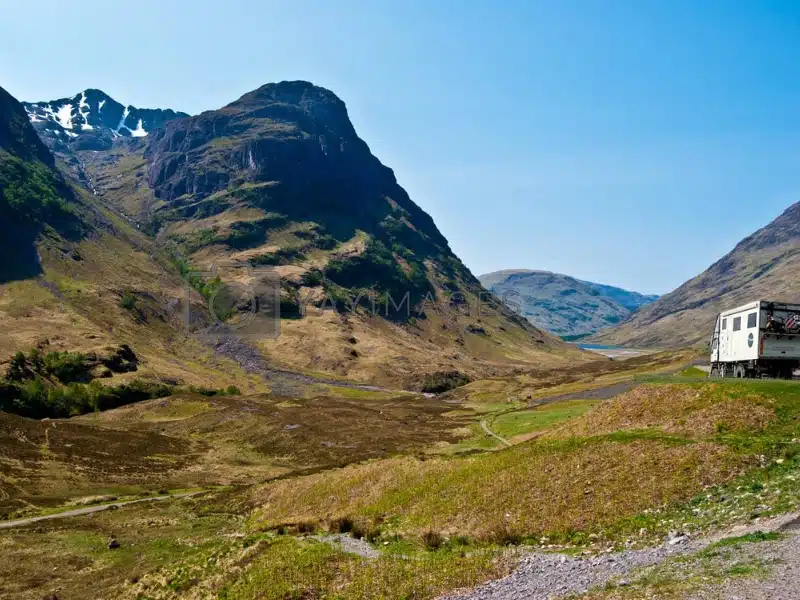
Explore Glen Coe, the site of the Massacre of Glencoe in 1692, when members of the Campbell clan murdered members of the MacDonald clan on the orders of the English Crown. Or follow the Glen Coe Geotrail to learn more about the ancient volcanic history of this otherworldly place. Shaped by glaciers and fiery volcanic explosions millions of years ago, Glen Coe is a landscape full of natural wonders.
Spend some time in the Lochaber area, dominated by Ben Nevis and known as the outdoor capital of the UK. Activity lovers will be in their element here; you can mountain bike, hike, climb, abseil, and enjoy all manner of water sports on the loch.
Be in awe of Neptune’s Staircase, the longest staircase lock flight in Scotland. This flight of eight locks on the Caledonian Canal is an amazing feat of engineering that raises the canal by 19m over 1/4 mile. It takes around 90 minutes for a boat to travel the locks. This is the perfect spot to practice your ‘gongoozaling’ – the activity of watching boats and activities on canals for pleasure!
Visit the magical Glenfinnan Viaduct. Made famous by the Harry Potter films, this railway viaduct has carried trains on the West Highland Line since 1897. Glenfinnan is also the spot where Bonnie Prince Charlie called for the local clansmen to assemble in 1745, proclaiming the throne of Great Britain to be denounced and rightfully returned to his family, the Stuarts. To see the legendary Jacobite steam train cross the viaduct, be at your chosen viewpoint before 10.45am or 3pm when the train crosses the viaduct. For a quieter experience, take the Glenfinnan Trail to the viewpoint and then turn around for a magnificent view of Loch Shiel and the Glenfinnan Monument that commemorates the Jacobite uprising.
Head east and pick up the legendary A82 road. Around the Bridge of Orchy, you’ll drive a section of the infamous Skyfall road, from the Bond film of the same name, and one of the most dramatic and scenic drives in Scotland. Time for a photo opportunity!
Make a stop at the very pretty village of Fort Augustus, the gateway to Loch Ness and the most southerly tip of this famous body of water. It is also the point where the Caledonian Canal leaves Loch Ness, cutting through the small village on its way south.
Visit Urquhart Castle at Drumnadrochit, halfway up Loch Ness. Once one of Scotland’s largest castles, Urquhart saw much conflict during its 500 years as a medieval fortress, especially during the Wars of Independence.
Route: Ardelve – Broadford – Portree – Trotternish – Duntulm – Dunvegan – Armadale – Mallaig Distance: ~ 276 miles Duration: 3-5 days Best time to go: May to September for longer days, better hiking weather, and the best chance of clear views, with late spring and early autumn helping you dodge the worst of the crowds and midges Best for: Dramatic mountain scenery, iconic hikes, waterfalls, wildlife spotting, and photographers chasing some of Scotland’s most spectacular landscapes
Surrounded by sparkling seas where towering cliffs defend the island from crashing waves, Skye is a real balm for the soul with jagged mountains, heather-carpeted moors, and myths and legends aplenty. There are lots of things to do on Skye, so expect to be busy on this road trip, even though it’s a short route!
You can drive to Skye from Inverness in around two and a half hours. From Glasgow, it will take five to six hours. Just getting to Skye is an incredible trip in its own right, and you can maximise your time by flying into Inverness and out of Glasgow (or vice versa).
Use the Skye Bridge to cross Loch Alsh, or go over the sea to Skye the old-fashioned way and get a CalMac ferry from Mallaig. Our itinerary assumes you will drive from Inverness over the bridge and get the ferry back to the mainland, but you can follow the route in either direction.
Skye is one of the busiest places in Scotland in summer. We visited in September when the high-season visitors had left and avoided the main tourist areas of Portree, Trotternish, and Dunvegan to find solitude and space on the rest of the island.
Route Highlights
Not on Skye, but just a few miles before the Skye Bridge, is Eilean Donan Castle, one of Scotland’s most iconic images and one of the most photographed castles in the country. Situated on an island at the point where the three great sea lochs of Alsh, Duish, and Long meet, the striking castle is surrounded by magnificent scenery and is full of history.
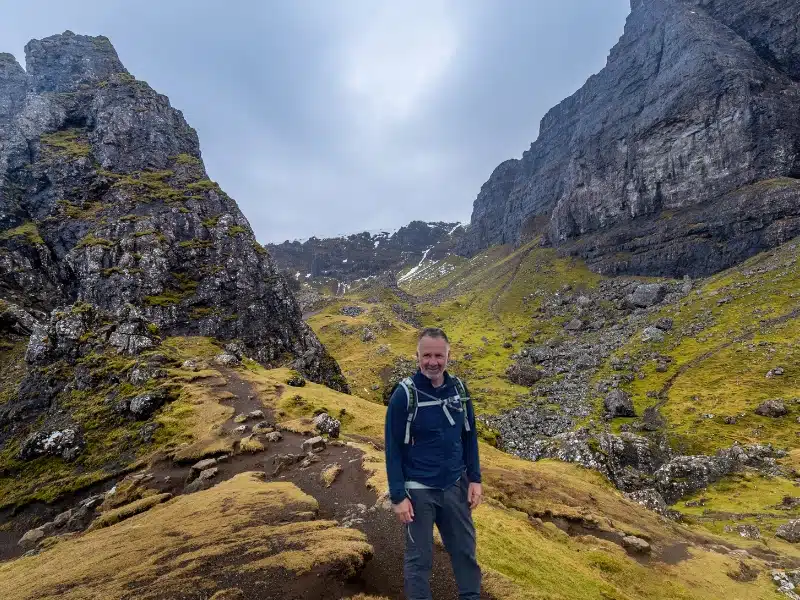
The 2.3-mile hike up to the Old Man of Storr on the Trotternish peninsula is one of the must-dos on Skye. The ‘Old Man’ is a large spike of rock that stands high and can be seen for miles around. Created by an ancient landslide, the Storr is one of the most photographed places in Scotland.
Off the beaten track and much less known, but no less for it, is Rubha nam Brathairean (Brothers’ Point), a dramatic headland that marks the easternmost point of Trotternish. Not far from here, you’ll also find Kilt Rock and Mealt Falls – epic views that you can get to within a few minutes of walking from the free parking.
Visit The Quiraing for a great 4.5-mile hike with spectacular landscapes and beautiful views, or get a feel for this strangely named area from the car park.
The Fairy Glen is a curious rock formation just inland from Uig. Formed by an ancient landslide and shaped by glaciers over thousands of years, the Fairy Glen is best photographed from above to fully appreciate the weird and wonderful shapes of the landscape.
Visit Skye’s most famous historic building, Dunvegan Castle, the seat of the chief of Clan MacLeod. In a beautiful position at the edge of Loch Dunvegan, the castle gardens are a hidden oasis of beautiful plants.
Catch an amazing sunset from Neist Point, where there is also a lighthouse of the same name. The most westerly point on Skye, this beautiful spot also affords fantastic views of the Outer Hebrides.
Stop off at the world-famous Talisker Distillery for a tour that finishes with a wee dram of their peaty single malt.
Try a spot of wild swimming (we would advise a wetsuit!) in the bracing Fairy Pools, beautiful, crystal clear pools, and waterfalls at the foot of the Cuillin mountains, on the river Brittle. Take the 1.5-mile walk from the small parking lot to find this series of magical pools, formed 50-70 million years ago – but don’t expect them to look like the highly edited images posted on social media.
Take one of the most scenic Scottish roads from Broadford to the village of Elgol for incredible views of the dark and brooding Cuillin mountains.
Get out on the water in a canoe or take a boat trip to get acquainted with local wildlife. You’re likely to see seals, dolphins, porpoises, and lots of different species of seabirds, as well as find hidden coves, cliff waterfalls, and sea caves.
Hiking to the Old Man of Storr
6. Borders Historic Route
Route: Edinburgh – Dalkeith – Galashiels – Selkirk – Hawick – Langholm – Gretna Green Distance: ~ 88 miles Duration: 2-3 days Best time to go: April to October for the best weather and easier sightseeing, with autumn especially good for colourful countryside and quieter historic towns Best for: History lovers, abbeys and stately homes, literary connections, scenic countryside drives, and a shorter road trip packed with Scottish Borders character
This road trip from Edinburgh will take you through the lush and hilly countryside of the lowland Scottish Borders, through charming villages and small towns to famous Gretna Green, and the border with England.
Learn about Scottish industrial heritage and the vibrant arts and crafts scene, still alive and kicking in this primarily rural region.
This road trip is the best option if you plan on spending time in historic Edinburgh and want to see a bit of Scotland as part of your trip. If it’s a one-way drive, Newcastle Airport is an hour and a half away by car from Gretna Green, making this an ideal linear route.
Route Highlights
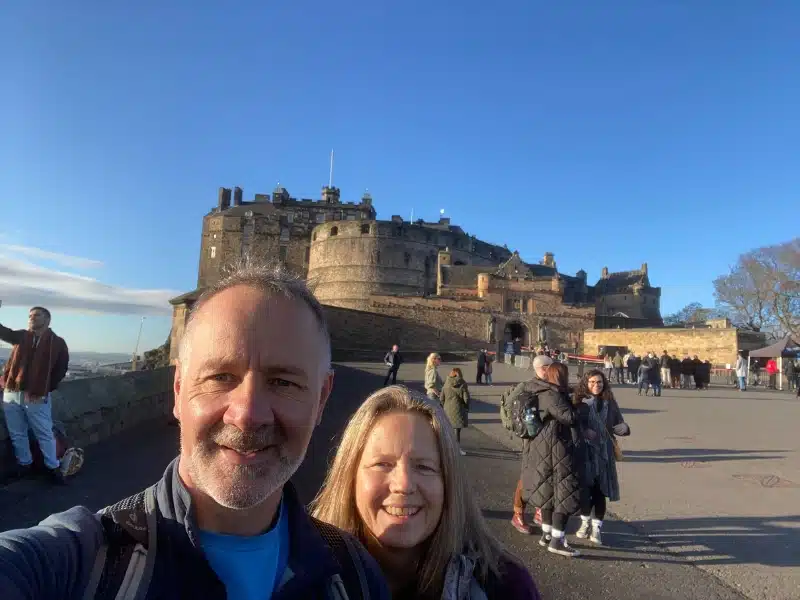
Visit historic Edinburgh, the capital city of Scotland. With wonderful medieval and neoclassical architecture and a great vibe, this is a city to spend at least a full day seeing. Take a city centre guided tour to see Edinburgh Castle, Calton Hill, the National Museum of Scotland, and the famous Royal Mile, the main road through Edinburgh’s old town, where you can shop for tartan and enjoy locally made fudge.
Harry Potter fans will want to visit Victoria Street. With its unusual shape and collection of quirky shops, it’s said to be the inspiration for Diagon Alley in the J.K. Rowling books.
Enjoy a locally brewed craft beer at Stewart Brewing, an independent craft brewery on the outskirts of Edinburgh. You might even see the team hard at work brewing while you enjoy your beer!
Stop at Dalkeith Country Park for easy walks and bike rides on the trails through the natural beauty of the 1,000-acre estate and working farm. You might spot Roe deer, otters, buzzards, foxes, badgers, hares, and rabbits here.
Visit Lady Victoria Colliery, one of the best and last surviving Victorian collieries in Europe, and now the National Mining Museum of Scotland. Explore the machinery used to mine and take coal to the surface, imagine what a miner’s life was like, and experience the sights and sounds of a working pit on a fantastic tour of the pit head.
Go back in time to Robert Smail’s Printing Works in the pretty village of Innerleithen. Try your hand at typesetting, and discover the origin of everyday phrases such as ‘mind your Ps and Qs’ as you discover how printing was carried out by highly skilled printers, with individual letters of type set by hand, presses operated with foot treadles and power generated by a waterwheel.
If you love gardens, then Harmony Garden in Melrose is a horticultural delight and a tranquil escape from life on the road. With colourful borders, beautifully manicured lawns, and a thriving kitchen garden, Harmony is perfectly in tune with nature. An added bonus is the superb views of Melrose Abbey and the nearby Eildon Hills.
Admire the creativity and skill of the glassblowers at work in Lindean Mill Glass. This innovative glass studio was established in 1978 by David Kaplan and Annica Sandström, whose work has been exhibited at the National Museum of Scotland in Edinburgh and the V&A in London.
Take a mill tour, a great way to see Scottish tartan being woven from scratch, at Lochcarron of Scotland in Selkirk, one of the biggest names in the Scottish Borders’ textile industry, which has been weaving high-quality tartan for over 100 years. The Dress Act of 1746 attempted to bring the warrior clans under government control by banning the tartan along with other aspects of Gaelic culture.
Continue your textiles education at the Borders Textile Towerhouse and discover more about the area’s role as a producer of sought-after fabrics. Designers such as Chanel, Dior, and Vivienne Westwood have used fabric produced in the Borders in their designs for many years. The gift shop here is perfect for finding a unique present or Scottish souvenir.
Discover exciting and tumultuous borderlands history at Gilnockie Tower, a fine example of a defensive peel tower that dates from the 16th century. Located on the River Esk, it’s home to the Clan Armstrong Centre, the ancestral home of the Armstrong Clan, and is packed with fascinating clan heritage.
Visiting Edinburgh Castle on a gorgeous day
7. Heart 200
Route: Stirling – Killin – Pitlochry – Perth – Kinross – Crieff – Stirling Distance: ~ 232 miles Duration: 5-7 days Best time to go: May to October for the most reliable weather, scenic driving conditions, and longer days, with autumn bringing beautiful foliage around Perthshire and Loch Tay Best for: A balanced Scottish road trip with lochs, mountains, charming small towns, easy hiking, and a quieter alternative to the North Coast 500
Heart 200 is a two-hundred-mile-plus romp around the centre of Scotland. This route offers the best of all the other routes combined as you travel through Scotland’s iconic, ever-changing landscapes.
Chuck in the historic cities of Perth and Stirling, and you’ve got a road trip perfect for first-time visitors to Scotland or those who want to see the best of this glorious country.
Divided into six sections, this road trip covers the forests of the west, the Highlands to the north, the rivers of the east, and the historic south, along with Stirling and Perth.
Along the route are places of historical interest, world-class golf courses, ancient castles, loch and river-based water sports for adrenaline seekers, and a few whisky distilleries, of course!
Over millennia, Scotland has made its mark on history thanks to famous figures ranging from the ancient Celts and the Roman Empire to King Robert the Bruce and Mary Queen of Scots, via Bonnie Prince Charlie, Rob Roy MacGregor, Robert Burns, Sir Walter Scott, and Queen Victoria, all of whom have connections to the heart of Scotland.
For a longer trip, pick up the Fife Coastal Route, which follows the shore of the Firth of Forth from Kincardine to Dundee, where you can head back inland to Perth. This route takes in pretty fishing villages, historic golf courses, castles, and distilleries along 77 miles of meandering coast road – well worth adding to your itinerary.
Route Highlights
If you fly into Edinburgh Airport, make a quick stop to see the magnificent Kelpies at Helix Park in Grangemouth. The Kelpies are 30-metre-high horse-head sculptures depicting kelpies, a mythical shape-changing aquatic spirit of Scottish legend, and will start your Heart of Scotland road trip off on the right note.
Whilst in the area, explore the Falkirk Wheel, the world’s only rotating boat lift that connects the Forth and Clyde Canal with the Union Canal in a half-turn that takes only five minutes!
Stirling is the first stop, and at the heart of the old town is medieval Stirling Castle, dominating the city from its craggy volcanic rock. Other attractions not to be missed are the 19th-century National Wallace Monument that overlooks the site of the 1297 Battle of Stirling Bridge, where William Wallace (famously played by Mel Gibson in the film Braveheart) defeated the English, and the Battle of Bannockburn Experience has interactive 3D displays on the history of the 1314 conflict.
Visit the wildlife at Blair Drummond Safari Park, near Stirling. Widely acknowledged to be one of the best safari parks in the UK for breeding and conservation (and the only one in Scotland), the park is set across 120 acres and is home to 350 animals, including lions and southern white rhinos.
Visit the imposing Doune Castle, a popular film set. Used as a set for Monty Python and the Holy Grail, as Castle Leoch in Outlander, and as Winterfell in Game of Thrones, this medieval stronghold could tell a few stories!
Find out everything you ever wanted to know about sheep and wool at The Scottish Wool Centre in Aberfoyle, with live sheep shows and hands-on demonstrations of spinning and working sheepdogs.
Stop at Killin, a small village at the southern point of Loch Tay. Famous for the Falls of Dochart, a spectacular series of rapids where the River Dochart rushes towards the Loch at the confluence of the rivers Dochart and Lochay; the best view is from the Bridge of Dochart in the village. This is also a great place to base yourself for local hiking.
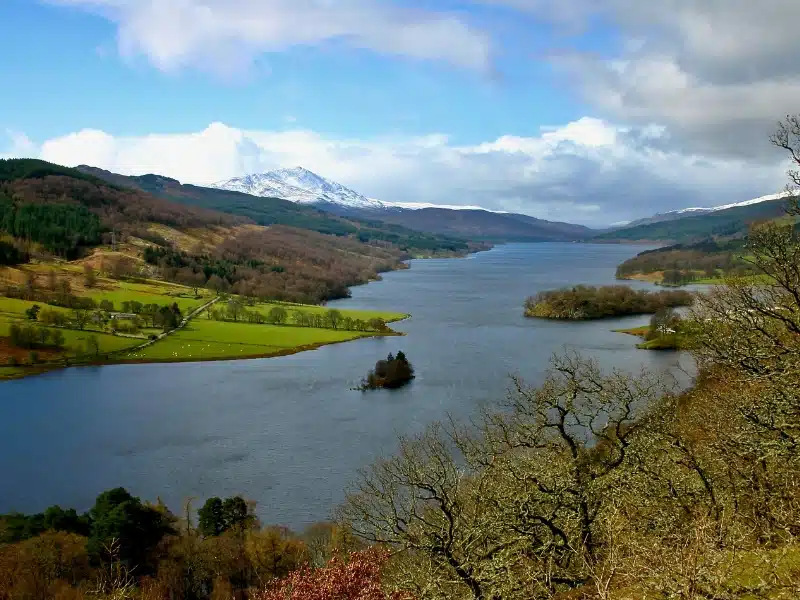
Take in the iconic Queen’s View along Loch Tummel, which is named after Queen Victoria, who visited the region in 1866. The vantage point at the Forestry Commission’s Visitor Centre offers a breathtaking vista of Schielhallion, one of Scotland’s most famous mountains.
Visit in August for the Kinloch Rannoch Highland Games, which always take place on the third Saturday of the month. Hosted by the local community, you can watch caber tossing, hill racing, and lots of other traditional Highland games events, as well as listen to the bagpipes being played.
Aberfeldy, although not on the official route, makes a good base for exploring local attractions like the Tay Bridge, Black Watch Monument, 16th-century Castle Menzies, Cluny House Gardens, Lundin Farm Stone Circle, and Dewar’s Aberfeldy Distillery.
A mecca for thrill-seekers, the white water rapids on the River Tay at Grandtully offer opportunities for kayaking, rafting, and canyoning, with lots of local companies providing access and equipment, whatever your level of skill or knowledge.
Historians should stop at the Gorge of Killiecrankie, the site of one of the bloodiest battles during the Jacobite Risings in 1689. Take a walk up to the viewpoint at Soldier’s Leap, where a Redcoat soldier is said to have jumped 18 feet across the ravine to escape the pursuing Jacobites. Salmon can often be seen jumping around the falls here, and keep an eye out for red squirrels and woodpeckers, which are quite prolific during fall, when the colours are spectacular.
Admire the listed historic house of Scone Palace, situated near the village of Scone and the city of Perth. Scone Palace was the crowning place of Scottish kings, where Macbeth, Robert the Bruce, and Charles II were once crowned. Nowadays, this red sandstone palace is among the very finest surviving examples of the late Georgian Gothic style in the United Kingdom.
The Queen’s View along Loch Tummel to Schielhallion
8. Kintyre 66
Route: Tarbert – Kennacraig – Carradale – Tayinloan – Isle of Gigha – Machrihanish – Mull of Kintyre Lighthouse – Campbeltown – Tarbert Distance: ~ 115 miles Duration: 3-5 days Best time to go: May to September for the best ferry conditions, milder weather, and long daylight hours, with June and September offering fewer crowds and a better chance of dry days Best for: Remote coastal scenery, island hopping, whisky distilleries, quiet beaches, wildlife spotting, and travellers who prefer Scotland well away from the usual tourist trail
A relative newcomer to the Scottish road trip scene is Kintyre 66, or K66, as it’s becoming known. If you’ve ever watched Paul McCartney and Wings’ video of the song Mull of Kintyre and been inspired by the landscape, then this road trip in Scotland is for you.
An easy hop from Glasgow Airport, the K66 is perfect for a long weekend. Start in Tarbert, a pretty village at the top of Kintyre. Just a narrow strip of land a mile wide, it connects the peninsula to the mainland, making Kintyre Scotland’s only mainland island.
The landscape and beaches are pristine and unspoiled, the seas are huge, the night sky is clear, and the wildlife is abundant – this really is a trip for outdoor lovers. Kayaking in the turquoise waters is a popular pastime, and hiking some of the incredible trails, with their spectacular views, is a must.
Local produce and food are also a highlight of this trip, with seafood at the top of the list. You’ll also find whisky and gin distilleries and several breweries in Kintyre, making sure that local food and drink sustain all your activity!
The official K66 is, unsurprisingly, 66 miles long, but we’ve added on the far south of Kintyre to include the iconic Mull of Kintyre lighthouse.
The single-track route there meanders over the rolling moors before helter-skeltering down a steep cliff to the lighthouse – don’t be put off, it’s an amazing drive with breathtaking views right across to Ireland.
Route Highlights
The ruins of Skipness Castle lie at the far north of the peninsula. The castle was originally built in the early 1200s by the MacSweens. It later fell to Clan MacDonald and has been rebuilt several times over the centuries.
A visit to the Beinn an Turc Distillery near Torrisdale to sample their Kintyre gin is a must! This sustainable distillery, which uses its own power generated by a hydroelectric plant, creates a delicious gin using botanicals and water from its own land.
Visiting the glorious beaches of the peninsula is a real treat. Unspoiled and often with no one else around, some of the best beaches in Scotland can be found here. Our favourites are Carradale Bay and nearby Torrisdale Bay.
Head to Saddell Bay to see GRIP, a cast-iron sculpture created by British artist Antony Gormley to mark the Landmark Trust’s 50th anniversary. The human form stares out over the Kilbrannan Sound to Arran from the rocks below Saddell Castle. Originally, the sculpture was placed for just a year, but thanks to a generous donation, it will remain indefinitely.
The enchanting Isle of Gigha can be reached in just 20 minutes on a ferry from Tayinloan and is a fantastic day trip destination. Kissed by the Gulf Stream, the beautiful Achamore Gardens feel exotic, whilst in contrast, a hike up Creag Bhan, the highest point on the island, showcases the best of the raw and wild landscape.
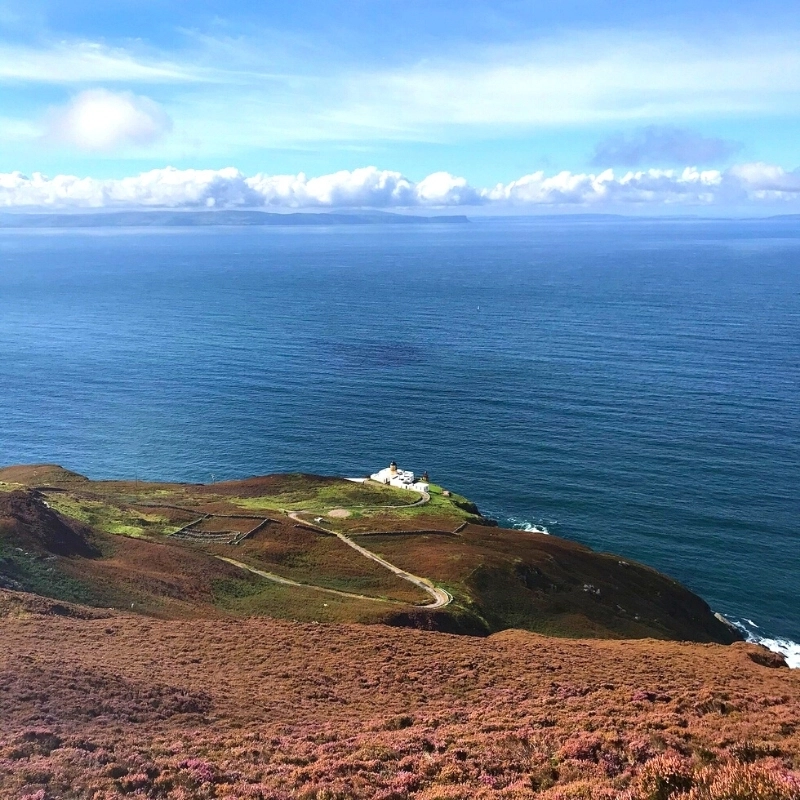
An absolute must-do is a visit to the Mull of Kintyre Lighthouse, on the very far southwest tip of the peninsula. The views are pretty special, and the drive there is dramatic, but not for the faint-hearted.
The next stop just up the coast is Machrihanish, a village most famous for its iconic beachside golf course.
Westport boasts a sandy beach, perfect for surfing. There is a surf school in the village where you can hire equipment and take lessons if this is your first time on a board. You’ll need a wetsuit, whatever the weather – the water in these parts is pretty chilly!
The seafood caught, prepared, and served on Kintyre is out of this world. Fresh from the boat in the morning, you’ll find scallops, mussels, lobsters, crabs, langoustines, and clams on every menu. Another local taste is Gigha halibut, which you can enjoy in the West Loch Hotel, on the A83 out of Tarbert.
Mull of Kintyre Lighthouse
Before You Hit the Road in Scotland
Scotland is made for road trips, but driving here has a few quirks that first-time visitors might not expect. Here’s what to know before setting off.
Driving on Scottish Roads
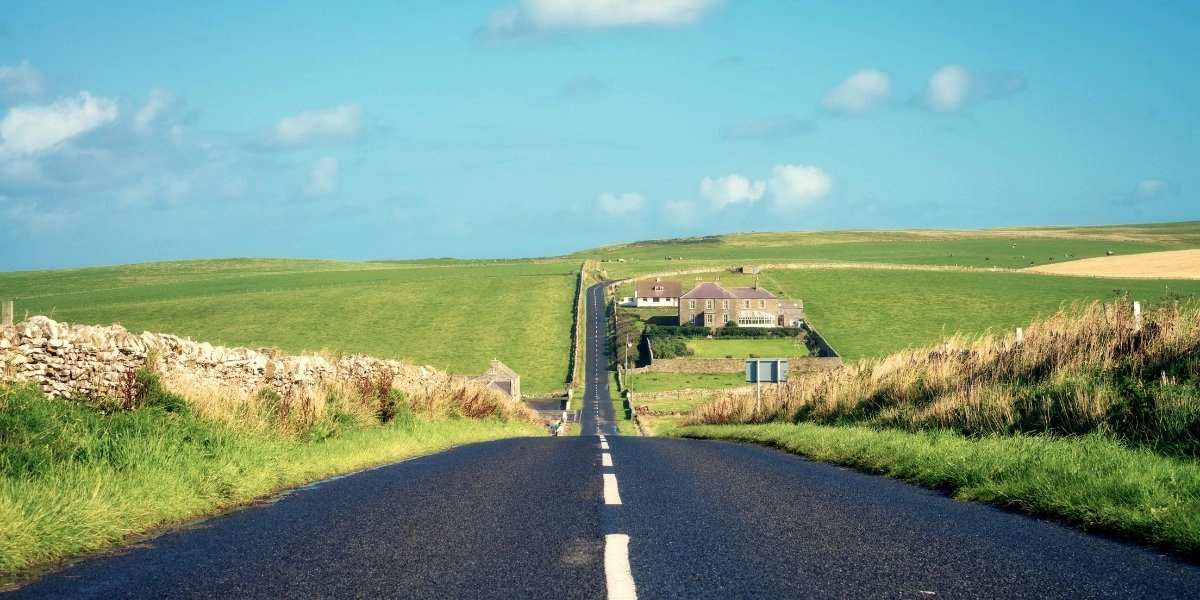
Scotland’s roads range from smooth motorways to winding single-track lanes in the Highlands and islands. If you’re driving on single-track roads, use passing places to let oncoming traffic through or allow faster vehicles to overtake, and always give a quick thank-you wave. Drive slowly on unfamiliar rural roads, watch for sheep and deer, and remember that fuel stations can be few and far between in remote areas, so we never let the tank drop below half.
Mobile Signal
Phone coverage can be patchy or non-existent in parts of the Highlands, Skye, and Kintyre. Download offline Google Maps before you leave, or use a backup navigation app like Maps.me. If your route includes ferries, especially in summer, book ahead as missed sailings can seriously disrupt your plans.
Midges
If you’re visiting between late May and September, especially on the west coast, prepare for biting midges at dawn and dusk. Pack insect repellent and layers, whatever the forecast says.
Motorhomes, Campervans, and Overnight Stops
Scotland is brilliant for campervan travel, but not every road suits larger vehicles. Routes like Bealach na Bà can be challenging, and some villages have overnight parking restrictions. Wild camping laws in Scotland apply to people on foot, not motorhomes, so always check local signage and use official stopovers where required.
Scottish Outdoor Access Code
Whenever and however you visit Scotland, always follow the Scottish Outdoor Access Code. The code helps you to get the best from your Scotland itinerary and ensures that the flora and fauna of this beautiful country are not harmed.
When to Take a Scottish Road Trip
Scotland’s weather is generally moderate but changeable. As the topography of Scotland varies greatly, you’ll notice differences between highland and lowland weather, as well as coastal influences.
Spring
Late spring is a great time for planning a trip to Scotland. The countryside comes alive with wildflowers and baby animals as the warmer weather beats back winter.
Summer
With good weather and summer averages of around 20°c, this is one of the best times for touring Scotland. The downside is that popular routes, attractions, and hotels will be busy, so a road trip in Scotland in the summer months will require a little more planning.
Autumn
A wonderful time for driving holidays, the fall colours in Scotland are some of the most dramatic in the world. Autumn is also deer rutting season, with lots of opportunities around the Highlands to see this mighty display.
Winter
Plan trips to Scotland during the colder months for winter sporting opportunities, dramatic scenery, and the possibility of seeing the Northern Lights, or ‘Mirrie Dancers’ as they are sometimes called in Scotland.
There are an average of 15-20 snow days a year, rising to over 100 snow days in the Highlands. Head to Aviemore in the Cairngorms if you’re looking for the white stuff, or just enjoy this fantastic winter destination for the scenery.
Getting to Scotland
Scotland has six main airports, and the good news is that one of them will be the perfect starting point for your ultimate Scottish road trip itinerary. We recommend booking through Skyscanner for live deals and the best prices.
Edinburgh Airport (pronounced Ed-in-bruh if you want to sound like the locals!) for the Borders Historic Route and Heart 200.
You can hire a car at any of these airports and be on your chosen Scotland driving tour route within a one-hour drive. Book your rental car well in advance and use a car hire booker like Discovercars.com, which will provide the best deals from all the top car hire companies. How? Because they have such a large market share, they’ve got way more buying power than individuals and can negotiate much harder on price.
Hiring a Motorhome
For a real adventure, hire a motorhome or campervan in Scotland. We recommendMotorhome Republic, a booking platform that compares deals from multiple rental companies, giving you a wide choice of campervan and motorhome options, plus access to an English-speaking customer support team for expert help if you need it.
For those planning a Scottish staycation from the rest of the UK, take public transport like the train or even coach from London to Edinburgh and hire a car from there, or drive yourself to Scotland.
Driving in Scotland: Legal Essentials
Remember to drive on the left during your UK trip!
Visitors with a non-UK licence should check the current rules for driving in Great Britain before travelling. Requirements vary according to where your licence was issued and how long you are staying.
If you’re not a British citizen, you should carry your passport or ID card at all times as you road trip around Scotland.
You must have at least 3rd party insurance for your vehicle.
Your car must be considered legal and roadworthy in the country in which it is registered.
If you’re bringing a vehicle designed for driving on the right-hand side of the road, check whether your headlights need adjusting or beam converters to avoid dazzling oncoming traffic.
Unlike France, the UK does not have laws that require you to carry certain equipment in your car, but that doesn’t mean that you shouldn’t. Being prepared in the event of an accident or a breakdown is invaluable. The best way is to carry a reflective jacket, a warning triangle, a first-aid kit, and a fire extinguisher.
Scotland Road Trip FAQs
How many days do you need for a Scotland road trip?
That depends on the route and your travel style. For shorter Scotland road trips like the Borders Historic Route or Kintyre 66, a long weekend is enough. For routes like the North East 250, Heart 200, or the South West Coastal 300, plan for 5–7 days to enjoy the highlights without rushing. If you’re tackling the North Coast 500 or combining multiple regions into a bigger Scotland itinerary, 10–14 days is much more realistic. Scotland may look compact on a map, but the roads can be slow, especially in the Highlands and on single-track routes.
What is the best road trip in Scotland?
If you want the classic bucket-list experience, the North Coast 500 is Scotland’s most famous road trip for good reason, with dramatic coastal scenery, mountain passes, castles, and remote beaches. If you prefer fewer crowds, the Argyll Coastal Route or the South West Coastal 300 are fantastic alternatives. The best Scotland road trip really depends on what you enjoy, whether that’s whisky, hiking, history, wildlife, or simply spectacular driving.
Is the NC500 worth it?
Yes, but only if you do it properly. The North Coast 500 is one of the best road trips in Scotland, but it’s not a route to rush. We’ve seen people try to cram it into five or six days and spend most of the trip driving. Give yourself at least 10 days if possible, take the detours, and expect slower progress on single-track roads. If you’re looking for a quieter Scottish Highlands road trip, the North East 250 or Argyll Coastal Route may suit you better.
Can you road trip Scotland in winter?
Absolutely, but winter road trips in Scotland need more planning. Short daylight hours, snow in the Highlands, icy rural roads, and occasional ferry disruptions can affect your itinerary. That said, winter can be a magical time to visit, with dramatic scenery, fewer tourists, cosy pubs, and even the chance of seeing the Northern Lights in northern Scotland. Routes in the Highlands require extra caution, while southern routes are generally easier.
Do you need a car in Scotland?
For this kind of trip, yes. Scotland has trains, buses, and organised tours, but many of the country’s most spectacular places are difficult or time-consuming to reach without your own transport. If you want the freedom to explore remote beaches, scenic viewpoints, castles, and smaller villages at your own pace, hiring a car is by far the best option for a Scotland road trip.
Which Scotland road trip is best for first-timers?
The Argyll Coastal Route is our top pick for first-time visitors, because it gives you a bit of everything that makes Scotland special: lochs, mountains, castles, dramatic scenery, famous film locations, wildlife, and great food, all without the scale of the North Coast 500. If you only have a few days, Heart 200 is another excellent choice for a balanced introduction to Scotland.
If you want to escape day to day life, explore new destinations and enjoy travel freedom, then take a road trip. And where better than in the glorious isles of the United Kingdom, where landscapes vary from the gentle to the dramatic, and roads thread through the patchwork countryside between quaint villages and historic towns? If you’ve got wheels, we’ve got the best UK road trip ideas for you!
Portugal is a small country with a lot to offer. From the historic towns of the north, to the glowing Algarve, via iconic cities, granite hard mountains and rolling vineyards, these historic and coastal road trips in Portugal will bring the country alive.
Europe is perfect for an epic road trip. From the rolling fields of Tuscany and the soaring mountains of the Sierra Nevada to the beaches of the South of France and the mighty Alps, you can find a European road trip route to suit your taste and travel style. No flying required! Our top eighteen bucket list Europe road trip itinerary ideas will give you plenty of inspiration to get on the road.
This post may contain affiliate links, from which we earn an income. Click here to read our affiliate policy. Europe is made for road trips. In a single journey you can follow river valleys, cross Alpine passes, explore medieval towns and historic cities, and drive some of the continent’s most spectacular coastlines. This 6,300km European road trip is based on a route we travelled ourselves in our motorhome, taking us through France, Germany, Austria, Slovenia,…
Ever dreamt of cruising along roads framed by fairytale castles, pausing in quaint medieval towns, or admiring the majesty of the mighty Alps? Germany has it all – dramatic landscapes, cutting-edge cities, a rich tapestry of history, and roads that make driving an absolute joy. Whether you yearn for enchanting castles, picturesque vineyards, medieval charm, or simply an off-the-beaten-track escape, our guide to the best German road trips will help you plan the ultimate getaway…
Ahhh, France. A country so eclectic and beguiling, it is the most visited nation on the planet. A French road trip is the best way to explore the wonderful diversity and beautiful landscapes of this country. Use our detailed guide and travel tips to find French road trip ideas in every region, and to plan your ultimate France road trip.
Expertise: road trips, motorhome travel, overlanding, long-term travel and travel planning. Likes: living in a box, wine and croissants!
Bio: Izzy Nicholls is a travel writer, author and co-founder of The Gap Decaders. Since 2018, she has travelled extensively across Europe and beyond by motorhome, overland truck and motorcycle. Izzy is the co-author of Selling Up to Live in a Motorhome and also writes contemporary women’s fiction as Izzy Kelly. Visit Izzy's author page