This post may contain affiliate links, from which we earn an income. Click here to read our affiliate policy.
The ultimate Germany road trip planner
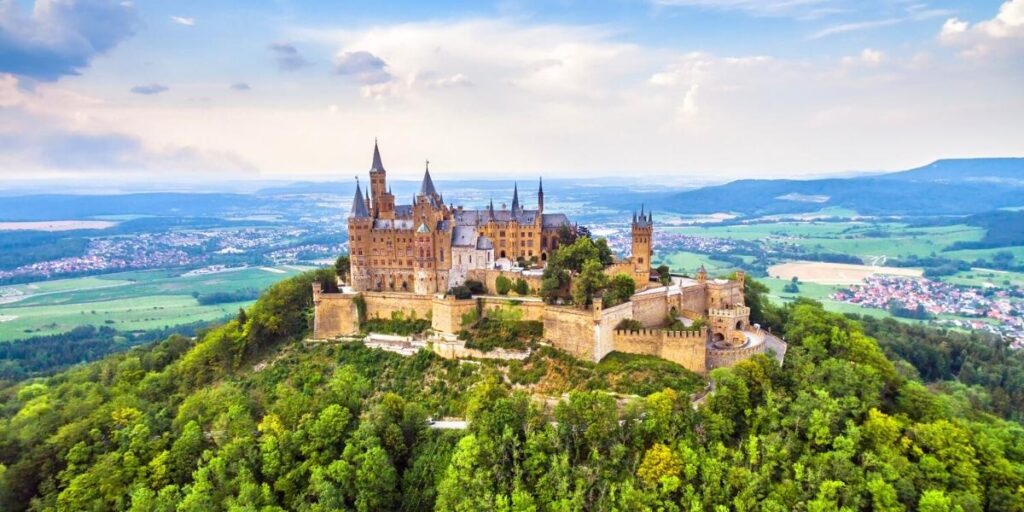
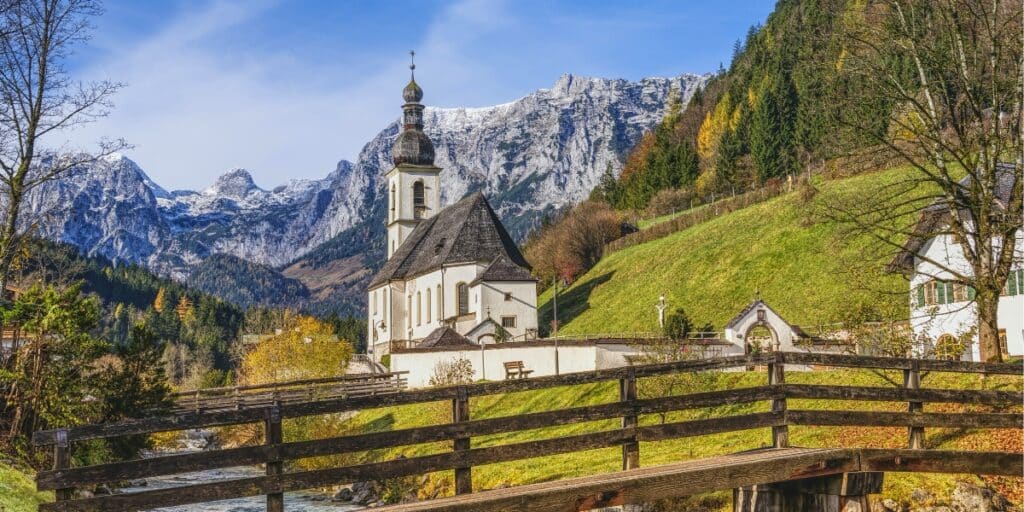
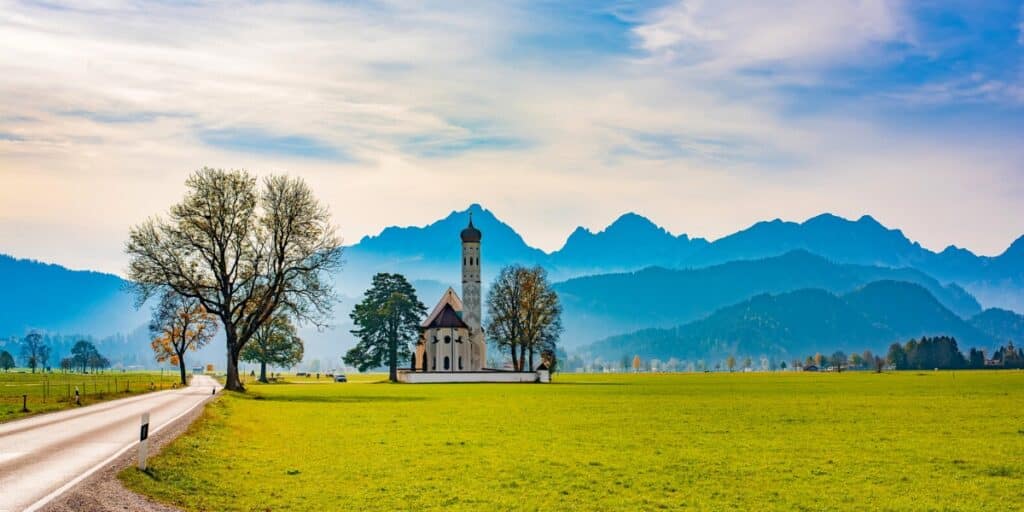
Germany is one of Europe’s best countries for a road trip, with Alpine passes, vineyard-lined river valleys, Baltic beaches, medieval towns and some of the continent’s most enjoyable driving roads.
We lived in Germany for five years and have travelled extensively across the country since, from the Baltic coast in the north to the Bavarian Alps in the south. And while routes such as the Romantic Road and German Alpine Road are rightly famous, some of our favourite journeys take you into quieter parts of the country, through the wine regions, historic towns and landscapes of central and eastern Germany.
In this guide, we’ve brought together 12 of the best German road trips, including classic touring routes and some less obvious alternatives. Each one includes the route, distance, how long to allow, the best time to go and our recommended places to stay, so you can compare them and find the right Germany road trip for you.
Germany Road Trips: Key Facts
Routes: The Gap Decaders features 12 Germany road trips, covering the Baltic coast, the Alps, historic cities, medieval towns, castles and wine regions.
Choose your route: Options range from scenic mountain and coastal drives to cultural routes through some of Germany’s best-known historic regions.
Best for: Castles, Alpine scenery, medieval towns, vineyards, historic cities and varied driving routes.
First-hand experience: Our recommendations are based on living in Germany for five years and travelling extensively throughout the country.
Germany Road Trip Map
Enjoy The Gap Decaders? Add us as a preferred source on Google.
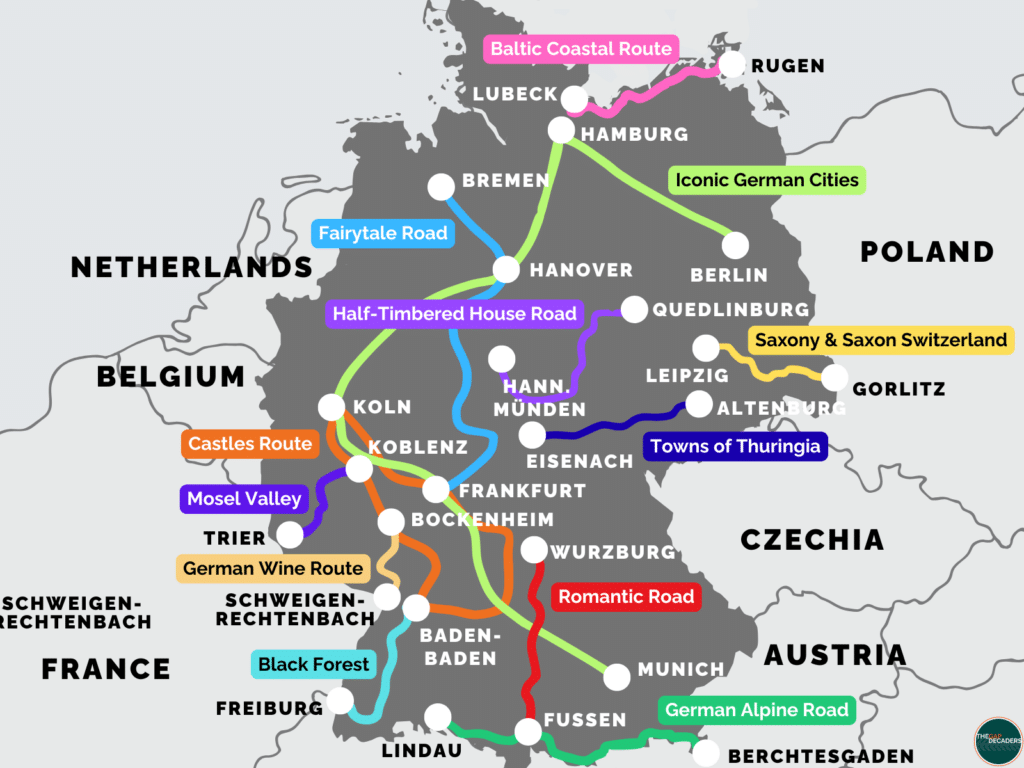
Find Your Perfect German Road Trip
Not sure which route is right for you? Choose what you want most from your trip, from mountain scenery and fairytale castles to wine country, historic cities and quiet coastal roads, and find the German road trip that fits.
If you like mountains and epic scenery
German Alpine Road: Alpine scenery and mountain driving
Black Forest: Forest roads, lakes and traditional villages
Romantic Road: Countryside, castles and Bavarian landscapes
Saxony & Saxon Switzerland: Vineyards, historic cities and spectacular landscapes
If you like castles, history and fairytales
German Fairy Tale Road: Storybook towns and Brothers Grimm connections
Germany’s Castle Route: Castles, palaces and medieval towns
Romantic Road: Walled towns, historic cities and Neuschwanstein
German Half-Timbered House Road: Traditional Germany with timber-framed towns and cobbled streets
If you like food, wine and slow travel
Mosel Valley: Vineyards, riverside towns and wine tasting
Black Forest: Regional food, spa towns and scenic countryside
Baltic Coastal Route: Seaside resorts, historic ports and a slower-paced coastal drive
German Wine Route: The vineyards and wine villages of the Palatinate
If you like cities and culture
Iconic German Cities: Berlin, Hamburg, Munich and Germany’s major cities
Germany’s Castle Route: Historic centres, architecture and cultural sights
Romantic Road: Würzburg, Augsburg and historic towns
Towns of Thuringia: A compact journey through the heart of Germany, packed with history, architecture and cultural heavyweights including Erfurt and Weimar.
Some of these itineraries have full standalone guides with day-by-day planning, where to stay, and extra stops. I’ve linked them under the relevant region below.
Planning tools we actually use for Germany
1. The Romantic Road
Want the full version? Read our detailed Romantic Road guide.
Route: Wurzburg – Weikersheim – Rothenberg – Dinkelsbühl – Augsburg – Fussen
Duration: 7 days
Distance: 340 km
Best time to go: May to October for sightseeing and scenic driving, or December for traditional Christmas markets
Best for: Fairytale castles, medieval towns, Bavarian scenery and historic architecture
One of the best southern Germany road trips is along the scenic route known as the Romantic Road or Romantische Strasse. This Bavaria road trip stretches for 340km from Wurzburg to Fussen, passing through some of Germany’s prettiest landscapes, fairy tale towns and villages.
The official Romantic Road route has 29 stops, but doing all of them is intense, and after a while, the highlights all blend together into one! To cover the route in full, we took a week, but you could easily spend longer! This gave us enough time to pop into most of the official stops and spend a bit longer at the most interesting places, which we have covered here.
The first stop on Germany’s Romantic Road is Wurzburg, an attractive city that was almost totally destroyed in World War Two. Highlights include the Marienberg Fortress, Wurzburg Cathedral, the Old Main Bridge (which crosses the River Main), and the stunning UNESCO World Heritage-listed Wurzburg Residence.
Wurzburg and the Franconia region are also well-known for their wines, and you’ll see vines planted in front of the Marienberg Fortress and in the surrounding countryside, so be sure to stop for a wine tasting and sample a local drop.
After exploring Wurzburg, head south to the fairytale town of Rothenburg ob der Tauber, one of the most beautiful places in Germany that visitors flock to worldwide.
We recommend stopping in the charming town of Weikersheim en route. There’s a beautiful palace to visit and a small but very picturesque Altstadt.
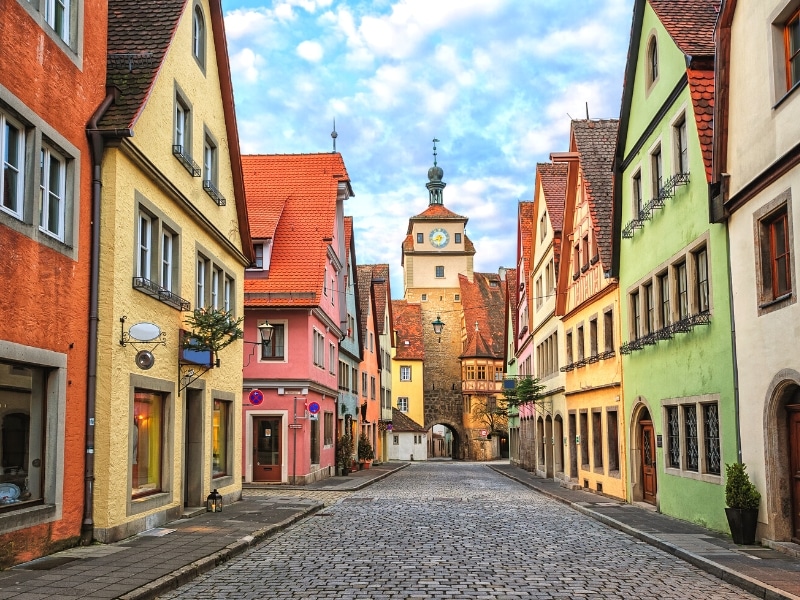
In Rothenburg, brightly painted half-timbered houses line the Insta-worthy cobbled streets, and the medieval city walls with their watchtowers ooze romanticism.
Other highlights include St. Jacob’s Cathedral, the castle gardens, the views from the tower of City Hall, the open-all-year Kathe Wohlfahrt Christmas store and the German Christmas Museum.
Along the way to the next stop of Augsburg you will pass the popular medieval town of Dinkelsbühl, known for its beautiful architecture and the sweet treat schneeball or snowball, a delicious deep-fried short-crust pastry you must try!
Augsburg, which was a free imperial city from 1276 to 1803, is one of the oldest cities in Germany. The beautiful Gothic Augsburg Cathedral dates back to the 13th century and is one of the most important religious buildings in the region.
Augsburg’s town hall, known as the Rathaus, is another highlight due to its beautiful 16th-century Renaissance architecture. The highlight of the interior is the Golden Hall, a ceremonial hall that features six portals, wall frescos, and splendid coffered ceilings, all of which are literally covered in gold.
One of Augsburg’s most famous landmarks is the Fuggerei, the world’s oldest social housing project, founded in 1516. The project consists of a small town within Augsburg with narrow streets, small houses, and gardens. It is a unique look into the history of housing and gives visitors a glimpse into how the lower class used to live in Germany.
In Fussen, explore the old town and head to Schwangau to visit Germany’s most famous schloss, Neuschwanstein Castle, built by mad King Ludwig. If you have a few extra days, enjoy some city life by heading to Munich, where you’ll find fantastic Bavarian culture and a lively social scene.
Where to Stay
Würzburg: Hotel Grüner Baum for its great location, traditional Franconian decor and outstanding breakfast.
Rothenburg: Hotel Herrnschloesschen for its gorgeous and unique decor, fantastic restaurant and beautiful garden.
Füssen: Hotel Das Rübezahl for its spectacular views across the Alps towards Neuschwanstein and Hohenschwangau castles, excellent spa and restaurant, making it a lovely place to finish your German road trip.
2. The German Alpine Road
Want the full version? Read our detailed German Alpine Road guide.
Route: Lindau – Bad Hindelang – Pfronten – Füssen – Oberammergau – Garmisch-Partenkirchen – Bad Tölz – Rottach-Egern – Oberaudorf – Aschau im Chiemgau – Reit im Winkl – Berchtesgaden
Duration: 7 to 10 days
Distance: 450 km
Best time to go: June to September for the best mountain driving conditions, clear views and outdoor activities
Best for: Alpine scenery, mountain roads, lakes, castles and outdoor adventures
Starting at Lake Constance (Bodensee) and winding its way through the diverse and spectacular Bavarian landscape to Lake Koningssee, following the Alps from west to east, the German Alpine Road, or Deutsche Alpenstrasse, is simply spectacular and has to be one of the most scenic road trips in Germany.
On this South Germany road trip, the oldest tourist route in Germany, you’ll explore picture-perfect towns, alpine lakes and meadows, historic castles, and fantastic driving roads, perfect for whatever your means of transport.
Starting in the pretty harbour town of Lindau on Lake Constance, take the twisting road of the Rohrbach ascent into the Allgäu peaks for spectacular views and the Scheidegg waterfalls in the Rohrach Gorge.
Continue through Oberstaufen, stopping for a dip in the cold and clear waters of Grosser Alpsee, to the traditional German town of Immenstadt before crossing the Oberjoch Pass. With 106 bends, this is one of the most scenic and exciting drives of the whole route – make sure you allow enough time to stop for photos!
As you continue east, you’ll step into the fairytale world of King Ludwig II on a tour of the castles of Neuschwanstein and Hohenschwangau and the Museum of the Bavarian Kings. Three lakes on this part of the route – Weissensee, Hopfensee, and Forggensee – offer gorgeous scenery.
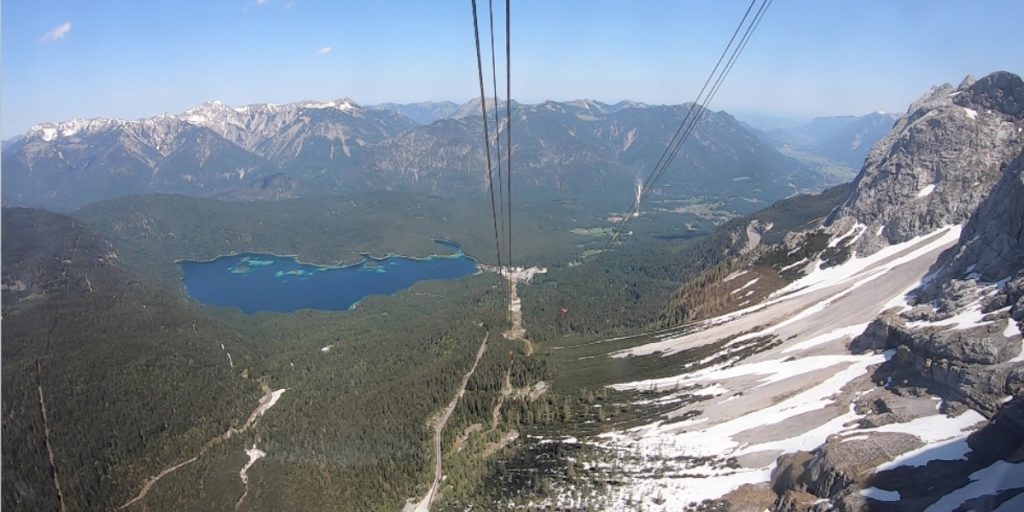
Upper Bavaria, the land of drama, adventure, and extreme sports, is next on the route. Here, you can explore the summit of the Zugspitze, Germany’s highest mountain, take in Linderhof Palace, swim in the beautiful Eibsee, and discover the many intricate Baroque churches and monasteries, like the Church of Wies. Oberammergau, home of the famous ten-yearly Oberammergau Passion Play, is also in this region and well worth visiting.
The next part of the route runs through the Tölzer Land, beside Lake Walchensee, across the fabulous Kesselberg Pass, and on to Lake Kochelsee. After Benediktbeuern with its abbey, Bad Heilbrunn, Bad Tölz, and Lenggries, the route climbs to the Sylvenstein reservoir, where you’ll have fantastic views.
The next section of the route in the Tegernsee and Schliersee region sees you driving through Rottach-Egern, Tegernsee, Schliersee, and Bayrischzell, known for their restaurants and cafés that provide Bavarian hospitality and delicious local food and drink for you to sample. As you continue, the road meanders through the mountains to Chiemsee, and panoramic views are guaranteed.
The German Alpine Route saves the best for last – crossing the 868m high Schwarzbachwacht Pass into the incredible landscape of the Berchtesgaden Alps and Konigsee, widely thought to be the most stunning lake in Germany.
Where to Stay
Füssen: Hotel Sonne is right in the heart of Füssen’s old town, making it easy to explore the historic centre on foot. Its contemporary interiors, local cuisine and convenient location also make it a great base for visiting nearby Neuschwanstein and Hohenschwangau castles.
Bad Tölz: Hotel am Wald is a peaceful option just outside the centre of Bad Tölz, with panoramic views, comfortable rooms and a wellness area with an indoor pool and sauna, ideal for relaxing after a day on the Alpine Road.
Berchtesgaden: Alpenhotel Fischer is an adults-only, family-run hotel with panoramic mountain views, free parking and an excellent wellness area with an indoor pool, saunas and steam room. It’s around 1.5 km from the centre of Berchtesgaden and makes a relaxing base for exploring the surrounding Bavarian Alps.
3. The Mosel Valley
Route: Koblenz – Cochem – Beilstein – Zell am Mosel – Traben-Trarbach – Bernkastel-Kues – Trier
Duration: 5 to 7 days
Distance: 172 km
Best time to go: May to October, especially September and October for the grape harvest and wine festivals
Best for: Wine lovers, riverside towns, medieval castles and slow travel
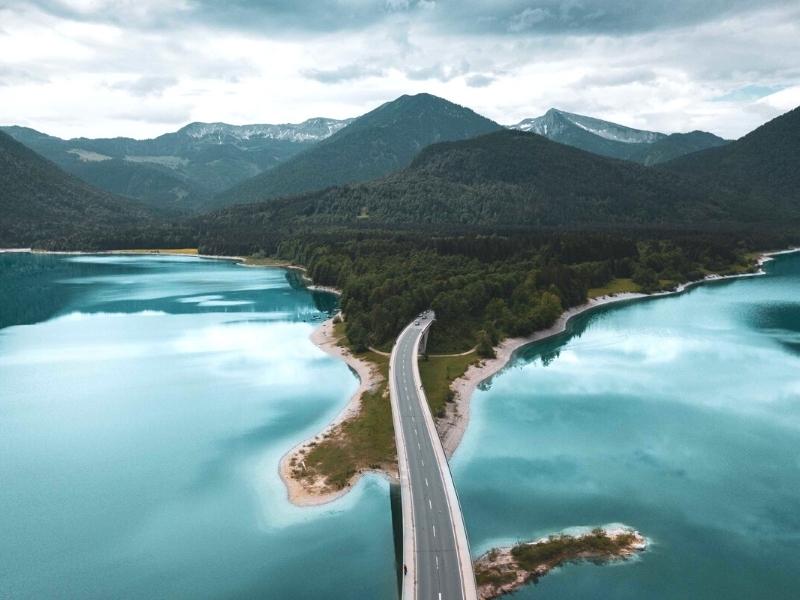
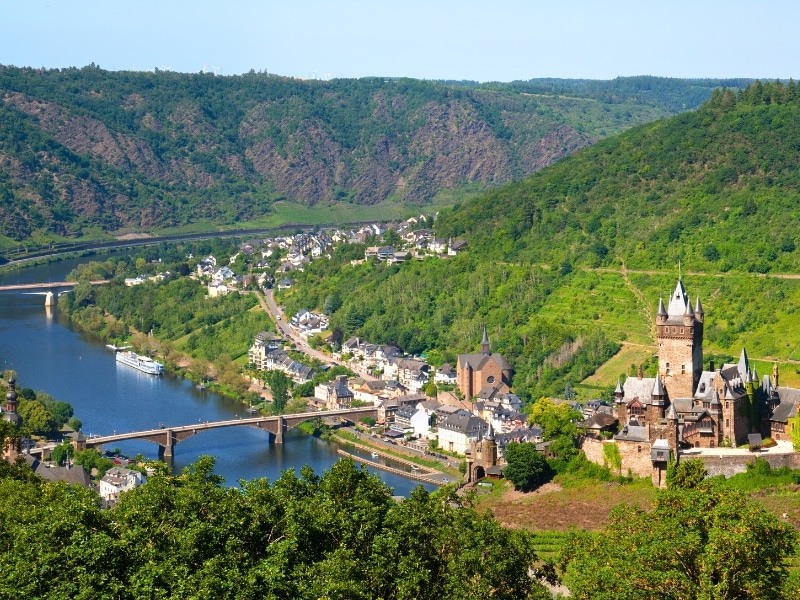
A beautiful river snaking through it, soaring medieval castles dotted across it, and almost vertical vineyards nestled on its hills. It’s the picturesque Mosel (or Moselle) Valley, and this is one of the best roads in Germany for wine lovers!
Punctuated by the small but beautiful Mosel River, the valley essentially stretches from the small city of Koblenz, a fairy-tale German town, to Trier along the water’s edge.
This breathtaking valley is best explored by taking a least a week, the pinnacle of slow travel as you hop from one riverside town to the next.
Kick off your Mosel road trip itinerary in Koblenz, where the mouth of the Mosel meets the Rhine, to walk along the ancient Roman walls or just amble through the Altstadt (old town), before heading to visit the first traditional town of Cochem.
On the way there, avid Instagrammers and history buffs should definitely make a turn at Burg Eltz, one of the most spectacular castles and hidden gems in Germany, to take the requisite snap. Once in Cochem, you’ll slow the pace.
You can marvel at the unique vineyards (a signature of the entire Mosel road trip), where the vines crawl up the hillside at 90-degree angles. If you go in harvest time (September and October) you’ll see the workers strapped into harnesses with spiked boots just to be able to pick the ripe grapes.
Cochem also boasts one of Germany’s legendary castles looming above it, plus it’s the best place to just take a walk along the promenade, stopping in at one of the riverfront cafes for a plate of zwiebelkuchen (onion cake) and a sparkling glass of federweisser, a traditional fizzy grape drink.
Your next few nights should definitely include stays in some of the lovely towns dotted along the river: Beilstein for Burg Metternich, Zell am Mosel for traditional German food and hillside views, and our favourite stop on the entire itinerary, Traben-Trarbach.
This gorgeous little town used to be two villages, Traben and Trarbach, on opposite sides of the river, which were eventually united with the construction of a short bridge.
Before you hit your final destination of Trier, stay overnight in Bernkastel-Kues, a spa town peppered with wood-timbered houses, many a hot spring, and the ruins of the Landshut Castle.
Before you know it, your German road trip is at an end, as it culminates in the beguiling town of Trier. An old Roman city with landmarks like the Porta Nigra black gate, an old-school amphitheatre, the Roman baths, and a towering cathedral, just to name a few.
It’s here that we raised a(nother) glass of perfectly poured Riesling in celebration of the Mosel Valley, one of the best road trips in Germany.
Where to Stay
Cochem: Hotel Villa Vinum is a characterful boutique hotel right beside the Mosel, less than five minutes’ walk from Cochem’s historic centre. Individually decorated rooms, private parking and views towards the river, vineyards or Reichsburg Castle make it a particularly good base for exploring the Mosel Valley.
Traben-Trarbach: The Goldene Traube combines a traditional exterior with contemporary rooms in a central Traben-Trarbach location. Its rooftop terrace, excellent breakfast and on-site parking make it a convenient overnight stop as you follow the Mosel towards Trier.
Trier: Vienna House Easy by Wyndham Trier is around a ten-minute walk from the city centre and close to Trier’s Roman amphitheatre and Imperial Baths. Spacious modern rooms and an underground car park with direct hotel access make it an especially practical place to finish the road trip.
Is this your first time visiting Germany? Get all the information you need in our Germany Travel Guide, including what to pack, the best time of year to go, getting there, and practical tips to help you have the best trip!
4. The Black Forest
Want the full version? Read our detailed Black Forest guide.
Route: Baden-Baden – Mummelsee – Triberg – Titisee-Neustadt – Freiburg im Breisgau
Duration: 5 to 7 days
Distance: 179 km
Best time to go: May to October for hiking and scenic drives, or December for Christmas markets and winter scenery
Best for: Forest landscapes, traditional villages, outdoor activities and scenic driving
A road trip through the Black Forest is like stepping into a living fairytale, where ancient woodlands, charming villages, and breathtaking vistas make for an incredible journey. At the heart of this experience lies the legendary Black Forest High Road (Schwarzwaldhochstraße), one of Germany’s most celebrated scenic routes.
Your adventure begins in Baden Baden, a sophisticated spa town known for its thermal baths and elegant streets. After savouring a leisurely breakfast at a local café and perhaps indulging in a restorative spa treatment, you’re ready to hit the road.
As you embark on the Black Forest High Road, the scenery transforms dramatically – lush, dense forests give way to rolling hills and panoramic views. Once a favourite among royal travellers and early tourists, this road carries with it the echoes of history and the promise of discovery.
A must-see along the route is the enchanting Mummelsee. Nestled high within the forest, this shimmering lake is steeped in legend and mystery. Local lore speaks of forest spirits that call this serene body of water home, adding an element of magic to your visit.
Make sure to stop at one of the rodelbahns, a summer toboggan on rails that is great fun. They are often built into the sides of hills to best use your weight and kinetic energy to hurtle the toboggan along the tracks. There are brakes but it’s more fun without!
Whether you choose to take a leisurely lakeside stroll, rent a paddle boat for a closer look, or simply relax with a picnic while soaking in the views, the Mummelsee offers a peaceful interlude amid your adventure. We enjoyed the view with the local speciality of Schwarzwaelder Schinken (smoked ham) finely chopped on buttered farmhouse bread and a locally brewed Honig Bier (honey beer).
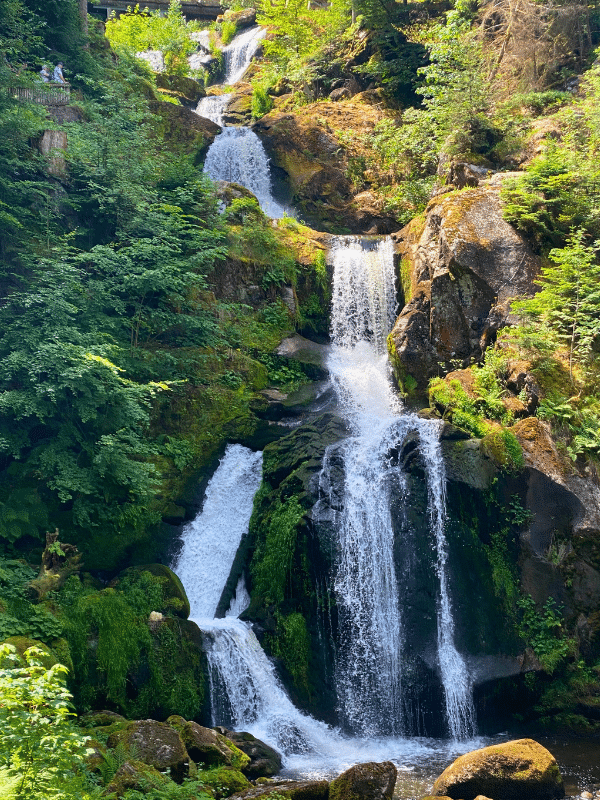
Further along, the quaint town of Triberg beckons. Famous for its majestic waterfall, the highest in Germany at 163 metres, Triberg offers both natural wonder and a taste of local craft traditions. The roaring falls provide a spectacular backdrop as you explore the town’s narrow streets lined with charming shops and workshops where master artisans create iconic cuckoo clocks.
After climbed to the top of the falls using the staircases and bridges provided and took the back route through the forest to the small Bergsee Lake. On the edge of the lake we stopped at Café Bergseestüble for kaffe und kuchen, a traditional German custom of coffee and cake. And of course we had homemade Black Forest cake – chocolate cake with cherry and kirsch filling and lashings of whipped cream between each layer! As you wander back to town, visit the beautiful Wallfahrtskirche Maria in der Tanne, a Baroque pilgrimage church with an ornate interior.
No Black Forest road trip would be complete without a stop at Titisee-Neustadt. This picturesque town, set beside the sparkling Titisee Lake, has a lively but relaxed vibe. There are lots of activities going on around Titisee – you can hike around the whole lake, paddle board, kayak, swim and spend a day at Badeparadies Schwarzwald, a spa and water paradise ideal for families.
Finish your road trip in the vibrant city of Freiburg, which offers a refreshing contrast with its sun-drenched streets, a blend of historical charm and innovative green living. Marvel at the awe-inspiring Freiburg Minster with its soaring spires, then wander through the cobbled alleys of the old town where bustling markets and quaint cafés invite you to pause and enjoy the moment.
Where to Stay
Baden-Baden: Hotel Der Kleine Prinz is a charming boutique hotel in a restored 19th-century villa, just a short walk from Baden-Baden’s thermal baths, Kurhaus and historic centre. Individually decorated rooms, an excellent restaurant and private parking make it a particularly good base for starting your Black Forest road trip.
Triberg: Gasthaus Staude is a traditional country guesthouse in a peaceful location in the heart of the Black Forest, around a 15-minute drive from Triberg. With free parking, an on-site restaurant serving regional specialities and a log cabin sauna, it’s a lovely rural base for exploring the waterfalls and surrounding walking trails.
Freiburg: Boutiquehotel Oberkirch im Zentrum has an unbeatable location in Freiburg’s historic centre, directly opposite the cathedral on Münsterplatz. The privately run hotel has traditionally styled rooms and a restaurant serving Baden specialities, with limited private garage parking available by advance reservation.
5. Saxony & Saxon Switzerland
Route: Leipzig – Meissen – Dresden – Pirna – Saxon Switzerland – Bautzen – Görlitz
Distance: 300 km
Duration: 7 to 10 days
Best time to go: May to October for sightseeing, hiking and scenic driving
Best for: Dramatic landscapes, historic cities, architecture and eastern Germany
This eastern Germany road trip combines two very different sides of Saxony: grand cities packed with art and architecture, and the extraordinary sandstone landscapes of Saxon Switzerland.
Start in Leipzig, a city with strong musical connections, a fascinating recent history and an energetic cultural scene, before heading east towards Meissen.
Famous for its porcelain, Meissen sits above the Elbe and makes a beautiful stop on the way to Dresden. This is also wine country. Grapes have been cultivated in Saxony for around 800 years, and the official Saxon Wine Route runs for almost 60 km through the Elbe Valley between Pirna and Diesbar-Seusslitz near Meissen.
Dresden deserves at least a couple of days. Much of the historic centre was destroyed during the Second World War and subsequently reconstructed, including the magnificent Frauenkirche. Today, its palaces, museums and position on the Elbe make it one of Germany’s great city stops.
From Dresden, the landscape changes dramatically as you head towards Pirna and Saxon Switzerland National Park. Leave the car behind for a while and explore on foot, where huge sandstone formations rise above deep wooded valleys and the Elbe.
The Bastei is the best-known viewpoint, but spending a couple of days here gives you time to get beyond the busiest spots and properly explore the national park.
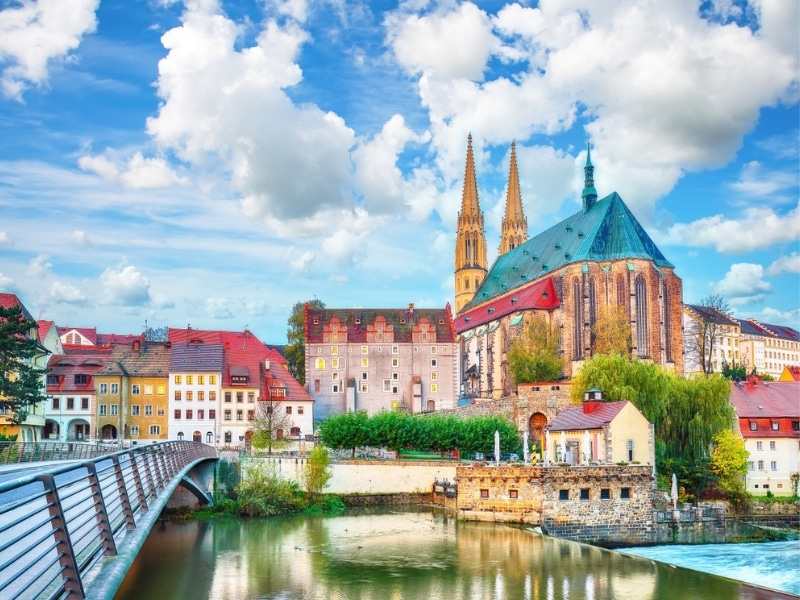
Continue east to Bautzen, known for its towers and beautifully preserved old town, before finishing in Görlitz on the Polish border. With an extraordinary collection of historic architecture spanning several centuries, it makes a memorable finale to a road trip through a part of Germany many international visitors overlook.
Where to Stay
Leipzig: Steigenberger Icon Grandhotel Handelshof is right in the historic centre and makes a particularly convenient base for exploring Leipzig on foot before starting the road trip.
Dresden: Cloud One Dresden-Frauenkirche has a superb position on Neumarkt beside the Frauenkirche, putting you right in the heart of Dresden’s reconstructed old town.
Görlitz: Emmerich Hotel is a characterful boutique choice in Görlitz’s historic centre and a lovely place to finish the route, surrounded by the architecture that makes the city so special.
6. German Fairy Tale Road
Want the full version? Read our detailed German Fairytale Road guide.
Route: Frankfurt – Steinau – Alsfeld – Marburg – Kassel – Gottingen – Hamelin – Bremen
Duration: 7 days
Distance: 660 km
Best time to go: May to October, or December for Christmas markets and a more atmospheric fairytale feel
Best for: Medieval towns, castles, Brothers Grimm connections and family travel
This central to north Germany road trip from Frankfurt does not technically start in the city, but Frankfurt is the perfect place to fly into and pick up a rental car. If you’re spending the night, make sure you visit the South Bank, where you’ll find an eclectic selection of restaurants, bars, and clubs.
The Fairy Tale route known as Deutsche Märchenstraße officially starts in the pretty town of Steinau an der Strasse, where the Brothers Grimm lived until they were twelve.
The setting is straight out of their own fairy tales, complete with typical half-timbered houses, twisting cobbled alleys, and the turreted fairy tale castle of Schloss Steinau, which overlooks the whole town. Visit the Brüder Grimm Haus and Museum Steinau, both of which showcase the works of the brothers.
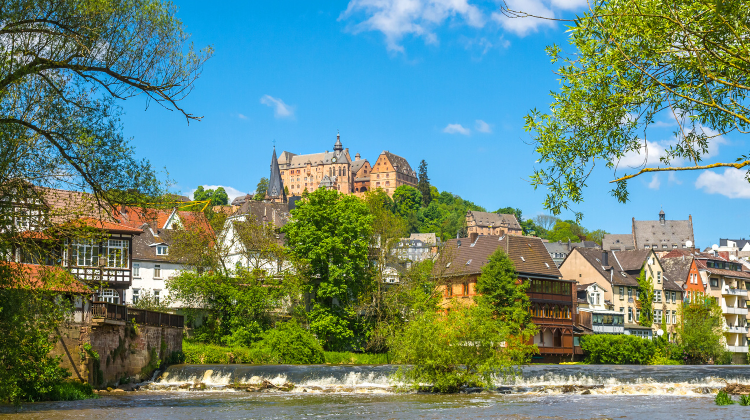
Take the back roads to Marburg, stopping at Alsfeld for Little Red Riding Hood inspiration as you enjoy the gorgeous landscapes and slower pace for a few hours. Marburg’s altstadt is full of medieval houses and the hilltop Landgrafenschloss, a dramatic castle holding exhibits on sacred art and local history.
Lively bars and restaurants line the Marktplatz and the narrow streets surrounding it, making this a great location for an overnight stop.
From Marburg, head to Bad Wildungen, home to the distinctive Friedrichstein Palace, which initially served as a castle and is now a museum. This palace inspired the Brothers Grimm story of Snow White.
Kassel is where the Brothers Grimm spent their teenage years whilst working as librarians for the King of Westphalia, Jerome Bonaparte, the younger brother of the infamous Napoléon.
There is very little left of historic Kassel, but there are two worthwhile attractions to visit: the Brüder Grimm Museum and the Schloss und Bergpark Wilhelmshöhe, a tranquil green space and the largest hill park in all of Europe.
En route to Gottingen is Hofgeismar, known for Sababurg Dörnröschenschloss or Sleeping Beauty’s Castle, set in the Reinhardswald Nature Park. The tale of Sleeping Beauty is about a princess cursed by an evil fairy who put her to sleep for 100 years only to be awakened by her Prince Charming.
Gottingen is home to the University of Gottingen, where the Grimm Brothers once served as professors. Make for the traditional and atmospheric central market square, where the statue of Ganseliesel, the Little Goose Girl of German lore, is one of the most kissed statues anywhere in the world – it is said that the kisser is rewarded with good luck!
Hameln (or Hamelin) is next up and one of the most famous fairy tale destinations in Europe. Hameln is the home of the Pied Piper, or Rattenfänger, who rid the town of rats in 1284, only to be cheated out of his payment.
The Pied Piper returned to Hameln a year later and lured away all the children. The story is re-enacted in the town centre every Sunday between May and October and is a fantastic spectacle.
The Weser Renaissance architecture of the Rattenfängerhaus and the Hochzeitshaus makes a fitting historic backdrop for the streets which are thronged with locals dressed the part, stalls selling food, and live music playing.
Finally, on to the Hanseatic city of Bremen, your final stop. Good places to visit in Bremen include the traditional Marktplatz, which is located in the city’s charming Altstadt, the 600-year-old Rathaus or town hall, the Roselius-Haus Museum, and the stunning St. Petri Dom, the 11th-century gothic cathedral.
Another landmark can be found in the city’s central town square; a statue of the Bremen musicians and heroes of the Brothers Grimm story, The Town Musicians of Bremen.
If you have time, extend your trip and head to the modern and progressive port city of Hamburg. Explore the historic districts, edgy culture, and extraordinary commercial past with our one day Hamburg itinerary.
Where To Stay
Frankfurt: Steigenberger Icon Frankfurter Hof is a landmark five-star hotel in the heart of Frankfurt, within easy walking distance of the historic centre and River Main. Its elegant rooms, restaurants and extensive spa make it a luxurious place to start the road trip, while its central location means you can explore much of the city on foot.
Marburg: VILA VITA Rosenpark is a stylish hotel around a 10–15 minute walk from Marburg’s historic old town, with spacious rooms, excellent dining and an extensive wellness area. Its large underground car park makes it particularly convenient for a road trip stop, and Marburg’s hilltop Landgrave Castle is also easily accessible from the hotel.
Bremen: Atlantic Grand Hotel Bremen has a superb location in the heart of the historic centre, just a minute’s walk from the Town Hall and Bremen Town Musicians and a couple of minutes from the River Weser. Contemporary rooms, bike rental and an on-site underground car park make it an excellent base for exploring Bremen without needing to use the car.
7. The German Wine Route
Route: Schweigen-Rechtenbach – Bad Bergzabern – Landau – Neustadt an der Weinstraße – Deidesheim – Bad Dürkheim – Bockenheim
Distance: 85 km
Duration: 3 to 5 days
Best time to go: March and April for almond blossom or September and October for the grape harvest and wine festivals
Best for: Wine lovers, vineyard landscapes, pretty villages and regional food
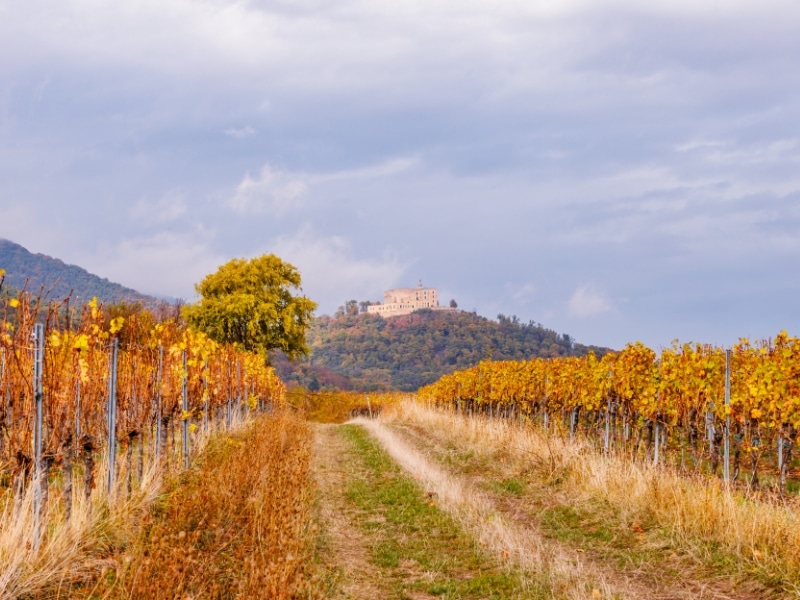
Germany’s oldest wine route has been winding through the vineyards of the Palatinate since 1935, running for around 85 km from the German Wine Gate at Schweigen-Rechtenbach, close to the French border, to Bockenheim in the north.
This is not a road trip to rush. The actual driving could easily be completed in a couple of hours, but that would rather miss the point. The Deutsche Weinstraße is all about stopping in wine villages, walking through vineyards and sampling the region’s excellent Rieslings along the way.
Start at the imposing German Wine Gate before heading north through one of Germany’s warmest regions. In spring, the route is lined with pink almond blossom, while summer brings lush vineyards and long evenings perfect for eating outside. Come autumn, the focus switches firmly to the grape harvest, with wine festivals taking place throughout the region.
Landau makes a good early stop before the route leads through Neustadt an der Weinstraße and on towards Deidesheim, one of the best-known wine towns in the Palatinate. This is somewhere to slow down, find a traditional wine tavern and order a glass of something produced just a few kilometres away.
Further north is Bad Dürkheim, home to the enormous Dürkheimer Riesenfass. With a capacity of 1.7 million litres, it is the world’s largest wine barrel, although these days you’re more likely to eat and drink inside it than find it filled with wine.
The route finishes at Bockenheim, but give yourself several days to get there. With short driving distances, excellent food and vineyards around almost every bend, the German Wine Route is made for slow travel.
Where to Stay
Neustadt an der Weinstraße: Hotel Tenner is a good-value base on the edge of Neustadt, surrounded by vineyards and well placed for exploring the central section of the German Wine Route.
Deidesheim: Hotel Deidesheimer Hof sits right on the historic market square and makes an atmospheric base in one of the route’s most appealing wine towns.
Bad Dürkheim: Gartenhotel Heusser is a comfortable spa-style option with extensive gardens and wellness facilities, ideal for slowing down towards the northern end of the route.
8. Germany’s Castle Route
Route: Köln – Frankfurt – Mespellbrunn Castle – Stuttgart – Bad Wildbad – Heidelberg – Koblenz – Eltz Castle – Rheinstein Castle – Cochem Castle – Köln
Duration: 5 to 7 days
Distance: 950 km
Best time to go: May to October for castle visits, gardens and scenic driving
Best for: Castles, palaces, medieval towns and German history
This South Germany itinerary covers a whole mix of destinations in a fabulous circuit, visiting some of Germany’s best castles on the route. Starting and finishing in the graceful city of Cologne (Köln in German), this road trip covers the southwest of the country.
It takes you south as far as Stuttgart before circling back north towards the Mosel Valley. To make the most out of this road trip, we suggest three to four days, which will give you time to enjoy the castles as well as the wine in the Rhine region – perfect for a long weekend.
This part of the country is one of the best places to visit in Germany, and you’ll get to see some of Germany’s prettiest castles, the stunning and verdant forests, the Rhine River, as well as a number of picturesque cobbled towns. Stay off the autobahns for the best driving through beautiful landscapes and scenery.
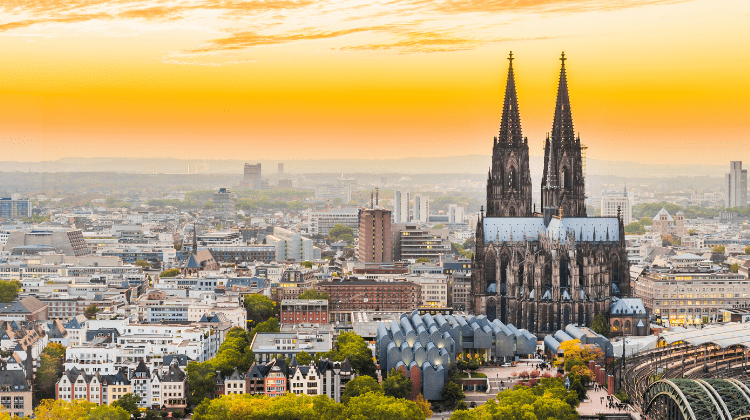
Start your castle road trip in Koln, making sure to visit the simply stunning cathedral, and head southeast towards Frankfurt. Spend some time in the Altstadt, wandering around the pretty and atmospheric streets.
From here, head towards Mespellbrunn Castle. It’s located pretty much in the middle of nowhere, however, it’s a stunning castle, which looks a lot like the Sleeping Beauty tower, located on a lake.
From Mespellbrunn Castle, keep heading southeast towards Stuttgart, a beautiful city full of green and open spaces. Be sure to spend plenty of time here exploring the town and its elegant buildings.
It’s worth stopping overnight and taking advantage of the fantastic restaurants, bars and beer gardens which line the narrow cobblestone streets of the old town.
From Stuttgart, start to head back north-west. Spend time visiting the lovely Bad Wildbad in the Black Forest and maybe indulge yourself in one of the many thermal baths there.
Head for historic Heidelberg and visit the imposing Heidelberg Castle before crossing the wide River Neckar on the famous old bridge. This is another great town for an overnight stay.
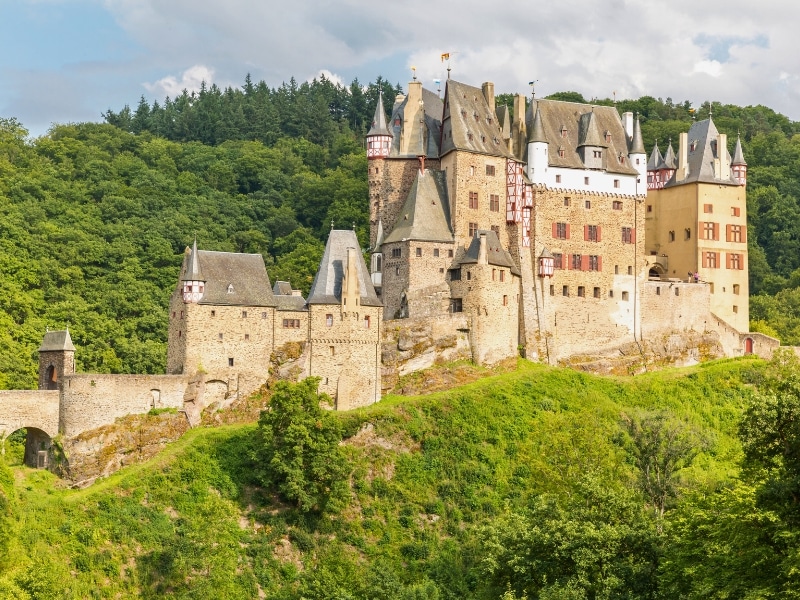
Stop by the pretty and very German town of Koblenz before heading to Burg Eltz Castle. If you’re looking for a quintessential fairytale castle, then Eltz is it! When you’re done swooning over Eltz, head to the small complex of Rheinstein Castle high on the banks of the Rhine (or Rhein in Germany) River.
Make for your last stop in Cochem on the gorgeous Moselle and the impressive Cochem Castle. Stay for the night and try some of the delicious wine produced in this region, or take a guided tour of a vineyard with a wine tasting.
This is a fully packed itinerary covering all the best bits of Germany and some truly magical castles. I’m sure you’ll agree, this makes a fantastic German road trip!
Where to Stay
Köln: Hotel Lyskirchen Köln is in the heart of the old town, just 100 metres from the Rhine promenade and around a 15-minute walk from Cologne Cathedral. Modern rooms, an indoor pool and an on-site parking garage make it a particularly convenient base for exploring the city before continuing your road trip.
Bad Wildbad: Mokni’s Palais Hotel & SPA is an adults-only wellness hotel in the heart of Bad Wildbad, with access to the historic Palais Thermal and neighbouring Vital Therme included with your stay. Thermal pools, saunas and spa facilities make this a great place to slow down for a night or two, and private garage parking is available by advance reservation.
Heidelberg: Ninetynine Hotel Heidelberg City combines colourful contemporary design with comfortable rooms and a relaxed, sociable atmosphere. Its location makes it a practical base for exploring Heidelberg and the historic old town before continuing along the Castle Road.
More German Travel Ideas

9. German Half-Timbered House Road
Route: Quedlinburg – Wernigerode – Stolberg – Mühlhausen – Eschwege – Hann. Münden
Distance: 300 km
Duration: 5 to 7 days
Best time to go: April to October, or December for Christmas markets
Best for: Half-timbered towns, medieval architecture, history and traditional Germany
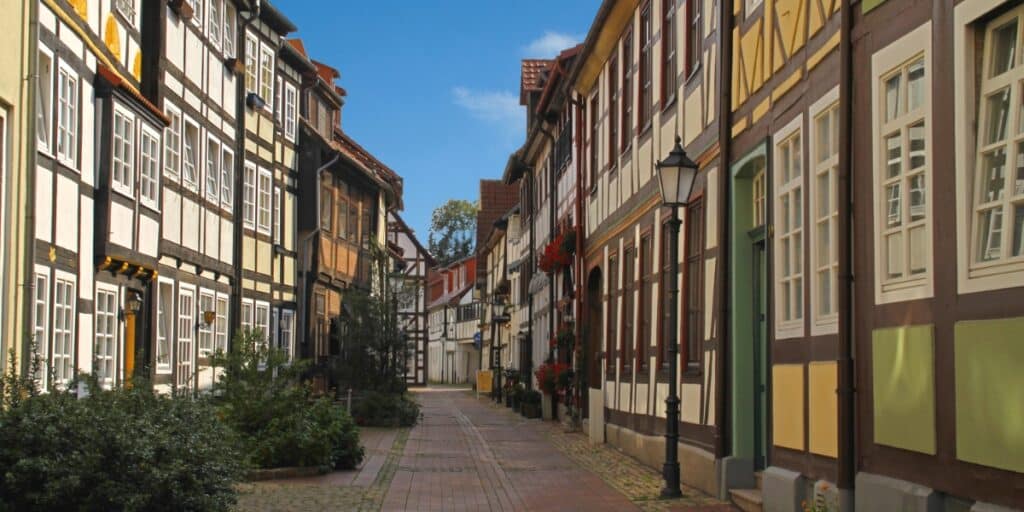
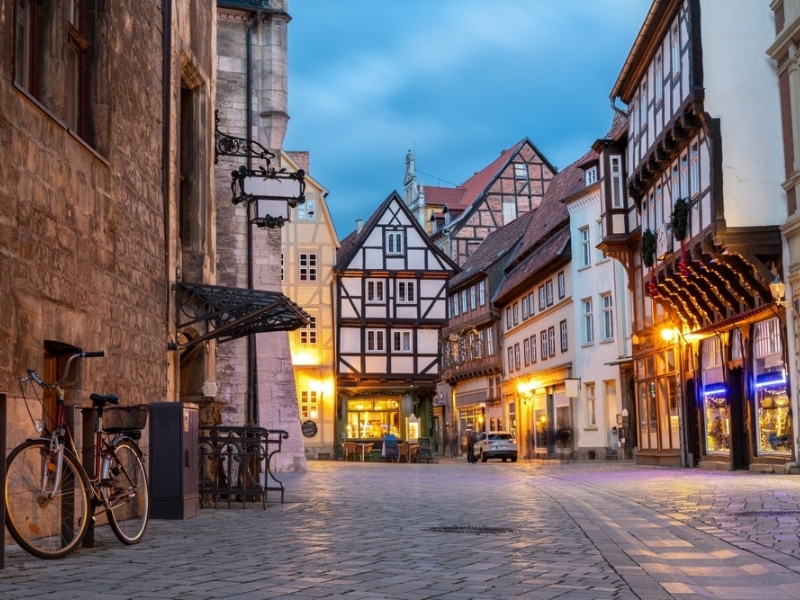
Germany has around 2.5 million half-timbered buildings, and the German Half-Timbered House Road was created to link some of the finest examples. The complete route is vast, connecting around 100 towns across more than 3,000 km, so trying to cover it all in one road trip would be quite an undertaking.
Instead, this itinerary picks out a manageable section through central Germany, starting in beautiful Quedlinburg and travelling through the Harz region before continuing towards Hann. Münden.
Quedlinburg is a fitting place to begin. Its old town is packed with centuries-old timber-framed buildings, narrow streets and cobbled squares, setting the tone for what follows.
From here, head towards Wernigerode on the edge of the Harz Mountains, where colourful half-timbered houses crowd around the market square beneath Wernigerode Castle.
Continue through the Harz to Stolberg before heading towards Mühlhausen and Eschwege. The architecture changes subtly as you travel, which is part of the appeal of the route. Half-timbering developed differently across Germany, and the complete road showcases around 1,000 years of building traditions.
Finish in Hann. Münden, where three rivers meet and hundreds of half-timbered buildings fill the historic centre.
This is Germany at its most traditional, with old market squares, medieval streets and timber-framed houses at almost every stop. It also takes you through an area of the country largely untouched by your other road trips.
Where to Stay
Quedlinburg: Romantik Hotel am Brühl would be our choice, close to Quedlinburg’s historic centre and very much in keeping with the character of this road trip.
Wernigerode: A-ROSA Gothisches Haus Wernigerode is right on the historic market square, surrounded by the colourful half-timbered architecture that makes Wernigerode such a highlight of the route. The town itself has a particularly wide accommodation choice.
Hann. Münden: Hotel Alter Packhof makes a fitting final stop, occupying a historic building close to the old town and the meeting point of the Werra and Fulda rivers.
10. Baltic Coastal Route
Route: Lübeck – Wismar – Rostock – Stralsund – Rügen
Duration: 5 days
Distance: 222 km
Best time to go: May to September for warmer weather, long days and the best beach conditions
Best for: Baltic beaches, seaside resorts, historic port towns and relaxed coastal driving
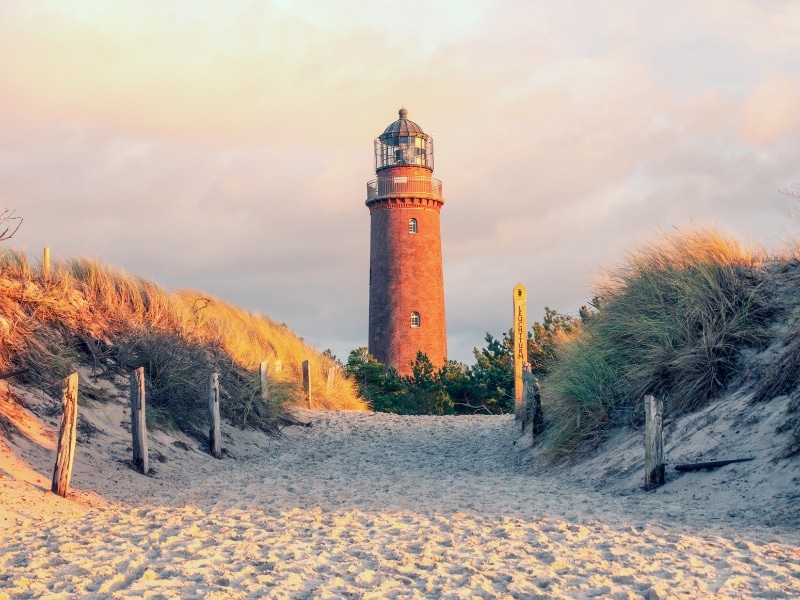
A road trip along Germany’s Baltic coast promises pristine white-sand beaches, charming Hanseatic towns, and stunning nature reserves, all rolled into one enchanting journey. This lesser-explored region is full of cute fishing villages, historic UNESCO sites, and chic seaside resorts.
Whether you’re a history buff eager to delve into coastal history or simply love kicking back on the beach with fresh seafood, the Baltic coast of Germany makes for an unforgettable adventure.
Start your trip in Lübeck, a medieval Hanseatic city famous for its UNESCO-listed Altstadt and Gothic brick architecture. Wander the winding lanes around the Holstentor, sample the city’s legendary marzipan at Café Niederegger, and soak up Lübeck’s café culture.
If you enjoy a dose of seaside charm, make time for neighbouring Travemünde – its sandy shoreline and resort vibe are perfect for a leisurely afternoon stroll.
Next, head east towards Wismar, another Hanseatic treasure. Centuries-old gabled houses ring its striking Marktplatz, and the Nikolaikirche showcases remarkable brickwork that testifies to the city’s maritime past. Here, you can spend a day exploring the bustling harbour or hopping on a boat tour around Wismar Bay.
Following the coastline, you’ll reach Rostock. Pause in Warnemünde, its coastal district, where a towering lighthouse overlooks a wide sandy beach that’s beloved by surfers and sunbathers alike. Spend your time meandering through the old fisherman’s quarter of Warnemünde, sampling fresh fish from local stands, or immersing yourself in Rostock’s lively student scene.
Further north, Stralsund dazzles with its panoramic view of the Rügen Bridge and colourful gabled houses. This UNESCO-listed city is brimming with culture. Visit the Ozeaneum for an immersive exploration of Baltic marine life, then stroll the medieval streets at sunset for picture-perfect snaps.
No Baltic road trip would be complete without crossing to Rügen, Germany’s largest island. Known for its rugged chalk cliffs and golden beaches, Rügen captivated us with its natural splendour. We spent a few days exploring Jasmund National Park and marvelling at the famous Königsstuhl rock formation, and cycling through the island’s beech forests.
If you have a few extra days visit the fascinating Hanseatic city of Hamburg, full of maritime history alongside some of Germany’s most iconic modern architecture.
Where to Stay
Lübeck: Fisher’s Loft Hotel is a characterful boutique hotel in the heart of Lübeck’s UNESCO-listed old town, with spacious loft-style rooms in a beautifully converted historic building. Its central location puts the main sights within easy walking distance, with several public parking options around a ten-minute walk away.
Rostock: Prize by Radisson, Rostock City sits on the waterfront within walking distance of Rostock’s historic centre, with colourful contemporary rooms and some balconies overlooking the city harbour. On-site parking and easy access back to the road make it a practical overnight stop on the Baltic Coastal Route.
Stralsund: Hotel Alter Hafenspeicher occupies a beautifully converted historic warehouse directly on Stralsund’s harbour, just moments from the UNESCO-listed old town, Ozeaneum and waterfront. Spacious rooms retain original timber details and many have harbour views, although the hotel has only five parking spaces, so it’s worth having a backup parking option in mind.
11. Towns of Thuringia
Route: Eisenach – Gotha – Erfurt – Weimar – Jena – Gera – Altenburg
Distance: 225 km
Duration: 5 to 7 days
Best time to go: April to October for sightseeing and exploring the historic centres
Best for: German history, culture, historic towns and architecture
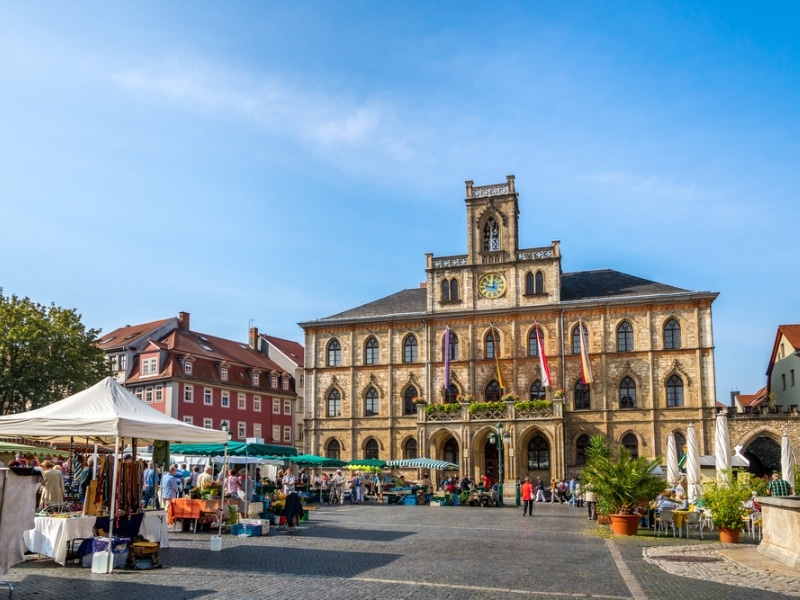
Running right across the heart of Thuringia, this route connects seven historic towns between Eisenach in the west and Altenburg in the east. The official Towns of Thuringia route covers around 225 km, making it perfect for a leisurely road trip with very little time spent behind the wheel.
Start in Eisenach, dominated by magnificent Wartburg Castle. This UNESCO-listed fortress is closely associated with Martin Luther and is one of Germany’s most important historic castles.
From Eisenach, continue to Gotha before reaching Erfurt, the Thuringian capital and one of the highlights of the route. Its beautifully preserved medieval centre is home to the Krämerbrücke, a 120-metre bridge lined with inhabited buildings and one of the city’s most distinctive sights.
Next comes Weimar, forever associated with Goethe and Schiller and one of Germany’s great cultural cities. Its relatively compact size makes it easy to explore on foot, and there is enough here to justify at least a full day.
Continue east to Jena, a university city with connections to Goethe, Schiller, science and optics, before travelling on through Gera to Altenburg.
Altenburg provides a suitably quirky ending to the route. The city is known as the birthplace of the card game Skat, invented here in 1813, alongside its impressive castle and historic centre.
What we particularly like about this road trip is how much history and culture it packs into a relatively short distance. You can spend most of your time exploring rather than driving, and it fills that big central-eastern gap in your Germany itinerary beautifully.
Where to Stay
Eisenach: Hotel am Markt is set in a historic building right on Eisenach’s market square, within easy walking distance of the old town sights and a short drive from Wartburg Castle. Private parking makes it a practical base for starting the road trip.
Erfurt: Hotel Krämerbrücke Erfurt is ideally positioned beside the famous Krämerbrücke in the historic centre, so you can park up and explore the old town on foot.
Weimar: Hotel Elephant Weimar is a historic hotel right on the market square, within easy walking distance of Weimar’s main cultural sights and a particularly good fit for the history and culture of this road trip.
12. Iconic German Cities
Route: Berlin – Hamburg – Hanover – Munster – Koln – Frankfurt – Munich
Duration: 2 to 3 weeks
Distance: 1366 km
Best time to go: April to October for sightseeing and outdoor attractions, or December for Christmas markets
Best for: History, architecture, museums, nightlife and Germany’s major cities
If you really can’t decide which road trip to take and you have a few weeks, then why not consider taking a driving tour of Germany, hopping between some of Germany’s most historic and beautiful cities, and taking in elements of all our road trips on the way?
This Germany road trip from Berlin will take you past or in close proximity to some of the most beautiful places in Germany including fairy tale castles and towns, famous landmarks, stunning rivers, and wine regions.
You’ll drive on fantastic roads and if you choose not to use the autobahns, you’ll enjoy a relaxed pace and be able to enjoy the ever-changing scenery and small historic towns of this surprisingly gorgeous country.
However, if you do choose the autobahns and take your own car, upgrading your BMW, Audi, or Mercedes with some premium performance parts can make the experience even more thrilling.
If you’re road-tripping Germany in winter, you’ll love the clear crips days, frosty landscapes and, of course, the traditional Christmas markets that the country is famous for. Fairy lights, gluhwein, traditional artisan gifts, and hearty, warming local food will make your winter road in Germany really memorable.
Don’t forget Germany’s recent history, either. This route will take you close to both Dachau and Bergen Belsen concentration camps, which make for harrowing visits that nevertheless should be taken, lest we forget the past, which must never be repeated.
You’ll also find the opportunity to tour the top car museums of BMW in Munich and Porche and Mercedes in Stuttgart. Why not test yourself and take a drive around the famous Nurburgring on your way past?
Where to Stay: Our Top German Hotels
These are luxurious, treat-yourself hotels known for their sumptuous decor, opulent furnishings, and outstanding service.
Berlin: Hotel Zoo Berlin is a stylish boutique hotel directly on Kurfürstendamm in Berlin’s City West, surrounded by shops, restaurants and galleries and just 500 metres from Zoologischer Garten station. Elegant contemporary rooms, a rooftop terrace and private parking behind the hotel make it a luxurious but practical base for exploring the capital.
Köln: Excelsior Hotel Ernst am Dom is a landmark five-star hotel directly opposite Cologne Cathedral and just a couple of minutes’ walk from the main station. Family-run since 1863, it combines grand-hotel tradition with elegant rooms, excellent dining and parking, while the old town and Rhine waterfront are easily explored on foot.
Frankfurt: Sofitel Frankfurt Opera for its sumptuous contemporary interiors, luxurious spa and indoor pool, and outstanding location beside the Alte Oper. With elegant rooms, refined dining and polished five-star service, it delivers the full treat-yourself experience while putting Frankfurt’s historic centre within easy walking distance.
Munich: Vier Jahreszeiten Kempinski München is a historic five-star hotel on fashionable Maximilianstraße, within easy walking distance of Marienplatz, the Hofbräuhaus and Bavarian State Opera. Its elegant rooms, indoor pool and spa, excellent restaurants and on-site parking make it a superb final stop on a road trip through Germany.
Planning Your German Road Trip
Getting to Germany
Germany’s central location and excellent road network make it easy to reach from the UK and elsewhere in Europe, and it’s also a great starting point for a longer European road trip.
If you’re driving to Germany from the UK, you’ll first need to cross the Channel by ferry or Eurotunnel before continuing through France, Belgium or the Netherlands. Once you reach Germany, the extensive autobahn network makes it straightforward to get to the starting point of your chosen route.
Flying to Germany
Germany is well connected by air, with Frankfurt, Munich and Hamburg particularly useful starting points for the road trips in this guide. We recommend Skyscanner for comparing routes, airlines and fares.
Hiring a Car in Germany
Flying in and hiring a car is an easy option if you don’t want to make the long drive from the UK. Germany’s major airports have a wide choice of rental companies, and picking up a car at the airport means you can usually be on the road quickly.
We recommend Rentalcars.com for comparing rental options and prices from different providers in one place.
Hiring a Motorhome or Campervan
Germany is also a fantastic country to explore by motorhome or campervan, with an extensive network of campsites and Stellplätze, dedicated overnight parking areas for motorhomes found across the country.
We recommend Motorhome Republic, which compares campervan and motorhome rentals from multiple suppliers.
If you’re travelling in your own motorhome or campervan, Park4Night is useful for finding campsites, Stellplätze and other suitable overnight stops along your route.
Best Time to Visit Germany
Germany is a year-round road trip destination, but the best time to visit depends on the type of trip you’re planning.
The main road trip season runs from May to October, when days are longer, attractions are open and conditions are generally good for sightseeing, hiking and scenic driving. July and August are usually the warmest and busiest months, particularly around popular destinations and during the school holidays.
Spring and autumn are excellent times for a German road trip if you prefer quieter roads and fewer visitors. May and June bring long days and green landscapes, while September and October are particularly good for the wine regions and autumn colour.
Winter brings colder temperatures, shorter days and the possibility of snow and ice, particularly in Bavaria and other higher areas. But Germany is also one of our favourite European winter destinations, with fantastic Christmas markets, winter sports and snow-covered landscapes making December especially atmospheric.
Tips for Driving in Germany
Germany’s roads are generally well maintained, its autobahns are toll-free for cars and there is an excellent network of regional roads, making the country ideal for a road trip.
Although Germany is famous for unrestricted autobahns, not every section is without a speed limit. Permanent or temporary limits apply on many stretches, particularly around junctions, roadworks and urban areas. Where no mandatory limit is shown, the recommended maximum speed is 130 km/h (81 mph).
RELATED POST: Driving in Europe – Everything You Need to Know
More Road Trips to Explore
Best UK Road Trips: 18 Scenic Routes to Explore

Portugal Road Trip: The Ultimate 10 Day Itinerary
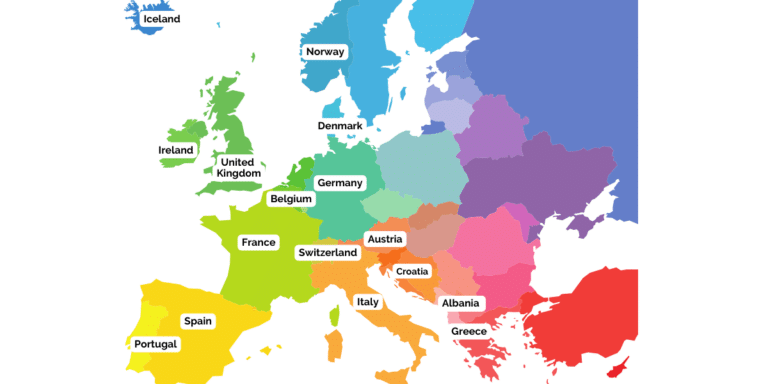
Europe Road Trip: 28 Epic Routes You Can Actually Drive

European Road Trip: Six Countries in 90 Days
France Road Trip: 13 Amazing Itineraries
Driving in the Alps: Top Tips & Best Routes
Love it? Pin it!