Italy is made for a motorhome road trip. In the space of a few weeks you can drive from the Alps to the Italian Riviera, cross the rolling hills of Tuscany and Umbria, explore some of Europe’s greatest cities and finish among the mountains of northern Italy.
We’ve travelled extensively through Italy by motorhome and overland vehicle, and this itinerary brings together many of our favourite places in one three to four week route.
The journey starts at the Mont Blanc Tunnel, crossing from France into Italy’s Aosta Valley before heading to Turin and Milan. From there, you’ll travel south via Parma to the colourful villages of the Cinque Terre before reaching Pisa and the landscapes of Tuscany.
You’ll visit San Gimignano, Siena and Montepulciano, drive through the Val d’Orcia and continue south to Rome, the furthest point on the route.
The journey north takes you through Umbria to Spoleto and Assisi before returning to Tuscany for Florence. Bologna, Padua and Venice come next, followed by Verona and Lake Garda before a final drive into the Italian Alps and across the spectacular Stelvio Pass.
The complete route covers around 2,067km with approximately 35 hours of driving. We’ve designed it for three to four weeks, with several two-night stops so you’ve got time to explore rather than simply moving on every day.
Italy Motorhome Itinerary Key Facts
Route: The Gap Decaders’ Italy motorhome itinerary is a three to four week route through Piedmont, the Italian Riviera, Tuscany, Lazio, Umbria, Emilia-Romagna, Veneto, Lake Garda and the Italian Alps. Distance: The complete motorhome route covers around 2,067km, with approximately 35 hours of driving. Best time: Late spring and early autumn are ideal for most of this route, avoiding the hottest and busiest summer period. However, the Stelvio Pass is seasonal and usually only accessible during the warmer months, so its opening needs to be checked before travelling. First-hand experience: The Gap Decaders have travelled extensively through Italy by motorhome and overland vehicle, and this itinerary is based on a route we’ve driven ourselves.
Enjoy The Gap Decaders? Add us as a preferred source on Google.
Italy Motorhome Route at a Glance
Distance: 2,067km Driving time: Around 35 hours Duration: 3–4 weeks Best for: A longer Italy motorhome road trip combining historic cities, Tuscany and Umbria, the Italian Riviera, Venice, the Italian Lakes and the Alps.
Route: Mont Blanc Tunnel → Aosta Valley → Turin → Milan → Parma → La Spezia and Cinque Terre → Pisa → Volterra → San Gimignano → Monteriggioni → Siena → Val d’Orcia → Montepulciano → Rome → Spoleto → Assisi → Florence → Bologna → Padua → Venice → Verona → Lake Garda → Bormio → Stelvio Pass
The route starts as you cross into Italy through the Mont Blanc Tunnel, with Turin and Milan providing your first city stops before you head south to the Cinque Terre.
From there, you’ll travel through Tuscany to Pisa, San Gimignano, Siena and Montepulciano before continuing to Rome. The return north takes you through Spoleto and Assisi to Florence, Bologna and Venice.
Verona and Lake Garda lead you back towards the mountains, with the final section taking you through Bormio and over the Stelvio Pass, where the itinerary ends and you can continue into Austria, Switzerland or towards the Dolomites. Italy Motorhome Itinerary 2025
Italy Motorhome Route Map
Our interactive map shows the complete Italy motorhome itinerary, including the suggested route, places to visit and our recommended campsites and sostas.
You don’t need to follow the route exactly as we’ve driven it. Use the map to shorten the journey, skip somewhere that doesn’t appeal or add your own detours along the way.
All our recommended overnight stops and parking places are included, and we’ll also link to Park4Night throughout the itinerary so you can check recent reviews and current information before you arrive.
How Long Do You Need for This Italy Motorhome Itinerary?
We’ve designed this route to take between three and four weeks.
Three weeks gives you enough time to complete the route, but it’s a fairly full itinerary. You’ll have several two-night stops in places such as the Cinque Terre, Rome, Florence, Bologna and Venice, but you’ll still be moving regularly.
Four weeks gives you much more breathing space. You can spend longer in Tuscany, add another night in Rome or Florence, slow down around Lake Garda and have more flexibility when somewhere inevitably makes you want to stay.
If you only have two weeks, I’d choose one half instead. Tuscany, Umbria and Rome make a superb central Italy road trip, while Turin, Milan, Venice, Verona, Lake Garda and the Alps work well as a northern Italy route.
Your first day in Italy starts with quite an entrance as you cross beneath Mont Blanc from Chamonix in France to Courmayeur in Italy’s Aosta Valley.
From Courmayeur, the route follows the A5 east through the mountains towards Aosta before gradually leaving the Alps behind as you make your way south to Turin.
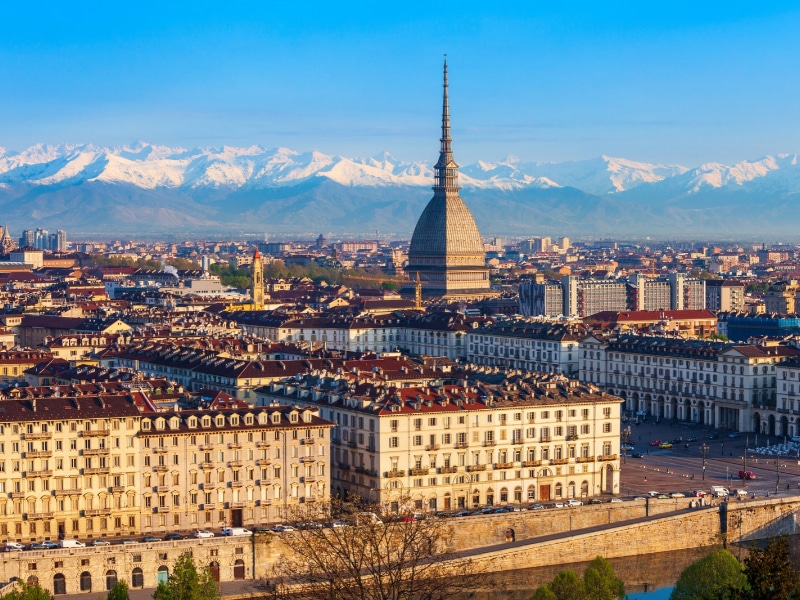
Turin is the capital of Piedmont and one of Italy’s most underrated cities. Grand boulevards, elegant arcaded streets and huge piazzas give the centre a very different feel from many of the historic Italian cities you’ll visit later in this road trip.
Start around Piazza Castello, where you’ll find the Palazzo Reale and Palazzo Madama, before wandering through the surrounding streets and cafés. The Mole Antonelliana, home to the National Cinema Museum, dominates the skyline, while the Egyptian Museum has one of the world’s most important collections of Egyptian antiquities.
The city’s cathedral, the Duomo di Torino, is home to the famous Turin Shroud. The shroud itself isn’t permanently on public display, although you can visit the chapel where it is kept.
Turin is also the birthplace of the aperitivo, so this is a particularly good place to adopt the Italian habit of having a pre-dinner drink accompanied by something to eat.
Where to Stay in Turin
Stay at the Area Camper Caio Mario at 12 Via Felice Rignon, a large, secure motorhome area in the south of Turin with water, waste disposal, toilets, showers and optional electricity.
Insider Tip: Catch tram 4 from Caio Mario straight into central Turin. You can currently pay on board by contactless bank card, so there’s no need to work out the ticket machines before your first Italian coffee!
Don’t try taking the motorhome into central Turin. As well as busy city traffic, Turin has a ZTL, or Zona a Traffico Limitato, controlling vehicle access to parts of the centre. The restrictions and permit arrangements can change, so parking outside the centre and using public transport is the much easier option.
Day 2: Turin to Milan
Distance: 159km Driving Time: 2 hours 15 minutes
Leave Turin and head east towards Milan, with a relatively easy drive across the plains of northern Italy.
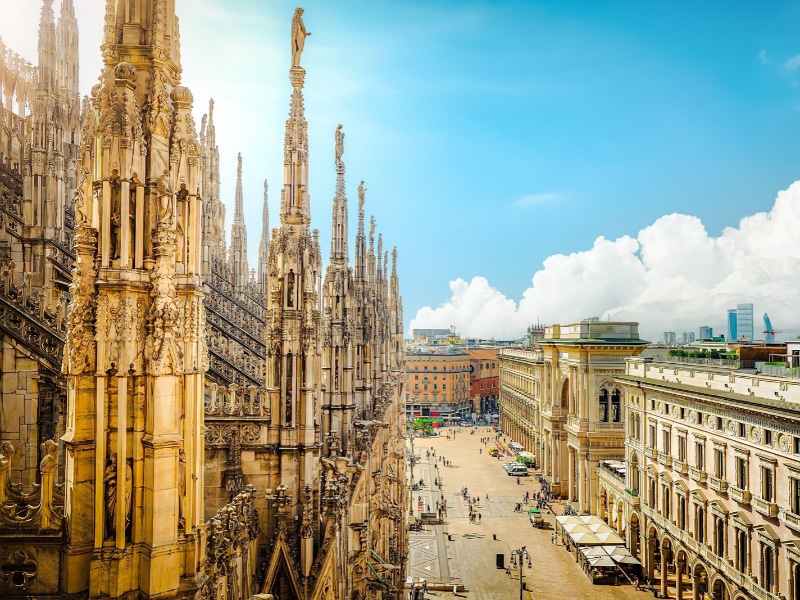
Milan is Italy’s financial and fashion capital, but there’s much more here than designer shopping. At the heart of the city is the enormous Gothic Duomo di Milano, which took almost six centuries to complete. It’s worth booking a ticket that includes the rooftop terraces, where you can walk among the cathedral’s spires and get some fantastic views across the city.
Next door is the beautiful Galleria Vittorio Emanuele II, one of the world’s oldest shopping galleries, with its glass-domed roof, mosaic floors and rather expensive collection of shops and cafés.
From here, it’s an easy walk through the historic centre to Castello Sforzesco. If you have time, continue through Parco Sempione to the Arco della Pace.
Milan is also home to Leonardo da Vinci’s The Last Supper, housed in the convent of Santa Maria delle Grazie. Tickets are limited and can sell out well in advance, so this is one attraction you really do need to plan ahead for.
Where to Stay in Milan
Stay at New Park Milano, a secure motorhome area at 6 Via Luigi Tüköry in the north of Milan. It has electric hook-up, fresh water, waste disposal, toilets and showers, with public transport into the city centre nearby.
This is very much a practical city stop rather than a campsite, but it means you can leave the motorhome securely parked while you explore Milan.
Recent visitors report paying around €30 for 24 hours, although prices vary according to vehicle size, and payment is currently cash only. Check the latest information before arriving.
Leave Milan and head south towards the Ligurian coast, crossing the Apennines before dropping down to La Spezia, your base for the next two nights.
The most direct route follows the A1 towards Parma before joining the A15 for La Spezia. Much of today is motorway driving, but the scenery becomes increasingly dramatic as you cross the mountains towards the coast.
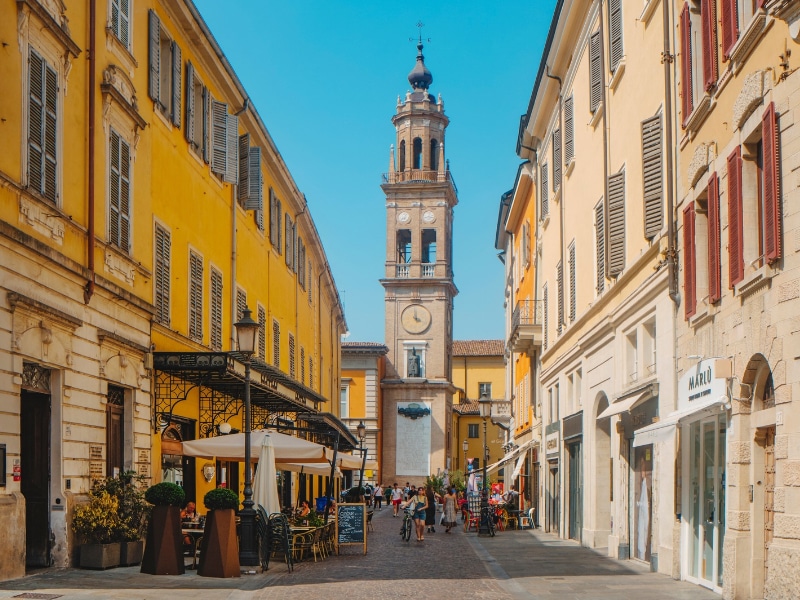
Parma makes an excellent stop along the way, particularly if you’re interested in food. The city and surrounding countryside are famous for two of Italy’s best-known products, Parmigiano Reggiano and Prosciutto di Parma. You can take a tour to see these quintessential Italian products being made. If you want to visit a Parmesan dairy, book ahead and aim for a morning tour as this is when much of the production takes place.
Continue across the Apennines to La Spezia. Once you’re parked, you can leave the motorhome here until Day 5. Trying to explore the Cinque Terre by motorhome is more trouble than it’s worth, and the train makes getting between the villages incredibly easy.
Where to Stay in La Spezia
Spend two nights at Area Sosta Camper ATCMP, a secure municipal motorhome area with fresh water, waste disposal, toilets and showers, with electricity available at extra cost. It’s in the port area rather than somewhere scenic, but it’s a practical base for visiting the Cinque Terre.
The maximum stay at the sosta is currently 36 hours, which gives you just enough time for an overnight followed by a full day exploring the Cinque Terre before continuing south the following morning.
From the sosta, walk to the nearby bus stop and take the local bus to La Spezia Centrale railway station. From here, the Cinque Terre Express runs along the coast, stopping at Riomaggiore, Manarola, Corniglia, Vernazza and Monterosso. This is the quickest and easiest way to travel between the five villages.
Alternatively, take the bus towards the waterfront and catch a seasonal ferry from La Spezia to the Cinque Terre. The journey takes longer, but seeing the villages from the water is fantastic. A good option is to travel out by ferry, spend the day exploring the villages using the train, then take the train back to La Spezia.
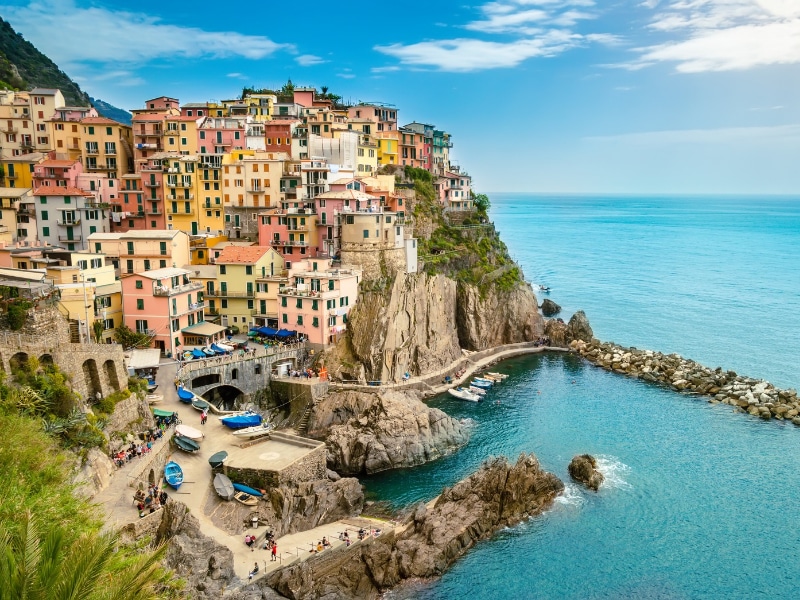
The Cinque Terre is a string of five historic villages squeezed between the mountains and the Ligurian Sea. Brightly coloured houses tumble down steep hillsides towards tiny harbours, while vineyards and terraces climb the slopes above.
You can comfortably visit all five villages in a day using the train, but don’t feel you need to rush around ticking them off. Part of the pleasure here is wandering the narrow streets, stopping for lunch and enjoying the views.
Riomaggiore is the first village from La Spezia, followed by Manarola, Corniglia, Vernazza and Monterosso al Mare. Corniglia is the only village without direct access to the sea and sits high above the coast, while Monterosso has the largest beach and is a good place to stop for a swim if the weather is warm.
Walking in the Cinque Terre
The villages are connected by a network of walking trails, although sections can close because of landslides, maintenance or bad weather, so check the current trail status before setting off.
The famous Sentiero Azzurro, or Blue Trail, follows the coastline between the villages, although you don’t need to walk the entire route. Combining one section on foot with the train is a great way to experience the landscape without turning your day into a serious hike.
The Via dell’Amore between Riomaggiore and Manarola has also reopened after a long restoration, but access is controlled and booking requirements apply, so check the arrangements before you visit.
See the Cinque Terre from the Water
If the weather is good, consider seeing part of the Cinque Terre from the sea.
Seasonal ferries run along the coast from La Spezia and between several of the villages. Looking back towards the cliffs from the water gives you a completely different perspective, and it also makes a nice change from trains and walking.
Kayaking is another option, particularly around Monterosso, and gives you a chance to escape some of the crowds on land.
Insider Tip: Don’t leave without trying pesto while you’re here. It originated in Liguria, and you’ll find it everywhere, usually served with pasta and plenty of local olive oil and Parmesan.
Day 5: La Spezia to Pisa
Distance: 78km Driving Time: 1 hour 30 minutes
After the bustle of the Cinque Terre, today is an easy drive south into Tuscany and the small city of Pisa.
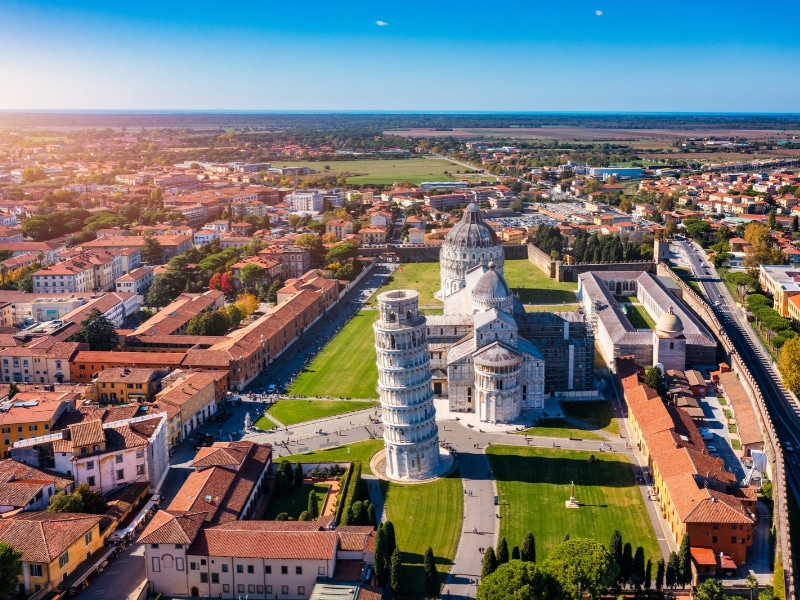
Pisa is inevitably all about the Leaning Tower, but the tower is only one part of the extraordinary group of buildings in Piazza dei Miracoli. Here you’ll also find Pisa Cathedral, the Baptistery and the Camposanto, all clustered together within the old city walls.
You can visit the cathedral and wander around the piazza without climbing the tower, but if you do want to go up, book a timed ticket in advance. The 294-step climb is slightly disorientating thanks to the lean, but the views from the top are worth it.
Away from Piazza dei Miracoli, Pisa becomes noticeably quieter. Take a wander along the River Arno, explore the streets around Borgo Stretto or stop for an aperitivo before heading back to the motorhome.
You don’t need a full day here, which is why it works particularly well after the Cinque Terre. An early departure from La Spezia gives you most of the afternoon and evening to explore Pisa.
Insider Tip: We recommend Ristorante Trattoria da Mario for lunch or dinner. Just a five-minute walk from the Leaning Tower, it’s a traditional family-run trattoria and a good place to escape the more touristy restaurants immediately around Piazza dei Miracoli.
Where to Stay in Pisa
Stay at the motorhome area on Via di Pratale, a straightforward city sosta around 2.5km from the centre. It’s about a 30-minute walk to the Leaning Tower, or around 10–15 minutes by bike, and there’s also a bus stop close to the entrance.
The site has fresh water and waste disposal, with a limited number of electric hook-ups. It’s open year-round and works particularly well for a one-night stop when your main priority is exploring Pisa.
One thing to be aware of if you have a tall motorhome is the 3.2m height restriction shown for the approach, so check your vehicle height and the latest access information before setting off.
Today you leave Pisa and head inland, where the scenery starts to become unmistakably Tuscan. Expect rolling hills, vineyards, olive groves and hilltop towns as you make your way towards Volterra and San Gimignano.
Your first stop is Volterra, an ancient walled town sitting high above the surrounding countryside. Park here below the historic centre and make the uphill walk into town, where you’ll find narrow medieval streets, impressive city walls and Piazza dei Priori at its heart.
Volterra has a history stretching back to Etruscan times, and you can still see remains of the Etruscan walls and gateways alongside Roman and medieval buildings. The Roman Theatre, just outside the medieval walls, is also worth seeing before you continue south-east towards San Gimignano.
San Gimignano
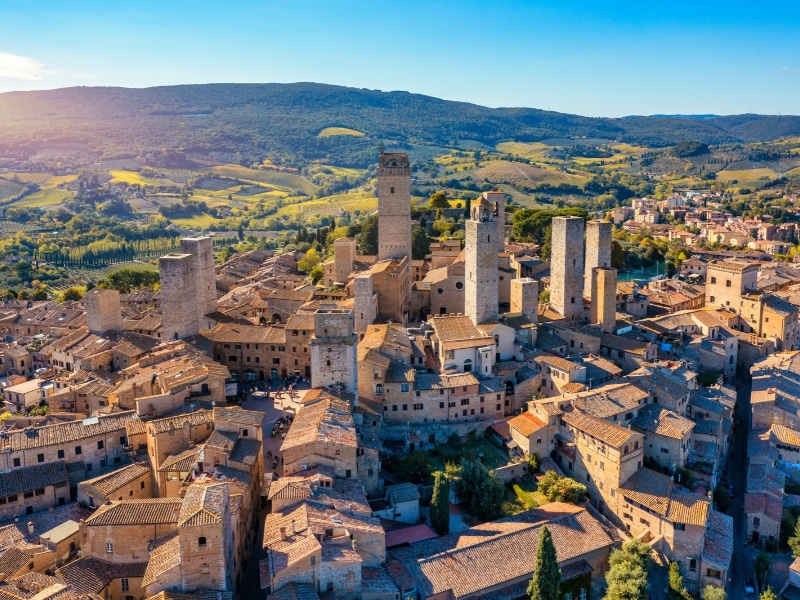
You’ll spot San Gimignano well before you arrive, with its medieval towers rising above the surrounding countryside. Once an important stopping point on the pilgrimage route to Rome, the town became wealthy enough for its most powerful families to build competing tower houses as symbols of their status.
Fourteen of the original towers survive today, giving San Gimignano one of the most distinctive skylines in Tuscany.
Once inside the walls, spend the afternoon wandering the cobbled streets and piazzas around Piazza della Cisterna and Piazza del Duomo. You can climb Torre Grossa for superb views across the Tuscan countryside and visit the Collegiata di Santa Maria Assunta, whose interior is covered with remarkable medieval frescoes.
San Gimignano is very popular during the day, but staying nearby means you can enjoy the town later in the afternoon and evening, once many of the day visitors have left.
Where to Stay in San Gimignano
Stay at Camping Boschetto di Piemma in Santa Lucia, around 2km from San Gimignano. The campsite has shaded pitches, electric hook-up, toilets and showers, a restaurant and pizzeria.
There’s a bus stop right outside the campsite, with regular services into San Gimignano, so there’s no need to move the motorhome. You can also walk into town if you fancy it.
Days 7–8: San Gimignano to Siena via Monteriggioni
Distance: 38km Driving Time: 50 minutes
It’s only a short drive from San Gimignano to Siena, so take your time and stop at Monteriggioni on the way.
This tiny medieval village is completely enclosed by its remarkably intact 13th-century walls and makes an easy stop between the two cities. Park at the dedicated motorhome area below Monteriggioni, from where it’s around a 10–15 minute walk uphill to the village.
You don’t need more than a couple of hours here. Wander through the gateways and around the little streets and piazza, and walk along a section of the walls for views across the surrounding Tuscan countryside.
From Monteriggioni, continue south to Siena and get settled at the campsite. With two nights here, there’s no need to rush straight into sightseeing mode. Head into the centre later in the afternoon, have your first wander around the streets and enjoy Piazza del Campo as the day visitors begin to disappear.
Exploring Siena
Give yourself a full day for Siena. Its UNESCO-listed historic centre is compact enough to explore on foot, but there’s far more here than you can comfortably squeeze into a couple of hours.
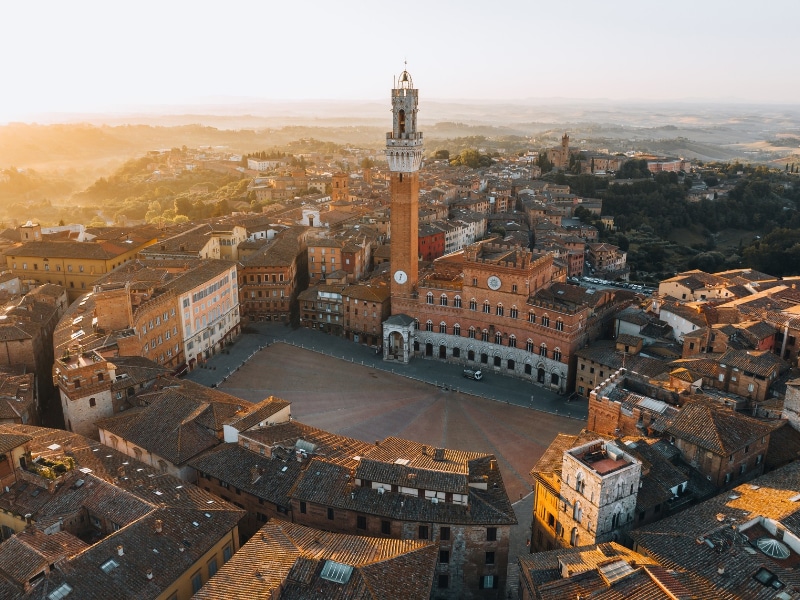
Start at Piazza del Campo, the enormous shell-shaped medieval square at the heart of the city. It’s surrounded by cafés and historic buildings and dominated by the Palazzo Pubblico and Torre del Mangia.
The square is also the setting for the Palio di Siena, the famous bareback horse race held twice each summer. The riders represent Siena’s historic contrade, or neighbourhoods, and you’ll spot their flags, colours and symbols as you explore the city.
From Piazza del Campo, make your way through the medieval streets to Siena Cathedral. Its striped marble exterior is impressive, but make sure you go inside too. The cathedral is particularly famous for its extraordinary marble floor, made up of dozens of intricate panels created over several centuries.
If you’ve got the legs for another climb, head up the Torre del Mangia for panoramic views across Siena’s terracotta rooftops and the Tuscan countryside beyond.
Leave some time simply to wander. Siena is one of those cities where the smaller streets, steep passageways and neighbourhood squares are as much a part of the experience as the headline sights.
Insider Tip: Stop for lunch at one of the restaurants in the streets around Piazza del Campo and try ribollita, the traditional Tuscan soup made with bread, beans and vegetables.
Where to Stay in Siena
Stay at Camping Siena Colleverde, around 2.5km from Siena’s historic centre. It’s a large campsite with motorhome pitches, electric hook-up, water and waste facilities, toilets and showers, a swimming pool, restaurant and small shop.
The big advantage here is the public transport. Buses run from close to the campsite into Siena, so you can leave the motorhome pitched up for both nights and explore the city on foot.
Some of the campsite is terraced and pitches can be sloping, so levelling ramps are useful. Access to some areas can also be tight for larger motorhomes.
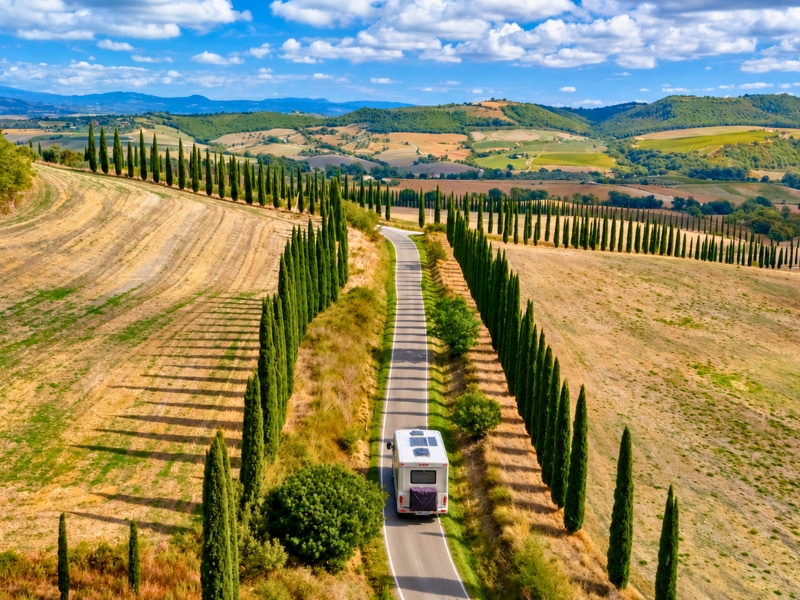
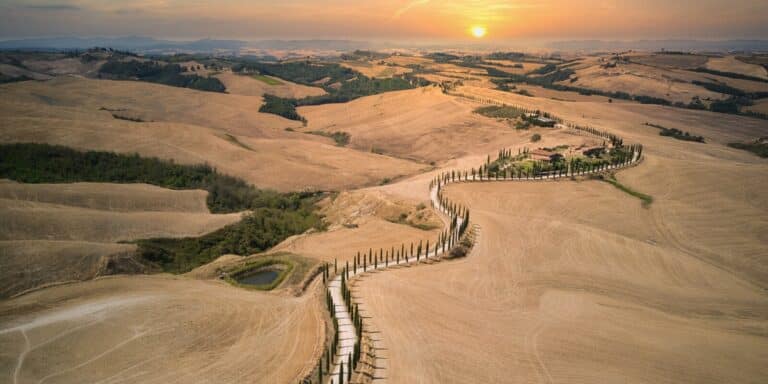
Today is as much about the journey as the destination. Leaving Siena, you’ll head south into the Val d’Orcia, where some of Tuscany’s most recognisable landscapes stretch across rolling hills, vineyards, olive groves and long lines of cypress trees.
Take the smaller roads rather than rushing towards Montepulciano, and make a stop in San Quirico d’Orcia. This small walled town sits right in the heart of the valley and makes a lovely place for a wander and a coffee before continuing south.
From San Quirico, pick up the SP146 towards Montepulciano, one of our favourite drives in this part of Tuscany. Take your time and make use of the viewpoints and safe stopping places along the way.
Insider Tip: If you’ve seen Gladiator, you might recognise parts of the Val d’Orcia. Just before San Quirico d’Orcia is the gateway used for Maximus’s family home, while the Elysian Fields scenes were filmed near Pienza, along the dirt track from Pieve di Corsignano. We’ve marked both locations on our interactive map.
If you’ve got plenty of time, detour into Pienza before continuing to Montepulciano. Its compact historic centre overlooks the Val d’Orcia and it’s also a great place to try pecorino, the sheep’s milk cheese for which the town is famous.
Montepulciano
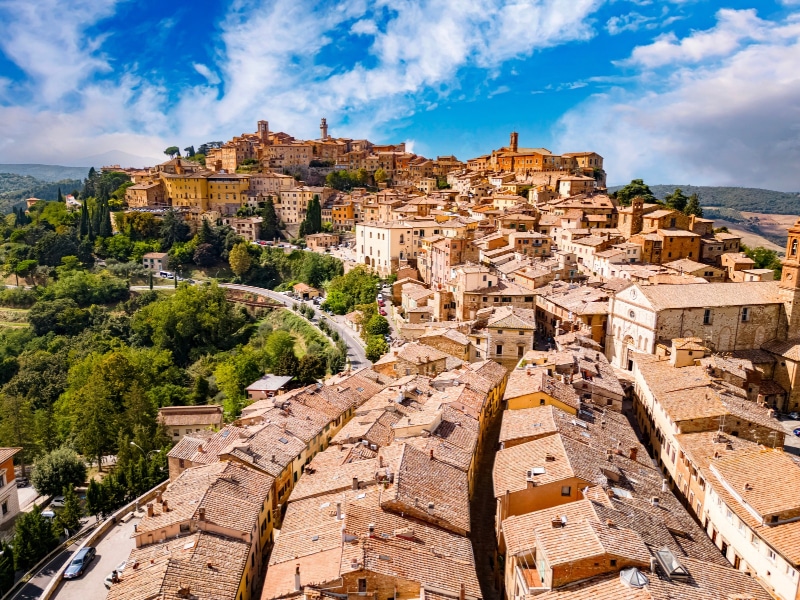
Montepulciano occupies a spectacular position high above the surrounding countryside, and you’ll need to be prepared for some uphill walking once you arrive.
The main street climbs through the historic centre towards Piazza Grande, passing wine shops, enotecas, small restaurants and Renaissance palazzi along the way. At the top, Piazza Grande is surrounded by some of Montepulciano’s most important buildings, including the Palazzo Comunale and Duomo.
The town is particularly famous for Vino Nobile di Montepulciano, and several of its historic wine cellars are tucked beneath buildings in the centre. With the motorhome parked up for the night, this is a particularly good place to stop for a tasting.
Montepulciano is also somewhere we’d eat out. Look for local dishes such as pici pasta with wild boar ragù, pecorino served with honey and, naturally, a glass of Vino Nobile.
Where to Stay in Montepulciano
Stay at Area Sosta Camper Comunale P5 on Piazza Pietro Nenni, a large dedicated motorhome parking area just below Montepulciano’s historic centre.
It’s essentially a town car park rather than a campsite, but its location makes it ideal for an overnight stop. The old town is only a short walk away, with steps and lifts helping with the climb up the hill.
There is fresh water and waste disposal but no electric hook-up. Be aware that the area is closed on Thursdays from 7am to 3pm for the weekly market, so you’ll need to plan around this if your visit falls on a Thursday.
Today you’re heading south to Rome, the furthest point on this Italy motorhome itinerary.
It’s a straightforward drive from Montepulciano, and with two nights in Rome there’s no need to try to squeeze sightseeing into your arrival day. Get settled at the campsite, then head into the city for your first taste of the Italian capital.
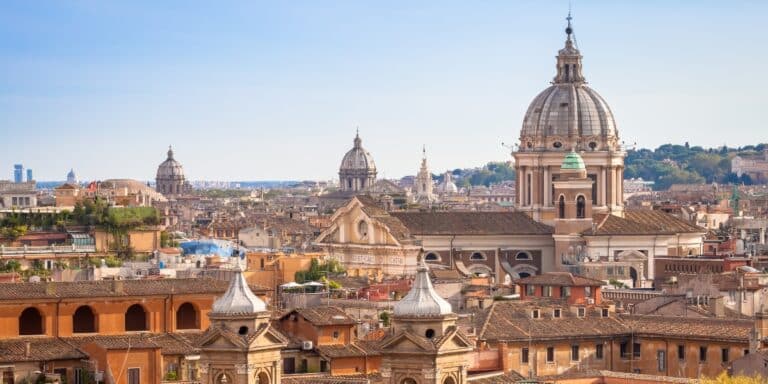
Rome can feel overwhelming at first. There is an extraordinary amount to see, with ancient ruins, Renaissance palaces, enormous churches and lively neighbourhoods all competing for your attention.
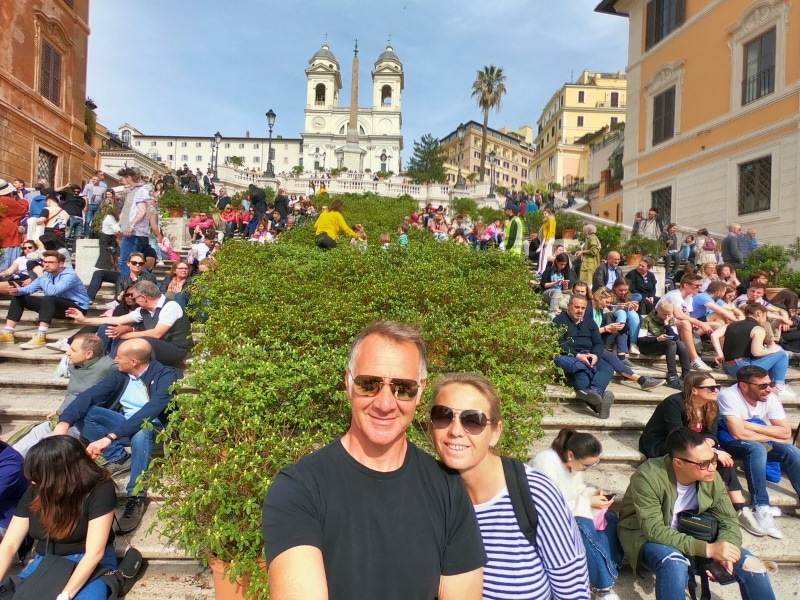
Spend your first afternoon and evening exploring some of the sights that don’t require advance tickets. The Spanish Steps, Trevi Fountain, Piazza Navona and Pantheon can easily be combined on foot, and this is also a great part of Rome simply to wander and stop for dinner.
Exploring Ancient Rome
Use your second day for Rome’s big ancient sites.
Start at the Colosseum, then continue into the Roman Forum and Palatine Hill, where temples, arches and the remains of imperial palaces reveal the scale of ancient Rome.
These are some of the busiest attractions in Italy, so book your tickets in advance rather than relying on getting them when you arrive.
From here you can continue towards Piazza Venezia and the enormous Vittoriano monument before crossing into the historic centre.
Insider Tip: If you want to visit the Vatican Museums, Sistine Chapel and St Peter’s Basilica, seriously consider adding a third night in Rome. Trying to combine the Vatican with the Colosseum, Roman Forum and the historic centre in one full day turns Rome into a race. With three nights, you can give Ancient Rome one day and Vatican City another, with time left for the streets, piazzas and food that make the city so enjoyable.
Stay at Flaminio Village, north of central Rome. It makes a practical base for visiting the capital because you can leave the motorhome safely on site and use public transport rather than attempting to drive into the city.
The campsite has motorhome pitches with electric hook-up, toilets and showers, a swimming pool, restaurant and other facilities, making it a good place to stop for a couple of nights after several days on the road.
Public transport into central Rome is accessible from close to the campsite, so once you’re pitched up there’s no need to move the motorhome until you’re ready to continue north.
Optional 1 Week Detour: Pompeii, Vesuvius and the Amalfi Coast
If you’ve got another week to spare, Rome is the perfect point to extend this itinerary south into Campania.
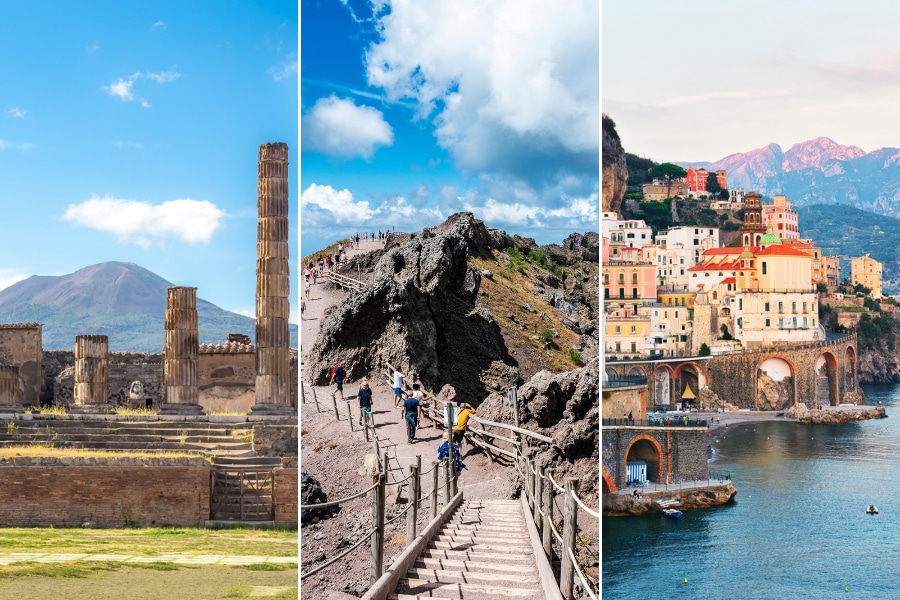
From Rome, continue towards Naples and spend a day exploring Pompeii, the extraordinary Roman city buried by the eruption of Mount Vesuvius in AD 79. You can also visit Vesuvius itself, walking to the crater rim for views across the Bay of Naples.
From here, continue towards the Amalfi Coast for a few days. This spectacular stretch of coastline is home to places such as Positano, Amalfi and Ravello, with steep mountains dropping straight into the Mediterranean.
The Amalfi Coast isn’t somewhere you can explore by motorhome itself. The famous SS163 coast road is narrow, busy and challenging for larger vehicles, with restrictions applying to motorhomes on parts of the route at certain times. A better option is to find a campsite (we recommend Village Camping Campogaio Santafortunata) or sosta outside the busiest coastal areas and explore by public transport, ferry or scooter.
Allow around a week for the detour, giving you time for Pompeii and Vesuvius followed by a few days around the Amalfi Coast before heading north again to pick up the main itinerary.
Once you’ve finished exploring the Amalfi Coast, retrace your route north towards Rome and pick up our main itinerary again with Day 12, heading into Umbria and Spoleto.
Today you leave Rome and turn north into Umbria, swapping the crowds and traffic of the capital for a much slower day in Spoleto.
Surrounded by wooded hills, Spoleto is often passed over in favour of better-known Umbrian destinations such as Assisi, but that’s part of its appeal. It feels like a living Italian town rather than somewhere that exists primarily for visitors.
Once you’re parked up, head into the historic centre and take your time. Stop for coffee in one of the squares, wander the narrow streets and visit the impressive Duomo di Spoleto, which sits at the bottom of a broad flight of steps in Piazza del Duomo.
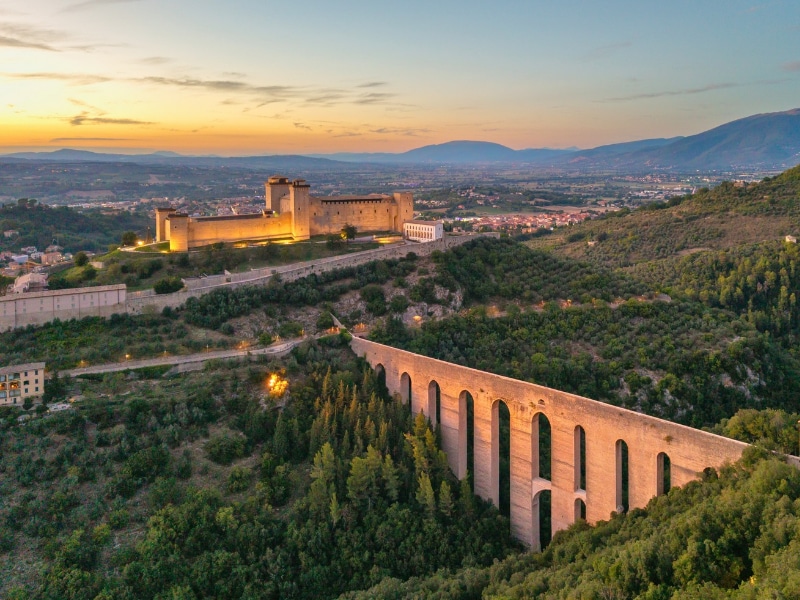
One of the best things about exploring Spoleto is that you don’t have to walk all the way up its steep hills. A network of underground moving walkways and escalators helps you climb through the town towards Rocca Albornoziana, the enormous 14th-century fortress that dominates the skyline.
From the fortress, continue towards Ponte delle Torri, Spoleto’s spectacular stone bridge spanning the deep gorge below. It’s one of the town’s most distinctive sights and the views from this part of Spoleto are superb.
This isn’t a day for racing between attractions. After Rome, Spoleto is a good place to slow things down, wander without much of a plan and enjoy being back in a smaller Italian town.
Where to Stay in Spoleto
Stay at Area Sosta Camper Spoleto in the Ponzianina area. It’s not the prettiest overnight stop, sitting beneath the elevated road, but its location is excellent for visiting Spoleto.
There is fresh water, grey and black waste disposal and electric hook-up, and the moving walkways and escalators into the historic centre are just a few minutes away. The current parking charge is €8 for 24 hours, with electricity charged separately.
There can be some road noise, so we’d choose this one for its convenience rather than its surroundings.
If you’re arriving on a Friday, be aware that access is affected by the weekly morning market, so check the latest arrangements before you arrive.
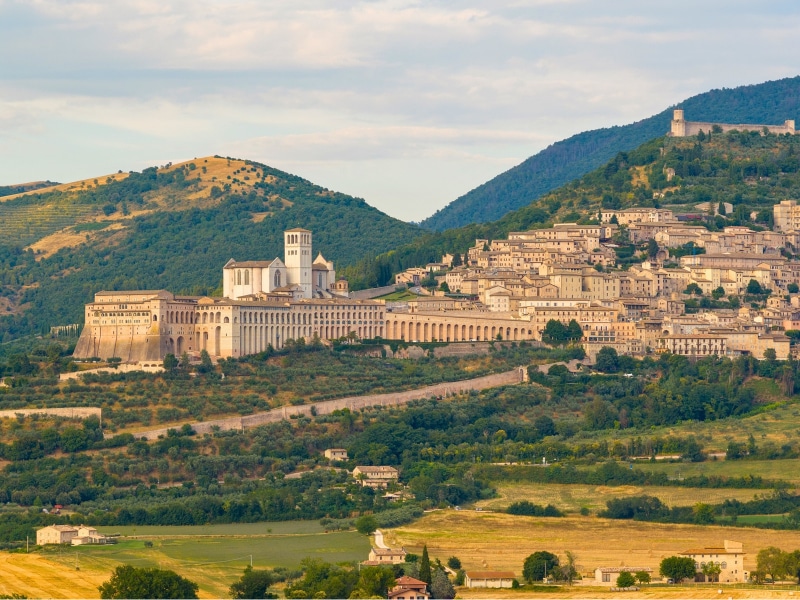
It’s another short driving day as you continue north through Umbria to Assisi, one of Italy’s most important pilgrimage destinations and the birthplace of St Francis of Assisi.
You’ll see the town long before you arrive. Assisi spreads across the slopes of Monte Subasio, with the enormous Basilica di San Francesco dominating the western end of the town.
The basilica is the obvious place to start. Built over the tomb of St Francis, it’s actually two churches, one above the other, decorated with extraordinary medieval frescoes. Even if you’re not religious, it’s difficult not to be impressed by the scale and significance of the building.
From the basilica, wander uphill through the medieval streets towards Piazza del Comune, Assisi’s main square. Here you’ll find the remarkably well-preserved Roman Temple of Minerva, now incorporated into the Church of Santa Maria sopra Minerva.
Continue through the old town to the Basilica di Santa Chiara, dedicated to St Clare of Assisi, and allow plenty of time simply to explore the smaller streets and enjoy the views across the Umbrian countryside below.
Assisi is steep, so expect plenty of uphill walking, but it’s compact enough to explore comfortably over an afternoon.
Where to Stay in Assisi
Stay at Green Village Assisi, a campsite around 3km from the historic centre. It has pitches for motorhomes, electric hook-up, toilets and showers, a swimming pool, restaurant and other facilities, so it’s a comfortable place to stop after a day exploring Assisi.
The campsite offers transport into Assisi, meaning you can leave the motorhome pitched up and avoid dealing with parking closer to the historic centre.
Today you leave Umbria and head back into Tuscany for Florence. It’s a longer driving day than the last couple, but there’s a lovely place to break the journey on the shores of Lake Trasimeno.
Insider Tip: Stop at Campo del Sole, or Field of the Sun, at Punta Navaccia on Lake Trasimeno. This unusual open-air sculpture park is made up of 27 large columns arranged in a spiral beside the lake. It’s a peaceful spot to stretch your legs and have lunch before continuing towards Florence. There’s also a campsite nearby if you’ve got enough time to add another night to the itinerary.
From Lake Trasimeno, continue north towards Florence and get settled at the campsite. We’ve allowed two nights here so you can use the rest of Day 14 to relax or make a first trip into the city, then devote Day 15 to Florence itself.
Exploring Florence
Florence is compact and very walkable, but there’s an enormous amount packed into its historic centre. Start early and book any must-see museums and attractions in advance, particularly the Uffizi Gallery and Accademia Gallery.
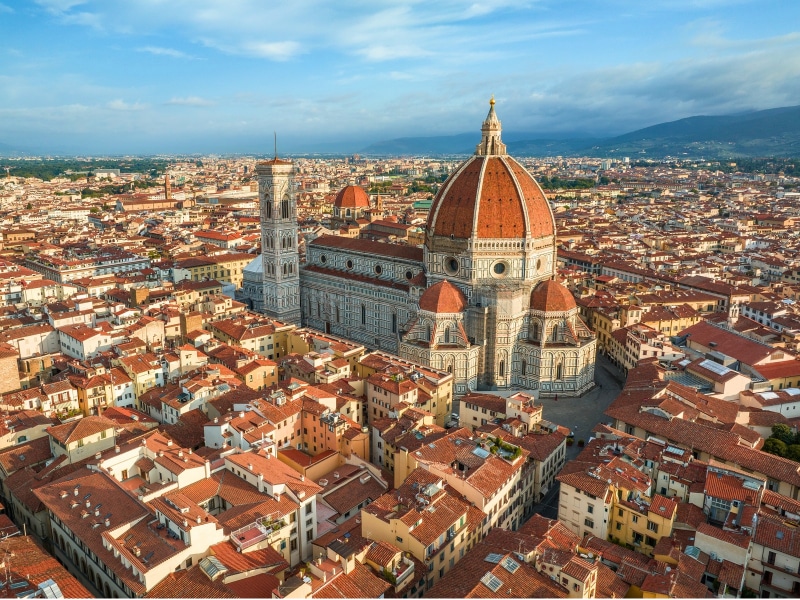
At the heart of the city is Piazza del Duomo, dominated by the Cathedral of Santa Maria del Fiore and Brunelleschi’s enormous terracotta dome. Alongside it are Giotto’s Campanile and the Baptistery of St John.
From here, wander towards Piazza della Signoria and Palazzo Vecchio before continuing to the Uffizi Gallery, home to one of the world’s great collections of Renaissance art.
Cross the Arno on the Ponte Vecchio, with its distinctive shops built along the bridge, to reach the Oltrarno district. On this side of the river you’ll find Pitti Palace, the Boboli Gardens and the streets around Santo Spirito.
Back on the northern side of the river, Santa Croce is also worth making time for. The basilica contains the tombs and memorials of some of Italy’s most famous figures, including Michelangelo, Galileo and Machiavelli.
Don’t try to see every museum in a single day. Florence is just as enjoyable at street level, wandering between piazzas, markets and cafés and stopping occasionally for gelato or a glass of wine.
Insider Tip: Florence is a fantastic place to try traditional Tuscan food. We recommend Trattoria Mario for simple regional dishes and Tuscan soups, Il Latini for hearty Tuscan cooking, or Cibrèo for a more modern take on traditional local food.
Stay at hu Firenze Camping in Town, around 5km from Florence’s historic centre. It’s a large, well-equipped campsite with motorhome pitches, a camper service area, swimming pools, restaurant, bar, pizzeria and market.
The location works particularly well for a two-night stay because you can leave the motorhome pitched up and use public transport. Bus 14 stops just a few metres from the entrance and takes you to Cavour San Marco, close to the Duomo. Firenze Rovezzano railway station is also less than 1km away and has connections to Santa Maria Novella.
Leave Florence and head north across the Apennines into Emilia-Romagna and Bologna, one of Italy’s great food cities.
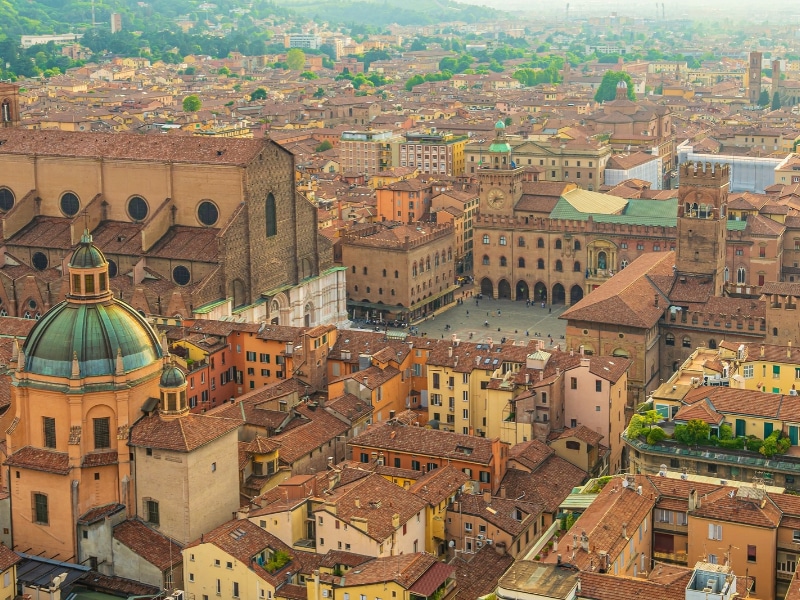
Bologna is traditionally known as ‘La Dotta, La Grassa e La Rossa’, the learned, the fat and the red. The names refer to its ancient university, its formidable food culture and the terracotta colours that dominate the historic centre.
We’ve allowed two nights here, giving you the afternoon of Day 16 to get your bearings and a full day to explore without having to rush.
Exploring Bologna
Start in Piazza Maggiore, the heart of the historic centre and home to the enormous Basilica di San Petronio. From here, wander through the surrounding streets and you’ll quickly find one of Bologna’s most distinctive features: its porticoes.
There are kilometres of these covered walkways throughout the city, and Bologna’s porticoes were added to UNESCO’s World Heritage List in 2021.
Make your way towards the Two Towers, Asinelli and Garisenda, which have been symbols of Bologna for centuries. From here, you’re also perfectly placed to explore the narrow streets of the Quadrilatero, the city’s historic market district.
But we’d make food at least as important as sightseeing here. Emilia-Romagna is the home of tagliatelle al ragù, tortellini, mortadella, Parmigiano Reggiano and Prosciutto di Parma, and Bologna is a very easy place to spend an afternoon eating your way around the centre.
Insider Tip: If you’d rather explore independently than join an organised food tour, use our free self-guided Bologna food tour. It includes suggestions for a DIY lunch in one of Bologna’s oldest osterias, along with delicatessens, wine bars and places where you can see fresh pasta being made.
Where to Stay in Bologna
Stay at Area Sosta Camperopoli on Via della Beverara, around 4km from the historic centre. It’s a secure, gated motorhome area with electric hook-up, fresh water and waste disposal, and it’s open year-round.
Bus 30 stops around 50 metres away and takes you into central Bologna, so you can leave the motorhome parked for both nights. You can also cycle into the centre in around 15–20 minutes.
This is very much a practical city stop rather than somewhere to sit outside and relax. Pitches can be close together and, because the area is near Bologna Airport, you may hear aircraft and road noise. There are no proper showers and toilet facilities are basic.
Today you leave Bologna and head north-east into the Veneto region towards Venice, with a stop in Padua along the way.
Padua is well worth a few hours rather than simply driving past. Instead of trying to take the motorhome into the centre, park at Area Sosta Camper Padova. It’s a fenced, video-monitored motorhome area with the tram stop just a couple of minutes’ walk away, making it an easy place to leave the motorhome while you explore the city.
Once in the centre, Padua is easy to explore on foot, with arcaded streets, lively piazzas and cafés that make it a good place to break the journey.
The city’s standout sight is the Scrovegni Chapel, famous for its remarkable cycle of frescoes painted by Giotto in the early 14th century. Visitor numbers are controlled, so if this is somewhere you particularly want to see, book your timed entry in advance.
Also worth seeing is the Basilica of Saint Anthony, with its distinctive domes and elaborate interior. From here, wander through the old town before returning to the motorhome and continuing to Venice.
Once you’ve reached the campsite, leave the motorhome pitched up for the next two nights. Venice is a place for boats and walking, not motorhomes!
Exploring Venice
Give Day 19 entirely to Venice. It’s one of those cities where having too rigid a sightseeing plan can actually get in the way, so allow some time simply to wander, cross bridges and see where the narrow streets take you.
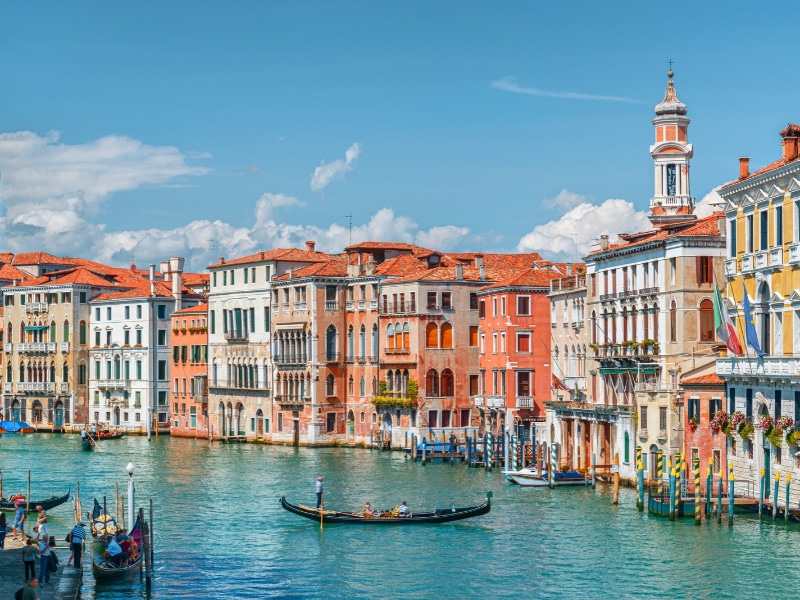
Start around Piazza San Marco, where you’ll find St Mark’s Basilica, the Doge’s Palace and the Campanile. From here, explore the streets around the Grand Canal and cross the Rialto Bridge before heading away from the busiest areas into some of the quieter neighbourhoods.
A vaporetto ride along the Grand Canal is also a great way to see Venice from the water without paying for a gondola.
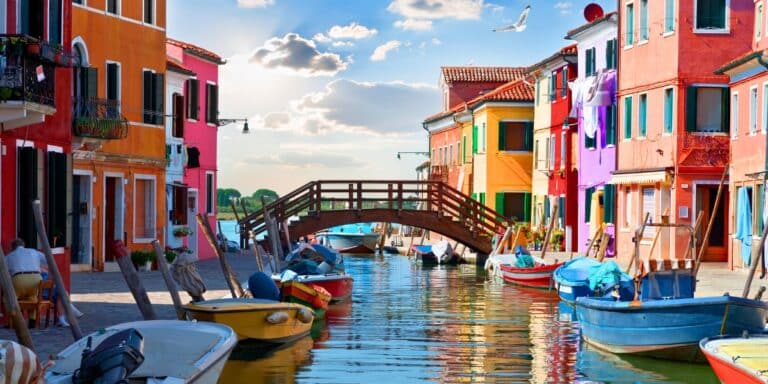
If you’ve visited Venice before or have more time, you could use part of the day to visit the lagoon islands. Murano is famous for glassmaking, Burano for its brightly coloured houses and traditional lace, while Torcello is much quieter and gives you a very different side of the Venetian lagoon.
Venice gets extremely busy, so book any attractions you definitely want to visit in advance. Our one-day Venice itinerary is also useful if you want a more structured route through the city.
Stay at Venezia Camping Village in Mestre for both nights. It’s a well-kept campsite with motorhome pitches, electric hook-up, fresh water and waste facilities, modern toilets and showers, a restaurant, small shop, laundry and indoor swimming pool.
The big advantage is the transport into Venice. The bus stop is just a few minutes’ walk from the campsite, with frequent buses taking around 10–15 minutes to reach Piazzale Roma. You can buy bus tickets, as well as combined bus and vaporetto passes, at reception.
It makes Venice particularly easy by motorhome. You can leave the vehicle safely on the campsite for the day and head straight into the city by public transport.
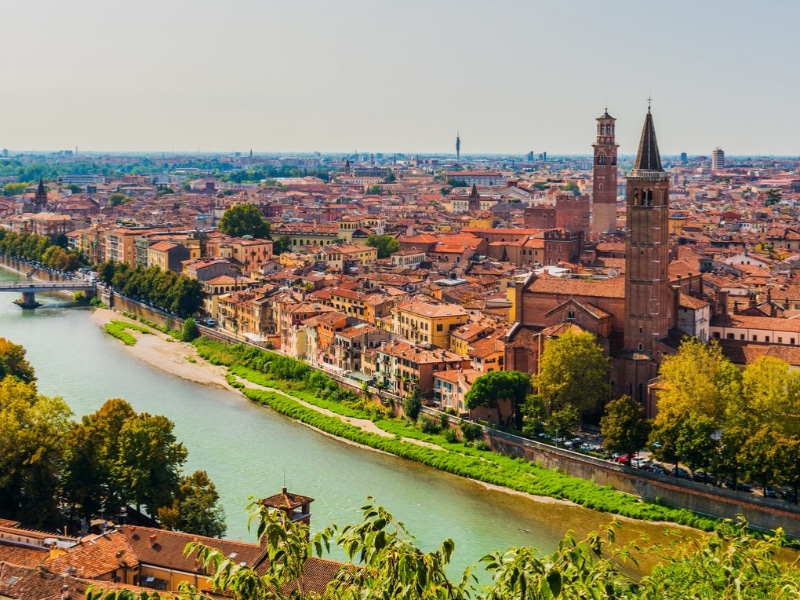
Leave Venice behind and head west across the Veneto to Verona, one of our favourite smaller Italian cities and an easy place to explore in an afternoon and evening.
At the heart of Verona is the Arena, the enormous Roman amphitheatre in Piazza Bra. Built in the first century, it’s remarkably well preserved and is still used for concerts and opera performances today.
From the Arena, wander through the historic centre to Piazza delle Erbe, one of Verona’s liveliest squares, before continuing to nearby Piazza dei Signori.
You’ll inevitably come across Juliet’s House and its famous balcony. The Shakespeare connection is more legend than history, but it’s become one of Verona’s best-known sights and is easy to include as you explore the old town.
Also worth seeing is Castelvecchio, the imposing 14th-century fortress beside the River Adige. Cross its fortified bridge for lovely views along the river before looping back into the centre.
Insider Tip: The best way to experience Verona Arena is during a live opera. The summer opera festival is held inside the amphitheatre, and seeing a production such as Aida, Carmen or La Traviata in this extraordinary setting is a memorable experience. If your visit coincides with the season, check what’s on and book ahead.
Where to Stay in Verona
Stay at Corte Agricola Monrò, a small agricamping site in Parco Adige Sud, close enough to explore Verona without moving the motorhome.
There are just a handful of motorhome pitches, with electric hook-up, fresh water, waste disposal, toilets, showers and WiFi. The setting is surprisingly rural for somewhere so close to the city, with shaded pitches and a small working farm.
The Arena is around 1.8km away and you can walk into Verona along the River Adige, cycle into the centre in around 10 minutes, or use bus 72 from a stop about 300 metres away. Advance booking is recommended as there are so few pitches.
Today is a short drive from Verona to Lake Garda, giving you most of the day to enjoy Italy’s largest lake.
The scenery becomes increasingly dramatic as you travel north, with the mountains rising around the lake and the southern shores gradually giving way to the Alps.
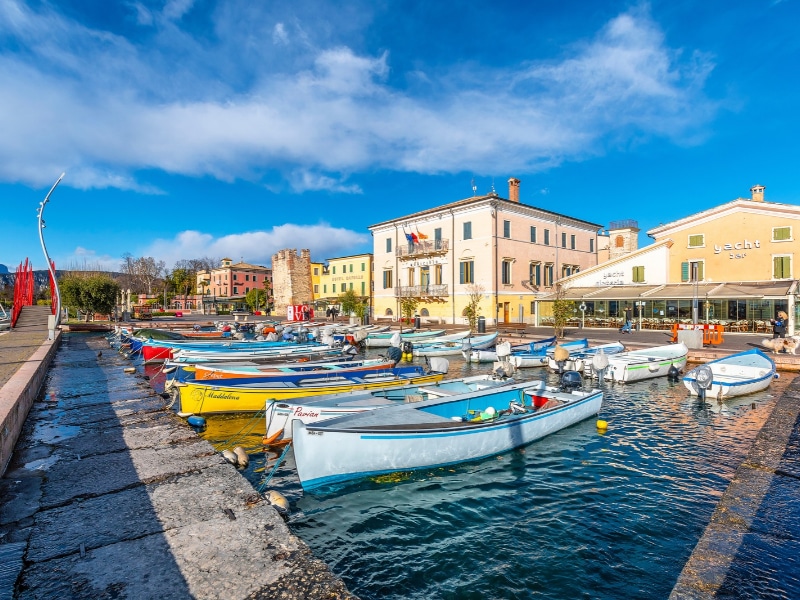
There are dozens of towns to choose from around Lake Garda, but our pick for this itinerary is Bardolino on the eastern shore. It’s a lively lakeside town with an attractive waterfront, plenty of restaurants and cafés and easy access to the lake.
Spend the afternoon wandering along the promenade and through the old town, or follow the lakeside path towards neighbouring Garda or south towards Lazise. If you’ve had enough sightseeing after the cities of the previous few days, this is also a good opportunity to do very little at all.
Bardolino is surrounded by vineyards and is particularly known for the light red wine that carries the town’s name, so this is a good place to try a glass of local Bardolino before dinner.
Make sure you’re back beside the lake towards the end of the day. Being on the eastern shore means you’re looking west across the water, and the sunsets can be spectacular.
Where to Stay at Lake Garda
Stay at La Rocca Camping Village, directly on the lake between Bardolino and Garda. It’s a large, well-equipped campsite with motorhome pitches, electric hook-up, modern facilities, restaurants, a supermarket and swimming pools.
The real attraction for this itinerary is the location. The lakeside pedestrian and cycle path runs directly past the campsite, so you can leave the motorhome pitched up and walk or cycle along the shore to both Bardolino and Garda. The campsite also has direct access to the lake and its own beach area.
It’s worth booking ahead in the main season, particularly if you want one of the pitches closest to the lake.
Today is one of the longer driving days of the itinerary, taking you away from Lake Garda and properly into the Italian Alps.
The route heads west and north past Lake Iseo before the landscape becomes increasingly mountainous as you make your way towards Bormio. Don’t underestimate the journey time. The distance isn’t huge, but once you’re into the mountains the roads become slower, so this is a day to enjoy the drive rather than try to squeeze in lots of sightseeing stops.
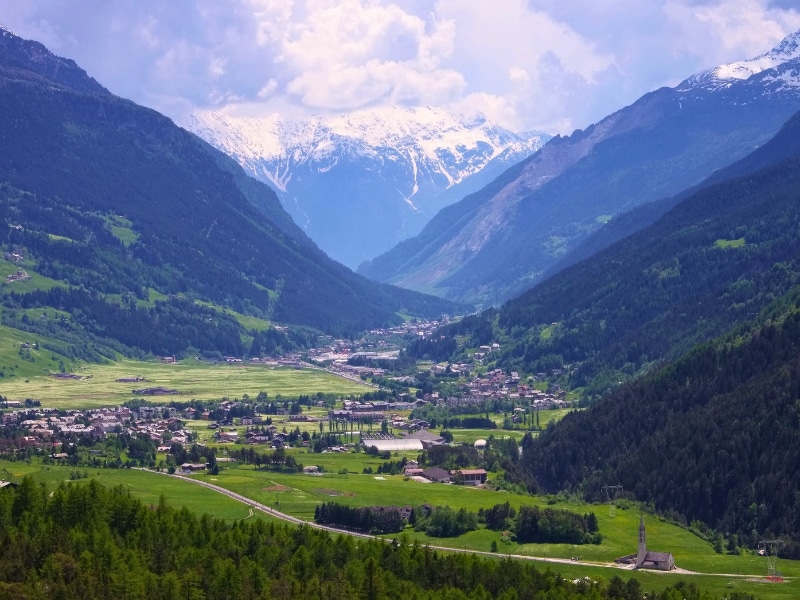
Bormio sits high in the Valtellina valley and makes the perfect final overnight stop before tackling the Stelvio Pass tomorrow.
Once you’ve arrived and parked up, head into the old town for a wander. Bormio has an attractive historic centre with cobbled streets, old stone buildings and Piazza Cavour at its heart, surrounded by the mountains you’ll be driving through the following day.
It’s also famous for its thermal waters, so if you’ve allowed a little extra time, this is a good place to swap sightseeing for a few hours in one of the town’s thermal spas.
Driving the Stelvio Pass Tomorrow
Before setting off in the morning, check that the Stelvio Pass is open. The pass is seasonal and normally closes during the winter, but opening and closing dates depend on snow and weather conditions.
Don’t rely entirely on your satnav for this section either. If the Stelvio is closed, navigation apps will route you around it, which can make the final section of this itinerary look very different.
Where to Stay in Bormio
The motorhome area on Via Battaglion Morbegno is brilliantly located for this itinerary, around a ten-minute walk from the centre of Bormio and ideally placed for setting off towards the Stelvio Pass the following morning.
It’s a large, fairly basic parking area with mountain views and facilities for fresh water and grey and black waste. There is no electric hook-up.
Day 23: Bormio to Prato allo Stelvio via the Stelvio Pass
Distance: 47km Driving Time: Allow around 3 hours
This is the grand finale of the itinerary, and although you’re only covering 47km, you won’t want to rush it.
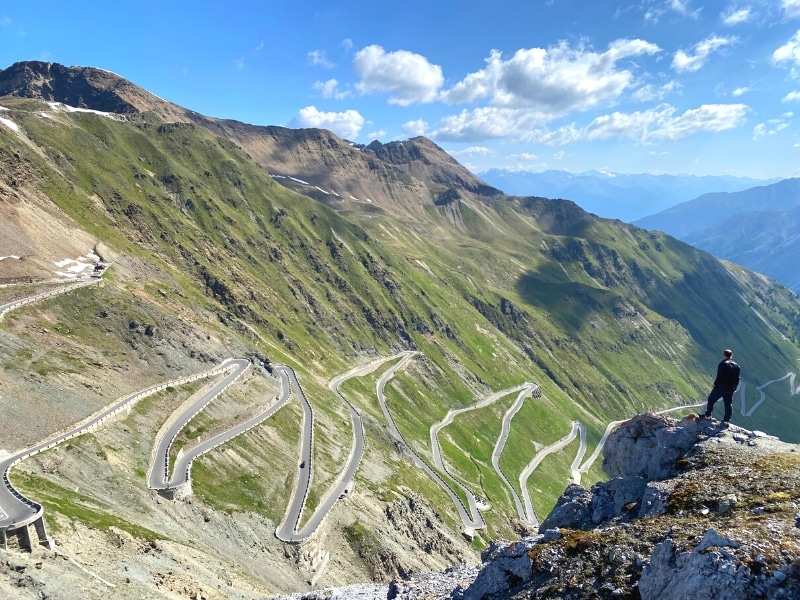
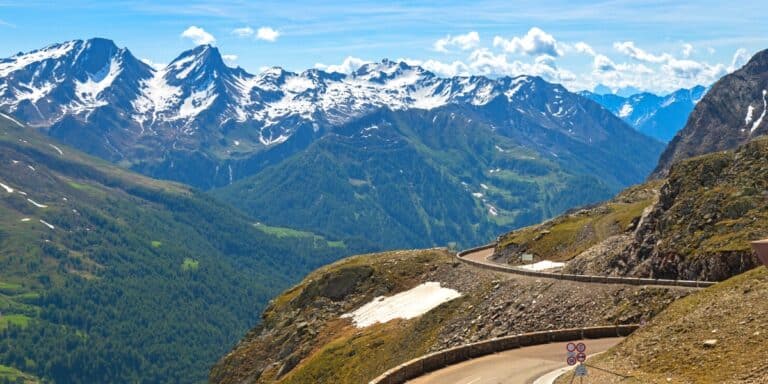
From Bormio, the SS38 climbs steadily towards the Stelvio Pass, reaching 2,757 metres above sea level. It’s one of the highest paved mountain passes in the Alps and one of those roads that’s as much about the drive as getting to the other side.
The road twists through increasingly dramatic mountain scenery before reaching the summit, where you’ll find parking, cafés and incredible views across the surrounding Ortler Alps. Stop here, stretch your legs and enjoy being at the top before starting the descent.
From the summit, the road towards Prato allo Stelvio is the section you’ve probably seen in photographs. The famous series of tightly stacked hairpins snakes down the mountainside towards Trafoi, with views across to the Ortler massif as you descend.
There are 48 numbered hairpin bends on this side of the pass, so take your time, use engine braking and be prepared for cyclists and motorbikes, particularly during the summer months.
Can You Drive the Stelvio Pass in a Motorhome?
Yes, but this is a proper Alpine pass and you need to be comfortable driving your motorhome on steep, narrow mountain roads with very tight hairpins.
There are tunnels on the southern Bormio side of the Stelvio Pass with a 3.3 metre height restriction. That’s within the height of many motorhomes, but it can be an issue for larger vehicles and overland trucks. Check your vehicle height carefully before committing to the route.
The Stelvio Pass is seasonal and can remain closed well into spring or close early if snow arrives. Check the road status and weather forecast before leaving Bormio, even if you’re travelling during the normal opening season.
Finishing Your Italy Motorhome Itinerary
Once you’ve descended through Trafoi, continue to Prato allo Stelvio for your final night.
Finish the itinerary at Camping Residence Sägemühle, a comfortable campsite in Prato allo Stelvio with spacious motorhome pitches, electric hook-up, fresh water, toilets and showers, laundry facilities and an indoor swimming pool.
There’s also a restaurant and pizzeria on site, which makes this a particularly easy place to settle in after driving the Stelvio Pass. The village and shops are within easy walking distance.
From here, your road trip doesn’t have to end. You can head north towards Austria, west towards Switzerland or turn east to continue exploring northern Italy and the Dolomites.
For us, Prato allo Stelvio makes a fitting end to this route. After 23 days, more than 2,000km and a journey that’s taken you from the Italian Riviera through Tuscany, Rome, Umbria, Venice and the Italian Lakes, you finish with one of the most memorable drives in the Alps.
Tips for Your Italy Motorhome Road Trip
Italy is a fantastic country to explore by motorhome, but there are a few practical things worth knowing before you set off. These are the things that will make this particular route easier.
Motorway Tolls in Italy
Most Italian autostrade are toll roads. On the traditional toll system, you take a ticket when you enter the motorway and pay when you leave, with the amount based on the distance travelled and your vehicle class.
Motorhomes with two axles generally fall into Class B because their height above the front axle exceeds 1.3 metres. Vehicles or combinations with three or more axles are charged according to the number of axles.
You can pay at the toll booths using cash or card, or use a compatible electronic toll tag. Make sure you choose the correct lane as you approach the toll booth, particularly if you don’t have an electronic tag.
ZTLs and Low Emission Zones in Italy
One of the biggest things to watch for when driving a motorhome in Italy is the ZTL, or Zona a Traffico Limitato. These restricted traffic zones are common in historic town and city centres and access may be limited to authorised vehicles at particular times. The rules and operating hours vary between cities.
Many ZTLs are camera controlled, so don’t assume that because there’s no barrier you can drive through. Look carefully for the ZTL signs and avoid following your satnav blindly into historic centres.
Italy also has local environmental and low-emission restrictions, which vary considerably between regions and cities. Check the rules for the places you’re visiting before travelling, particularly if you have an older diesel motorhome.
For this itinerary, we’ve deliberately chosen campsites and motorhome parking areas that allow you to leave the motorhome outside the busiest centres and continue on foot or by public transport.
Leave the Motorhome Outside Major Cities
Trying to drive a motorhome into the centre of Milan, Rome, Florence, Venice or Padua usually creates far more hassle than it saves.
We’ve deliberately selected secure overnight stops and parking areas with good walking, cycling or public transport connections so you can leave the motorhome behind.
Allow Extra Time for Mountain Roads
Driving times can be deceptive once you reach the Alps. A relatively short distance can take several hours in a motorhome, particularly on steep or winding roads.
The final section through Bormio and over the Stelvio Pass is a good example. Give yourself plenty of time and don’t plan a long onward journey for the same day.
Book Popular Attractions Ahead
Some of the biggest attractions on this route can sell out, particularly during the main season.
The Last Supper in Milan, the Scrovegni Chapel in Padua and major attractions in Florence and Rome are all worth booking ahead if they’re important to you. The same applies to popular sights and activities in Venice.
Prepare for Mosquitoes
Mosquitoes can be a nuisance around lakes, rivers and campsites during the warmer months, particularly around northern Italy and the Italian Lakes.
Pack insect repellent and make sure your motorhome’s flyscreens are in good condition before you leave.
Check Your Mobile Data
If you’re travelling from the UK, check your provider’s European roaming policy and fair-use allowance before you leave. A three or four week trip can easily expose limits you wouldn’t notice on a shorter holiday.
If you use a lot of data for navigation, streaming or working on the road, a local SIM or eSIM can be useful.
More European Motorhome Itineraries
Planning another European road trip? Our detailed motorhome itineraries include day-by-day routes, driving distances and times, recommended overnight stops, interactive maps and free downloadable PDFs.
🇫🇷 France Motorhome Itinerary A 2–3 week road trip through some of our favourite parts of France, from the Alps and Provence to the Dordogne and Loire. Explore our France itinerary.
🇩🇪 Germany Motorhome Itinerary Two weeks through the Mosel Valley, Black Forest, Lake Constance, Bavarian Alps and Romantic Road. Explore our Germany itinerary.
🇪🇸 Spain Motorhome Itinerary Six weeks exploring Spain, from the historic cities of Madrid, Seville and Granada to the wild beaches of Cabo de Gata and the Mediterranean coast. Explore our Spain itinerary.
🏴 Scotland Motorhome Itinerary A 2–3 week road trip from Loch Lomond and Glen Coe to Skye, Loch Ness and the Cairngorms, finishing in Edinburgh. Explore our Scotland itinerary.
Are you desperate for some Italian culture but don’t want to fly? With great routes across Europe, a road trip from UK to Italy is easy, leaving you arriving refreshed and unstressed, ready to enjoy la dolce vita from the comfort of your own car. We’ve spent the last five years full-time traveling in Europe and have driven from the UK to Italy more times than we can remember! In this guide we’re sharing the…
A northern Italy road trip is a great way to experience the diversity and beauty of Italy’s regions, cultures, and history. As you travel south through Italy, you will experience picturesque lakes, artistic and historical cities, the beautiful Mediterranean coast, and UNESCO sites tucked away within small Italian towns. We’ve spent months exploring Italy and in this northern Italy road trip planner we share insider tips, the best routes between towns and cities, and recommendations for things…
Italy captivates with historic cities, breathtaking landscapes, and extraordinary natural wonders. From the drama of the Dolomites to the ancient history of Sicily, choosing where to go to experience authentic Italy can be a tough call and one you can’t afford to get wrong. I curated this list of the best places to visit in Italy based on two criteria: they offer something special that epitomizes the country and will undoubtedly leave you feeling in…
Italy, a land of romance, history, and unparalleled beauty, is home to some of the most enchanting cities in the world. In this Italian city guide, we’ll take you on a journey through the best cities in Italy to visit and fall in love with, uncovering hidden gems, iconic landmarks, and experiences for un unforgettable Italian adventure.
A road trip through Tuscany is a spectacular drive through rolling hills, picturesque towns, and some of the most incredible landscapes across all of Italy. Tuscany is known for its charming medieval villages, historic cities, and world-renowned wine tastings and culinary traditions. We spent months exploring Tuscany and share insider tips, the best routes between towns and cities, and recommendations for things to do and see along the way, to help you plan your perfect…
Planning a trip to the Alps? One of the most rewarding ways to experience the magnificent Alps is by driving one of the scenic high alpine passes. The roads that traverse the Alps are well-known for their twists and turns, high altitudes, and stunning vistas that provide an opportunity to explore some of the most beautiful destinations in Europe. In our driving in the Alps guide, we share the best Alps driving routes, driving information…
Expertise: road trips, motorhome travel, overlanding, long-term travel and travel planning. Likes: living in a box, wine and croissants!
Bio: Izzy Nicholls is a travel writer, author and co-founder of The Gap Decaders. Since 2018, she has travelled extensively across Europe and beyond by motorhome, overland truck and motorcycle. Izzy is the co-author of Selling Up to Live in a Motorhome and also writes contemporary women’s fiction as Izzy Kelly. Visit Izzy's author page