
This post may contain affiliate links, from which we earn an income. Click here to read our affiliate policy.
From the green hills of northern Spain to the sun-baked plains of Castilla-La Mancha, the wild Atlantic beaches of Andalucía and the sparkling Mediterranean coast, this Spain motorhome itinerary takes you on an unforgettable journey through one of Europe’s most diverse countries.
Starting in Santander and finishing in Barcelona, you’ll discover medieval cities, hilltop castles, traditional white villages, Moorish palaces and some of Spain’s most spectacular mountain scenery. Along the way, you’ll visit the windmills of Don Quixote country, explore the historic cities of Toledo, Seville and Granada, and follow the coast from the windswept beaches of Tarifa to the beautiful bays of the Costa Blanca.
We’ve spent years travelling through Spain, from its remote mountain villages to its lively coastal towns, and this route brings together many of the places that keep drawing us back.
Spain Motorhome Itinerary Key Facts
Route: The Gap Decaders’ Spain motorhome itinerary is a minimum 6-week route from Santander to Barcelona, taking in Madrid, the windmills of Castilla-La Mancha, Toledo, Extremadura, Andalucía, the Costa de la Luz, the Sierra Nevada and Spain’s Mediterranean coastline.
Distance: The complete motorhome route is 3,700km depending on detours and sightseeing stops. The final distance and driving time will be confirmed once the route is mapped.
Best time: Spring and autumn are ideal for this route, particularly April to June and September to October, avoiding the intense summer heat of central and southern Spain. Mountain conditions in the Sierra Nevada can be unpredictable outside the warmer months.
First-hand experience: The Gap Decaders have travelled extensively throughout Spain by motorhome and overland truck, including extended periods exploring Andalucía, the Mediterranean coast and inland Spain. This itinerary brings together places we’ve visited and routes we’ve travelled ourselves.
Enjoy The Gap Decaders? Add us as a preferred source on Google.

Spain Motorhome Route at a Glance
Distance: Approximately 3,700km
Driving time: Approximately 50–55 hours, excluding sightseeing stops and breaks.
Duration: 6 weeks minimum, ideally 8-10 weeks
Best for: An extended Spain motorhome road trip combining historic cities, traditional white villages, the wild Atlantic beaches of the Costa de la Luz, the mountains of Andalucía and the Mediterranean coastline from Cabo de Gata to Barcelona
Route: Santander → Burgos → Segovia → Madrid → Consuegra → Toledo → Trujillo → Cáceres → Alcántara → Mérida → Zafra → Córdoba → Seville → Sanlúcar de Barrameda → Jerez de la Frontera → El Puerto de Santa María and Cádiz → Vejer de la Frontera → Tarifa → Málaga → Antequera → Granada → Trevélez and the Alpujarras → Nerja → Cabo de Gata → Murcia → Mar Menor → La Marina → Benidorm and Altea → Calpe → Dénia → Valencia → Peñíscola → Tarragona → Sitges → Barcelona
This 6 week Spain motorhome itinerary starts in Santander, where ferries arrive from the UK, and finishes in Barcelona, taking you through some of the country’s most spectacular cities, coastlines and mountain landscapes.
We’ve organised the itinerary into a logical route with suggested overnight stops, driving distances, sightseeing highlights and practical motorhome advice, so you can follow the full journey or adapt individual sections to suit your plans.
The route is divided into five sections:
- Days 1–5: Northern and Central Spain. Travel from Santander through Burgos and Segovia to Madrid, before exploring the famous windmills of Consuegra and the medieval city of Toledo.
- Days 6–9: Extremadura and the Portuguese Border. Discover the historic towns of Trujillo, Cáceres and Mérida, with a detour to the magnificent Roman bridge at Alcántara, close to the Portuguese border, before continuing south to Córdoba.
- Days 10–16: Western Andalucía and the Costa de la Luz. Explore Seville and the Sherry Triangle around Jerez, Sanlúcar de Barrameda and El Puerto de Santa María, visit Cádiz by ferry, and enjoy the Atlantic beaches and laid-back atmosphere of Tarifa.
- Days 17–27: Southern Andalucía and Cabo de Gata. Discover Málaga, Antequera and Granada, venture into the Sierra Nevada and Alpujarras to visit Trevélez, relax on the beaches around Nerja, and spend three nights exploring the volcanic landscapes and beautiful coastline of Cabo de Gata Natural Park.
- Days 28–42: The Mediterranean Coast to Barcelona. Travel north through Murcia and the Costa Blanca, visiting Alicante, Benidorm, Altea, Calpe and Dénia, before continuing to Valencia, Peñíscola and Tarragona. Finish your six-week Spanish road trip in Barcelona, with time to enjoy the Mediterranean beaches and historic coastal towns along the way.
The suggested days are a guide rather than a rigid schedule. Some destinations can be explored in a few hours, while cities such as Madrid, Seville, Granada and Barcelona deserve longer. Throughout the itinerary, we’ll highlight where extra nights are particularly worthwhile for anyone with more than a month to spend in Spain.
Spain Motorhome Route Map
Our interactive map shows the complete Spain motorhome itinerary, including the suggested route, places to visit and our recommended campsites and aires.
You don’t need to follow the route exactly as we’ve driven it. Use the map to shorten the journey, skip somewhere that doesn’t appeal or add your own detours along the way.
All our recommended overnight stops and parking places are included, and we’ll also link to Park4Night throughout the itinerary so you can check recent reviews and current information before you arrive.
How Long Do You Need for This Spain Motorhome Itinerary?
We’ve designed this route to take a minimum of six weeks, although eight to ten weeks would be ideal.
Six weeks gives you enough time to complete the route, but it’s a busy itinerary covering a large part of Spain. You’ll have time to explore the major cities, visit the famous landmarks and enjoy some of the coastline, but you’ll be moving regularly, with several longer driving days and some destinations limited to a few hours.
Eight weeks gives you much more breathing space. You can spend longer in Madrid, Seville and Granada, explore the white villages of Andalucía, enjoy a few days on the beaches of the Costa de la Luz and slow down along the Mediterranean coast. You’ll also have more flexibility to explore the Sierra Nevada and discover smaller towns away from the main tourist routes.
Ten weeks would be our preference. Spain is a wonderful country for slow motorhome travel, and having two months means you can spend several nights in places you love, explore the countryside around Extremadura, linger in Cabo de Gata and enjoy the Costa Blanca without feeling you’re constantly packing up and moving on.
If you only have two or three weeks, we’d recommend choosing one section of the route instead. Madrid, Toledo, Extremadura and western Andalucía make a fantastic inland road trip, while the Costa de la Luz, Andalucía’s historic cities and the Mediterranean coast can easily form separate itineraries.
RELATED POST: Motorhoming in Spain: Your Complete Touring Guide
Day 1: Santander to Burgos
Distance: Approximately 180km
Driving Time: Around 2 hours 15 minutes
Your Spain motorhome road trip begins in Santander, where Brittany Ferries operates services from Portsmouth and Plymouth. If you’re arriving on an overnight ferry, you’ll usually have plenty of time to make the relatively short drive inland to Burgos.
Before leaving Santander, it’s worth spending a little time exploring the city, particularly the elegant Magdalena Peninsula, home to the Palacio de la Magdalena, and the sweeping sands of Playa del Sardinero. If your ferry arrives later in the day, you may prefer to spend your first night in Santander and start the drive the following morning.
From Santander, take the A-67 south through the green Cantabrian countryside, climbing towards the mountains before joining the A-73 and N-623 towards Burgos. The scenery changes dramatically as you leave the lush northern coast behind and enter the wide-open landscapes of Castilla y León.
Burgos is one of northern Spain’s most impressive historic cities, best known for its magnificent Gothic cathedral, a UNESCO World Heritage Site. The cathedral dominates the old town, and its elaborate towers and ornate interior make it well worth a visit.
Spend the afternoon wandering through the medieval streets, crossing the River Arlanzón and visiting the Arco de Santa María, the grand gateway into the historic centre. If you have time, climb to the Mirador del Castillo for panoramic views across the cathedral rooftops and surrounding countryside.
Burgos is also famous for morcilla de Burgos, a traditional blood sausage made with rice, which you’ll find served in tapas bars throughout the city.
Insider Tip: Burgos sits at around 850 metres above sea level and can be surprisingly chilly, even when the weather on the coast is warm. Keep an extra layer handy, particularly if you’re visiting in spring or autumn.
Where to Stay in Burgos
This free municipal motorhome aire on Calle de las Torres has designated parking spaces, fresh water and waste disposal facilities. It’s around 3.5km from the historic centre, with a nearby bus service making it easy to visit Burgos without moving your motorhome.
Park4Night: Burgos Motorhome Area #279245
Coordinates: N 42°21’18.09” W 3°40’25.3848”

Day 2: Burgos to Segovia
Distance: Approximately 215km
Driving Time: Around 2 hours 30 minutes
Leaving Burgos, head south through the wide-open plains of Castilla y León towards Segovia, one of Spain’s most beautiful historic cities and a UNESCO World Heritage Site. The drive is straightforward, following the A-1 towards Madrid before turning west towards Segovia, with views of the Sierra de Guadarrama as you approach.
Segovia is famous for its extraordinary Roman aqueduct, built almost 2,000 years ago and still standing without mortar holding its enormous granite blocks together. Rising nearly 29 metres above the Plaza del Azoguejo, it’s one of the best-preserved Roman aqueducts in the world and an unforgettable sight as you enter the old town.
From the aqueduct, follow the narrow medieval streets towards Segovia Cathedral, an impressive late-Gothic building overlooking the Plaza Mayor. Continue through the old Jewish Quarter to the Alcázar, a spectacular hilltop castle with pointed towers and sweeping views across the surrounding countryside.
If you have time, walk down to the Mirador de la Pradera de San Marcos, where you’ll get one of the best views of the Alcázar perched high above the meeting point of the Eresma and Clamores valleys.
Segovia is also known for cochinillo asado, a traditional roast suckling pig with crisp skin, served in restaurants around the old town. It’s one of the region’s most famous dishes and worth trying if you enjoy local food.
Allow at least half a day to explore Segovia, although a full day is preferable if you want to visit the cathedral and Alcázar as well as enjoy the old town.
Insider Tip: Segovia’s historic centre has narrow streets and restricted vehicle access, so leave your motorhome outside the old town and explore on foot. The aqueduct is particularly impressive in the early morning or evening, when the light catches the granite arches.
Where to Stay in Segovia
This free municipal motorhome aire beside the bullring is around a 15-minute walk from Segovia’s historic centre. There are water and waste disposal facilities, although the spaces are sloping and can be tight for larger motorhomes. Parking is limited to ten designated spaces, and motorhomes are prohibited on Saturdays between 7am and 5pm because of the market.
Park4Night: Segovia Motorhome Area #19343
Coordinates: N 40°56’26.5416” W 4°6’28.4256”
Days 3–4: Segovia to Madrid
Distance: Approximately 95km
Driving Time: Around 1 hour 20 minutes
Leaving Segovia, head south towards Madrid, crossing the Sierra de Guadarrama, the mountain range that separates Castilla y León from the Spanish capital. The quickest route follows the AP-61 and AP-6 toll motorways, but if you have time, the N-603 offers a more scenic alternative through the mountains.
For an even more spectacular drive, consider taking the CL-601 over the Puerto de Navacerrada. At 1,858 metres, this mountain pass winds through pine forests and offers sweeping views across the Sierra de Guadarrama. It’s best suited to smaller motorhomes, and you’ll need to check the weather and road conditions, particularly outside the summer months.
Explore Madrid
Madrid is Spain’s lively capital, with grand architecture, world-class museums, beautiful parks and an extraordinary food scene. Two days gives you time to experience the city’s highlights without rushing, although you could easily spend much longer here.
On your first afternoon, start at Puerta del Sol, the bustling heart of Madrid, before wandering through the historic streets to Plaza Mayor, one of the city’s most impressive squares. Nearby, the Mercado de San Miguel is a popular stop for tapas, with stalls selling everything from jamón ibérico to fresh seafood and Spanish cheeses.
Continue to the magnificent Royal Palace, one of Europe’s largest royal residences, and the neighbouring Almudena Cathedral. If you have time, explore the palace’s lavish interiors or enjoy the views from the surrounding gardens towards Casa de Campo.
On your second day, head to the Prado Museum, home to an outstanding collection of European art, including works by Velázquez, Goya and El Greco. Art lovers may also want to visit the Reina Sofía Museum, where Picasso’s famous Guernica is displayed.
Afterwards, spend some time in El Retiro Park, Madrid’s beautiful green space, where you can wander along tree-lined paths, admire the Crystal Palace and relax beside the boating lake. The nearby Puerta de Alcalá and elegant Gran Vía are also worth exploring.
In the evening, head to La Latina, one of Madrid’s oldest neighbourhoods, known for its traditional tapas bars and lively atmosphere. Alternatively, explore the restaurants around Plaza de Santa Ana or enjoy a stroll through the illuminated streets of the city centre.
Madrid is also famous for its churros con chocolate, and a visit to Chocolatería San Ginés, which has been serving them since 1894, is a delicious way to round off your time in the capital.
Insider Tip: Madrid operates a city-wide low-emission zone, with additional restrictions in the central districts. Foreign-registered motorhomes are subject to access requirements, so check the latest regulations before travelling. We recommend leaving your motorhome outside the city and using public transport, which is efficient and makes sightseeing much easier.
Where to Stay in Madrid
Camping Osuna is a convenient base for exploring Madrid, located beside El Capricho Park on the eastern side of the city. Open year-round, the campsite has electric hook-ups, showers, toilets, laundry facilities, fresh water and motorhome waste disposal. Some pitches are uneven, and there can be road noise, but the excellent public transport connections make it a practical choice for a city visit.
The nearest Metro station is Canillejas, around a 10-minute walk from the campsite. Take Metro Line 5 (green), towards Casa de Campo, directly to Gran Vía in central Madrid. The journey takes approximately 25–30 minutes, and from Gran Vía you can walk to Puerta del Sol, Plaza Mayor and many of the city’s main attractions without needing to change trains.
The campsite is within Madrid’s low-emission zone, so check the access rules for your motorhome before arriving, particularly if it is foreign-registered.
Park4Night: Camping Osuna #256279
Coordinates: N 40°27’13.6332” W 3°36’11.772”
Day 5: Madrid to Consuegra and Toledo
Distance: Approximately 170km
Driving Time: Around 2 hours 15 minutes
Leaving Madrid, head south on the A-4 towards Consuegra, a small town in Castilla-La Mancha famous for its traditional white windmills. The drive takes you across the wide, open plains of central Spain, where olive groves, vineyards and fields of golden wheat stretch towards the horizon.
As you approach Consuegra, you’ll see the windmills standing along the ridge of Cerro Calderico, alongside the medieval Castillo de la Muela. These are the landscapes made famous by Miguel de Cervantes in Don Quixote, and the twelve restored windmills are among the most recognisable sights in Castilla-La Mancha.
You can drive up to the windmills and park nearby, although the access road is steep and winding in places, so larger motorhomes may be better left in the town below. Allow an hour or two to walk along the ridge, explore the castle and enjoy the sweeping views across the surrounding plains.
From Consuegra, continue north-west towards Toledo, around 65km away. The approach to the city is spectacular, with its ancient walls, towers and cathedral rising above the River Tagus.
Explore Toledo
Known as the City of Three Cultures, Toledo was shaped by centuries of Christian, Jewish and Muslim influence, and its remarkably preserved historic centre is a UNESCO World Heritage Site.
Start at the Puerta de Bisagra, the monumental gateway into the old town, before wandering through the maze of narrow cobbled streets towards the magnificent Toledo Cathedral. This enormous Gothic building is one of Spain’s most impressive cathedrals, with an extraordinary collection of paintings, sculptures and religious treasures.
Continue to the Alcázar, the imposing fortress overlooking the city, before exploring the old Jewish Quarter, where you’ll find the beautiful Synagogue of Santa María la Blanca and the Monastery of San Juan de los Reyes.
Toledo is also closely associated with the artist El Greco, who lived and worked here for much of his life. You can see some of his most famous paintings in the Church of Santo Tomé and the El Greco Museum.
Before leaving, make time for the Mirador del Valle, on the opposite side of the River Tagus. This viewpoint offers the classic panoramic view of Toledo, with the cathedral and Alcázar rising above the tightly packed rooftops. It’s particularly beautiful in the late afternoon when the buildings glow in the warm sunlight.
Toledo is famous for its marzipan, traditionally made by local convents, and you’ll find plenty of shops selling the sweet almond treats throughout the old town.
Insider Tip: Toledo’s historic centre is a maze of narrow, steep streets, many with restricted vehicle access. Leave your motorhome outside the old town and explore on foot. The Mirador del Valle is accessible by road, but parking can be difficult for larger vehicles, so consider visiting by taxi or tourist bus.
Where to Stay in Toledo
Camping El Greco is a convenient base for exploring Toledo, situated beside the River Tagus around 2km from the historic centre. The campsite has designated motorhome pitches, electric hook-ups, showers, toilets, a restaurant and motorhome service facilities. It’s relatively expensive by Spanish campsite standards, but its location makes it a practical choice for visiting the city.
Bus line 72 stops near the campsite entrance and runs hourly into Toledo’s historic centre, with a journey time of approximately 15 minutes. Alternatively, you can walk into the old town in around 30–40 minutes, although Toledo’s steep streets make the return journey more demanding. Check the return bus timetable before heading out for the evening.
Park4Night: Camping El Greco #24682
Coordinates: N 39°51’52.92” W 4°2’48.408”

Day 6: Toledo to Cáceres via Trujillo
Distance: Approximately 290km
Driving Time: Around 3 hours 30 minutes
Leaving Toledo, head west towards Extremadura, one of Spain’s least crowded regions and a wonderful place to explore by motorhome. The landscape gradually changes from the open plains of Castilla-La Mancha to rolling hills, cork oak forests and the vast dehesas where Iberian pigs graze beneath the trees.
Follow the A-40 and A-5 towards Trujillo, a beautiful medieval town perched on a granite hilltop. Trujillo is famous for its connections to the Spanish conquistadors, particularly Francisco Pizarro, who was born here and later led the Spanish conquest of the Inca Empire.
The town’s magnificent Plaza Mayor is surrounded by Renaissance palaces, churches and historic mansions, with a bronze statue of Pizarro dominating the square. Above the old town, the medieval castle offers sweeping views across the surrounding countryside, while the narrow streets leading up to it are lined with beautiful stone buildings.
Allow a couple of hours to explore Trujillo before continuing west to Cáceres, around 45 minutes away.
Explore Cáceres
Cáceres has one of the best-preserved medieval old towns in Europe, and its UNESCO-listed historic centre is an extraordinary collection of towers, palaces, churches and cobbled streets.
Enter the old town through the Arco de la Estrella, just off the impressive Plaza Mayor, and you’ll find yourself surrounded by honey-coloured stone buildings that have changed remarkably little over the centuries.
Wander through the narrow streets towards the Plaza de Santa María, home to the beautiful Concatedral de Santa María and several grand Renaissance palaces. Continue to the Plaza de San Jorge, where the imposing Church of San Francisco Javier stands above a broad flight of steps.
One of the pleasures of Cáceres is simply getting lost in its medieval streets, discovering quiet squares, hidden courtyards and ancient defensive towers. The old town is particularly atmospheric in the evening, when the buildings are illuminated and the day visitors have left.
Cáceres is also an excellent place to try traditional Extremaduran food, including jamón ibérico de bellota, Torta del Casar cheese and migas extremeñas, a hearty dish made with fried breadcrumbs, garlic and paprika.
Where to Stay in Cáceres
Motorhome overnight options in Cáceres are limited, so we’ve included two choices: a free municipal aire within walking distance of the historic centre and a well-equipped campsite a little further out.
Cáceres Municipal Motorhome Aire: This free aire on Calle Hortelanos is around a 10–15 minute walk from the historic centre, making it convenient for sightseeing. There are designated motorhome spaces and basic water and waste disposal facilities, but reviews are poor, with reports of rubbish and poorly maintained facilities. Its location is the main advantage, so check recent reviews before deciding to stay.
Park4Night: Cáceres Municipal Aire #697825
Coordinates: N 39°28’49.8972” W 6°21’59.7708”
Camping Cáceres: Around 5km from the historic centre, this well-reviewed campsite offers electric hook-ups, water, waste disposal, laundry facilities, a restaurant and a large swimming pool. Unusually, each pitch has its own private toilet, shower and washbasin. The campsite is open year-round and accepts ACSI CampingCard discounts during eligible periods.
A bus stop is around a 5–10 minute walk from the campsite, with services into Cáceres taking approximately 15 minutes. Alternatively, you can cycle into the city in around 20 minutes using the cycle paths. It’s a more comfortable option for anyone planning to spend an extra night exploring.
Park4Night: Camping Cáceres #16881
Coordinates: N 39°29’21.8364” W 6°24’45.612”
Day 7: Cáceres to Mérida via Alcántara
Distance: Approximately 230km
Driving Time: Around 3 hours 15 minutes
Today takes you into the quieter countryside of western Extremadura, close to the Portuguese border, before heading south to Mérida, home to some of the finest Roman remains in Spain.
Leaving Cáceres, take the N-521 west towards Alcántara, passing through a landscape of rolling hills, granite outcrops and dehesa, the traditional oak woodland where Iberian pigs graze. This is one of Spain’s least visited regions, with quiet roads and small villages that have changed little over the years.
The main reason to visit Alcántara is its extraordinary Roman bridge, built across the River Tagus in the early 2nd century AD during the reign of Emperor Trajan. Standing almost 50 metres above the river at its highest point, the six-arched stone bridge is one of the most impressive surviving examples of Roman engineering in Europe.
Allow time to walk across the bridge and admire the views along the Tagus valley. The nearby town of Alcántara is also worth a short wander, with narrow streets, historic churches and the impressive Conventual de San Benito.
From Alcántara, head south-east towards Mérida, passing through the open countryside of Extremadura. The drive is largely rural, with few major towns along the way.
Explore Mérida
Founded in 25 BC as Augusta Emerita, Mérida was once the capital of the Roman province of Lusitania. Today, its remarkable collection of Roman monuments forms a UNESCO World Heritage Site, and it’s one of the best places in Spain to discover the country’s ancient history.
Start at the Roman Theatre, the city’s most famous monument, with its beautifully preserved stage framed by towering marble columns and statues. Built in the 1st century BC, the theatre is still used for performances during the annual International Classical Theatre Festival.
Next door, the Roman Amphitheatre once hosted gladiatorial contests and public spectacles. Although less complete than the theatre, its surviving walls and underground passages give a fascinating insight into life in Roman Spain.
Continue to the National Museum of Roman Art, where you’ll find an outstanding collection of mosaics, sculptures and everyday objects excavated from the ancient city.
Elsewhere in Mérida, don’t miss the Temple of Diana, the remains of the Roman Circus and the magnificent Roman bridge spanning the River Guadiana. At nearly 800 metres long, it’s one of the longest surviving Roman bridges in the world and is now reserved for pedestrians.
Mérida is compact enough to explore on foot, although you’ll need several hours to see the main archaeological sites. A combined ticket covering several Roman monuments is usually the best-value option if you plan to visit more than one.
If you have extra time, the nearby Proserpina Reservoir, originally constructed as part of the Roman water supply system, is a lovely place for a walk or a relaxing afternoon beside the water.
Insider Tip: Mérida can be extremely hot in summer, with temperatures regularly exceeding 35°C. If you’re visiting in warmer weather, explore the exposed archaeological sites early in the morning or later in the afternoon, and leave the museum for the hottest part of the day.
Where to Stay in Mérida
The Mérida motorhome aire is in the Roman Theatre car park, just five minutes’ walk from the theatre and amphitheatre and around ten minutes from the historic centre. It’s an excellent location for sightseeing, with designated motorhome spaces, fresh water, grey and black waste disposal, WiFi and optional electric hook-up.
Insider Tip: If you’re arriving from Cáceres, watch out for a low bridge with a 3m height restriction on Calle Prado Viejo. Check your satnav route carefully, particularly in a taller motorhome.
Park4Night: Mérida Motorhome Aire #35761
Coordinates: N 38°55’9.0696” W 6°20’11.6088”
Days 8–9: Mérida to Córdoba via Zafra
Distance: Approximately 265km
Driving Time: Around 3 hours 15 minutes
Leaving Mérida, head south along the A-66 towards Zafra, a beautiful historic town often called Sevilla la Chica, or Little Seville, because of its elegant squares and traditional Andalusian architecture.
The drive takes you through the rolling countryside of southern Extremadura, where olive groves, vineyards and oak-covered hills give way to the foothills of the Sierra Morena.
Zafra makes an excellent stop for a morning coffee and a wander through its historic centre. The Plaza Grande and neighbouring Plaza Chica are particularly attractive, with whitewashed buildings, arcaded walkways and traditional cafés. The two squares are connected by the Arquillo del Pan, a picturesque passageway that has linked them for centuries.
Also worth seeing is the Palacio de los Duques de Feria, a 15th-century fortified palace now operating as a Parador hotel. Allow an hour or two to explore Zafra before continuing towards Córdoba, crossing the Sierra Morena into Andalucía.
With two nights in Córdoba, you’ll have time to enjoy the old town on your first afternoon and evening, followed by a full day exploring the city’s extraordinary historic sights.
Explore Córdoba
Córdoba was once the capital of Al-Andalus and one of the most important cities in medieval Europe. It’s also one of our favourite places in Spain. Today, its UNESCO-listed historic centre is famous for its extraordinary Islamic architecture, flower-filled patios and narrow whitewashed streets.
On your first afternoon, head into the historic Jewish Quarter, or Judería, where narrow lanes wind between whitewashed houses decorated with colourful flowerpots. Don’t miss the Calleja de las Flores, a tiny street offering one of the city’s most photographed views of the Mezquita’s bell tower.
Continue towards the River Guadalquivir and cross the Roman Bridge for wonderful views back towards the Mezquita-Catedral and the old town. The bridge is particularly atmospheric at sunset, when the golden stone buildings glow in the evening light.
Spend your second day exploring Córdoba’s most famous monuments, starting with the magnificent Mezquita-Catedral. Originally built as a mosque in the 8th century and later converted into a Christian cathedral, its vast prayer hall, with hundreds of red-and-white striped arches, is one of the most remarkable architectural sights in Spain. Book tickets in advance, particularly during the busy spring and autumn periods.
Just a short walk away is the Alcázar de los Reyes Cristianos, a medieval fortress with beautiful gardens, fountains and defensive towers. The gardens are especially lovely in spring, when the flowers are in bloom.
Allow time to explore some of Córdoba’s traditional patios, many of which are filled with colourful geraniums, climbing plants and decorative tiles. If you’re visiting in May, you may be lucky enough to experience the famous Festival de los Patios, when residents open their beautifully decorated private courtyards to visitors.
Córdoba is also a wonderful place to enjoy traditional Andalusian food. Try salmorejo, a thick chilled tomato soup topped with egg and jamón, or flamenquín, a local speciality of rolled pork coated in breadcrumbs and fried. In the evening, the streets around Plaza de la Corredera and the Judería are lovely places to find a restaurant and soak up the atmosphere.
If you have extra time, the archaeological site of Medina Azahara, around 8km west of Córdoba, is well worth visiting. This UNESCO World Heritage Site contains the remains of a magnificent 10th-century palace city built during the height of the Caliphate of Córdoba.
Insider Tip: Córdoba is one of the hottest cities in Europe, with summer temperatures frequently exceeding 40°C. Spring and autumn are much more comfortable for sightseeing. Visit the Mezquita early in the morning, when it’s generally quieter, and save the shaded patios and narrow streets for the warmer afternoon hours.
Where to Stay in Córdoba
Camper Park Medina Azahara is a well-maintained private motorhome aire in a quiet residential area around 10km west of Córdoba. It has 55 pitches of different sizes, including options for larger motorhomes, with fresh water, waste disposal, toilets and electric hook-ups on selected pitches. There’s a bakery and supermarket nearby.
Getting into Córdoba is straightforward using public transport. A bus stop around 200 metres from the aire has a direct service to the historic centre, taking approximately 30–40 minutes. Alternatively, the nearby Villarrubia de Córdoba railway station is around a ten-minute walk away, with trains taking approximately eight minutes to Córdoba’s main station. Services are less frequent than the bus, so check return times carefully.
The aire is also conveniently located for visiting Medina Azahara, around 1.2km away, and there’s a cycle route towards Córdoba for anyone travelling with bikes.
Park4Night: Camper Park Medina Azahara #31441
Coordinates: N 37°52’15.2832” W 4°51’21.6756”

Days 10–11: Córdoba to Seville
Distance: Approximately 145km
Driving Time: Around 1 hour 45 minutes
Leaving Córdoba, follow the A-4 west towards Seville, travelling through the fertile Guadalquivir Valley, where olive groves, citrus orchards and farmland stretch across the countryside. It’s an easy drive, giving you plenty of time to settle into your overnight stop and start exploring Andalucía’s magnificent capital.
Seville is one of Spain’s most captivating cities, famous for its Moorish architecture, grand plazas, orange-tree-lined streets and flamenco traditions. Two nights gives you a full day to explore its major sights, although you could easily spend three or four days here.
Explore Seville
On your first afternoon, head into the historic centre and explore the Barrio de Santa Cruz, Seville’s former Jewish Quarter. Its narrow cobbled lanes, whitewashed buildings, flower-filled courtyards and small squares are lovely to wander through, particularly in the late afternoon when the streets become quieter.
Continue towards the enormous Seville Cathedral, the largest Gothic cathedral in the world and home to the tomb of Christopher Columbus. Climb the Giralda, the cathedral’s former minaret, for spectacular views across the rooftops of the old town.
Nearby, the Plaza del Triunfo is surrounded by some of Seville’s most impressive historic buildings, including the cathedral, the Archivo de Indias and the Royal Alcázar.
Spend your second day exploring the magnificent Real Alcázar, a UNESCO World Heritage Site and one of Spain’s most beautiful royal palaces. Its extraordinary Mudéjar architecture, intricate tilework, carved ceilings and peaceful gardens make it a highlight of any visit to Seville. Book tickets in advance, particularly during spring and autumn.
Afterwards, head to the spectacular Plaza de España, built for the 1929 Ibero-American Exposition. This enormous semicircular plaza is decorated with colourful ceramic tiles representing Spain’s provinces, with bridges crossing a canal and an impressive central fountain. It’s one of Seville’s most photographed landmarks and well worth taking your time to explore.
Next door, María Luisa Park provides a welcome escape from the busy streets, with shaded paths, fountains and beautifully landscaped gardens.
In the late afternoon, cross the Guadalquivir River to Triana, a traditional neighbourhood famous for its ceramics, flamenco heritage and lively tapas bars. Wander through the streets around Calle Betis, visit the Mercado de Triana and enjoy views back towards the historic centre.
Seville is also one of the best places in Spain to experience flamenco. For a more intimate performance, look for a traditional tablao or smaller venue rather than one of the large tourist shows. An evening performance is a wonderful way to finish your time in the city.
Food is a big part of the Seville experience, and you’ll find excellent tapas bars throughout the old town and Triana. Try espinacas con garbanzos, a traditional dish of spinach and chickpeas, or carrillada, slow-cooked pork cheeks served in a rich sauce.
If you have extra time, consider visiting the Metropol Parasol, also known as Las Setas, a striking modern wooden structure overlooking Plaza de la Encarnación. Its elevated walkway offers panoramic views across the city, particularly at sunset.
Insider Tip: Seville can be extremely hot from June to September, with temperatures regularly exceeding 40°C. Spring and autumn are much more comfortable for exploring. If you’re visiting during Semana Santa or the Feria de Abril, expect large crowds, higher accommodation prices and busy public transport, so plan well ahead.
Where to Stay in Seville
We’ve stay at the motorhome aire at Puerto Gelves, a small marina on the River Guadalquivir, around 8km south of Seville. It’s a much more pleasant setting than some of the city’s other motorhome parking options, with views over the marina, a secure gated entrance and a few bars and restaurants nearby.
The aire has around 27 pitches, with electric hook-ups, fresh water, grey and black waste disposal, toilets, showers and laundry facilities. The facilities are fairly basic, and some pitches can be tight, but it’s a practical base for visiting Seville.
Getting into Seville is easy. The bus stop is a five-minute walk from the marina, where you can catch the M-140 bus towards Seville. The journey takes approximately 20–30 minutes and drops you at Paseo de las Delicias, near the Torre del Oro and within walking distance of the historic centre. Alternatively, you can cycle into Seville in around 30–40 minutes.
Insider Tip: The aire is popular and can fill up quickly, particularly in spring and autumn. Arrive in the morning if possible, and be aware that the marina has only a small number of shared toilets and showers.
Park4Night: Puerto Gelves Motorhome Aire #12067
Coordinates: N 37°20’28.0032” W 6°1’24.8844”
Day 12: Seville to Jerez de la Frontera via Sanlúcar de Barrameda
Distance: Approximately 160km
Driving Time: Around 2 hours 15 minutes
Leaving Seville, head south-west towards Sanlúcar de Barrameda, where the River Guadalquivir meets the Atlantic Ocean. The drive takes you through the flat agricultural landscapes of the lower Guadalquivir Valley, passing vineyards, olive groves and small Andalusian towns.
Today you’ll explore two of the three towns that make up Andalucía’s famous Sherry Triangle: Sanlúcar de Barrameda and Jerez de la Frontera. The third, El Puerto de Santa María, is an easy stop on tomorrow’s route towards Cádiz.
Sanlúcar de Barrameda is a lively coastal town known for its seafood, historic bodegas and manzanilla, a distinctive dry sherry produced exclusively in the town.
Head to the Barrio Alto, the older part of Sanlúcar, where you’ll find the impressive Castillo de Santiago and the beautiful Palacio de los Duques de Medina Sidonia. Several traditional bodegas offer tours and tastings, giving you an opportunity to learn about the region’s centuries-old sherry-making traditions.
Down by the waterfront, the Bajo de Guía neighbourhood is famous for its seafood restaurants overlooking the Guadalquivir estuary and the protected landscapes of Doñana National Park on the opposite bank. It’s a wonderful place to stop for lunch, particularly if you enjoy fresh prawns, grilled fish and traditional Andalusian seafood dishes.
If you have time, take a stroll along Playa de la Calzada, the broad sandy beach where the famous Sanlúcar horse races are held each August.
From Sanlúcar, continue inland to Jerez de la Frontera, around 30 minutes away, passing through the vineyards that produce some of Spain’s most famous fortified wines.
Explore Jerez de la Frontera
Jerez is the heart of the Sherry Triangle and a city with a strong identity shaped by wine, horses and flamenco. Its historic centre is filled with grand churches, traditional bodegas and elegant plazas, making it a rewarding place to explore.
Start at the Alcázar de Jerez, an impressive 11th-century Moorish fortress with defensive walls, gardens and a beautifully preserved mosque. Nearby, Jerez Cathedral combines Gothic, Baroque and Neoclassical architecture, with a distinctive bell tower rising above the old town.
One of the highlights of visiting Jerez is touring a traditional sherry bodega. Famous producers such as González Byass, home of Tío Pepe, and Bodegas Fundador offer guided visits explaining the solera ageing system, followed by tastings of different sherry styles.
Jerez is also renowned for its Andalusian horses. The Royal Andalusian School of Equestrian Art stages performances showcasing traditional Spanish horsemanship, with beautifully trained horses performing intricate movements to music. Check performance days and book ahead if you’d like to attend.
In the evening, wander through the streets around Plaza del Arenal and Plaza de la Asunción, where you’ll find plenty of traditional tapas bars and restaurants. Jerez is also one of the birthplaces of flamenco, and smaller venues and peñas offer opportunities to experience authentic performances.
If you’re visiting in spring, the Feria del Caballo is one of Jerez’s biggest annual events, celebrating the city’s equestrian traditions with horses, music, dancing and colourful fairground casetas.
Insider Tip: If you’re planning a bodega tour, book ahead and check the language of the guided visit. Many bodegas offer English-language tours, but not necessarily every day.
Where to Stay in Jerez de la Frontera
Área Camper and Van is a secure, purpose-built motorhome aire on the outskirts of Jerez, beside a large shopping centre with supermarkets, restaurants and other shops. It has around 55 pitches, with electric hook-ups, fresh water, grey and black waste disposal, toilets, showers and WiFi. There’s also a motorhome accessories shop and workshop nearby.
Getting into Jerez is straightforward. The bus stop is around 200 metres from the aire, with bus routes 8 and 18 serving the city centre. The journey takes approximately 10–15 minutes. Check the return route before travelling, as some services use different route numbers in the opposite direction.
It’s a particularly practical stop if you’re planning a sherry bodega tour, as you can leave your motorhome securely parked and enjoy a tasting without needing to drive afterwards.
Park4Night: Área Camper and Van Jerez #298535
Coordinates: N 36°41’30.3288” W 6°9’34.1784”
Days 13–15: Jerez de la Frontera to El Puerto de Santa María and Cádiz
Distance: Approximately 20km
Driving Time: Around 25 minutes
After several busy days exploring Andalucía’s historic cities, it’s time to slow down and enjoy the coast. Today is a short drive from Jerez de la Frontera to El Puerto de Santa María, the third town in the famous Sherry Triangle and a lovely place to spend three nights.
El Puerto sits on the Bay of Cádiz, with long sandy beaches, traditional seafood restaurants and a historic centre that reflects its maritime and sherry-making heritage. It’s also an excellent base for visiting Cádiz without having to drive your motorhome into the city.
With a campsite close to the beach, you can enjoy a proper break from travelling, spend a day exploring Cádiz by boat and still have time to relax by the sea.
Day 13: Explore El Puerto de Santa María
Once you’ve settled into your campsite, head into El Puerto’s historic centre, where you’ll find narrow streets, elegant old buildings and lively squares.
One of the town’s main landmarks is the Castillo de San Marcos, a medieval fortress built on the site of an earlier mosque. The castle has an interesting mix of Islamic and Christian architecture and is well worth visiting if tours are available.
Nearby, the Iglesia Mayor Prioral is another impressive historic building, with a striking Gothic entrance and an elaborate Baroque façade.
El Puerto is also home to some of the Sherry Triangle’s best-known bodegas, including Osborne, famous for the black bull silhouettes you’ll see beside roads across Spain. Several bodegas offer guided tours and tastings, although it’s worth booking ahead.
For lunch, head towards the waterfront or one of the traditional restaurants around the old town. The Bay of Cádiz is famous for its seafood, particularly fried fish, prawns and tortillitas de camarones, delicious little fritters made with tiny shrimp.
Spend the afternoon back at the beach. Playa de la Puntilla is a broad stretch of golden sand with shallow water and views across the bay, making it a lovely place to unwind after so much sightseeing.
Day 14: Take the Ferry to Cádiz
One of the best reasons to stay in El Puerto is the opportunity to visit Cádiz by boat.
The passenger ferry across the Bay of Cádiz is part of the local public transport network and offers a memorable approach to one of Europe’s oldest continuously inhabited cities. The crossing usually takes around 30 minutes, with views of the waterfront and Cádiz’s distinctive skyline as you approach.
Ferries depart from the maritime terminal near El Puerto’s town centre and arrive close to the historic centre of Cádiz, making it easy to explore on foot.
Services can be suspended in strong winds or rough weather, so check the timetable before travelling. Trains and buses provide alternatives if the ferry isn’t running.
Start at Plaza de San Juan de Dios in Cádiz , the lively square near the port, before heading into the maze of narrow streets that make up Cádiz’s old town.
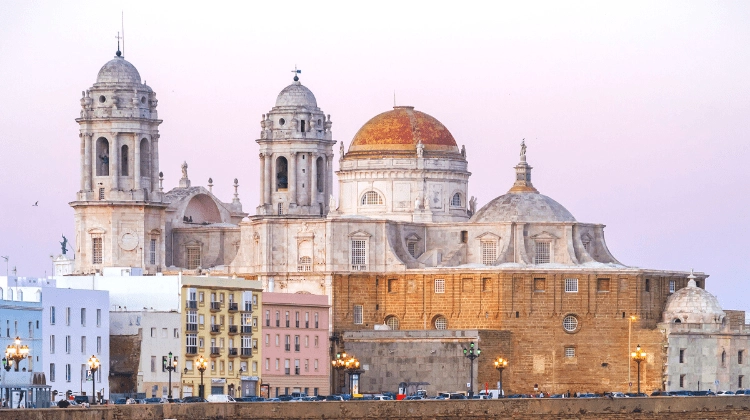
The magnificent Cádiz Cathedral dominates the waterfront with its golden dome and distinctive twin towers. Climb the Torre del Reloj for views across the rooftops and out towards the Atlantic Ocean.
From here, wander through the Barrio del Pópulo, one of the oldest parts of the city, where medieval arches, atmospheric streets and small squares give you a glimpse of Cádiz’s long history.
Continue to the Roman Theatre, discovered in 1980, and then make your way towards the Mercado Central de Abastos. This busy market is a great place to see the day’s seafood catch and sample local specialities from the food stalls.
For lunch, try pescaíto frito, a selection of lightly battered fried fish, or Cádiz’s famous tortillitas de camarones.
In the afternoon, follow the seafront towards Castillo de Santa Catalina and Playa de la Caleta, a small sandy beach framed by historic fortifications. This is one of Cádiz’s most atmospheric spots, particularly as the afternoon light softens.
If you have time, continue through Parque Genovés, a beautifully landscaped park overlooking the Atlantic, before wandering back through the old town.
Cádiz is wonderfully compact, and much of its charm comes from exploring without a strict plan. You’ll find colourful buildings, traditional tapas bars, tiny plazas and glimpses of the sea at the end of narrow streets.
Return to El Puerto by ferry in the late afternoon or early evening, checking the last departure time before you start exploring.
Insider Tip: Cádiz is one of the windiest cities in Spain, particularly when the Levante blows from the east. The ferry can be suspended in strong winds, so keep your plans flexible. If you have a choice of days, take the boat when the weather is calm and save your beach day for later.
Day 15: Enjoy the Beach and a Rest Day
After almost two weeks on the road, a day without driving or sightseeing is well deserved.
Spend the morning on the beach, enjoy a leisurely lunch overlooking the water or simply relax at the campsite. This is also a good opportunity to catch up on laundry, clean the motorhome and restock supplies before continuing along the Costa de la Luz.
If you’re feeling energetic, take a walk along the coast or explore more of El Puerto’s waterfront. There are several beaches around the town, and the surrounding coastline is particularly lovely outside the busiest summer months.
For a final evening, head into town for tapas and a glass of locally produced sherry, or enjoy a relaxed meal near the beach.
Tomorrow, you’ll continue south along the Costa de la Luz, where some of Andalucía’s most beautiful Atlantic beaches, white villages and dramatic coastal scenery await.
Where to Stay in El Puerto de Santa María
Camping TAIGA Puerto Santa María is a large, well-equipped campsite directly opposite Playa de la Puntilla. It’s an excellent base for a three-night stay, with the beach just across the road and easy access to El Puerto and the passenger ferry to Cádiz.
The campsite has a mixture of sunny and shaded pitches among pine trees, with electric hook-ups available for an additional charge. Facilities include modern toilet and shower blocks, a motorhome service point, laundry facilities, a supermarket, restaurant and a large outdoor swimming pool, which opens seasonally.
One of the biggest advantages is the location. You can walk into El Puerto’s historic centre in around 25–30 minutes, or cycle along the local cycle paths. The passenger ferry terminal for Cádiz is approximately 20–30 minutes away on foot, or around 10 minutes by bicycle. The crossing takes roughly 30 minutes and brings you conveniently close to Cádiz’s old town.
The campsite is open year-round and offers ACSI CampingCard discounts during eligible low-season periods. Prices vary considerably by season, and electricity may be charged separately, so check the total when booking.
Insider Tip: Ask for a shaded pitch among the pine trees if you’re visiting during warmer months. The campsite is popular, particularly in summer, so booking ahead is sensible. The swimming pool is seasonal, but the beach is right opposite and perfect for a relaxing day between sightseeing trips.
Park4Night: Camping TAIGA Puerto Santa María #6399
Coordinates: N 36°35’21.3468” W 6°14’19.716”
Day 16: El Puerto de Santa María to Tarifa via Vejer de la Frontera and Bolonia
Distance: Approximately 145km
Driving Time: Around 2 hours 30 minutes, excluding stops
Today you’ll follow one of Andalucía’s most beautiful stretches of coastline, travelling south along the Costa de la Luz towards Tarifa, the southernmost town on mainland Europe.
After the busy cities of the past fortnight, this part of Spain feels wonderfully different. Expect long Atlantic beaches, rolling countryside, whitewashed villages and views across the Strait of Gibraltar towards the mountains of Morocco.
Leaving El Puerto de Santa María, follow the A-48 towards Chiclana de la Frontera and Conil, before turning inland to visit one of Andalucía’s prettiest white villages.
Explore Vejer de la Frontera
Perched high on a hill above the surrounding countryside, Vejer de la Frontera is a beautiful pueblo blanco with narrow cobbled streets, whitewashed houses and spectacular views towards the Atlantic.
Park outside the historic centre and explore on foot, as the streets are narrow, steep and unsuitable for motorhomes.
Start at Plaza de España, a charming square surrounded by traditional buildings and cafés, with a colourful tiled fountain at its centre. From here, wander through the old town’s maze of streets, passing flower-filled courtyards, Moorish archways and viewpoints overlooking the surrounding countryside.
The medieval town walls and gates are reminders of Vejer’s long history, while the Castillo de Vejer occupies one of the highest points in the village.
Vejer also has a strong food scene, with excellent restaurants serving traditional Andalusian dishes alongside Moroccan-inspired flavours, reflecting the region’s historic connections with North Africa.
Allow a couple of hours to explore, enjoy a coffee and take in the views before continuing south towards the coast.
Explore Bolonia Beach and Baelo Claudia
From Vejer, follow the N-340 towards Tarifa, turning off towards Bolonia for one of the highlights of this section of the route.
Playa de Bolonia is an enormous sweep of golden sand backed by dunes and pine-covered hills. It’s one of the most beautiful beaches in southern Spain, with clear turquoise water and a wonderfully undeveloped setting.
At the western end of the beach, the enormous Duna de Bolonia rises above the coastline. Climbing the dune is hard work, particularly in soft sand, but the views along the coast are spectacular.
Just behind the beach you’ll find the remarkable Roman ruins of Baelo Claudia, one of Spain’s most impressive coastal archaeological sites.
The ancient town was an important Roman trading centre, particularly for the production of salted fish and garum, a fermented fish sauce exported throughout the Roman Empire. Today, you can walk among the remains of its forum, temples, theatre, baths and fish-processing factories, with the Atlantic Ocean providing an extraordinary backdrop.
The site is well worth visiting, particularly if you’ve enjoyed the Roman remains in Mérida earlier in the itinerary.
If the weather is good, spend some time on the beach before continuing towards Tarifa.
Insider Tip: The road down to Bolonia is winding and can be busy during summer. There are also parking restrictions around the beach, particularly for larger motorhomes. Check the access and parking arrangements before committing to the descent, and don’t assume that overnight parking is permitted.
Explore Tarifa
Continue along the N-340 towards Tarifa, where the Atlantic Ocean meets the Mediterranean Sea at the Strait of Gibraltar.
Tarifa is famous for its strong winds, which make it one of Europe’s leading destinations for kitesurfing and windsurfing. Even if you’re not interested in watersports, the town has a relaxed atmosphere, excellent beaches and a fascinating historic centre.
Wander through the Puerta de Jerez, the medieval gateway into the old town, and explore the narrow streets lined with whitewashed buildings, independent shops and lively tapas bars.
The Castillo de Guzmán el Bueno, an imposing fortress overlooking the harbour, has guarded the Strait of Gibraltar for centuries and offers excellent views towards Morocco.
One of Tarifa’s most unusual landmarks is the causeway leading to Isla de las Palomas, where the Atlantic and Mediterranean meet. The island itself has restricted access, but the approach provides a memorable view of the two seas on either side.
On a clear day, the mountains of North Africa appear remarkably close, just across the water. It’s an extraordinary reminder of how narrow the Strait of Gibraltar is at this point.
If you have time, head to Playa de Los Lances, a huge sandy beach stretching north from Tarifa, where colourful kites often fill the sky.
Tarifa is also an excellent place to enjoy fresh seafood, particularly locally caught tuna, which is a speciality along this stretch of the Andalusian coast.
Tarifa is also a wonderful place to extend your stay for a few days if you have time. With its beautiful beaches, laid-back atmosphere, excellent seafood restaurants and views across to Morocco, it’s somewhere you can easily settle into a slower pace of travel. Spend your days walking along the coast, watching the kitesurfers, exploring the old town or simply relaxing on the beach. You can also take a whale and dolphin-watching trip into the Strait of Gibraltar, where several species can be seen throughout the year. If you’re following this itinerary over six to eight weeks rather than 30 days, Tarifa would be one of our top choices for adding a couple of extra nights
Where to Stay in Tarifa
Camping Torre is a lovely coastal campsite around 6km east of Tarifa, with spectacular views across the Strait of Gibraltar towards Morocco. It’s a great choice if you’re planning to extend your stay and enjoy a few days by the sea.
The campsite is divided into two areas by the coastal road. The upper section has terraced pitches with panoramic sea views, while the lower section offers more open pitches close to the water. A pedestrian underpass connects the two areas. Some pitches are exposed to the wind, so choose carefully, particularly when the Levante is blowing.
Open year-round, the facilities include clean toilet and shower blocks, electric hook-ups, fresh water, motorhome waste disposal, laundry facilities and a seasonal swimming pool. Electricity is limited to 5 amps, and WiFi is mainly available around reception.
There’s access to the shoreline from the campsite, although the nearest substantial sandy beach is a short walk away. Tarifa itself is best reached by taxi or vehicle, as cycling along the main road isn’t particularly pleasant.
Insider Tip: The coastal road can be noisy and the most exposed pitches offer little protection from strong winds. Also check your phone’s network selection, as some visitors have reported their phones connecting to Moroccan networks across the Strait, potentially triggering roaming charges.
Park4Night: Camping Torre #55742
Coordinates: N 36°3’22.2768” W 5°39’32.4864”
Days 17–18: Tarifa to Málaga via the Costa del Sol
Distance: Approximately 165km
Driving Time: Around 2 hours 30 minutes, excluding stops
Leaving Tarifa, follow the N-340 towards Algeciras, enjoying the final views across the Strait of Gibraltar towards Morocco. As you round the bay, the enormous Rock of Gibraltar comes into view, rising dramatically above the surrounding coastline.
From here, the route continues east along the Costa del Sol, where the wild Atlantic scenery gradually gives way to sheltered Mediterranean beaches, busy resorts and mountains rising behind the coast.
Today’s drive takes you past Estepona and Marbella before reaching Málaga, where you’ll spend at least two nights. There’s plenty to see along the way, but we’d recommend choosing just one stop rather than trying to explore every town.
Optional Detour: Gibraltar
Gibraltar is a British Overseas Territory occupying a small peninsula at the southern tip of Spain. Despite its size, there’s plenty to see, from the famous Rock and its Barbary macaques to historic fortifications, caves and spectacular views across the Strait.
We wouldn’t recommend taking your motorhome into Gibraltar. Instead, park on the Spanish side at Area de Autocaravanas Alcaidesa Marina (where you can also stay the night) and walk across the border. This is a much more practical option, particularly for larger motorhomes, and avoids the narrow streets, traffic and limited parking within Gibraltar itself.
From the marina, it’s a short walk to the border crossing. You’ll need your passport, and once you’ve crossed, you can walk or take a bus towards Gibraltar’s centre.
One of the highlights is visiting the Upper Rock Nature Reserve, home to Gibraltar’s famous Barbary macaques, the only free-ranging wild monkeys in Europe. You can also explore St Michael’s Cave, the Great Siege Tunnels and the various viewpoints overlooking Spain, the Mediterranean and the African coastline.
Main Street is Gibraltar’s main shopping area, lined with British-style shops, pubs and restaurants. You’ll also notice familiar red telephone boxes and postboxes, giving the territory a distinctly British feel.
Allow at least half a day for Gibraltar, and longer if you want to explore the Upper Rock properly. If you plan to visit several attractions, check the available ticket packages before arriving.
Insider Tip: The border can become busy, particularly during weekends and holidays, so allow extra time for crossing in both directions. Gibraltar is outside the EU customs territory, so check customs allowances if you’re planning to shop.
From here, the route continues east along the Costa del Sol, passing Estepona, Marbella and Fuengirola before reaching Málaga. The scenery changes considerably as you leave the wild Atlantic coastline behind, with busy Mediterranean resorts, apartment developments and marinas backed by the mountains of southern Andalucía.
Although Estepona and Marbella both have attractive old towns and lovely waterfronts, we wouldn’t recommend planning sightseeing stops in either when travelling by motorhome. Parking can be difficult, particularly for larger vehicles, and finding somewhere suitable can quickly become a frustrating and time-consuming exercise.
You may find parking options on Park4Night, but many are roadside spaces, residential streets or shopping centre car parks rather than dedicated motorhome parking areas. These aren’t necessarily suitable for larger vehicles, and security can be a concern, particularly if you’re leaving your motorhome unattended with your belongings inside.
For this reason, we’d recommend treating today as a straightforward travelling day and heading directly to your campsite near Málaga. You’ll have plenty of time to settle in, relax and perhaps enjoy a leisurely evening before exploring the city tomorrow.
The A-7 follows the coast and is toll-free, although traffic can be heavy around Marbella, Fuengirola and the approaches to Málaga. The AP-7 toll motorway offers an alternative along some sections and can be worth considering during particularly busy periods.
Day 18: Explore Málaga
Málaga is one of Andalucía’s most enjoyable cities, with an attractive historic centre, fascinating museums, impressive Moorish architecture and a lively Mediterranean waterfront.
Start your day at the Alcazaba, an 11th-century Moorish fortress overlooking the city. Its defensive walls, courtyards, gardens and decorative arches make it one of Málaga’s most impressive historic attractions.
At the foot of the fortress, you’ll find the Roman Theatre, built during the reign of Emperor Augustus and rediscovered in the 20th century.
Above the Alcazaba stands Castillo de Gibralfaro, which offers spectacular views across Málaga’s rooftops, harbour and coastline. The walk up is steep, particularly during summer, but the panorama from the top is worth the effort.
From here, head into the historic centre to visit Málaga Cathedral, nicknamed La Manquita, or the one-armed lady, because its second tower was never completed.
Málaga is also the birthplace of Pablo Picasso, and the Museo Picasso Málaga houses an important collection of his work in the beautiful Palacio de Buenavista. Art lovers could easily spend a couple of hours here.
For lunch, visit the Mercado Central de Atarazanas, a colourful food market selling fresh seafood, fruit, vegetables and local produce. It’s a great place to sample traditional Andalusian tapas.
Afterwards, wander along Calle Larios, the city’s elegant main shopping street, before heading towards the harbour at Muelle Uno. This redeveloped waterfront area is filled with restaurants and cafés, with views towards the city and its historic landmarks.
If you fancy some time by the sea, continue to Playa de la Malagueta, Málaga’s popular city beach. The beachfront chiringuitos are famous for espetos, sardines grilled over open fires, traditionally in old fishing boats filled with sand.
Málaga is particularly enjoyable in the evening, when the streets and squares fill with people enjoying tapas and drinks. If you’re staying for a third night, you can take your time exploring the city and enjoy a more relaxed day at the beach.
Insider Tip: The Alcazaba and Gibralfaro Castle can be visited on a combined ticket. If you’re planning to see both, start early to avoid the hottest part of the day, particularly between June and September.
Where to Stay in Málaga
Camping Castillo AlMálaga is a small, privately operated motorhome stopover in a natural setting around 3.5km from Málaga city centre. It offers a quieter alternative to the busy coastal parking areas, with views towards the sea and surrounding countryside.
The gated site has around 20 pitches, with fresh water, grey and black waste disposal, toilets, showers, WiFi and laundry facilities. Electric hook-ups are available for an additional charge.
Getting into Málaga is straightforward by taxi or Uber. This makes it convenient for a full day of sightseeing without moving your motorhome.
There is, however, an important consideration for larger vehicles. The campsite is accessed via a 200-metre road with a 12% gradient, and several reviews mention difficult access, uneven ground and relatively small pitches. The facilities are also fairly basic.
Insider Tip: Contact the campsite before booking if you’re travelling in a large or heavy motorhome. The owners can provide a video of the access road, helping you decide if it’s suitable for your vehicle. This is particularly important if you’re towing a trailer or have limited ground clearance.
Park4Night: Camping Castillo AlMálaga #487531
Coordinates: N 36°44’50.568” W 4°24’17.5824”
If you have extra time, Málaga is well worth a third night. You could spend another day enjoying the beaches, exploring more of the city’s museums or simply relaxing before continuing inland towards Antequera and Granada.
Day 19: Málaga to Antequera
Distance: Approximately 55km
Driving Time: Around 50 minutes
Leaving the Mediterranean coast behind, today’s short drive takes you inland into the heart of Andalucía, where the busy resorts of the Costa del Sol give way to olive groves, rolling farmland and dramatic limestone mountains.
Follow the A-45 north from Málaga towards Antequera, climbing gradually through the mountains that separate the coast from Andalucía’s interior. It’s a lovely change of scenery after several days beside the sea, and the short distance means you’ll have plenty of time to explore.
Antequera is one of Andalucía’s most underrated historic towns, with an extraordinary collection of churches, an impressive Moorish fortress and some of Spain’s most important prehistoric monuments. It’s also the gateway to El Torcal, a remarkable natural landscape of sculpted limestone formations.
Explore Antequera
Start with the UNESCO-listed Antequera Dolmens Site, a collection of prehistoric burial monuments dating back more than 5,000 years.
The Dolmen of Menga is particularly impressive, with enormous stone slabs forming a monumental burial chamber. Nearby, the Dolmen of Viera is another fascinating example of Neolithic engineering, while the Tholos of El Romeral lies a short distance away.
These ancient monuments form part of a UNESCO World Heritage Site that also includes the surrounding natural landmarks of El Torcal and La Peña de los Enamorados, the distinctive mountain overlooking Antequera.
After visiting the dolmens, head into Antequera’s historic centre, where whitewashed houses, elegant churches and traditional squares spread across the hillside beneath the Alcazaba.
The Alcazaba de Antequera is a magnificent Moorish fortress with defensive walls, towers and panoramic views over the town and surrounding countryside. Beside it stands the Real Colegiata de Santa María la Mayor, an impressive Renaissance church built in the 16th century.
Antequera has an extraordinary number of churches for a town of its size, and you’ll encounter beautiful Baroque façades, bell towers and historic buildings as you wander through the streets.
For lunch, try porra antequerana, a thick, chilled tomato soup similar to salmorejo, traditionally served with chopped egg and ham. It’s one of the town’s best-known local dishes.
Visit El Torcal de Antequera
If there’s one place we’d strongly recommend making time for today, it’s El Torcal de Antequera, around 15km south of the town.
This extraordinary natural park is famous for its surreal limestone formations, created over millions of years as ancient seabed sediments were uplifted and gradually eroded by wind and water.
The result is a remarkable landscape of stacked rock towers, narrow passages and enormous stone formations that seem almost impossibly balanced.
Several marked walking routes allow you to explore the landscape, including the shorter green route of approximately 1.5km and the longer yellow route of around 3km. Both take you through some of El Torcal’s most spectacular scenery.
The walking isn’t particularly strenuous, but the ground is rocky and uneven, so sturdy footwear is essential. The limestone can also become very slippery after rain.
Keep an eye out for Spanish ibex, which are often seen among the rocks, along with griffon vultures soaring overhead.
The visitor centre has information about the geology and wildlife of the area, and there’s a viewpoint with sweeping views towards Málaga and the Mediterranean on clear days.
Insider Tip: El Torcal is one of Andalucía’s most impressive natural attractions, but access needs planning if you’re travelling in a motorhome. The mountain road is steep and winding, and parking at the upper visitor centre is limited. During busy periods, private vehicle access may be restricted, with shuttle transport operating from a lower parking area. Check the current arrangements before setting off, particularly if you’re driving a large motorhome.
Where to Stay in Antequera
The municipal motorhome aire in Antequera is a convenient, free overnight stop within walking distance of the historic centre. Located on Calle Miguel de Cervantes, beside the football stadium and sports complex, it’s a practical choice for exploring the town before continuing towards Granada.
There are 16 designated motorhome spaces, with free fresh water, grey waste disposal and chemical toilet emptying. The aire is open year-round, although there are no electric hook-ups, toilets or showers.
Antequera’s historic centre is approximately 10–15 minutes away on foot, and there are supermarkets, cafés and shops nearby, making it a useful place to stock up on supplies.
The main drawback is that the aire is beside a fairly busy road, so some traffic noise is inevitable. Several pitches are also sloping, and levelling ramps may be needed. Spaces are limited and the aire is frequently full, particularly during busy periods.
Insider Tip: The marked bays can be too short for larger motorhomes, and access to the service point can be awkward. Arrive early if possible, and don’t assume that parking in the surrounding streets is permitted simply because other motorhomes are doing so. Local parking restrictions are enforced.
Park4Night: Área Autocaravanas Antequera #13989
Coordinates: N 37°1’17.1084” W 4°34’19.3548”

Days 20–21: Antequera to Granada
Distance: Approximately 100km
Driving Time: Around 1 hour 15 minutes
Leaving Antequera, follow the A-92 east towards Granada, travelling through a landscape of rolling hills, olive groves and traditional Andalusian villages. As you approach the city, the mountains of the Sierra Nevada rise dramatically in the distance, providing a spectacular backdrop to one of Spain’s most beautiful destinations.
Granada is one of the highlights of this motorhome itinerary, and we’d recommend spending at least two nights here. Its extraordinary Moorish architecture, atmospheric old quarters and lively tapas scene deserve more than a hurried afternoon.
Today’s relatively short drive gives you time to settle into your overnight stop and explore the city, with tomorrow reserved for the magnificent Alhambra.
Day 20: Explore Granada’s Historic Centre and Albaicín
Once you’ve parked your motorhome, head into Granada’s historic centre, where narrow streets, elegant squares and historic buildings reflect the city’s fascinating past.
Start at Granada Cathedral, an impressive Renaissance building constructed after the Christian conquest of the city in 1492. Nearby, the Royal Chapel houses the tombs of Ferdinand and Isabella, the Catholic Monarchs whose conquest brought the last Muslim kingdom in Spain to an end.
From here, wander through the Alcaicería, a network of narrow shopping streets that once formed Granada’s silk market. Today, the colourful stalls sell ceramics, textiles, leather goods and souvenirs, but the area still retains something of its traditional bazaar atmosphere.
Continue towards Plaza Nueva, one of Granada’s oldest squares, before following the Carrera del Darro alongside the River Darro. This beautiful cobbled street passes historic stone bridges, traditional houses and the remains of old Moorish buildings, with glimpses of the Alhambra rising above.
It’s one of Granada’s loveliest walks, particularly in the late afternoon when the light softens against the ancient stonework.
From here, explore the Albaicín, Granada’s historic Moorish quarter and a UNESCO World Heritage Site. Its maze of steep, narrow streets is lined with whitewashed houses, traditional carmenes (houses with enclosed gardens) and small squares overlooking the city.
Make your way to the Mirador de San Nicolás, one of Granada’s most famous viewpoints, where the Alhambra stands against the mountains of the Sierra Nevada. It’s particularly beautiful around sunset, although it can become very busy.
The Albaicín is best explored slowly, allowing time to wander through its winding streets and discover quieter viewpoints away from the crowds.
For dinner, head back towards the centre and enjoy Granada’s famous tapas culture. Many traditional bars still serve a complimentary tapa with each drink, making an evening of bar-hopping a great way to sample local food.
Insider Tip: Granada is a city of steep hills and cobbled streets, particularly around the Albaicín. Wear comfortable shoes and don’t underestimate the walking involved. Local minibuses are useful for reaching the higher parts of the old town if you’d prefer to save your legs.
Day 21: Visit the Alhambra
Today is dedicated to one of Spain’s greatest attractions, the Alhambra.
Perched on a wooded hill overlooking Granada, this magnificent palace and fortress complex is among the finest surviving examples of Islamic architecture in Europe and a UNESCO World Heritage Site.
Originally developed as a royal residence by the Nasrid rulers of Granada, the Alhambra is famous for its intricate plasterwork, beautifully decorated courtyards, reflecting pools and peaceful gardens.
The highlight for many visitors is the Nasrid Palaces, where rooms such as the Hall of the Ambassadors and the spectacular Court of the Lions showcase the extraordinary craftsmanship of medieval Islamic Spain.
You’ll also explore the Alcazaba, the oldest part of the complex, where defensive towers offer panoramic views across Granada and the surrounding mountains.
The Generalife gardens are another highlight, with ornamental pools, fountains, flower-filled terraces and shaded pathways that once provided a peaceful retreat for Granada’s rulers.
Allow at least three to four hours for your visit, although it’s easy to spend longer exploring the palaces, gardens and grounds.
Booking tickets well in advance is essential, particularly during spring, summer and autumn. Tickets for the Nasrid Palaces are issued with a specific entry time, and you must arrive at the palace entrance for your allocated slot.
You’ll also need the original identification document used when booking, as tickets are personalised and identity checks are carried out.
After visiting the Alhambra, you might like to explore the Realejo, Granada’s former Jewish Quarter, which has a more relaxed atmosphere than the busy streets around the cathedral.
Alternatively, spend the afternoon enjoying the city’s cafés, browsing its independent shops or relaxing over a long lunch.
If you still have energy in the evening, consider visiting a traditional flamenco performance in Sacromonte, the hillside neighbourhood famous for its cave houses and distinctive zambra flamenco tradition.
Insider Tip: Don’t leave booking the Alhambra until you arrive in Granada. Tickets regularly sell out weeks in advance, particularly for the Nasrid Palaces. Book through the official Alhambra website and plan the rest of your Granada sightseeing around your allocated entry time. If you want to visit at a particular time of day, book as early as possible.
Where to Stay in Granada
MB Vega Nevada is a small, privately run motorhome aire on the outskirts of Granada, in a peaceful rural setting around 5km from the city centre. With just ten pitches, it’s a friendly alternative to the larger motorhome parks and a convenient base for exploring Granada and the Alhambra.
Open year-round, the aire receives consistently excellent reviews for their warm welcome and helpful local advice. Facilities include fresh water, grey and black waste disposal, toilets, hot showers and WiFi. Electricity isn’t generally available, so it’s best suited to self-contained motorhomes.
For convenient sightseeing, take a taxi or Uber into central Granada. Cycling is another possibility, with visitors reporting a journey of around 15 minutes into the city. We’d recommend taking a taxi for your Alhambra visit, particularly if you have an early entry time.
Park4Night: MB Vega Nevada #574689
Coordinates: N 37°10’21.792” W 3°38’9.5748”
Day 22: Granada to Trevélez via the Sierra Nevada
Distance: Approximately 100km
Driving Time: Around 2 hours 15 minutes
Leaving Granada, today’s route takes you into the magnificent Sierra Nevada mountains and through the Alpujarras, one of Andalucía’s most distinctive and beautiful regions.
The landscape changes dramatically as you climb away from Granada, with olive groves giving way to rugged mountains, deep valleys and traditional whitewashed villages clinging to steep hillsides.
The Alpujarras are famous for their Berber-influenced architecture, narrow streets and flat-roofed houses, a legacy of the region’s Moorish past. After the fall of Granada in 1492, these remote mountain valleys became one of the last strongholds of the Moriscos, and their influence is still visible in the villages today.
Today’s drive is one of the most scenic of the entire itinerary, but it’s also one that requires care in a motorhome. The mountain roads are winding, with steep gradients and some narrow sections, so allow plenty of time and avoid rushing.
Follow the A-44 south from Granada before turning towards Lanjarón and the Alpujarras on the A-348. From here, continue along the A-4132 through the mountain villages towards Trevélez.
Explore the Alpujarras Villages
Your first stop could be Lanjarón, a traditional spa town known for its natural mineral water and historic thermal baths. It’s an attractive place to stretch your legs, with fountains, cafés and views towards the surrounding mountains.
Continue towards Órgiva, the main commercial centre of the western Alpujarras, before climbing higher into the mountains towards Pampaneira, Bubión and Capileira.
These three villages are among the most beautiful in the region, with whitewashed houses, narrow cobbled streets and distinctive flat roofs built from local stone and clay.
Pampaneira is particularly popular, with craft shops selling colourful woven rugs, ceramics and traditional local products. The village is a lovely place to wander, although the steep streets can be challenging in hot weather.
Higher up the valley, Bubión and Capileira offer equally beautiful mountain scenery and a quieter atmosphere away from the busiest tourist areas.
Capileira sits at around 1,400 metres above sea level, with spectacular views across the Poqueira Gorge and towards the high peaks of the Sierra Nevada.
If you’re travelling in a smaller motorhome and have time, you could stop to explore one or two of these villages. However, parking is limited, particularly in Pampaneira, and the roads between the villages are steep and winding.
For larger motorhomes, we’d recommend enjoying the mountain scenery from the main road and being selective about where you stop.
Continue to Trevélez
From the Poqueira Valley, continue east through the mountains towards Trevélez, one of Spain’s highest villages, sitting at approximately 1,500 metres above sea level.
The drive is spectacular, with winding roads following the contours of the mountains and views across deep valleys, terraced hillsides and traditional villages.
Trevélez is famous throughout Spain for its jamón serrano, which is traditionally cured in the cool, dry mountain air. The village has a long history of ham production, and you’ll find shops selling locally cured hams alongside other regional specialities.
The village is divided into three neighbourhoods, Barrio Bajo, Barrio Medio and Barrio Alto, connected by steep, narrow streets and steps.
Take time to explore the traditional houses, small squares and mountain views, stopping for a coffee or a plate of locally produced ham along the way.
Trevélez is also a popular base for hiking in the Sierra Nevada National Park, with trails leading into the surrounding mountains and towards Mulhacén, the highest mountain on mainland Spain.
If you enjoy walking, this is another excellent place to extend your itinerary by a day or two. There are routes for different abilities, although the higher mountain trails require suitable equipment and careful planning.
Insider Tip: The Alpujarras are beautiful but not particularly motorhome-friendly in places. Many village streets are far too narrow for larger vehicles, and parking can be limited. Stick to the main roads, use designated parking areas and avoid following satnav shortcuts through village centres. In winter, snow and ice can affect the higher roads, so check conditions before travelling.
Where to Stay in Trevélez
The free overnight parking area in Trevélez is a convenient place to stop while exploring the village and surrounding Sierra Nevada mountains. Located in Barrio Medio, the middle neighbourhood of Trevélez, it offers a relatively level parking area within easy walking distance of local shops, restaurants and the village’s famous ham producers.
This is a public car park rather than a dedicated motorhome aire, so there are no electric hook-ups or motorhome waste disposal facilities. However, there is a nearby drinking water fountain, public toilets and a hot shower.
Insider Tip: This is a practical mountain stop for self-contained motorhomes, but be prepared for cold nights, even outside winter. At around 1,500 metres above sea level, temperatures can drop considerably after sunset.
Park4Night: Trevélez, Barrio Medio Parking #25682
Coordinates: N 37°0’7.5672” W 3°16’7.248”
Days 23-24: Trevélez to Nerja via the Costa Tropical
Distance: Approximately 125km
Driving Time: Around 2 hours 45 minutes, excluding stops
After a night high in the Sierra Nevada, today’s route takes you back towards the Mediterranean, descending through the eastern Alpujarras before following the beautiful Costa Tropical towards Nerja.
It’s a wonderfully varied drive, beginning among rugged mountains and traditional villages before reaching a coastline of sheltered beaches, subtropical fruit plantations and attractive seaside towns.
Leaving Trevélez, follow the A-4132 east towards Bérchules and Cádiar, before continuing towards the coast via the A-345 and A-346. These mountain roads are winding, with steep gradients and some narrow sections, so allow plenty of time and take care on the descents.
If you’re travelling in a large motorhome or aren’t comfortable driving mountain roads, consider returning west towards Órgiva and joining the A-44 towards Motril. It’s a longer route, but uses more major roads for much of the journey.
Once you reach the coast, join the A-7 west towards Nerja, passing through the Costa Tropical, a stretch of Andalucía known for its unusually mild climate and the cultivation of avocados, mangoes and other subtropical fruits.
Explore the Costa Tropical
If you’d like to break the journey, Salobreña is a lovely place to stop, with a striking whitewashed old town perched on a rocky hill above the Mediterranean.
The town is crowned by a Moorish castle, and its narrow streets offer beautiful views across the coastline and surrounding agricultural plains.
However, the historic centre has steep, narrow roads that aren’t suitable for motorhomes, so only stop if you’ve identified suitable parking outside the old town.
Further west, Almuñécar is another attractive coastal town, with a long seafront, traditional tapas bars and the impressive Castillo de San Miguel overlooking the Mediterranean.
Both towns are worth exploring if you have extra time, but we’d recommend choosing just one stop today, particularly after the mountain driving.
Continue along the A-7 towards Nerja, where the coastline becomes increasingly dramatic, with rocky headlands, secluded coves and steep cliffs dropping into the turquoise sea.
Explore Nerja
Nerja is one of the prettiest towns on Andalucía’s eastern Mediterranean coast, with a charming historic centre, beautiful beaches and spectacular views towards the mountains.
Start at the famous Balcón de Europa, a magnificent viewpoint built on a rocky promontory overlooking the Mediterranean. Once part of a coastal fortress, it’s now the heart of Nerja, with palm trees, cafés and sweeping views along the coastline.
From here, wander through the old town’s narrow streets, where whitewashed buildings, small squares and traditional restaurants create a relaxed atmosphere.
Nerja has several beautiful beaches, including Playa de Burriana, a broad sandy beach backed by restaurants and chiringuitos, and Playa de Calahonda, a picturesque cove tucked beneath the cliffs beside the Balcón de Europa.
If you’re visiting in warmer weather, it’s worth allowing time for a swim or simply relaxing by the sea after the mountain roads.
One of Nerja’s biggest attractions is the spectacular Cueva de Nerja, located a few kilometres east of the town near Maro.
Discovered in 1959, this enormous cave system contains extraordinary stalactites, stalagmites and vast underground chambers. Some of the formations are among the largest of their kind in the world, and the illuminated visitor route provides a fascinating glimpse into the area’s geological history.
The caves are extremely popular, particularly during summer, so booking tickets in advance is advisable.
Nearby, the village of Maro is also worth a visit if you have time, with attractive whitewashed streets and beautiful coastal scenery.
For dinner, head back into Nerja’s old town, where you’ll find plenty of traditional Andalusian restaurants serving fresh seafood, tapas and regional specialities.
Insider Tip: Nerja is another town where motorhome parking can be challenging, particularly during summer. The streets around the historic centre are narrow, and many beach car parks have restrictions. We’d recommend heading directly to your overnight stop and exploring on foot or using local transport rather than trying to park close to the Balcón de Europa.
Day 24: Relax on Nerja’s Beaches
After the winding mountain roads and busy sightseeing days, Nerja is a wonderful place to stop for a couple of nights and enjoy the Mediterranean.
With Playa El Playazo just across the road from the campsite, you can leave your motorhome parked and spend the day on the beach. This long stretch of coastline is quieter and less developed than some of Nerja’s central beaches, with plenty of space for a morning walk, a swim or an afternoon relaxing in the sunshine.
If you’d prefer somewhere livelier, head to Playa de Burriana, where you’ll find beachfront restaurants, watersports and traditional chiringuitos serving fresh seafood. It’s a great place to enjoy a leisurely lunch overlooking the Mediterranean.
You could also visit the nearby village of Maro, known for its dramatic coastal scenery and beautiful coves. The coastline around Maro is particularly attractive, with clear water, rocky cliffs and opportunities for kayaking when conditions are suitable.
Alternatively, spend the day doing very little. Catch up on laundry, enjoy a long lunch, wander into Nerja for an evening meal or simply relax at the campsite.
Nerja is also somewhere we’d happily recommend staying for a third night. With beautiful beaches, a lovely old town and the mountains rising behind the coast, it’s an excellent place to enjoy a few days without driving.
Where to Stay in Nerja
Camping Cortijo de San Miguel is a lovely, green campsite on the western edge of Nerja, just across the road from Playa El Playazo. It’s a great choice for enjoying the beach and exploring the town without having to move your motorhome.
The campsite has around 73 pitches surrounded by trees and subtropical vegetation, with different pitch sizes available, including XL and XXL spaces for larger vehicles. Facilities include electric hook-ups, fresh water, grey and black waste disposal, toilets, hot showers, WiFi and laundry facilities.
One of its biggest advantages is the location. The beach is just a couple of minutes away on foot, and you can walk along the coast into Nerja in approximately 25–30 minutes, or cycle there in around 10 minutes. It’s an easy way to visit the Balcón de Europa, enjoy the restaurants in the old town and return to your motorhome without worrying about parking.
The campsite is open year-round, with recent visitors reporting prices of approximately €25–35 per night for two people, depending on pitch size, with electricity usually costing extra. Larger pitches and peak-season stays can be more expensive.
The setting is attractive and generally peaceful, although pitches near the road can experience some traffic noise. Reviews are mixed regarding the number and cleanliness of the showers and toilets, particularly when the campsite is busy.
Insider Tip: This is a popular campsite, so booking ahead is sensible if you’re visiting during spring or summer. Check the pitch dimensions carefully if you’re travelling in a larger motorhome, as some of the standard spaces are quite small.
Park4Night: Camping Cortijo de San Miguel #29162
Coordinates: N 36°44’44.9016” W 3°53’51.3996”

Days 25–27: Nerja to Cabo de Gata Natural Park
Distance: Approximately 190km
Driving Time: Around 2 hours 30 minutes
Leaving Nerja, follow the A-7 east towards Almería and the extraordinary landscapes of Cabo de Gata-Níjar Natural Park, one of the most beautiful and unspoilt stretches of Spain’s Mediterranean coastline.
The scenery changes dramatically as you travel east. The green hills and subtropical plantations of the Costa Tropical gradually give way to dry valleys, rugged mountains and enormous areas of agricultural greenhouses. Beyond Almería, the landscape becomes increasingly wild, with volcanic hills, dusty plains and a coastline of dramatic cliffs and secluded beaches.
Cabo de Gata is one of the driest regions in mainland Europe, and its volcanic landscapes feel completely different from the busy resorts of the Costa del Sol. Much of the coastline is protected from large-scale development, leaving traditional fishing villages, beautiful beaches and spectacular natural scenery.
We’ve allowed three nights here because it’s somewhere that deserves time. With a campsite at Los Escullos, you can enjoy the surrounding coastline on foot, explore some of the natural park’s most beautiful villages and beaches, and still have time to relax.
Day 25: Arrive at Los Escullos and Explore La Isleta del Moro
After the drive from Nerja, head directly to Camping Los Escullos and settle in for your three-night stay.
The campsite is surrounded by dramatic volcanic scenery, with rocky hills rising behind it and the Mediterranean just a short distance away. It’s a wonderful place to unwind after several weeks on the road.
Spend the afternoon exploring the coastline around Los Escullos, where you’ll find beautiful beaches, unusual volcanic rock formations and the historic Castillo de San Felipe, an 18th-century coastal fortification built to protect the area from pirate attacks.
The surrounding coastal paths offer spectacular views across the Mediterranean, particularly in the softer light of late afternoon.
Nearby, La Isleta del Moro is one of Cabo de Gata’s prettiest fishing villages, with traditional whitewashed houses, colourful fishing boats and a small beach sheltered by rocky headlands.
The village has a wonderfully relaxed atmosphere, and its waterfront restaurants are known for fresh fish and seafood. It’s a lovely place to enjoy a leisurely lunch or an evening meal overlooking the sea.
If you’d prefer not to go anywhere after your drive, simply enjoy the campsite facilities and save exploring for tomorrow.
Day 26: Explore San José, Playa de los Genoveses and Playa de Mónsul
Today is dedicated to some of Cabo de Gata’s most spectacular beaches.
San José is a relaxed coastal village with whitewashed buildings, a small marina and a sandy beach backed by low volcanic hills. It’s one of the main visitor centres within the natural park and a useful starting point for exploring the coastline to the south.
Spend some time wandering around the village, enjoying a coffee overlooking the harbour or browsing the small shops before heading towards the beaches.
Playa de los Genoveses is a magnificent crescent of golden sand backed by dunes and natural vegetation. With no large hotels or beachfront developments, it remains one of the most beautiful beaches on Spain’s Mediterranean coast.
Further along the coast, Playa de Mónsul is famous for its enormous sand dune and dramatic volcanic rock formations. The contrast between the dark rocks, golden sand and clear turquoise water creates an extraordinary landscape.
The beach has appeared in several films, including Indiana Jones and the Last Crusade, and is particularly beautiful in the early morning or late afternoon.
Both beaches are reached along an unpaved access road from San José, and private vehicle access is regulated during the busiest summer months. Seasonal shuttle buses operate when restrictions are in place.
If you’re travelling in a large motorhome, we wouldn’t recommend attempting the beach access road. Instead, leave your vehicle at the campsite and arrange alternative transport, checking seasonal shuttle and taxi options before setting off.
There are very few facilities at either beach, so take plenty of water, food and sun protection. Natural shade is limited, and the beaches can become exposed when the wind picks up.
After a day exploring, return to Los Escullos for a relaxed evening at the campsite.
Day 27: Rodalquilar, Playa del Playazo and a Relaxed Afternoon
For your second full day, explore the northern part of the natural park, where the volcanic landscape is particularly striking.
Rodalquilar is a small village surrounded by rugged mountains and the remains of historic gold-mining operations. Mining played an important role in the area’s past, and the abandoned industrial buildings provide an interesting contrast to the peaceful village and surrounding scenery.
Today, Rodalquilar has a relaxed atmosphere, with small cafés, independent shops and traditional whitewashed houses.
The coastline around Rodalquilar is also excellent for walking, with trails leading through volcanic hills and along dramatic cliffs overlooking the sea.
If you’re interested in photography, this is one of the most rewarding parts of the natural park, particularly in the early morning or late afternoon when the light brings out the colours of the rocks.
Alternatively, make today a proper rest day. Enjoy the campsite swimming pool, take a walk to the nearby beach or spend the afternoon relaxing in the sunshine.
After several weeks of travelling, there’s no need to fill every day with sightseeing, and Cabo de Gata is one of the best places on this itinerary to slow down.
Insider Tip: Cabo de Gata is a fantastic destination for motorhome travellers, but it’s important to plan how you’ll explore. Many of the smaller roads and beach access tracks are narrow, unpaved or unsuitable for larger vehicles, and public transport within the natural park is limited. If you’re travelling in a large motorhome, consider hiring a car locally or arranging taxis for the more distant beaches and villages. You can still enjoy the coastline around Los Escullos on foot without moving your motorhome.
Where to Stay in Cabo de Gata
Camping Los Escullos is an excellent base for exploring Cabo de Gata-Níjar Natural Park, surrounded by dramatic volcanic scenery and within walking distance of the beautiful coastline around Los Escullos.
This large, well-equipped campsite has around 208 pitches, many with shade, and is particularly suitable for a longer stay. Facilities include electric hook-ups, fresh water, grey and black waste disposal, modern toilet and shower blocks, laundry facilities, WiFi, a restaurant, small supermarket and swimming pool.
The nearest beach is approximately 20 minutes away on foot along a coastal path, and there are lovely walking routes through the surrounding landscape. La Isleta del Moro, one of the natural park’s prettiest fishing villages, is also nearby.
The campsite is open year-round and accepts ACSI CampingCard discounts during eligible periods.
For three nights, it’s a particularly good choice because you can enjoy the pool, restaurant and surrounding walking trails without needing to move your motorhome every day. The campsite is also well positioned for exploring San José, Rodalquilar and some of Cabo de Gata’s most spectacular beaches, although you’ll need transport for the more distant attractions.
Park4Night: Camping Los Escullos #21384
Coordinates: N 36°48’10.4328” W 2°4’39.108”
Day 28: Cabo de Gata to Murcia
Distance: Approximately 230km
Driving Time: Around 2 hours 45 minutes
Leaving Cabo de Gata, head north towards Murcia, following the A-7 through the dry, mountainous landscapes of eastern Andalucía and into the Region of Murcia.
The scenery along this stretch is very different from the beaches and volcanic coastline you’ve just left behind. Expect rugged hills, wide valleys, agricultural landscapes and distant mountain ranges as you travel through one of Spain’s sunniest regions.
Murcia is often overlooked by travellers heading along the Mediterranean coast, but it’s well worth a stop. This lively university city has a beautiful historic centre, impressive Baroque architecture, excellent tapas and a distinctly Spanish atmosphere.
Unlike some of the more tourist-focused cities on this itinerary, Murcia feels like a working Spanish city, with bustling squares, traditional markets and plenty of local life.
Explore Murcia’s Historic Centre
Start your visit at Plaza del Cardenal Belluga, the city’s magnificent central square, dominated by the extraordinary Murcia Cathedral.
The cathedral is one of the most impressive buildings in southeastern Spain, combining Gothic, Renaissance and Baroque architecture. Its elaborate Baroque façade is particularly striking, and the bell tower rises high above the surrounding rooftops.
Opposite the cathedral stands the colourful Episcopal Palace, another beautiful example of Murcia’s historic architecture.
From here, wander through the narrow pedestrian streets of the old town, where you’ll find independent shops, cafés and lively squares.
One of the highlights is the Real Casino de Murcia, a remarkable 19th-century building with lavishly decorated interiors. Despite its name, it’s a historic private members’ club rather than a gambling casino, and parts of the building are open to visitors.
The Moorish-style courtyard, grand ballroom and richly decorated rooms make it one of Murcia’s most memorable attractions.
Continue towards the Teatro Romea, an elegant theatre overlooking a lively square, before making your way to Plaza de las Flores.
This is one of the best places in the city to stop for tapas, with traditional bars spilling out onto the square beneath colourful flower displays.
Murcia is particularly well known for its food, so try a marinera, a crisp breadstick topped with Russian salad and an anchovy, or zarangollo, a traditional dish made with courgettes, onions and eggs.
For something sweet, look out for paparajotes, lemon leaves coated in batter, fried and dusted with sugar and cinnamon. Just remember that the leaf itself isn’t eaten!
Discover Murcia’s Riverside
If you have time after exploring the old town, take a walk along the Segura River, which runs through the heart of Murcia.
The historic Puente de los Peligros, also known as the Old Bridge, is one of the city’s best-known landmarks and offers lovely views along the river.
The landscaped riverside paths are a pleasant place for an afternoon stroll, particularly when the weather is cooler.
Art lovers may also enjoy the Museo Salzillo, dedicated to the celebrated Murcian sculptor Francisco Salzillo and his extraordinary religious sculptures.
Murcia can be extremely hot during summer, so plan your sightseeing for the morning or late afternoon if you’re visiting between June and September.
Insider Tip: Murcia has a compact, largely pedestrianised historic centre, making it ideal for exploring on foot once you’ve parked. Don’t attempt to drive your motorhome into the old town, where streets can be narrow and access restrictions apply.
Where to Stay in Murcia
Área Camper Murcia Río is a well-equipped motorhome aire around 2.5km from Murcia’s historic centre, making it a convenient base for exploring the city without driving into its narrow streets.
The aire has around 60 spaces, with drinking water, grey and black waste disposal, toilets, showers, laundry facilities and optional electric hook-up. There’s also a supermarket nearby, making it a useful stop for stocking up.
One of its biggest advantages is the pleasant walking and cycling route alongside the Segura River into the city centre. Allow around 30–40 minutes on foot, or use local transport if you prefer.
Insider Tip: Satnavs have been known to direct motorhomes to the wrong entrance or through narrow residential streets. Check your approach carefully, particularly in a larger vehicle. There is also very little shade, which is worth considering during Murcia’s hot summers.
Park4Night: Área Camper Murcia Río #315843
Coordinates: N 37°59’20.724” W 1°6’8.4996”
Day 29: Murcia to Mar Menor
Distance: Approximately 55km
Driving Time: Around 45 minutes
Leaving Murcia, head southeast towards the Mar Menor, one of Spain’s most unusual coastal landscapes and a lovely place to slow down after exploring the city.
The Mar Menor is a vast saltwater lagoon separated from the Mediterranean by La Manga, a narrow strip of land lined with beaches and holiday developments. Its shallow, sheltered waters have long made it popular for swimming, sailing and watersports, although water quality has been a significant environmental concern in recent years.
For this stop, we’re heading to Los Alcázares on the western shore of the lagoon. It’s a traditional seaside town with a long promenade, sandy beaches and plenty of places to eat overlooking the water.
After the busy sightseeing days of Andalucía, this is an opportunity to enjoy a more relaxed side of Spain’s Mediterranean coast.
Explore Los Alcázares
Once you’ve settled in, head towards the waterfront and enjoy a walk along the Paseo Marítimo.
The promenade stretches along the shore, passing sandy beaches, palm trees, cafés and traditional bathing piers that reflect the town’s long history as a seaside resort.
Los Alcázares became popular as a holiday destination in the late 19th and early 20th centuries, when visitors came to enjoy the warm, shallow waters of the Mar Menor.
Today, it retains a relaxed atmosphere, particularly outside the main summer season.
Spend some time exploring the older part of town, where you’ll find traditional Spanish streets, small squares and restaurants serving fresh seafood and regional specialities.
One dish to look out for is caldero, a traditional rice dish from the Mar Menor area, usually prepared with fish stock and served with fish and alioli.
Enjoy the Mar Menor Waterfront
The main attraction here is the lagoon itself, with its wide-open views, sandy shoreline and beautiful sunsets.
The sheltered water is popular for paddleboarding, kayaking and sailing, and you’ll often see small boats out on the lagoon.
However, the Mar Menor has experienced serious environmental problems, including pollution and episodes of poor water quality. If you’re planning to swim or take part in watersports, check current local bathing-water advice rather than assuming conditions are suitable.
For a relaxed afternoon, follow the promenade towards the neighbouring beaches, stop for a drink overlooking the water or simply enjoy some downtime.
If you’re interested in exploring further, the nearby village of Los Urrutias offers another stretch of lagoon coastline, although there’s no need to move your motorhome just to see more of the shore.
Los Alcázares is particularly pleasant in the evening, when the waterfront becomes lively with people walking, cycling and enjoying dinner outdoors.
Where to Stay at Mar Menor
Camping Mar Menor is a spacious campsite right beside the lagoon, between Los Alcázares and San Javier. With direct access to the waterfront, it’s an excellent location for enjoying the Mar Menor without having to move your motorhome.
The campsite has around 150 pitches, with drinking water, electric hook-ups, grey and black waste disposal, modern showers and toilets, laundry facilities and WiFi. There’s also a swimming pool, restaurant and sports facilities, making it a comfortable place to spend a night or two.
The pitches are suitable for motorhomes and larger caravans, although the campsite lists a 4m height restriction. It’s open year-round and welcomes pets.
The campsite’s biggest attraction is its position directly beside the Mar Menor, with opportunities for waterfront walks, cycling and watersports. Los Alcázares is also within cycling distance, so you can explore the town and its restaurants without taking your motorhome.
Park4Night: Camping Mar Menor #674255
Coordinates: N 37°46’10.7652” W 0°48’54.6624”

Day 30: Mar Menor to La Marina
Distance: Approximately 75km
Driving Time: Around 1 hour 15 minutes
Leaving the Mar Menor, head north along the Mediterranean coast towards La Marina, passing through the southern Costa Blanca and into the province of Alicante.
This is one of the more developed stretches of Spain’s coastline, with busy holiday resorts, residential developments and popular beaches. However, there are still some beautiful natural areas to discover, particularly around the salt lagoons of Torrevieja and the dunes of Guardamar del Segura.
Rather than attempting to park a motorhome in central Alicante, we’re stopping at La Marina, a quieter coastal area with long sandy beaches, pine forests and protected dunes.
It’s a good place to enjoy another relaxed afternoon before continuing north towards Benidorm, Altea and Calpe.
Explore the Salt Lakes of Torrevieja
On your way north, consider a detour towards the extraordinary salt lagoons of Torrevieja, part of the Lagunas de La Mata y Torrevieja Natural Park.
The most famous is Laguna Rosa, a vast saltwater lagoon that can appear pink due to naturally occurring microorganisms and high salt concentrations.
The colour varies depending on the light, season and environmental conditions, so don’t expect the intense pink seen in heavily edited photographs.
The neighbouring Laguna de La Mata is surrounded by walking and cycling trails, with opportunities to spot birds and enjoy the unusual landscape.
Flamingos can sometimes be seen around the lagoons, along with other wading birds and waterfowl.
Swimming in the protected lagoons is prohibited, and visitors should stick to designated paths and viewing areas.
If you’re travelling in a larger motorhome, plan your stop carefully rather than following a satnav directly to an informal viewpoint. The roads around some access points can be narrow, and parking isn’t always suitable for larger vehicles.
Discover Guardamar del Segura
Continuing north, Guardamar del Segura is known for its extensive sandy beaches and beautiful coastal dunes.
The town’s pine forests were planted in the late 19th and early 20th centuries to help stabilise the moving dunes, which had threatened nearby farmland and buildings.
Today, the Parque Alfonso XIII and surrounding dunes provide a lovely contrast to the more heavily developed sections of the Costa Blanca.
There are walking paths through the pine trees and towards the beach, making this a pleasant place to stretch your legs.
Guardamar also has a long sandy coastline, traditional restaurants and a lively town centre, although finding suitable motorhome parking can be difficult during busy periods.
If you can’t find an appropriate place to stop, continue to your overnight base at La Marina and enjoy the coast from there.
Relax on the Beaches of La Marina and El Pinet
Once you’ve arrived at La Marina, spend the afternoon enjoying the beautiful beaches that stretch along this part of the Costa Blanca.
Playa de La Marina is a broad sandy beach backed by dunes and pine trees, with plenty of space to enjoy the Mediterranean.
Further south, Playa del Pinet is another attractive stretch of coastline, with natural dunes and views towards the nearby salt flats.
The beaches here feel noticeably less urban than those around Alicante and Benidorm, making them particularly appealing for motorhome travellers looking for a quieter stop.
There are walking routes through the surrounding coastal landscape, and the wide sandy beaches are ideal for a leisurely afternoon.
If you’ve had enough sightseeing, this is another opportunity to relax, enjoy the sunshine and spend some time by the sea.
Insider Tip: The southern Costa Blanca can be frustrating in a motorhome, with height barriers, parking restrictions and narrow access roads around some beaches. We’d recommend treating Torrevieja and Guardamar as optional stops rather than essential visits. Head directly to your overnight base if parking looks difficult, and explore the beaches around La Marina on foot.
Where to Stay in La Marina
Camper Park El Pinet Playa is a well-equipped motorhome aire in La Marina, approximately 1km from Playa del Pinet and the beautiful sandy beaches of the southern Costa Blanca.
The aire has 66 pitches, with drinking water, grey and black waste disposal, electric hook-ups, hot showers, toilets, laundry facilities and WiFi. There’s also a small bar and swimming pool, making it a particularly comfortable place to spend a night or two.
The beach is around 15–20 minutes away on foot, and local shops and restaurants are also within walking distance. The surrounding dunes and pine forests offer some lovely opportunities for coastal walks.
The aire is open year-round, making it a more flexible option than some of the seasonal motorhome stops nearby.
Park4Night: Camper Park El Pinet Playa #90875
Coordinates: N 38°9’4.68” W 0°38’32.172”
Day 31: La Marina to Calpe via Benidorm and Altea
Distance: Approximately 105km
Driving Time: Around 1 hour 45 minutes, excluding sightseeing stops
Leaving La Marina, continue north along the Costa Blanca towards Calpe, passing some of Spain’s best-known Mediterranean resorts along the way.
Today’s drive takes you through a very different landscape from the quieter beaches around El Pinet. The coastline becomes increasingly developed as you approach Benidorm, with high-rise hotels, apartment blocks and busy resort towns backed by rugged mountains.
But there are some beautiful places to discover between the larger resorts, particularly the whitewashed old town of Altea and the dramatic coastal scenery around Calpe.
We’ve included Benidorm as an optional stop rather than an essential part of the itinerary. Motorhome parking can be difficult, particularly in peak season, and there’s no point spending your morning driving around looking for somewhere suitable.
Visit Benidorm
Benidorm is one of Spain’s most famous holiday resorts, known for its extraordinary skyline, long sandy beaches and lively atmosphere.
Love it or hate it, there’s nowhere quite like it on the Spanish Mediterranean coast.
The resort’s two main beaches, Playa de Levante and Playa de Poniente, stretch along either side of the historic old town, with high-rise hotels and apartment buildings rising behind them.
Between the beaches, the Balcón del Mediterráneo is a beautiful white-tiled viewpoint overlooking the sea. It’s one of Benidorm’s most recognisable landmarks and offers wonderful views along the coastline.
The old town itself is surprisingly traditional in places, with narrow streets, tapas bars and small squares tucked between the larger resort developments.
Calle Santo Domingo, often called Tapas Alley, is a popular place to sample Spanish tapas and enjoy the lively atmosphere.
If you’ve never visited Benidorm, it’s worth seeing for yourself, even if it’s not somewhere you’d normally choose to spend a holiday.
However, parking a motorhome close to the centre can be challenging. Height barriers, restrictions and busy roads make spontaneous sightseeing stops difficult, especially in larger vehicles.
If you can’t identify suitable parking in advance, we’d recommend continuing towards Altea rather than risking an unsuitable car park.
Explore Altea’s Whitewashed Old Town
Just north of Benidorm, Altea feels like a completely different world.
This beautiful coastal town is famous for its whitewashed houses, cobbled streets and distinctive blue-domed church rising above the Mediterranean.
The old town, known as Altea la Vella or the Casco Antiguo depending on the area being described, is one of the prettiest places on the Costa Blanca.
Its narrow streets wind uphill between traditional houses, art galleries, small boutiques and cafés, eventually reaching Plaza de la Iglesia.
Here you’ll find the beautiful Church of Nuestra Señora del Consuelo, with its striking blue-and-white tiled domes and wonderful views across the rooftops towards the sea.
The surrounding streets are particularly atmospheric, with flower-filled balconies, hidden courtyards and small restaurants tucked into the whitewashed buildings.
Down by the waterfront, Altea has a long promenade and a pebbly beach overlooking the Mediterranean.
It’s a lovely place to stop for lunch, although motorhome parking can also be limited around the town centre. Check suitable parking options before leaving the main road, and avoid attempting to drive into the narrow streets of the old town.
Discover Calpe and the Peñón de Ifach
Continue north to Calpe, where the enormous limestone rock of Peñón de Ifach rises dramatically from the Mediterranean.
This extraordinary natural landmark dominates the coastline and is one of the most recognisable sights on the Costa Blanca.
The rock rises to 332 metres above sea level and forms part of the protected Peñón de Ifach Natural Park.
There are walking trails around its lower slopes, while the more challenging route towards the summit offers spectacular coastal views. Access to the upper route is regulated, and the steep, rocky sections beyond the tunnel are unsuitable for anyone uncomfortable with heights or exposed paths.
If you’re planning to climb, check current access arrangements and reserve a place if required.
For a more relaxed afternoon, explore Calpe’s waterfront and beaches.
Playa de la Fossa stretches along the northern side of the Peñón de Ifach, with a broad sandy beach, restaurants and wonderful views of the rock.
On the southern side, Playa del Arenal-Bol offers another long stretch of sand close to the town centre.
Calpe also has an attractive old town, where narrow streets, colourful murals and traditional buildings provide a contrast to the modern seafront developments.
If you have time, visit the historic Torreó de la Peça, part of the town’s former defensive walls, and wander through the surrounding streets.
The nearby salt flats, Las Salinas de Calpe, are another interesting feature of the town. Flamingos can sometimes be spotted feeding in the shallow water, with the enormous Peñón de Ifach rising behind them.
Insider Tip: Prioritise Altea if you enjoy traditional Spanish towns, or head directly to Calpe for more time at the beach and around the Peñón de Ifach.
Where to Stay in Calpe
Camping Calpe Mar is a well-equipped campsite just 300 metres from the Mediterranean, making it a convenient base for exploring Calpe without having to move your motorhome.
The campsite has 107 pitches for motorhomes, caravans and tents, with electric hook-ups, drinking water, waste disposal, modern toilets and showers, laundry facilities and WiFi. There’s also a swimming pool, making it a comfortable place to relax after a day exploring the Costa Blanca.
Its biggest advantage is the location. The beach is only a few minutes away on foot, with a seafront promenade, restaurants and shops nearby. There’s also a supermarket close to the entrance, and the Peñón de Ifach Natural Park is within reach for anyone planning to explore the famous limestone rock.
The campsite is open year-round and participates in the ACSI CampingCard scheme during eligible periods.
Insider Tip: Park4Night lists a 3.1m height restriction, so check directly with the campsite before booking if you have a tall or particularly long vehicle.
Park4Night: Camping Calpe Mar #52393
Coordinates: N 38°38’43.4436” E 0°3’23.13”
Day 32: Calpe to Dénia via Moraira and Jávea
Distance: Approximately 65km
Driving Time: Around 1 hour 30 minutes, excluding sightseeing stops
Leaving Calpe, continue north along the Costa Blanca towards Dénia, passing rugged headlands, secluded coves and some of the most beautiful coastal scenery in the Valencian Community.
Today’s drive is short, but there’s plenty to see along the way. This part of the Costa Blanca is known for its dramatic cliffs, turquoise waters, attractive seaside towns and the mountains rising immediately behind the coast.
The most scenic route follows the coastal roads through Moraira and Jávea, although some sections are winding and can be busy during summer. If you’re travelling in a larger motorhome, we’d recommend using the main roads and treating the smaller coastal detours as optional.
Discover Moraira
Moraira is a lovely seaside town with a small marina, sandy beaches and a relaxed atmosphere.
Once a traditional fishing village, it has developed into a popular coastal resort, but its low-rise buildings and attractive waterfront give it a different feel from Benidorm and Calpe.
The town is centred around a small sandy beach, Playa de l’Ampolla, overlooked by the historic Castillo de Moraira, an 18th-century coastal fortification built to defend against pirate attacks.
There are pleasant waterfront walks, plenty of restaurants and beautiful views along the rocky coastline.
If you’re able to find suitable motorhome parking, it’s a lovely place to stop for a coffee or a stroll along the seafront.
However, parking is limited in the centre, particularly during the summer months, so don’t feel obliged to stop if the available spaces aren’t suitable.
Explore Jávea and Cabo de San Antonio
Further north, Jávea, also known as Xàbia in Valencian, is one of the most attractive towns on this stretch of coastline.
The town has three distinct areas: the historic old town, the harbour and the beachfront around Playa del Arenal.
The old town is particularly charming, with narrow streets, traditional houses, small squares and the impressive fortified Church of San Bartolomé.
Down by the harbour, fishing boats still operate alongside waterfront restaurants, while Playa del Arenal is the town’s main sandy beach, with a lively promenade and plenty of places to eat.
One of the area’s most spectacular viewpoints is Cabo de San Antonio, a dramatic headland overlooking the Mediterranean between Jávea and Dénia.
On a clear day, the views stretch along the coastline towards the Peñón de Ifach, with the mountains rising behind the towns below.
Discover Dénia’s Castle and Historic Centre
Continue north towards Dénia, a lively Mediterranean port town backed by the impressive Montgó mountain.
Dénia has a fascinating history, with Roman, Moorish and Christian influences reflected in its architecture and historic streets.
The town’s most prominent landmark is Dénia Castle, which rises above the old town and harbour.
Originally developed during the Islamic period, the castle offers wonderful views across the rooftops, marina and Mediterranean coastline. Within the grounds, you’ll also find archaeological remains and displays exploring the town’s past.
Below the castle, the historic centre is full of narrow streets, traditional buildings, lively squares and excellent restaurants.
The Baix la Mar neighbourhood, close to the port, is particularly attractive, with colourful houses and streets that reflect Dénia’s fishing heritage.
Dénia is also recognised by UNESCO as a Creative City of Gastronomy, and its restaurants are known for seafood, rice dishes and the famous red prawns of Dénia.
If you enjoy food, this is a great place to try a traditional arroz a banda, a rice dish cooked in fish stock and typically served with seafood or fish.
Insider Tip: The coastal road between Calpe, Moraira and Jávea is beautiful, but it’s not always practical for larger motorhomes. Some roads leading to beaches and viewpoints are narrow, steep or restricted, and parking can be extremely difficult during summer. We’d recommend choosing just one sightseeing stop along the way, then heading to your overnight base in Dénia and exploring the town on foot or by public transport.
Where to Stay in Dénia
The Dénia Port Motorhome Parking is a large, level, paid parking area beside the harbour, just a short walk from the historic centre, castle and waterfront.
We’ve stayed here regularly on our travels through Spain and find it a really convenient base for exploring Dénia. Being able to walk straight into the town, harbour and restaurants without moving the motorhome is a huge advantage.
This is a straightforward car park rather than a campsite, with no electric hook-ups, drinking water or motorhome waste disposal facilities, so you’ll need to arrive with sufficient water and empty waste tanks.
Park4Night: Dénia Port Motorhome Parking #489177
Coordinates: N 38°50’48.1416” E 0°6’31.3092”

Days 33–34: Dénia to Valencia
Distance: Approximately 110km
Driving Time: Around 1 hour 30 minutes
Leaving Dénia, continue north towards Valencia, Spain’s third-largest city and one of the highlights of this Mediterranean road trip.
The journey follows the coastal plain, with orange groves, agricultural land and mountain views along the way. You’ll also pass close to the wetlands and rice-growing areas that have helped shape Valencia’s famous cuisine.
Valencia combines an atmospheric old town with striking modern architecture, beautiful gardens and long sandy beaches. It’s a city that rewards a little extra time, so we’ve allowed two nights here to explore without rushing.
For motorhome travellers, we’d recommend heading directly to your campsite or aire and using public transport to explore. Valencia has an extensive low-emission zone framework, and restrictions are being introduced in stages, so check the current rules for your vehicle before driving into the city.
Day 33: Explore Valencia’s Historic Centre
Once you’ve settled into your overnight stop, head into Valencia’s historic centre, known as Ciutat Vella.
Start at Plaza de la Virgen, one of the city’s most beautiful squares, surrounded by historic buildings and outdoor cafés. Here you’ll find Valencia Cathedral, an impressive building combining Gothic, Romanesque and Baroque architecture.
The cathedral is traditionally associated with the Holy Grail, and its Chapel of the Holy Chalice contains a vessel believed by some to be the cup used at the Last Supper.
For wonderful views across the rooftops, climb the Miguelete bell tower, where more than 200 steps lead to a viewing platform overlooking the old town.
Nearby, Plaza de la Reina is another lively square, with restaurants, cafés and views of the cathedral’s elaborate façade.
Continue towards La Lonja de la Seda, Valencia’s magnificent 15th-century Silk Exchange and a UNESCO World Heritage Site. Its extraordinary Gothic trading hall, with soaring twisted columns, reflects the city’s importance as a Mediterranean trading centre.
Across the street, the Mercado Central is one of Europe’s largest covered fresh food markets, housed in a beautiful Modernist building.
Inside, you’ll find stalls selling fresh produce, seafood, cured meats, cheeses and local specialities. It’s a wonderful place to browse and pick up something for lunch, although the main market operates during the morning and early afternoon, so don’t leave your visit too late.
Spend the rest of the afternoon wandering through the narrow streets of El Carmen, one of Valencia’s oldest neighbourhoods.
Here, medieval buildings sit alongside colourful street art, independent shops and lively squares. The Torres de Serranos and Torres de Quart are impressive surviving gateways from the city’s former defensive walls.
For dinner, head to one of the traditional restaurants in the old town and enjoy some Valencian cuisine.
Day 34: City of Arts and Sciences, Turia Gardens and the Beach
Today is all about Valencia’s modern side, starting with the spectacular City of Arts and Sciences.
Designed principally by Valencian architect Santiago Calatrava, this extraordinary collection of futuristic buildings has become one of Spain’s most recognisable architectural landmarks.
The complex includes the Museu de les Ciències, an interactive science museum, the Hemisfèric cinema and planetarium, and the Palau de les Arts Reina Sofía opera house.
Nearby, the Oceanogràfic is one of Europe’s largest aquariums, with marine habitats representing different oceans and ecosystems.
You could easily spend most of the day exploring the attractions, but even if you don’t go inside, the architecture and reflecting pools make the area well worth visiting.
The complex sits at the eastern end of the Jardín del Turia, a remarkable green space created in the former riverbed of the Turia after the river was diverted following the devastating floods of 1957.
Today, the gardens stretch for around nine kilometres through the city, with walking paths, cycle routes, landscaped gardens and recreational spaces.
Hiring bicycles is a lovely way to explore the gardens and reach the City of Arts and Sciences without relying on public transport.
In the afternoon, head towards Valencia’s Mediterranean beaches.
Playa de la Malvarrosa is the city’s best-known beach, with a long stretch of golden sand, a wide promenade and plenty of restaurants overlooking the sea.
Nearby Playa del Cabanyal, also known as Las Arenas, offers another broad sandy beach close to the marina.
The surrounding El Cabanyal neighbourhood is worth exploring for its colourful tiled houses and traditional fishing-quarter atmosphere.
Enjoy an Authentic Valencian Paella
Valencia is the birthplace of paella, and trying the real thing is an essential part of visiting the city.
Traditional paella Valenciana is usually made with rice, chicken, rabbit, green beans and garrofó, a large local butter bean, rather than the seafood mixture many visitors associate with paella.
The dish originated in the agricultural areas around Valencia, particularly the rice-growing lands near the Albufera lagoon.
For an authentic experience, look for a restaurant that prepares paella to order, ideally at lunchtime, when Valencians traditionally enjoy it.
If you have extra time, consider visiting the Albufera Natural Park south of Valencia, where rice fields, wetlands and traditional fishing villages surround a large freshwater lagoon.
The village of El Palmar is particularly well known for its paella restaurants, and boat trips on the lagoon offer a lovely way to experience the landscape.
However, Albufera is best treated as an optional excursion or an extra day’s stay rather than trying to squeeze it into an already busy sightseeing schedule.
Insider Tip: Valencia is an excellent city to explore by bicycle, particularly along the flat paths of the Turia Gardens. If you’re staying outside the centre, check public transport connections before booking your campsite. We’d avoid driving a motorhome into the historic centre, where narrow streets, restricted access and limited parking make it unnecessarily stressful.
Where to Stay in Valencia
Camper Park Aldaia is a dedicated motorhome aire on the western outskirts of Valencia, with excellent public transport connections into the city centre.
The aire has 50 level pitches, each approximately 4 metres wide and either 8 or 9 metres long, with electric hook-ups, drinking water, grey and black waste disposal, toilets, hot showers, laundry facilities and free WiFi.
A bus stop is around 150 metres away, with services into central Valencia taking approximately 15–25 minutes depending on traffic. There’s also a cycle route towards the city and the Turia Gardens, making this a particularly convenient base if you enjoy exploring by bicycle.
The surrounding area has supermarkets, shops and other useful services within easy reach, so it’s a good opportunity to stock up before continuing north.
Insider Tip: Recent visitors praise the friendly welcome and useful advice about getting into Valencia. However, the aire is close to roads, railway lines and the airport, so some traffic and aircraft noise is possible. Pitch widths are also fairly modest, and larger motorhomes should confirm availability of a suitable space before arriving.
Park4Night: Camper Park Aldaia #486342
Coordinates: N 39°27’47.358” W 0°26’52.0188”
Day 35: Valencia to Peñíscola via Sagunto
Distance: Approximately 155km
Driving Time: Around 2 hours, excluding sightseeing stops
Leaving Valencia, continue north along Spain’s Mediterranean coast towards Peñíscola, one of the most picturesque towns in the Valencian Community.
Today’s journey takes you through the province of Castellón, passing citrus groves, agricultural landscapes and a succession of seaside towns, with the mountains rising inland.
The AP-7 provides the easiest route north, but there’s an opportunity to stop at Sagunto, where one of Spain’s most impressive hilltop fortresses overlooks the surrounding countryside.
Your destination is Peñíscola, a beautiful walled town perched on a rocky peninsula, with narrow whitewashed streets, a magnificent medieval castle and sweeping sandy beaches.
It’s one of those places that looks spectacular as you approach, with the old town rising above the Mediterranean and the castle dominating the skyline.
Discover Sagunto’s Roman Theatre and Castle
Just north of Valencia, Sagunto is an ancient town with a fascinating history stretching back more than 2,000 years.
The town is particularly famous for its resistance to Hannibal during the Second Punic War, when the Carthaginian siege of Saguntum helped trigger the conflict between Rome and Carthage.
Today, its most impressive landmark is the enormous hilltop castle, which stretches along a ridge above the town.
The fortress has been occupied and modified by Romans, Moors and later Christian rulers, leaving an extraordinary collection of walls, gateways and archaeological remains.
From the ramparts, there are sweeping views across the town, surrounding mountains and Mediterranean coastline.
Below the castle stands the Roman Theatre, originally constructed in the first century AD and later extensively restored. It’s still used for performances and cultural events.
The old town is also worth exploring, with narrow streets, historic buildings and a former Jewish quarter.
However, the roads around the historic centre are narrow and steep, and parking a motorhome close to the castle isn’t practical. If you want to visit Sagunto, research suitable parking on the outskirts before arriving and allow time for the uphill walk.
For larger motorhomes, we’d treat Sagunto as an optional stop rather than an essential detour.
Explore Peñíscola’s Walled Old Town
Continue north towards Peñíscola, where the historic old town rises dramatically from a rocky headland surrounded by the Mediterranean.
The town is dominated by the magnificent Castillo del Papa Luna, a medieval fortress built by the Knights Templar in the late 13th and early 14th centuries.
The castle later became the residence of Pope Benedict XIII, known as Papa Luna, during the Western Schism, giving Peñíscola its nickname, the City in the Sea.
Today, the castle is one of the town’s biggest attractions, with impressive stone halls, defensive walls and terraces overlooking the Mediterranean.
The views from the upper ramparts are spectacular, particularly across Playa Norte, the long sandy beach stretching north from the old town.
Below the castle, a maze of narrow cobbled streets winds between whitewashed houses decorated with colourful flowers and traditional blue-painted details.
Spend some time wandering through the old town, discovering small squares, craft shops and restaurants tucked into the historic buildings.
One of the most photographed spots is Casa de las Conchas, a house with a façade decorated entirely with seashells.
Nearby, the Bufador is a natural opening in the rock where waves can force air and seawater through a narrow passage, creating an impressive sound during rougher conditions.
Peñíscola’s historic streets have also appeared in several films and television productions, including Game of Thrones, which used the town as a filming location for Meereen.
Enjoy Peñíscola’s Beaches and Waterfront
After exploring the castle and old town, head down towards Playa Norte, one of the most beautiful urban beaches on this stretch of the Mediterranean coast.
The beach stretches for several kilometres, with golden sand, a wide promenade and wonderful views back towards the castle rising above the sea.
It’s a lovely place for an afternoon walk, particularly when the light softens towards sunset.
On the southern side of the old town, Playa Sur is smaller and more sheltered, with views towards the harbour and surrounding coastline.
The fishing port is another interesting place to explore, particularly if you enjoy watching the fishing boats returning with their catch.
Peñíscola is also known for its seafood, with restaurants serving fresh fish, prawns, rice dishes and traditional Valencian specialities.
If you’re visiting outside the busiest summer months, the town has a wonderfully relaxed atmosphere, making it a lovely place to spend the evening.
Insider Tip: Peñíscola’s old town is completely unsuitable for motorhomes, with narrow streets, steep approaches and restricted vehicle access. Head directly to your campsite or motorhome aire and explore on foot or by local transport. The castle and historic streets involve plenty of steps and uneven surfaces, so wear comfortable shoes.
Where to Stay in Peñíscola
Área de Autocaravanas La Brisa is a dedicated motorhome aire in Peñíscola, conveniently located within walking distance of Playa Norte, the historic old town and the magnificent Papa Luna Castle.
The aire has around 75 pitches, with drinking water, grey and black waste disposal, toilets, hot showers and WiFi. There’s no electric hook-up, so you’ll need to be self-sufficient for your stay.
The beach is approximately 10–15 minutes away on foot, with the old town and castle a little further along the waterfront. It’s an excellent location for exploring Peñíscola without having to move your motorhome.
Park4Night: Área de Autocaravanas La Brisa #370320
Coordinates: N 40°21’59.7672” E 0°23’48.246”
Days 36–37: Peñíscola to Tarragona via the Ebro Delta
Distance: Approximately 135km
Driving Time: Around 1 hour 45 minutes, excluding sightseeing stops and detours
Leaving Peñíscola, continue north along the Mediterranean coast and into Catalonia, where the landscape changes from rocky headlands and seaside resorts to wide agricultural plains, wetlands and historic coastal towns.
Today’s route follows the AP-7 towards Tarragona, with the opportunity to explore the extraordinary Ebro Delta along the way.
The delta is one of the most important wetland areas in the western Mediterranean, with vast rice fields, salt marshes, lagoons and sandy beaches stretching towards the sea.
Beyond the delta, the coastline becomes increasingly developed as you approach Tarragona, a historic port city with some of Spain’s most impressive Roman remains.
We’ve allowed two nights here, giving you time to explore Tarragona’s fascinating history and enjoy the Mediterranean coast without rushing.
Day 36: Explore the Ebro Delta and Tarragona’s Roman Heritage
The Ebro Delta, known locally as the Delta de l’Ebre, is a remarkable landscape formed where the River Ebro meets the Mediterranean.
Unlike the rugged coastline you’ve been following, the delta is almost completely flat, with enormous rice fields, irrigation channels and shallow lagoons stretching towards the horizon.
It’s an important habitat for migratory birds, and flamingos can often be seen feeding in the wetlands alongside herons, egrets and other waterbirds.
The landscape is particularly beautiful during spring and summer, when the rice fields turn vivid green, and again in autumn when the colours change before the harvest.
For a manageable detour, head towards the northern edge of the delta around L’Ampolla, where you’ll find coastal scenery, walking routes and opportunities to enjoy the wetlands.
If you have more time, the southern delta around Poblenou del Delta and the Encanyissada lagoon is particularly rewarding for birdwatching and photography.
However, the delta is much larger than it first appears on a map, and exploring its more remote areas can involve narrow roads, agricultural tracks and limited parking.
We wouldn’t recommend following a satnav onto unpaved tracks or attempting to reach isolated beaches in a large motorhome.
If you’d like to explore the delta properly, consider adding an extra night rather than trying to fit everything into today’s journey.
Continue north to Tarragona, one of the most historically significant cities on Spain’s Mediterranean coast.
Known as Tarraco during Roman times, Tarragona was an important administrative centre of Roman Hispania, and its remarkable archaeological remains form part of a UNESCO World Heritage Site.
The city’s most famous landmark is the Roman Amphitheatre, spectacularly positioned on a hillside overlooking the Mediterranean.
Built in the second century AD, the amphitheatre once hosted gladiatorial contests and other public spectacles, with seating for thousands of spectators.
Today, its surviving stone terraces and arena offer a fascinating glimpse into Tarragona’s Roman past, with the sea providing an extraordinary backdrop.
Nearby, the Balcó del Mediterrani is a beautiful viewpoint overlooking the coastline and port.
It’s one of the city’s most popular places for an evening stroll, with sweeping views across the Mediterranean.
Day 37: Discover Tarragona’s Old Town and Mediterranean Coast
With a full day in Tarragona, you can explore the historic centre at a more relaxed pace and discover some of the city’s lesser-known attractions.
Start in the Part Alta, Tarragona’s atmospheric old town, where narrow streets wind between medieval buildings, lively squares and remarkable Roman remains.
At its heart stands Tarragona Cathedral, an impressive Romanesque and Gothic building constructed on the site of earlier Roman religious structures.
The cathedral’s grand entrance, beautiful cloister and surrounding medieval streets make this one of the most atmospheric parts of the city.
Nearby, Plaça del Fòrum occupies part of the former Roman provincial forum and is now surrounded by cafés and restaurants.
You’ll also find surviving sections of the Roman walls, which once formed part of the city’s extensive defensive system.
The Passeig Arqueològic provides an opportunity to walk alongside some of these ancient fortifications and appreciate their extraordinary scale.
For another glimpse of Roman Tarragona, visit the remains of the Roman Circus, where chariot races once took place. Parts of the structure survive beneath the buildings and streets of the modern city.
After exploring the old town, head towards El Serrallo, Tarragona’s traditional fishing quarter.
This attractive neighbourhood sits beside the working harbour and is known for its seafood restaurants, colourful fishing boats and relaxed atmosphere.
It’s a lovely place to enjoy lunch, particularly if you’d like to try traditional Catalan seafood dishes.
Look out for romesco, a sauce made with roasted peppers, nuts and other ingredients, which has strong connections to Tarragona and the surrounding region.
In the afternoon, return to the coast for some relaxation.
Platja Llarga, close to your campsite, is a beautiful stretch of golden sand backed by natural vegetation and pine trees.
The beach is ideal for a long walk, swimming when conditions are suitable or simply enjoying the Mediterranean sunshine.
Alternatively, spend the afternoon relaxing at the campsite before heading into Tarragona for dinner.
Where to Stay in Tarragona
Camping Platja Llarga is a recently renovated campsite and motorhome area approximately 6km from Tarragona’s historic centre, with direct access to the beautiful Platja Llarga beach.
The campsite has around 45 pitches, some with welcome shade during summer, and offers drinking water, grey and black waste disposal, electric hook-ups, hot showers, toilets, laundry facilities and WiFi. There’s also a bar and restaurant, making it a comfortable place to relax after exploring the city.
One of its biggest advantages is the public transport connection. A bus stop directly outside the campsite provides services into Tarragona, with the journey taking around 30 minutes. This makes it easy to visit the Roman amphitheatre, cathedral and old town without moving your motorhome.
The beach is approximately 100 metres away, reached through a pedestrian underpass beneath the railway line, so you can also enjoy a walk or swim before continuing north.
Park4Night: Camping Platja Llarga #593449
Coordinates: N 41°7’50.6244” E 1°18’12.0132”

Day 38: Tarragona to Sitges
Distance: Approximately 65km
Driving Time: Around 1 hour
Leaving Tarragona, continue north towards Sitges, one of Catalonia’s most attractive seaside towns, known for its beautiful beaches, whitewashed buildings and lively cultural scene.
Today’s drive is relatively short, giving you plenty of time to enjoy the coast before reaching Barcelona.
The easiest route follows the AP-7 and C-32, avoiding the smaller coastal roads that can be difficult in a motorhome. As you approach Sitges, the rugged limestone hills of the Garraf Massif rise behind the Mediterranean, creating a dramatic contrast to the sandy beaches and seaside towns.
Sitges has long been popular with artists, writers and visitors from Barcelona, and its historic centre has a wonderful atmosphere, with narrow streets, traditional houses and cafés spilling onto lively squares.
It’s also known for its welcoming, inclusive atmosphere and vibrant festivals, particularly its famous Carnival and international film festival.
Explore Sitges Old Town
Start your visit in the historic centre, where narrow cobbled streets wind between whitewashed buildings, independent shops and small art galleries.
The most recognisable landmark is the Church of Sant Bartomeu i Santa Tecla, dramatically positioned on a rocky headland overlooking the Mediterranean.
The church’s distinctive bell tower and beautiful seaside setting make it one of the most photographed buildings on the Catalan coast.
From the surrounding terraces, there are wonderful views along the beaches and waterfront, particularly in the late afternoon when the light softens.
Continue along Carrer de Fonollar, a picturesque street overlooking the sea, where you’ll find the Museu del Cau Ferrat and Museu de Maricel.
Cau Ferrat was once the home and studio of artist Santiago Rusiñol, an important figure in Catalan Modernisme, and today houses a fascinating collection of art and decorative objects.
Nearby, the Palau de Maricel is another beautiful historic building, with impressive architectural details and wonderful Mediterranean views.
Spend some time wandering through the surrounding streets, browsing the boutiques and enjoying the town’s relaxed atmosphere.
Enjoy Sitges’ Beaches and Promenade
Sitges is famous for its beaches, with a succession of sandy bays stretching along the waterfront.
Platja de la Ribera is one of the most popular, located close to the old town and lined with restaurants and cafés.
Further east, Platja de la Fragata sits beneath the church, offering lovely views of the historic buildings rising above the beach.
The Passeig Marítim is a beautiful palm-lined promenade stretching along the coastline, with elegant villas, gardens and wide views across the Mediterranean.
It’s a lovely place for an afternoon stroll or cycle ride, particularly outside the busiest summer months.
If you’d prefer somewhere quieter, continue along the promenade towards the beaches further west, where the atmosphere becomes more relaxed away from the centre.
Sitges also has an excellent food scene, with plenty of restaurants serving fresh seafood, Catalan dishes and local wines.
One traditional speciality to look out for is xató, a salad made with escarole, salt cod, tuna, anchovies and a rich nut-and-pepper sauce, particularly associated with this part of Catalonia.
Where to Stay in Sitges
HolaCamp Sitges is an established campsite on the outskirts of Sitges, within walking distance of the beaches and historic centre. It’s a convenient base for exploring this lovely coastal town without having to move your motorhome.
The campsite offers shaded pitches, electric hook-ups, drinking water, grey and black waste disposal, toilets, hot showers, laundry facilities and WiFi. There’s also a swimming pool, restaurant and small supermarket, making it a comfortable stop after several days of travelling.
The nearest beach is approximately 1km away, while Sitges town centre is around 2.5km from the campsite. You can walk or cycle into town, with the seafront promenade providing a particularly pleasant route.
Insider Tip: Some pitches have low branches or restricted manoeuvring space, and larger motorhomes may be charged more or have fewer pitches available. If your vehicle is over 7 metres long, we’d recommend confirming the pitch dimensions when booking. The campsite is also served by buses towards Barcelona, although we’ll move closer to the city for the final part of this itinerary.
Park4Night: HolaCamp Sitges #27336
Coordinates: N 41°13’55.5636” E 1°47’4.92”
Days 39–42: Sitges to Barcelona
Distance: Approximately 58km
Driving Time: Around 50 minutes, depending on traffic and your overnight stop
The final leg of your six-week Spain motorhome itinerary takes you from the relaxed seaside town of Sitges to Barcelona, Catalonia’s vibrant capital and one of Europe’s most exciting cities.
It’s a short drive, but the change of pace is considerable. Barcelona is a city of extraordinary architecture, lively markets, historic neighbourhoods and Mediterranean beaches, with enough to see and do to fill several weeks.
We’ve allowed four nights here, giving you three full days to explore and a little flexibility for an optional trip into the mountains.
The most straightforward approach is to follow the C-32 towards Barcelona, although your exact route will depend on where you’re staying. Avoid driving into the city centre in your motorhome, particularly if you’re unfamiliar with Barcelona’s traffic restrictions.
Day 39: Explore Barcelona’s Gothic Quarter and Waterfront
Once you’ve settled into your overnight stop, head into central Barcelona and begin exploring the Barri Gòtic, the city’s atmospheric Gothic Quarter.
This fascinating neighbourhood is a maze of narrow medieval streets, hidden squares and historic buildings, with Roman remains still visible beneath parts of the old city.
At its heart stands Barcelona Cathedral, an impressive Gothic building with soaring towers, beautiful stained-glass windows and a peaceful cloister.
Spend some time exploring the surrounding streets, where you’ll discover independent shops, cafés and small squares tucked between centuries-old buildings.
Plaça del Rei is particularly atmospheric, surrounded by medieval architecture that once formed part of the royal palace complex.
From the Gothic Quarter, wander towards La Rambla, Barcelona’s famous pedestrian boulevard.
It’s one of the city’s busiest streets, lined with shops, cafés and street performers, and leads towards the waterfront and Christopher Columbus Monument.
Just off La Rambla is Mercat de la Boqueria, a colourful food market selling fresh produce, seafood, cured meats and local specialities.
It’s a great place to browse, although the busiest central stalls can be expensive and crowded.
Continue towards Port Vell, Barcelona’s historic harbour, where broad promenades, boats and waterfront restaurants provide a welcome change from the narrow streets of the old town.
If you have time, head into Barceloneta, the former fishing neighbourhood beside the city’s most famous urban beach.
The beachfront promenade is a lovely place for an evening walk, with plenty of restaurants serving seafood and traditional Catalan dishes.
Day 40: Discover Gaudí’s Barcelona
Today is all about Antoni Gaudí, the extraordinary Catalan architect whose imaginative buildings have become some of Barcelona’s most recognisable landmarks.
Start at the Sagrada Família, Gaudí’s remarkable basilica and one of the most ambitious architectural projects in Europe.
Construction began in 1882, and the building is famous for its soaring towers, elaborate façades and spectacular interior, where columns rise towards the ceiling like the branches of enormous trees.
The stained-glass windows fill the interior with changing colours throughout the day, creating an unforgettable atmosphere.
Book your tickets well in advance, particularly during weekends and the summer months, as popular entry times sell out.
From the Sagrada Família, continue to Passeig de Gràcia, one of Barcelona’s grandest avenues and home to two more famous Gaudí buildings.
Casa Batlló is instantly recognisable for its flowing balconies, colourful mosaic façade and unusual roof, often compared to the back of a dragon.
A short walk away, Casa Milà, also known as La Pedrera, has an undulating stone exterior and a remarkable rooftop filled with sculptural chimneys and views across the city.
Both buildings are fascinating to visit, although entry tickets are relatively expensive. If you’re working to a budget, you can still appreciate their extraordinary architecture from the street.
In the afternoon, head to Park Güell, another of Gaudí’s imaginative creations.
Originally conceived as a residential development, the park is now a UNESCO World Heritage Site, famous for its colourful mosaics, curved terraces and distinctive architectural features.
The famous serpentine bench offers wonderful views across Barcelona towards the Mediterranean.
Park Güell is situated on a hillside, so expect some uphill walking, particularly if you’re arriving by public transport.
Insider Tip: The Sagrada Família and Park Güell are two of Barcelona’s busiest attractions, and both require advance planning. We’d recommend booking timed-entry tickets before you arrive and allowing plenty of time to travel between them. Don’t try to squeeze every Gaudí attraction into a single morning.
Day 41: Montjuïc, Barcelona’s Markets and Beaches
Spend your third day discovering another side of Barcelona, beginning with Montjuïc, the prominent hill overlooking the port.
Montjuïc is home to gardens, museums, historic fortifications and some of the city’s best viewpoints.
One of its main attractions is Montjuïc Castle, a former military fortress with panoramic views across the Mediterranean, harbour and city.
You can reach the hill using public transport, with a cable car available for part of the journey if you’d prefer to avoid the steep climb.
Nearby, the Museu Nacional d’Art de Catalunya occupies the magnificent Palau Nacional, overlooking Plaça d’Espanya.
The building itself is impressive, and the terraces offer wonderful views across Barcelona.
Montjuïc also contains several beautiful gardens, making it a pleasant place to escape the busiest streets.
After exploring the hill, head towards El Born, one of Barcelona’s most interesting neighbourhoods.
Its medieval streets are filled with independent boutiques, restaurants and cafés, while the magnificent Basilica of Santa Maria del Mar is one of the finest examples of Catalan Gothic architecture.
Nearby, the Parc de la Ciutadella offers shaded paths, lawns and an elaborate monumental fountain.
If you’re ready for some downtime after several days of sightseeing, spend the afternoon at the beach.
Barcelona has a succession of urban beaches stretching northeast from Barceloneta, with Bogatell and Nova Icària often feeling a little less hectic than the busiest central stretches.
Finish your day with a relaxed dinner in one of the city’s neighbourhood restaurants.
Catalan cuisine is a highlight of any visit, with dishes such as escalivada, grilled vegetables, seafood rice and pa amb tomàquet, toasted bread rubbed with tomato and drizzled with olive oil.
Day 42: Visit Montserrat or Enjoy a Final Day in Barcelona
For your final day, you have two excellent options.
If you’d like to experience something completely different from the city, take a trip to Montserrat, a spectacular mountain range northwest of Barcelona.
Its unusual serrated peaks rise dramatically above the surrounding countryside, creating one of Catalonia’s most distinctive landscapes.
Montserrat is best known for its Benedictine monastery, Santa Maria de Montserrat, which houses the revered Black Madonna.
The monastery sits high among the mountains, surrounded by dramatic rock formations and wonderful walking routes.
You can reach Montserrat by train from Barcelona, connecting with either the rack railway or cable car for the ascent to the monastery.
The journey makes an excellent day trip without needing to move your motorhome, although you’ll want to check transport schedules and allow plenty of time for the return journey.
Once there, you can explore the monastery, enjoy the mountain views and follow one of the marked walking trails.
Alternatively, spend your final day enjoying Barcelona at a slower pace.
You might revisit a favourite neighbourhood, explore the shops along Passeig de Gràcia, visit another museum or simply enjoy a long lunch beside the Mediterranean.
After six weeks travelling through Spain, from the green landscapes of the north to the historic cities of Andalucía and the beaches of the Mediterranean, there’s something rather lovely about finishing with a day that has no particular agenda.
Insider Tip: Barcelona operates a low-emission zone, known as the ZBE Rondes de Barcelona, with restrictions that can affect foreign-registered vehicles. Check the current rules and any registration requirements before travelling, even if you’re only passing through the metropolitan area. The restrictions depend on vehicle classification and operating times, so don’t assume that an overnight stop outside the centre automatically avoids them.
Where to Stay in Barcelona
Barcelona Beach Camperland is a private motorhome aire in El Masnou, northeast of Barcelona, just a minute’s walk from Ocata Beach. It’s an excellent base for exploring the city while enjoying a quieter coastal setting at the end of your six-week motorhome tour of Spain.
The aire has around 80 spaces and is fully fenced, with coded entry and security cameras. Facilities include electric hook-ups, grey waste disposal and WiFi, although you’ll need to be self-sufficient as this isn’t a full-service campsite.
One of its biggest advantages is the location. Ocata railway station is just a few minutes’ walk away, with direct trains into central Barcelona taking 30 minutes, making it easy to explore the Gothic Quarter, Sagrada Família and other attractions without moving your motorhome.
The beautiful sandy beach is practically on your doorstep, and there’s a supermarket approximately five minutes away on foot. It’s a lovely combination of city sightseeing and seaside relaxation.
The aire is listed as open year-round, with overnight parking at approximately €25 and electricity an additional €5. Check the current prices and book ahead, particularly if you’re planning to stay for several nights.
Park4Night: Barcelona Beach Camperland #722694
Coordinates: N 41°28’59.1492” E 2°20’3.66”

Tips for Your Spain Motorhome Road Trip
Spain is a fantastic country to explore by motorhome, but there are a few practical things worth knowing before you set off. These are the things that will make this particular six-week route easier.
Motorway Tolls in Spain
Most of Spain’s motorways are toll-free, including the autovías (A roads) and many former toll sections of the autopistas (AP roads).
However, some motorway sections still charge tolls, including parts of the AP-7 and AP-9. Toll charges depend on the route and vehicle classification, and payment is generally possible by card, cash or a compatible electronic toll tag.
For this itinerary, you can complete most of the journey without paying motorway tolls, although a few toll roads may offer a faster or more convenient alternative.
Low-Emission Zones in Spain
Spain has introduced low-emission zones, known as Zonas de Bajas Emisiones (ZBEs), in many towns and cities. Restrictions vary by municipality, and some zones use cameras to monitor vehicle access.
This is particularly relevant when visiting Madrid, Seville, Granada, Valencia and Barcelona.
Foreign-registered motorhomes need to pay particular attention to Barcelona, where vehicles entering the low-emission zone must be registered with the metropolitan authority, even if they meet the emissions requirements.
Check the current restrictions before travelling, particularly if you have an older diesel motorhome. Don’t assume that restrictions only apply to cars.
Leave the Motorhome Outside Major Cities
Trying to drive a motorhome into central Madrid, Seville, Granada, Valencia or Barcelona is rarely worth the hassle.
We’ve deliberately chosen campsites and motorhome aires that allow you to leave your vehicle behind and explore on foot or by public transport.
The same applies to busy coastal towns such as Marbella, Benidorm and Sitges, where parking can be difficult, particularly during summer.
Allow Extra Time for Mountain Roads
Most of this itinerary follows straightforward main roads, but the mountain sections require more careful planning.
The drive through the Alpujarras towards Trevélez is particularly winding, with steep gradients and narrow sections through mountain villages.
Allow more time than your satnav suggests, and check that your chosen route is suitable for your motorhome’s dimensions.
If you’re travelling in a large or heavy motorhome, avoid shortcuts through small villages and stick to established main roads wherever possible.
Understand Parking and Camping Rules
Spain distinguishes between parking a motorhome and camping, and understanding the difference can save you a fine.
Generally, a correctly parked motorhome is treated like any other vehicle, provided it doesn’t extend beyond its normal footprint or discharge fluids. However, putting out an awning, setting up tables and chairs or using levelling equipment that occupies additional space may be considered camping.
Local parking restrictions still apply, and some coastal areas and municipalities have specific rules affecting motorhomes.
For this itinerary, we’ve included dedicated motorhome aires and campsites wherever possible, particularly around popular beaches and cities.
Book Popular Attractions Ahead
Several major attractions along this route are worth booking well before you arrive.
The Alhambra in Granada is the most important, as tickets can sell out weeks in advance during busy periods.
In Barcelona, book the Sagrada Família and Park Güell ahead, particularly if you want specific entry times.
Other attractions, including the Royal Palace in Madrid and the Alcázar in Seville, can also be busy during weekends and holidays.
Plan Ahead for Cabo de Gata’s Beaches
Cabo de Gata is one of the highlights of this itinerary, but access to some of its most beautiful beaches is restricted during the summer.
Vehicle access to Playa de los Genoveses and Playa de Mónsul may be controlled, with limited parking and shuttle buses operating during busy periods.
Don’t assume you’ll be able to drive your motorhome directly to the beaches. Check the current arrangements locally and use the shuttle service where necessary.
Prepare for the Heat
Summer temperatures in inland Spain can be extremely high, particularly around Córdoba, Seville, Mérida and Granada.
Temperatures regularly exceed 35°C during heatwaves, making sightseeing uncomfortable in the middle of the day.
If you’re travelling in July or August, plan outdoor activities for early morning or evening, carry plenty of drinking water and consider booking campsites with shade or electric hook-up for air conditioning.
Spring and autumn are generally more comfortable for following this entire route.
Check Your Mobile Data
If you’re travelling from the UK, check your provider’s European roaming policy and fair-use allowance before leaving.
A six-week road trip can easily exceed the data limits included in some roaming packages, particularly if you’re using your phone for navigation, streaming or working on the road.
Coverage is generally good along the main routes, although mobile signals can be weaker in mountainous areas such as the Alpujarras and in more remote parts of Cabo de Gata.
A Spanish SIM or European eSIM can be useful if you need additional data.
Book Coastal Campsites in Summer
Spain has an excellent network of motorhome aires and campsites, but popular coastal locations can become extremely busy during July and August.
This is particularly true around Cádiz, Tarifa, Nerja, Calpe, Sitges and Barcelona.
Some motorhome aires don’t accept reservations, so arriving earlier in the day gives you a better chance of finding a space.
If you’re travelling during peak season, we’d recommend booking the main coastal campsites ahead, particularly where we’ve suggested staying for two or three nights.
More European Motorhome Itineraries
Planning another European road trip? Our detailed motorhome itineraries include day-by-day routes, driving distances and times, recommended overnight stops, interactive maps and free downloadable PDFs.
🇫🇷 France Motorhome Itinerary
A 2–3 week road trip through some of our favourite parts of France, from the Alps and Provence to the Dordogne and Loire. Explore our France itinerary.
🇩🇪 Germany Motorhome Itinerary
Two weeks through the Mosel Valley, Black Forest, Lake Constance, Bavarian Alps and Romantic Road. Explore our Germany itinerary.
🇮🇹 Italy Motorhome Itinerary
A four-week road trip through Italy, taking in the Italian Lakes, Dolomites, Venice, Tuscany, Rome and the spectacular Amalfi Coast. Explore our Italy itinerary.
More Spain Travel Ideas to Explore

Wintering in Spain: Best Winter Destinations in Spain

Driving to Spain from the UK: Best Routes & Driving Tips

Northern Spain Road Trip: 7–10 Day Itinerary, Route and Tips

Andalucia Road Trip: The Perfect 10-14 Day Itinerary

Spain Road Trip: 10 of the Best Routes, Regions, and Island Drives

Fall in Love with Spain: 20 Unforgettable Experiences for a Dream Trip
Love it? Pin it!


