
This post may contain affiliate links, from which we earn an income. Click here to read our affiliate policy.
Germany is a fantastic country to explore by motorhome. Excellent roads, a huge network of stellplätze and some seriously good driving routes make it easy to travel, while the landscape changes constantly as you head from the river valleys of western Germany towards the Black Forest and Bavarian Alps.
We’ve travelled through Germany many times over the years and also lived there for five years, so it’s a country we know well. This itinerary brings together some of our favourite places and drives in one two-week road trip.
Starting and finishing in Calais, the route uses Bruges as an easy first stop before heading into Germany at Trier. From there, you’ll follow the Mosel Valley, explore Heidelberg and drive one of the best roads in the Black Forest before continuing south to Lake Constance.
The second half of the trip takes you into Bavaria for Neuschwanstein Castle, the Zugspitze and Eibsee before turning north along the Romantic Road through Augsburg, Dinkelsbühl and Rothenburg ob der Tauber. Cologne and Ypres complete the journey back towards Calais.
The complete route covers around 2,459km with approximately 35 hours of driving. It works well as a two-week road trip, with several days where you can leave the motorhome parked and explore on foot, by bike or using local transport.
We’ve included our recommended campsites and stellplätze, motorhome parking, driving distances and times, along with the places and experiences we think are worth making time for along the way.
Germany Motorhome Itinerary Key Facts
Route: The Gap Decaders’ Germany motorhome itinerary is a two-week route through the Mosel Valley, Heidelberg, the Black Forest, Lake Constance, Bavaria, the Romantic Road and Cologne, with overnight stops in Belgium at the beginning and end of the trip.
Distance: The complete motorhome route covers around 2,459km, with approximately 35 hours of driving.
Best time: Late spring, summer and early autumn are ideal for this route, particularly if you want to enjoy the Black Forest, Lake Constance and the Bavarian Alps.
First-hand experience: The Gap Decaders have travelled extensively through Germany by motorhome and overland vehicle and lived in Germany for five years. This itinerary is based on a route we’ve driven ourselves.
Enjoy The Gap Decaders? Add us as a preferred source on Google.

Germany Motorhome Route at a Glance
Distance: 2,459km
Driving time: Around 35 hours
Duration: 14 days
Best for: A two-week Germany motorhome road trip combining the Mosel Valley, Black Forest, Lake Constance, Bavarian Alps, Romantic Road, historic towns and cities.
Route: Calais → Bruges → Trier → Mosel Valley → Heidelberg → Black Forest → Lindau and Lake Constance → Neuschwanstein → Zugspitze and Eibsee → Garmisch-Partenkirchen → Augsburg → Dinkelsbühl → Rothenburg ob der Tauber → Cologne → Ypres → Calais
The route starts in Calais, with an overnight stop in Bruges before heading into Germany at Trier. From there, you’ll follow the Mosel Valley to Heidelberg before travelling through the Black Forest and south to Lake Constance.
The second half of the route takes you to Neuschwanstein Castle and the Bavarian Alps before heading north along the Romantic Road to Rothenburg ob der Tauber and Cologne. A final overnight stop in Ypres breaks up the return journey to Calais.
The itinerary is designed to fit comfortably into two weeks, with several non-driving days built in so you have time to explore the Black Forest, Lake Constance and the Zugspitze rather than moving on every day.
Interactive Germany Motorhome Route Map
Our interactive map shows the complete Germany motorhome itinerary, including the suggested route, places to visit and our recommended campsites and stellplätze.
You don’t need to follow the route exactly as we’ve driven it. Use the map to shorten the journey, skip somewhere that doesn’t appeal or add your own detours along the way.
All our recommended overnight stops and parking places are included, and we’ll also link to Park4Night throughout the itinerary so you can check recent reviews and current information before you arrive.
How Long Do You Need for This Germany Motorhome Itinerary?
We’ve designed this route as a two-week motorhome road trip, and 14 days gives you enough time to follow the complete itinerary without driving every single day.
There are full days built in for exploring the Black Forest, Lake Constance and the Zugspitze, while stops such as Heidelberg, Neuschwanstein and Rothenburg ob der Tauber fit naturally into the driving days.
If you have three weeks, you could slow the route down considerably. We’d add extra nights in the Mosel Valley, Black Forest and Bavarian Alps, and spend longer around Lake Constance. You could also add Munich, which sits relatively close to the route but isn’t included in our two-week itinerary.
If you only have ten days or so, we wouldn’t try to squeeze in the whole route. The Black Forest, Lake Constance and Bavaria work particularly well together, or you could concentrate on the Mosel Valley, Heidelberg and the Romantic Road.
RELATED POST: Motorhoming in Germany: Your Complete Touring Guide
Day 1: Calais to Bruges
Distance: 113km
Driving time: 1 hour 30 minutes
After crossing the Channel into Calais, today’s drive is an easy one. Head north through France and across the border into Belgium for your first overnight stop in Bruges.
Bruges is compact enough to explore in an afternoon, with most of the main sights within easy walking distance of the historic centre. The Markt and Burg squares are a good place to start before wandering along the cobbled streets and canals that run through the old town.
This is also a city that works brilliantly by bike, so if you’re carrying bikes on the motorhome, get them off the rack and explore on two wheels. Bruges has an extensive network of cycle paths and cycling makes it easy to get beyond the busiest streets around the centre.
Belgium is also the place to start sampling some of the food you’ll encounter on the trip. You’ll find plenty of opportunities for waffles, Belgian chocolate and frites as you explore.
Insider Tip: Cycle out to Kruisvest Park on the eastern side of the city, where you’ll find historic windmills lining the canal. It’s a lovely ride away from the busiest parts of Bruges and one of our favourite ways to see another side of the city.
Where to Stay in Bruges
Stay at Camping Memling, a small campsite around 3km from the historic centre. It’s roughly ten minutes by bike or around 40 minutes on foot to the city centre, making it easy to leave the motorhome pitched up while you explore Bruges.
Park4Night: Camping Memling #18926
Coordinates: N 51°12’25.974” E 3°15’46.2096”

Day 2: Bruges to Trier
Distance: 355km
Driving time: 4 hours
It’s a longer driving day today as you leave Bruges and head southeast through Belgium, skirting Brussels and Luxembourg before crossing the border into Germany.
Much of today’s journey is about making progress rather than sightseeing, so we’d aim to get on the road reasonably early and save your time for Trier at the end of the day.
Trier sits on the banks of the Mosel and is widely regarded as Germany’s oldest city. Founded by the Romans, it has an extraordinary collection of Roman monuments alongside a compact and very walkable old town.
Start at the Porta Nigra, the enormous Roman city gate that has become Trier’s most recognisable landmark, before heading into the Hauptmarkt, the colourful main square at the heart of the old town.
From here, it’s a short walk to Trier Cathedral, or Trierer Dom, and you’ll find more of the city’s Roman remains scattered around the centre if you have time to explore further.
Trier also puts you firmly into one of Germany’s great wine regions. The steep hillsides along the Mosel are covered in vineyards, with Riesling the variety you’ll see most often on local wine lists.
Insider Tip: If you need to stock up, do it before settling in for the evening. Once you leave Trier tomorrow, you’ll be following the Mosel through wine villages and countryside towards Cochem, so having the motorhome stocked means you can concentrate on enjoying the drive.
Where to Stay in Trier
Stay at Reisemobilpark Treviris, a dedicated motorhome stellplatz beside the Mosel. It’s a simple city stop rather than a campsite, but its location makes it a convenient base for exploring Trier.
The old town is around a ten-minute walk away, so once you’re parked you can leave the motorhome for the rest of the day and explore on foot.
Park4Night: Reisemobilpark Treviris #9716
Coordinates: N 49°44’25.8036” E 6°37’30.18”

Day 3: Trier to Heidelberg via the Mosel Valley
Distance: 306km
Driving time: 4 hours 20 minutes
Today is one of those days when the drive is as much a part of the itinerary as the destination. Leave Trier and follow the Mosel Valley towards Cochem, using routes 53 and 49 as the river twists between steep vineyard-covered hillsides.
There are plenty of small wine villages along the way, but Cochem makes the obvious stop. The town sits right on the Mosel beneath Reichsburg Cochem, the hilltop castle that dominates the valley.
We wouldn’t try to pack too much sightseeing into today. It’s a reasonably long driving day and the Mosel is best enjoyed slowly, so stop for coffee or lunch in Cochem, have a wander along the river and then continue towards Heidelberg.
Heidelberg is one of Germany’s best-known university cities, with a beautiful old town squeezed between the Neckar River and the wooded hills above it. Its pedestrianised centre is packed with Baroque buildings, cafés and restaurants, while the ruins of Heidelberg Castle overlook the city from the hillside.
Take a walk along the Hauptstrasse through the heart of the Altstadt, then head up towards the castle for views across Heidelberg and the Neckar Valley.
Insider Tip: Take Heidelberg’s funicular railway up the hillside rather than walking. The railway links the old town with the castle and continues higher up the Königstuhl, so you can combine your castle visit with some fantastic views over Heidelberg.
Where to Stay in Heidelberg
Stay at Wohnmobilstellplatz Heidelberg, a dedicated motorhome stellplatz with around 50 pitches, electricity, fresh water and waste disposal. It’s well connected to the centre by public transport, making it easy to leave the motorhome parked and explore Heidelberg and the castle without driving into the city.
Park4Night: Wohnmobilstellplatz Heidelberg #189158
Coordinates: N 49°23’29.0724” E 8°40’15.8088”

Days 4–5: Heidelberg and the Black Forest
Distance: Around 200km on Day 4, plus local exploring
Driving time: Around 3 hours on Day 4
Leave Heidelberg and head south towards Baden-Baden, the elegant spa town on the northern edge of the Black Forest.
Baden-Baden has been attracting visitors to its thermal waters for centuries, and it’s worth stopping for a few hours before continuing into the mountains. The centre is compact and easy to explore on foot, with cafés, boutiques and gardens stretching along the River Oos.
If you fancy trying the thermal baths, you’ll find two very different experiences in the centre. The historic Friedrichsbad offers a traditional Roman-Irish bathing experience and is generally textile-free, although there are designated bathing days when swimwear is permitted. At the more modern Caracalla Spa, swimwear is required in the thermal pools, but its separate sauna area is textile-free.
From Baden-Baden, pick up the B500, the Schwarzwaldhochstraße or Black Forest High Road, heading south towards Freudenstadt. This is one of the best drives of the itinerary, climbing through the northern Black Forest with viewpoints and places to stop along the way.
Make time for Mummelsee, a small mountain lake beside the B500 where you can stretch your legs and try some of the region’s specialities, including Schwarzwälder Schinken, the Black Forest’s smoked ham.
Insider Tip: Don’t let your satnav take you on the quickest route from Baden-Baden. Follow signs for the B500 and Schwarzwaldhochstraße towards Freudenstadt instead. The road itself is a big part of today’s experience.
Exploring the Black Forest
Day 5 is deliberately left free for exploring, and there are several directions you can take depending on what you want to see.
Freiburg im Breisgau is one of our favourite cities in this part of Germany. Its compact old town centres on Freiburg Münster and the Münsterplatz, with the little Bächle waterways running alongside many of the streets. It’s also a good place to stop for lunch or coffee before heading back into the countryside.
For a more traditional Black Forest day, head towards Hornberg, Gutach and Triberg. The Black Forest Open-Air Museum at Vogtsbauernhof near Gutach brings together historic farmhouses, mills and workshops from across the region and is a good introduction to how people lived and worked here.
Triberg is one of the best-known towns in the Black Forest and a good place to combine a walk to the waterfalls with some unapologetically touristy Black Forest traditions. You’ll find cuckoo clocks everywhere, along with plenty of opportunities to stop for a slice of proper Schwarzwälder Kirschtorte.
If you’d rather spend the day outdoors, there are hundreds of kilometres of walking and cycling routes throughout the region, along with lakes, mountain viewpoints and forest trails. For something a bit different, have a go on a Sommerrodelbahn, one of the Black Forest’s summer toboggan runs. You ride individually in a small sled down a twisting track, controlling your own speed as you go. They’re ridiculously good fun and very German!
You won’t fit all of this into one day, so we’d pick the things that interest you most rather than trying to race around ticking everything off.
Where to Stay in the Black Forest
Stay at Ferienparadies Schwarzwälder Hof, a family-run campsite that makes a good base for exploring the Black Forest. You’ll stay here for the next two nights, giving you a full day tomorrow to explore more of the region without having to move on to another campsite.n.
Park4Night: Ferienparadies Schwarzwälder Hof #87164
Coordinates: N 48°18’0.2952” E 7°56’37.1328”

Days 6–7: Black Forest to Lindau and Lake Constance
Distance: Around 190km
Driving time: Around 2 hours 30 minutes
After two nights exploring the Black Forest, today you’ll continue south-east towards Lake Constance, or Bodensee, which sits where Germany, Austria and Switzerland meet.
Your destination is Lindau, and we’ve chosen it as the base for two nights because there’s plenty to see and do without needing to move the motorhome again the following day.
Lindau’s historic old town occupies an island in Lake Constance, connected to the mainland by a causeway and railway. Once you’re parked up, head onto the island and spend the rest of Day 6 getting your bearings.
The harbour is the obvious place to start. Its entrance is guarded by a six-metre-high Bavarian lion on one side and Lindau’s lighthouse on the other, with views across the lake towards Austria and the Alps.
From here, wander into the old town, where you’ll find colourful historic buildings, cobbled streets and pretty squares. Maximilianstraße runs through its heart, and the beautifully decorated Altes Rathaus, or Old Town Hall, is one of the buildings to look out for.
There’s no need to plan too much for this afternoon. Have a wander, find somewhere for dinner and enjoy being somewhere you don’t have to think about driving again tomorrow.
Exploring Lindau and Lake Constance
Day 7 is a full day without any driving, and there’s plenty in Lindau to fill it.
Start back at the harbour and climb the Neuer Leuchtturm, Lindau’s lighthouse, for views across the old town, Lake Constance and, on a clear day, the Alps.
You can then spend some time properly exploring the island. As well as the Old Town Hall and Maximilianstraße, look out for the Mangturm, the distinctive former watchtower beside the harbour, and Peterskirche, one of Lindau’s oldest churches.
If the weather is good, leave some time for the lake itself. There are places to swim around Lindau, or you can hire a kayak or paddleboard and see the shoreline from the water.
Another option is to take a boat trip. Passenger boats connect Lindau with destinations around Lake Constance, so you can spend a few hours out on the water without having to move the motorhome.
If you’re carrying bikes, the Bodensee-Radweg passes through Lindau and makes it easy to explore further along the shoreline. The complete Lake Constance Cycle Path is around 260km, so for today we’d simply choose a section and turn around when you’ve had enough.
Insider Tip: Head back to the harbour later in the day. The combination of the lion, lighthouse, lake and mountains makes this one of the loveliest spots in Lindau as the light starts to soften.
Where to Stay in Lindau
Stay for two nights at Park Camping Lindau am See, a large campsite right on the shore of Lake Constance. There’s direct access to the lake, a restaurant and beach bar, and full motorhome services including electricity, fresh water and waste disposal.
A nearby bus runs into Lindau, so you can park the motorhome when you arrive and leave it on the campsite for the whole of Day 7 while you explore the island. If you’re carrying bikes, there’s also a cycle path into Lindau, around 4.5km away.
Park4Night: Park Camping Lindau am See #39090
Coordinates: N 47°32’16.08” E 9°43’52.32”

Days 8–9: Lindau to Neuschwanstein, Zugspitze and Eibsee
Distance: Around 170km on Day 8
Driving time: Around 2 hours 30 minutes
Leave Lindau this morning and head east before turning towards Füssen and the Bavarian Alps. The scenery gets increasingly dramatic as you travel, and by the time you reach Füssen you’ll be surrounded by mountains.
Today’s main stop is Neuschwanstein Castle, built for King Ludwig II of Bavaria from 1869 and probably Germany’s most recognisable castle. It sits high above the village of Hohenschwangau, with the Alps rising behind it.
If you want to see the interior, you’ll need a timed ticket and should allow enough time to get from the ticket centre to the castle. But for us, the real reason to come here is the setting.
Walk up to Marienbrücke, the bridge spanning the gorge above Pöllat waterfall, for the classic view back towards Neuschwanstein. This is the viewpoint you see in most photographs of the castle, with the surrounding mountains and countryside stretching away behind it.
From Neuschwanstein, continue south towards Ehrwald, where you’ll stay for the next two nights. The campsite is just across the border in Austria, but don’t let that put you off if you’re concerned about Austria’s road tolls.
From Füssen, take the B179 towards Reutte and Ehrwald and set your satnav to avoid motorways. You can reach the campsite on this route without using Austrian motorways or roads requiring a motorway vignette.
This is particularly useful if you’re travelling in a motorhome over 3,500kg, as Austria’s motorway and expressway toll system for heavier vehicles is different from the vignette used by lighter vehicles. Stick to the route we’ve suggested and make sure your satnav doesn’t decide to take you onto a motorway as a quicker alternative.
Exploring the Zugspitze and Eibsee
Day 9 is all about the mountains. At 2,962 metres, the Zugspitze is Germany’s highest mountain, sitting directly on the border between Germany and Austria.
One of the best ways to make a day of it is to approach from the German side and combine the cogwheel railway with the mountain cable cars, rather than simply travelling straight to the summit and back.
From Garmisch-Partenkirchen, the cogwheel train climbs towards the Zugspitzplatt, the high plateau below the summit. From here, the Gletscherbahn cable car takes you up to the summit area, where viewing platforms give you huge panoramas across the Alps.
For the journey down, take the Zugspitze cable car towards Eibsee. It’s a spectacular descent, dropping from the summit towards the turquoise lake almost 2,000 metres below.
Once you’re back at lake level, don’t rush away. Eibsee is one of the most beautiful alpine lakes in Bavaria, surrounded by forest beneath the Zugspitze.
There’s a walking trail around the lake, or you can simply explore part of the shoreline. In warmer weather, you can swim, hire a kayak or paddleboard, or find a quiet spot for a picnic beside the water.
Where to Stay Near the Zugspitze
Stay for two nights at Zugspitz Resort in Ehrwald, Austria, just across the border from Germany. This gives you a convenient base for both nights without having to find another overnight stop after a full day on the mountain.
Park4Night: Zugspitz Resort #85676
Coordinates: N 47°25’36.2136” E 10°56’29.8608”

Day 10: Zugspitze to Dinkelsbühl via Garmisch-Partenkirchen and Augsburg
Distance: 254km
Driving time: 3 hours
After two nights beneath the Zugspitze, start the day with a wander around Garmisch-Partenkirchen before turning north. It’s a lovely Bavarian mountain town, with traditional painted houses, mountain views and plenty of cafés where you can indulge in the German ritual of kaffee und kuchen.
Insider Tip: If you stop for coffee and cake at a traditional bakery, you may need to choose your cake at the counter first. You’ll be given a ticket or number to take to your table, which you then hand to the waiter when you order your drinks.
From Garmisch-Partenkirchen, head north towards Augsburg and pick up the Romantic Road. If you’d rather have a city fix, you could detour east to Munich instead, although you’ll need to adjust the rest of the itinerary to accommodate it.
The Romantic Road, or Romantische Straße, runs through Bavaria and Baden-Württemberg, linking historic towns, villages and countryside as it heads north towards Würzburg. Today you’ll follow part of it through Augsburg to Dinkelsbühl.
Stop in Augsburg
Augsburg is one of Germany’s oldest cities and makes a good halfway stop. Head into the historic centre to see the impressive Renaissance Rathaus and its lavish Golden Hall, before visiting Augsburg Cathedral.
One of the city’s most interesting sights is the Fuggerei. Founded by Jakob Fugger in 1521, it’s the world’s oldest social housing complex still in use and feels like a tiny town within the city, with its own streets, houses and church.
From Augsburg, continue north towards Dinkelsbühl.
Exploring Dinkelsbühl
Dinkelsbühl is one of the highlights of the Romantic Road and has managed to retain much of its medieval character.
Its old town remains enclosed by walls punctuated by towers and fortified gates, with colourful houses lining the streets inside. It’s much smaller than Augsburg, so once you’ve parked up you can simply wander without needing much of a plan.
Walk through the Altstadt, take a look at St George’s Minster and follow part of the old town walls before finding somewhere for dinner.
Where to Stay in Dinkelsbühl
Stay at Wohnmobilstellplatz P5 Larrieder Straße, a dedicated motorhome stellplatz within easy walking distance of Dinkelsbühl’s old town. There are around 35 spaces, with electricity, fresh water and waste disposal available.
The stellplatz can get busy in summer and some of the spaces are better suited to shorter motorhomes, so we’d aim to arrive reasonably early if you’re travelling in a larger vehicle.
Park4Night: Wohnmobilstellplatz P5 Larrieder Straße #132452
Coordinates: N 49°4’28.7904” E 10°19’18.48”

Day 11: Dinkelsbühl to Rothenburg ob der Tauber
Distance: 45km
Driving time: 45 minutes
It’s a very short driving day today, but don’t let your satnav send you straight onto the fastest roads. Continue north on the B25 and set your satnav to avoid motorways so you can enjoy more of the countryside and villages along the Romantic Road.
Your destination is Rothenburg ob der Tauber, one of Germany’s best-preserved medieval towns. Inside its walls you’ll find cobbled streets, colourful half-timbered houses, towers, gateways and little squares that are best explored without much of a plan.
Walk along the old town walls for a different perspective over the rooftops, then head towards the Marktplatz and Rathaus at the heart of the Altstadt. Plönlein, with its crooked half-timbered house and two diverging streets, is probably Rothenburg’s most photographed spot, but there’s much more to see once you get away from that little corner.
Because today’s drive is so short, there’s no need to rush. Arriving around lunchtime gives you the afternoon to explore, but one of the reasons we’ve deliberately included an overnight stop here is what happens later in the day.
Insider Tip: Rothenburg can be incredibly busy with day-trippers and coach tours. Stay overnight and explore again in the late afternoon and evening, when many of the tour groups have left. The streets become noticeably quieter and it’s a completely different place.
Where to Stay in Rothenburg ob der Tauber
Stay at Camping Tauberromantik, around a 20-minute walk from the historic centre. It’s close enough to leave the motorhome on site and walk into Rothenburg, which is particularly useful if you want to head back into town in the evening after the daytime crowds have gone.
Park4Night: Camping Tauberromantik #151583
Coordinates: N 49°23’15.5364” E 10°10’4.674”

Day 12: Rothenburg ob der Tauber to Cologne
Distance: 360km
Driving time: 3 hours 45 minutes
Get an early start this morning because you’ve got a fairly long drive north to Cologne, and you’ll want as much time as possible in the city once you arrive.
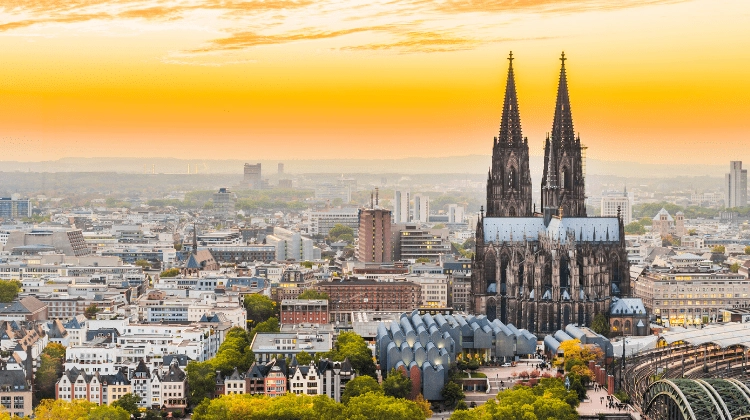
Cologne sits on both banks of the Rhine and is one of Germany’s liveliest cities, but there’s one landmark that dominates everything else. The enormous twin towers of Cologne Cathedral rise above the city centre and are visible long before you reach them.
The cathedral is a UNESCO World Heritage Site and free to enter, although there’s a separate charge if you want to climb the tower. It’s a long way up, with more than 500 steps, but the views across Cologne and the Rhine are worth the effort.
If you’ve got time for a museum, the Museum Ludwig is right beside the cathedral and has an excellent collection of modern art, including works by Picasso. Or, for something completely different, head to the Chocolate Museum on the riverfront.
Spend some time wandering through Cologne’s Altstadt before crossing the Rhine on the Hohenzollern Bridge. On the opposite bank, the Rheinboulevard is a great place to sit beside the river with views back towards the cathedral and old town.
For an even better view, head up the KölnTriangle viewing platform on the Deutz side of the river. At just over 100 metres high, the observation deck gives you a fantastic panorama across the Rhine, with the cathedral directly opposite.
Insider Tip: If you’ve still got some energy left in the evening, head to Cologne’s Belgian Quarter. It’s one of the city’s best areas for bars and restaurants and a good place to experience Cologne away from the main tourist sights.
Where to Stay in Cologne
Stay at Reisemobilhafen Köln, a dedicated motorhome stellplatz beside the Rhine. It’s around 3km from the centre, which you can reach by bike or public transport, so there’s no need to take the motorhome into central Cologne.
Park4Night: Reisemobilhafen Köln #3570
Coordinates: N 50°57’44.6724” E 6°59’9.9456”
Day 13: Cologne to Ypres
Distance: 420km
Driving time: 4 hours 20 minutes
Today you leave Germany and head west through Belgium towards Ypres for the final night of the trip.
It’s another fairly long driving day, but Ypres is worth making time for when you arrive. The city is forever associated with the First World War and the battles fought around the Ypres Salient, and there are memorials, cemeteries and museums throughout the surrounding countryside.
In the centre of Ypres, the magnificent Cloth Hall dominates the Grote Markt. Almost completely destroyed during the First World War, it was painstakingly rebuilt and today houses the In Flanders Fields Museum, which tells the story of the war in this part of Belgium.
From the Grote Markt, it’s only a short walk to the Menin Gate. The memorial bears the names of more than 54,000 Commonwealth servicemen who died in the Ypres Salient and have no known grave.
Insider Tip: Make sure you’re at the Menin Gate before 8pm for the Last Post Ceremony. The ceremony has taken place here every evening since 1928, apart from during the German occupation in the Second World War, and is a moving way to end your time in Ypres.
If you arrive early enough and want to explore more of the area, you could also visit one of the Commonwealth War Graves Commission cemeteries outside the city before returning to Ypres for the evening.
Where to Stay in Ypres
Stay at Urban Gardens | Camping Jeugdstadion, close to the centre of Ypres. It’s within easy walking distance of the Grote Markt and Menin Gate, which means you can park up for the night and walk into town for the Last Post Ceremony.
Park4Night: Urban Gardens | Camping Jeugdstadion #486610
Coordinates: N 50°50’48.9336” E 2°53’51.342”

Day 14: Ypres to Calais
Distance: 95km
Driving time: 1 hour 20 minutes
It’s a short final drive today, leaving Ypres and crossing back into France for Calais.
With less than 100km to cover, you can take the morning slowly if your Channel crossing isn’t until later in the day. Have breakfast in Ypres, pick up any last Belgian chocolate or beer and then make your way towards the coast.
Allow plenty of time for check-in at the ferry terminal or LeShuttle, particularly during busy holiday periods. If you’ve got a later crossing, you could also use the extra time to stock up at one of the large supermarkets around Calais before heading home.
And that’s it. After around 2,500km on the road, you’ve travelled from the Mosel vineyards to the Black Forest, Lake Constance and the Bavarian Alps, followed part of the Romantic Road and explored some of Germany’s most beautiful historic towns before finishing in Cologne and Ypres.
Tips for Your Germany Motorhome Road Trip
Driving on German Autobahns
Germany’s autobahns have a reputation for having no speed limits, but that doesn’t mean you can assume every section is unrestricted. Many stretches have permanent or variable speed limits, so keep an eye on the signs rather than relying on what your satnav tells you.
Motorhomes also have different speed limits depending on their weight, so make sure you know which rules apply to your vehicle before travelling.
For this route, we’d also resist the temptation to use the autobahn for every journey. Some of the best driving is away from it, particularly through the Mosel Valley, Black Forest and along the Romantic Road.
Motorhome Tolls in Germany
Germany does not charge a general motorway toll for private motorhomes, so you can use the autobahn network without buying a vignette or paying a distance-based toll.
Even if you have a large motorhome or truck conversion over 3.5 tonnes, you don’t need to pay the German road toll as long as the vehicle is being used as a motorhome and isn’t being used to carry goods.
German Low Emission Zones
Germany still has a number of Umweltzonen, or low emission zones, although many cities have removed theirs in recent years. Where a zone remains, vehicles generally need the appropriate German environmental sticker, or Umweltplakette, displayed on the windscreen.
The green sticker used in Germany isn’t something to leave until you arrive at the entrance to a city. Check the current requirements for your motorhome and the places you’re planning to visit before your trip.
As of 2026, Germany’s Federal Environment Agency says there are 35 Umweltzonen remaining, but the number is reducing as individual cities remove them.
Sundays in Germany
One thing that can catch visitors out is Sunday closing. Most shops and supermarkets in Germany are closed on Sundays and public holidays, although there are exceptions including some shops at railway stations, airports, petrol stations and tourist destinations.
If you’re moving on a Sunday, we’d make sure you’ve stocked the motorhome with food and essentials the day before.
Restaurants, cafés and tourist attractions are a different matter and many remain open on Sundays, so the old itinerary’s suggestion that restaurants generally close as well was too broad.
Carry Some Cash
Card payments are far more widespread in Germany than they once were, but we’d still carry some euros in cash.
Smaller stellplätze, parking machines, bakeries and rural businesses can sometimes be cash-only, and coins are useful for motorhome service points, electricity and public toilets.
Water and Motorhome Services
Germany has an excellent network of stellplätze and many have fresh water and waste disposal facilities.
Carry your own drinking-water hose and fittings, and never use the hose provided at a cassette-emptying point to fill your fresh-water tank. We’d also keep a few different tap adaptors on board, as fittings vary.
Best Time to Follow This Germany Motorhome Itinerary
We’d choose May, June or September for this route. You’ll generally have good conditions for exploring the Black Forest and Bavaria, Lake Constance is lively, and you’ll avoid the busiest part of the summer holiday season.
July and August can also be lovely, particularly if you want to swim and spend time on the water at Lake Constance, but campsites and the major sights are much busier. Neuschwanstein, Lindau and the Zugspitze can all be particularly popular in summer, so we’d book key campsites and attractions ahead.
September is perhaps our favourite time for this trip. The summer crowds begin to ease, the weather can still be pleasantly warm and Lake Constance is particularly good for walking and cycling in early autumn.
April and October are possible, but you’ll need to be more flexible around the Alpine section of the route. Mountain weather can change quickly, and some seasonal campsites and tourist facilities may have reduced opening periods.
We wouldn’t choose winter for this particular itinerary. Germany is fantastic in winter, but this route has been designed around scenic driving, Lake Constance and spending time outdoors in the Black Forest and Bavarian Alps. A winter motorhome trip would need a rather different itinerary.
More European Motorhome Itineraries
Planning another European road trip? Our detailed motorhome itineraries include day-by-day routes, driving distances and times, recommended overnight stops, interactive maps and free downloadable PDFs.
🇫🇷 France Motorhome Itinerary
A 2–3 week road trip through some of our favourite parts of France, from the Alps and Provence to the Dordogne and Loire. Explore our France itinerary.
🇮🇹 Italy Motorhome Itinerary
A four-week road trip through Italy, taking in the Italian Lakes, Dolomites, Venice, Tuscany, Rome and the spectacular Amalfi Coast. Explore our Italy itinerary.
🇪🇸 Spain Motorhome Itinerary
Six weeks exploring Spain, from the historic cities of Madrid, Seville and Granada to the wild beaches of Cabo de Gata and the Mediterranean coast. Explore our Spain itinerary.
🏴 Scotland Motorhome Itinerary
A 2–3 week road trip from Loch Lomond and Glen Coe to Skye, Loch Ness and the Cairngorms, finishing in Edinburgh. Explore our Scotland itinerary.
More Germany Travel Ideas to Explore
Germany Road Trip: 12 Unmissable Routes

Driving in the Alps: Top Tips & Best Routes

The Best of the Black Forest: Highlights & Hidden Gems

Beautiful Cities in Germany: 27 Picturesque Cities to Visit

Driving from UK to Germany: Best Routes, Costs & Tips

Deutsche Märchenstraße: Germany’s Fairy Tale Road
Love it? Pin it!


