
This post may contain affiliate links, from which we earn an income. Click here to read our affiliate policy.
Driving to Türkiye (Turkey) from the UK is a proper road trip, taking you across Europe to a country where you could spend months exploring and still leave with places on your list. From Istanbul’s busy waterfront to the Aegean coast and the extraordinary landscapes of Cappadocia, there’s plenty to make the long journey worthwhile.
We’ve driven to Türkiye in our truck, and it’s a journey that rewards giving yourself time along the way. For motorhomers looking beyond the usual winter destinations, Türkiye’s southern coast is also worth considering, although planning the journey there is as important as choosing where to stay.
In this guide, we share the practical details of driving to Türkiye from the UK, including route options, driving distances and times, likely costs and the paperwork you’ll need, alongside advice for travelling by motorhome and planning a winter trip.
Driving to Türkiye from the UK Key Facts
Driving to Türkiye: The Gap Decaders’ practical guide to travelling from the UK to Türkiye by car, campervan or motorhome.
Route options: Drive through Europe to Türkiye, with different routes to suit your starting point, available time and places you want to visit.
Best for: An extended road trip, an overland adventure or a motorhome journey to Türkiye’s southern coast for winter.
First-hand experience: The Gap Decaders have driven to Türkiye in their overland truck and explored the country as part of a longer overland trip.
Enjoy The Gap Decaders? Add us as a preferred source on Google.
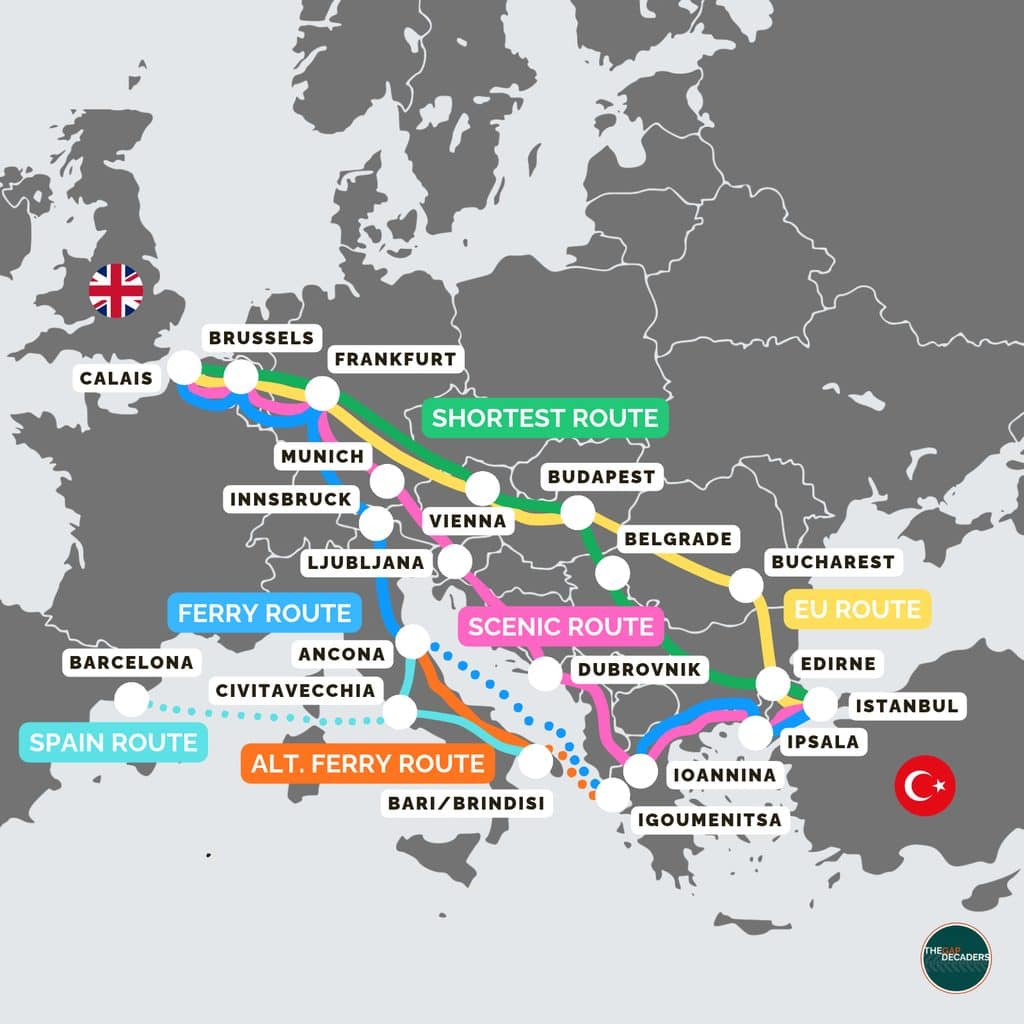
Best Routes to Türkiye from the UK at a Glance
Shortest Route via Serbia and Bulgaria: Travel through Belgium, Germany, Austria and Hungary, then Serbia and Bulgaria into Türkiye. A good choice for keeping mileage down, with additional border crossings to allow for.
EU Route via Romania and Bulgaria: Continue from Hungary through Romania and Bulgaria, staying within the EU and Schengen Area until the Turkish border. Allow more time for slower roads along parts of this route.
Scenic Route Through the Western Balkans and Greece: Head through Slovenia and Croatia, then Montenegro and Albania before crossing northern Greece into Türkiye. Best for a longer trip with time to explore along the way.
Ferry Route via Italy and Greece: Drive to an Italian Adriatic port, sail to Igoumenitsa and continue across northern Greece. If you’re already in Spain, the Barcelona–Civitavecchia ferry provides another way to reach Italy.
How Long Does It Take to Drive to Türkiye from the UK?
Driving from London to Istanbul covers approximately 1,864 miles (3,000km), with around 35–40 hours of driving, depending on your route. You’ll also need to allow for your Channel crossing, rest stops, overnight stays and border formalities.
As a planning guide, allow five to seven days if you’re treating the journey mainly as a drive to your destination. In a motorhome, seven to ten days gives you more room for shorter driving days and a few worthwhile stops, although you could easily turn the journey into a much longer European road trip.
Your starting point in the UK will make a difference, so add time for reaching Dover, Folkestone or your chosen ferry port rather than treating the London estimate as the whole journey.
Heading to Türkiye for Winter?
Reaching Istanbul still leaves a substantial journey if you’re heading for the Mediterranean coast. Istanbul to Antalya is approximately another 700 km, taking around eight to nine hours by car, so we’d allow two driving days in a motorhome.
You don’t need to visit Istanbul to reach the coast, and the best route will depend on your destination in Türkiye. If you’re travelling primarily for a winter stay, plan the journey all the way to your coastal base rather than just to the Turkish border.
For a first planning estimate, we’d set aside around ten days to two weeks from the UK to the southern coast in a motorhome, allowing time for overnight stops and some flexibility along the way.
Make sure you have travel insurance you can trust when driving to Türkiye. We recommend True Traveller for their 5-star TrustPilot reviews, variety of cover options, best activities cover as standard, great prices, and excellent service.
Planning Your Route to Türkiye
The best route to Türkiye depends on how much time you have and what you want from the journey. You can take a direct motorway route through central Europe, travel through Romania to stay within the EU until the Turkish border, or make a longer trip through the western Balkans and Greece. Ferries from Italy to Greece offer another option if you’d like to reduce the overland driving.
For the route comparisons below, we use Calais as the starting point and Istanbul as the destination. Distances and driving times exclude your journey through the UK and your Channel crossing, with ferry time shown separately where relevant.
Istanbul is a useful benchmark, but you don’t need to go there if you’re heading straight to the Aegean or Mediterranean coast. We’ll explain where it makes sense to leave each route for the onward journey south.
Crossing the Channel
LeShuttle from Folkestone to Calais is the quickest crossing, with a scheduled journey time of 35 minutes. You drive onto the train and stay with your vehicle during the crossing, making it a convenient option with a motorhome or pets. Allow additional time for check-in and border checks when planning your day.
The Dover–Calais ferry gives you time to stretch your legs and have something to eat before starting the drive across Europe. Crossing times vary by operator and sailing, with DFDS taking around 100 minutes, so compare the total price and departure times for your travel dates.
Dover–Dunkirk is another useful option, taking around two hours with DFDS and bringing you ashore closer to Belgium. If you choose this crossing, join your route from Dunkirk rather than driving back to Calais.
If you live further north or west in the UK, a longer ferry crossing may save a substantial drive to Kent. Compare the overall journey from home, including fuel and any overnight stops, rather than choosing purely on the ticket price. You can join the routes below from your arrival port without going via Calais.
For comparing routes, sailing times and prices, we recommend checking Direct Ferries, which lets you compare multiple operators and crossings in one place before booking.
The Shortest Route via Serbia and Bulgaria
Route: Calais → Brussels → Frankfurt → Passau → Vienna → Budapest → Belgrade → Sofia → Plovdiv → Edirne → Istanbul.
Distance: 2,927 km, depending on your exact route and overnight stops.
Driving time: Allow around 30–35 hours in a car, with additional time for a motorhome, rest stops and border formalities.
Suggested journey time: Five to seven days from Calais for a steady journey, or longer if you want to explore.
Best for: Travellers who want to minimise mileage on the overland journey to Türkiye.
This route through Belgium and Germany is slightly shorter, although Google Maps may show a quicker journey through France. Compare both for your departure date, taking French motorway tolls into account alongside the estimated driving time.
This is a straightforward option if your priority is reaching Türkiye without adding a long ferry crossing or a substantial sightseeing detour. From Calais, head through Belgium into Germany, continuing towards Passau and crossing Austria via Vienna before travelling through Hungary to Budapest.
From Budapest, follow the motorway south to the Röszke–Horgoš border crossing into Serbia, then continue towards Belgrade and Niš. At Niš, take the motorway towards Dimitrovgrad and cross into Bulgaria at Gradina–Kalotina, continuing around Sofia and towards Plovdiv.
You enter Türkiye at the Kapitan Andreevo–Kapıkule border crossing near Edirne, then follow the motorway towards Istanbul. The cities in the route outline are navigation waypoints, so you can stay on bypasses rather than driving through their centres unless you’re stopping to visit.
What to Allow For
Borders
Border crossings are the main unpredictable part of this route. You leave the EU and Schengen Area when entering Serbia, re-enter them in Bulgaria, then leave again for Türkiye. Give yourself flexibility on border-crossing days rather than booking an overnight stop that depends on getting through at a particular time.
Tolls
On this route, you’ll need an Austrian motorway vignette for vehicles up to 3.5 tonnes, a Hungarian e-vignette and a Bulgarian e-vignette for vehicles up to 3.5 tonnes. Buy these through the official toll websites before entering the roads they cover, checking your registration number, vehicle category and start date carefully.
Heavier motorhomes need different arrangements in Austria and Bulgaria. Austria generally requires a GO-Box or another approved toll device for vehicles over 3.5 tonnes technically permissible maximum laden mass, while Bulgaria uses distance-based tolls, payable through a route pass or an approved toll device. Hungary includes motorhomes in its e-vignette system, but you must select the category appropriate to the vehicle’s registration details.
In Serbia, take a ticket when entering the tolled motorway and pay at the exit booth by card or cash. Once in Türkiye, arrange an HGS account for motorway tolls and keep it topped up.
Weather
For a winter journey, plan for cold weather throughout the transit rather than assuming conditions will resemble those at your destination. Keep your daily distances manageable and leave room to delay a departure if the weather turns.
Continuing Towards the Coast
If Istanbul is on your list, this route brings you naturally to the city. If you’re heading straight for a winter stay on the Aegean or Mediterranean coast, use Edirne as your next planning point and compare the onward routes to your chosen destination before committing to the drive into Istanbul.
The EU Route via Romania and Bulgaria
Route: Calais → Brussels → Frankfurt → Passau → Vienna → Budapest → Arad → Sibiu → Bucharest → Ruse → Veliko Tarnovo → Edirne → Istanbul.
Distance: 3,050 km, depending on your exact route and overnight stops.
Driving time: Allow around 40-45 hours in a car, with additional time for a motorhome and rest stops.
Suggested journey time: Six to eight days from Calais, allowing longer for sightseeing.
Best for: Travellers who want to stay within the EU and Schengen Area until entering Türkiye.
This route follows the same approach through Belgium, Germany and Austria as the Serbia option, continuing to Budapest before turning towards Romania. Enter Romania at Nădlac and head towards Arad, Deva and Sibiu, then continue towards Bucharest.
Romania makes a rewarding addition to the journey if you have time to stop. Sibiu is a particularly convenient place to break the drive, with an old town that’s easily explored on foot, while a longer stay gives you time to venture further into Transylvania.
Use the available bypasses around Bucharest and head south to Giurgiu, crossing the Danube bridge into Bulgaria at Ruse. Continue towards Veliko Tarnovo and the Turkish border at Kapitan Andreevo–Kapıkule, then travel via Edirne towards Istanbul.
What to Allow For
Borders
Romania and Bulgaria are both fully within the Schengen Area, so this route avoids leaving and re-entering Schengen through Serbia. Temporary border checks can still take place, and you’ll need to allow time for the full border formalities when entering Türkiye.
The additional mileage doesn’t tell the whole story. Parts of the journey through Romania and Bulgaria use roads through towns and villages, where progress is slower than on the motorways further west. Keep daily distances realistic, particularly in a larger motorhome, and check current conditions at the Giurgiu–Ruse bridge before travelling.
Tolls
For the Austrian section, vehicles up to 3.5 tonnes technically permissible maximum laden mass generally need a motorway vignette, while heavier motorhomes normally require a GO-Box or another approved toll device. Hungary uses e-vignettes for motorhomes, with the category determined by the vehicle’s registration details.
In Romania, buy a rovinieta for the national road network through the official erovinieta.ro website or an authorised seller, selecting the correct vehicle category. The Giurgiu–Ruse bridge has a separate crossing charge.
Bulgaria requires an e-vignette for cars and M1-registered motorhomes, including those over 3.5 tonnes. Check the vehicle category on your registration document, as heavier vehicles registered in other categories can require distance-based toll payments.
Weather
This route passes through inland areas where winter can bring snow, ice and freezing temperatures. The section between Sibiu and Bucharest needs particular attention to the forecast, as do the roads across Bulgaria.
Follow the main transit roads and avoid adding mountain sightseeing routes to a winter journey without checking seasonal access. Allow spare days so that poor conditions don’t force you into a long drive, and aim to complete unfamiliar rural sections in daylight.
Continuing Towards the Coast
After entering Türkiye near Edirne, decide if you want to visit Istanbul before heading south. If your priority is reaching an Aegean or Mediterranean winter base, compare an onward route towards the Çanakkale crossing with the journey via Istanbul, using your final destination to guide the choice.
The Scenic Route Through the Western Balkans and Greece
Route: Calais → Brussels → Frankfurt → Munich → Salzburg → Villach → Ljubljana → Zagreb → Split → Dubrovnik → Kotor → Shkodër → Tirana → Gjirokastër → Ioannina → Thessaloniki → Alexandroupoli → İpsala → Istanbul.
Distance: 3,679 km, depending on your coastal diversions.
Driving time: Allow approximately 40–45 hours, with additional time for motorhomes, sightseeing and border crossings.
Suggested journey time: At least two weeks from Calais, ideally three weeks or more to explore along the way.
Best for: Travellers who want to make the journey through the Balkans part of their trip.
This route takes you down the Adriatic coast through Croatia and Montenegro, then across Albania into Greece before turning east towards Türkiye. It’s a good choice if you have time to explore along the way, with plenty of opportunities to break the journey for a few nights.
From Calais, travel through Germany and Austria towards Slovenia, continuing via Ljubljana and Zagreb to Croatia’s A1 motorway. Follow it south towards Split, then continue towards Dubrovnik, using the Pelješac Bridge to remain in Croatia rather than crossing Bosnia and Herzegovina’s coastal strip at Neum.
Continue into Montenegro and around the Bay of Kotor, allowing time for the winding coastal roads. Head towards Albania via the Božaj–Hani i Hotit border crossing, then travel south through Shkodër and towards Tirana.
For a relatively direct journey through Albania, continue via Fier, Tepelenë and Gjirokastër to the Kakavia border crossing into Greece. The Albanian Riviera is a worthwhile extension if you have more time, but it adds slower coastal driving to the route described here.
From Kakavia, head towards Ioannina and join the A2 Egnatia Odos motorway east through northern Greece. Continue past Thessaloniki, Kavala and Alexandroupoli to the Kipoi–İpsala border crossing into Türkiye, then follow the main roads towards Istanbul.
What to Allow For
Borders
You leave the EU and Schengen Area when crossing from Croatia into Montenegro, then cross another international border into Albania. You re-enter the EU and Schengen Area at the Albanian–Greek border before leaving again for Türkiye.
Keep passports and vehicle documents accessible and check that your motor insurance covers Montenegro, Albania and Türkiye, including the level of cover you want. Allow flexibility on border-crossing days, particularly if you’re travelling during busy holiday periods.
Using the Pelješac Bridge avoids the two additional border crossings at Neum. If you want to visit Bosnia and Herzegovina, places such as Mostar can be included as a separate detour, with the extra driving and border formalities planned into your journey.
Tolls
In Austria, vehicles up to 3.5 tonnes technically permissible maximum laden mass generally require a motorway vignette, while heavier motorhomes normally need a GO-Box or another approved toll device. Some Austrian routes also have separate section tolls, so the total depends on your chosen approach to Slovenia.
Slovenia requires an e-vignette for vehicles up to 3.5 tonnes, with registered motorhomes in category 2A. Vehicles over 3.5 tonnes use the DarsGo distance-based toll system and need an appropriate onboard device.
Croatia charges motorway tolls according to the distance travelled and vehicle category, with payment by cash or card at toll booths. In Montenegro, charges apply if your chosen route uses the Sozina Tunnel or the Smokovac–Mateševo motorway; neither is essential for the route via Kotor and the Božaj border crossing.
In Albania, the Thumanë–Kashar motorway on the approach towards Tirana is tolled. Across northern Greece, the Egnatia Odos has toll plazas where you can pay by cash or card. Once in Türkiye, arrange an HGS account for the toll roads you use.
Weather
The Adriatic coast can be a pleasant part of an autumn journey, but it still experiences heavy rain and strong winds. In Croatia, the bora wind can cause restrictions or closures for high-sided vehicles, including motorhomes, so check road conditions before committing to exposed sections.
Winter conditions are also possible on the inland sections through Austria and Slovenia, around Gjirokastër and the Greek border, and on the higher stretches of the Egnatia Odos near Metsovo. Following the coast for part of the trip doesn’t remove the need to prepare for snow and ice.
For a winter journey, build spare days into your plans and check that campsites and motorhome facilities are open before making a long diversion to reach them. Shorter daylight hours and slower coastal roads make this a route to take at a comfortable pace.
Continuing Towards the Coast
After crossing at İpsala, you’re well placed to head south towards the Çanakkale crossing and the Aegean coast without visiting Istanbul. If your destination is around İzmir, the southern Aegean or further along the Mediterranean, compare that onward journey before turning east towards Istanbul.
The Ferry Route via Italy and Greece
Route: Calais → Frankfurt → Innsbruck → Brenner Pass → Verona → Bologna → Ancona → ferry to Igoumenitsa → Thessaloniki → Alexandroupoli → İpsala → Istanbul.
Distance: 2,877 km of driving via Ancona, excluding the sea crossing.
Driving time: Allow approximately 38–43 hours, with additional time for motorhomes, rest stops and border formalities.
Ferry time: Allow roughly 17–22 hours from Ancona to Igoumenitsa, depending on the sailing, plus check-in and disembarkation.
Suggested journey time: Six to eight days from Calais, including the ferry crossing.
Best for: Travellers who want to break up the driving with an Adriatic crossing and avoid travelling through the non-EU Balkan countries.
Taking a ferry from Italy to Greece gives you a substantial break from driving and brings you ashore with a mostly motorway journey across northern Greece ahead. Compare the fare for your vehicle and accommodation with the fuel, tolls and overnight stops on an overland route, as the crossing won’t necessarily save money or overall journey time.
For the route outlined here, travel through Germany towards Innsbruck, cross into Italy via the Brenner Pass and continue south past Verona and Bologna to Ancona. Your navigation may suggest an alternative approach through France and Switzerland, so compare the mileage and toll arrangements before choosing your route.
Ancona is a useful departure point because it avoids driving further down Italy. Bari and Brindisi offer shorter crossings to Igoumenitsa, but involve more driving on the Italian side, making them worth considering if you’re already exploring southern Italy.
Choose Igoumenitsa as your arrival port for the onward drive to Türkiye. From the port, join the A2 Egnatia Odos and follow it east across northern Greece, passing Thessaloniki and Alexandroupoli before reaching the Kipoi–İpsala border crossing.
Travelling from Spain via Barcelona
If you’re already in Spain, you can take a Grimaldi Lines ferry from Barcelona to Civitavecchia, on Italy’s west coast, with your car or motorhome. From Civitavecchia, drive across Italy to Ancona, or continue towards Bari or Brindisi, for a separate ferry to Igoumenitsa.
This makes it possible to combine a stay in Spain with an onward journey towards Türkiye without driving all the way around the Mediterranean coast through France. Compare the complete journey, including both ferry fares, cabins and the drive between Italian ports.
These are separate crossings, so leave a generous gap between them. An overnight stop in Italy gives you some flexibility if the first sailing is delayed and avoids turning the drive between ports into a rush.
What to Allow For
Borders
The journey through Italy and Greece stays within the EU and Schengen Area until you reach the Turkish border. You’ll still need the travel documents required by your ferry operator, so keep them accessible for check-in.
At Kipoi–İpsala, allow time for passport checks and the formalities for temporarily bringing your vehicle into Türkiye. Avoid planning a long onward drive that depends on a quick border crossing.
When booking either ferry, enter your vehicle’s full travelling dimensions and arrange any pet accommodation you need. Book on the basis that you’ll use passenger accommodation during the crossing, unless the operator explicitly confirms another arrangement for your sailing.
Tolls
For the approach through Austria, vehicles up to 3.5 tonnes technically permissible maximum laden mass generally require a motorway vignette, with a separate section toll for the A13 Brenner motorway. Heavier motorhomes normally use the GO toll system with a GO-Box or another approved device.
Italy charges tolls on most motorways along this route. You can pay at the toll booths by card or cash, using the appropriate lanes rather than those reserved exclusively for electronic toll devices.
Across northern Greece, the Egnatia Odos has toll plazas accepting cash or card. Once in Türkiye, arrange an HGS account and keep it topped up for the toll roads you use.
If you choose the Barcelona ferry option, your Italian motorway charges will depend on which Adriatic departure port you select.
Weather
The Brenner route is a major Alpine transit route, but winter can still bring snow, ice and delays. Check the forecast and road conditions before crossing Austria into Italy, and allow flexibility in your ferry plans rather than relying on an uninterrupted drive to the port.
Adriatic sailings can also be affected by poor weather. Check your operator’s latest departure information before travelling to the terminal, especially when combining two crossings from Spain.
After arriving in Greece, remember that the Egnatia Odos crosses higher ground near Metsovo, where winter conditions can be very different from those at the coast. Allow time to pause if conditions deteriorate.
Continuing Towards the Coast
After entering Türkiye at İpsala, compare the route south towards the Çanakkale crossing with the journey via Istanbul. For an Aegean winter base, heading south can fit your plans better than continuing to Istanbul first.
Can You Get a Ferry from Greece to Türkiye?
There is no direct vehicle ferry from mainland Greece to mainland Türkiye, but you can travel via the Greek island of Chios. Take a ferry from Piraeus to Chios, followed by a separate crossing from Chios to Çeşme on Türkiye’s Aegean coast. Both legs offer options for motorhomes up to 9 metres long, subject to availability on your chosen sailing.
Winter sailings may be infrequent, and timetables may not be confirmed far in advance. When we checked departures just a few weeks ahead, schedules were still awaiting confirmation, so check availability and vehicle acceptance for both crossings before booking either leg.
This option is worth exploring if you have flexible dates and want to visit Chios, particularly as arriving in Çeşme puts you close to İzmir for the onward journey south. Allow time between the crossings in case of delays or weather disruption.
For a straightforward mainland journey, follow the route across northern Greece to the Kipoi–İpsala land border instead.
Onward Travel in Türkiye
Crossing the border is only the beginning of the Turkish part of your journey. Istanbul makes a useful endpoint for comparing the routes from Calais, but your onward plans should depend on the places you want to visit, particularly if you’re heading south for winter.
Visiting Istanbul Before Heading South
If you want to explore Istanbul, continue east from Edirne or İpsala and allow a few nights to enjoy the city before moving on. With a motorhome, choose somewhere suitable to stay and use public transport for sightseeing, rather than trying to navigate the historic centre.
For the onward journey towards İzmir and the Aegean coast, compare routes via the Osmangazi Bridge and the O-5 motorway. If you’re heading directly towards Antalya, an inland route via the Afyonkarahisar area is another option, although winter weather needs careful consideration.
Don’t assume that your motorhome can use every bridge or tunnel suggested by a navigation app around Istanbul. Check the crossing restrictions for your vehicle category and use a route suitable for its dimensions and weight.
Heading Straight to the Aegean Coast
If Istanbul isn’t part of your plans, you can head south through European Türkiye towards the Gallipoli peninsula and cross the Dardanelles using the 1915 Çanakkale Bridge. This brings you onto the Asian side near Lapseki without driving through Istanbul.
From the Bulgarian border near Edirne, head towards Keşan and Gelibolu. From the Greek border at İpsala, continue towards Keşan before turning south towards the crossing.
The bridge is tolled, so include its charge when comparing routes. Once across, you can continue towards Çanakkale and follow the western side of Türkiye towards Ayvalık and İzmir, adding coastal stops as time allows.
This approach works particularly well if you want to explore the Aegean coast on your way south. It also avoids making Istanbul a compulsory detour simply because it was the endpoint used in your initial route planning.
Continuing to the Mediterranean Coast
From İzmir, you can continue towards Aydın and Muğla, then choose your route according to your destination. Marmaris, Köyceğiz, Dalyan and Fethiye are possible stops before travelling further east towards Kaş, Demre, Finike and Antalya.
Allow plenty of time if you follow the coastal D400 between Fethiye and Antalya. Sections are winding and progress in a motorhome can be much slower than the distance suggests, particularly if you stop frequently to explore.
If your priority is reaching a booked winter base, compare the coastal journey with the main inland alternatives. A shorter estimated driving time needs to be weighed against the altitude and forecast, as an inland shortcut can introduce colder conditions and mountain driving.
Planning the Journey in Winter
Plan your onward journey around the weather along the whole route. A mild forecast for Antalya tells you little about conditions on higher roads a few hours inland, and even a journey starting near the coast can climb substantially.
Check the forecast before each longer driving day and allow time to wait if snow, ice or heavy rain affects your route. For a coastal winter trip, it often makes sense to explore western Türkiye gradually on the way south, leaving inland destinations such as Cappadocia for a separate visit when conditions suit your plans.
Before heading to a campsite or motorhome stop, confirm that it is open and that the facilities you need are available through winter. Keep your arrival plans flexible enough to change your stopping point if the drive takes longer than expected.
RELATED POST: Motorhoming in Turkey: The Ultimate Guide to Planning Your Trip


Driving on the Continent
Every driving route from the UK to Turkey crosses at least three European countries, so make sure you understand the rules for each country on your chosen route before leaving home.
For UK drivers taking their own vehicle, you should carry:
UK vehicle insurance provides the minimum third-party cover required in the EU, and you don’t normally need a green card for these countries. Check your own policy before travelling, as the level of cover provided outside the UK can vary.
A UK photocard driving licence is generally sufficient for the EU countries on these routes. Requirements differ outside the EU, so check each transit country separately and arrange the permit or translation required for Türkiye before departure.
If you’re taking your own UK-registered vehicle abroad for less than 12 months, carry the original V5C. Your vehicle must also remain taxed, insured and, where applicable, have a valid MOT while you’re away.
You may need a UK sticker on the rear of your vehicle. You don’t need a separate sticker if your number plate already displays the UK identifier with the Union flag, but plates showing GB, an EU flag or no national identifier require a UK sticker.
You’ll be driving on the right throughout mainland Europe, so take extra care at junctions and roundabouts and when pulling away after stopping. Headlight converters may also be necessary if your vehicle cannot adjust its headlights for driving on the right.
Many of the countries crossed by these routes are within the Schengen Area, but that doesn’t guarantee an uninterrupted border crossing. Temporary border controls can be introduced, so keep your passports and vehicle documents accessible throughout the journey.
Safety equipment requirements vary between countries. A reflective hi-vis jacket and warning triangle are sensible essentials, but check the individual rules for every country on your chosen route before you travel.
If you have an accident, move to a safe place where possible, use your hazard lights and follow the local rules for warning other traffic. Exchange details with the other driver, take photographs and contact the emergency services on 112 if anyone is injured or police assistance is required.
RELATED POST: Driving in Europe: Everything You Need to Know
Driving Through the Transit Countries
Once you’ve chosen your route, check the driving requirements for each country you’ll pass through, including those where you’re only spending a few hours. Speed limits and compulsory equipment vary, and heavier motorhomes can have different rules from cars and smaller campervans.
The route descriptions above cover the main border crossings and toll arrangements. Before setting off, also check winter tyre and snow chain requirements for your travel dates, along with any emissions zones affecting your planned overnight stops. Use your vehicle’s registered weight and classification when checking the rules.
Check your motor insurance and breakdown cover against the complete route, including any countries you might visit as a detour. Ask your providers to confirm the countries covered, the maximum trip duration and any vehicle weight or size limits, paying particular attention to cover for the Asian part of Türkiye.
For navigation, enter your motorhome’s dimensions and weight into a suitable route planner and review each day’s journey before leaving. Treat diversions onto minor roads with care, particularly in mountain areas, and keep an offline map available for places where you lose your mobile connection.
Driving in Türkiye
Türkiye has an extensive network of motorways and main roads, making long-distance travel relatively straightforward once you’ve adjusted to the traffic. Allow more time for coastal roads and rural journeys, where bends, steep gradients and stretches through towns can make progress slower than the map suggests.
Driving Licence
For a UK licence holder, current UK government guidance requires a 1968 International Driving Permit or a UK driving licence notarised in Turkish. Arrange the permit before leaving the UK and carry it alongside your original driving licence.
Road Conditions and Driving Style
Expect busy traffic around cities, frequent lane changes and drivers joining or leaving the road with little warning. Leave a generous gap and give yourself time to react, particularly while you’re getting used to the local driving style.
On smaller roads, watch for uneven surfaces, pedestrians and animals, and avoid assuming that a wide road will remain equally spacious through the next village. In a motorhome, review any suggested shortcut before leaving the main route.
Plan unfamiliar rural and mountain journeys for daylight where possible. It’s much easier to judge road surfaces, passing places and the approach to an overnight stop when you can see clearly.
Speed Limits
Speed limits are shown in kilometres per hour. For passenger cars, the general limits are:
- Built-up areas: 50km/h.
- Two-way roads outside built-up areas: 90km/h.
- Divided roads: 110km/h.
- Motorways: 130km/h or 140km/h, depending on the motorway.
Lower posted limits take precedence. These are passenger-car limits, so don’t automatically apply them to a campervan or motorhome: Türkiye’s limits vary by vehicle category, and your registration classification matters.
Motorway Tolls and HGS
Türkiye uses HGS, an electronic system linked to your registration number, for motorway and bridge tolls. Arrange an account through a PTT post office or another authorised provider, taking your passport and vehicle registration document.
Make sure the vehicle category and registration number are recorded correctly, then add enough credit for your planned journey. Toll categories can depend on axle configuration and wheelbase, so a motorhome may cost more than a passenger car.
Check for outstanding tolls before leaving Türkiye, including charges from privately operated motorways and bridges. If a payment hasn’t been collected, use the relevant operator’s official payment service rather than assuming that topping up your account has cleared it.
Buying Fuel
Diesel is commonly labelled “motorin” and petrol “benzin”. At an attended filling station, clearly identify the fuel you need before the attendant starts filling, particularly if your vehicle’s filler arrangement is unfamiliar.
Keep your fuel level comfortable before a longer rural or mountain journey. Larger forecourts are usually easier to negotiate with a motorhome, especially if you’re towing or have a substantial rear overhang.
Police Checks
You may encounter police or gendarmerie checkpoints during your trip. Slow down, follow instructions and keep your passport, driving licence, permit, insurance and vehicle paperwork somewhere accessible.
Allow a little extra time rather than treating a checkpoint as an unexpected problem, and keep your documents together so you can produce them easily.
Driving a Motorhome
Main roads are generally the easiest choice for covering distance, but take care when approaching old town centres, coastal villages and hillside campsites. Check the final approach to your overnight stop rather than relying entirely on the satnav.
On winding coastal sections, allow time for slower driving and use suitable places to let following traffic pass. For winter travel, check the altitude and forecast as well as the distance, because a route inland can take you into very different conditions from those on the coast.
Documents and Border Requirements for Türkiye
Before setting off, check the entry requirements for everyone travelling and the paperwork for your vehicle. Your permission to stay in Türkiye and your vehicle’s temporary import permission are separate, so both need to cover your planned visit.
Passports and Length of Stay
British citizen passport holders can visit Türkiye for tourism without a visa for up to 90 days in any 180-day period. Your passport must be valid for at least 150 days from your arrival date and have at least one blank page.
When entering at a land border, check that your passport has been stamped and dated correctly before leaving the checkpoint.
Türkiye is outside the Schengen Area, so time spent there does not count towards your Schengen allowance. However, it doesn’t reset that allowance either: calculate how many Schengen days you’ll have available for the return journey through Europe.
Vehicle Documents
Keep the following together and accessible at the border:
- Your original vehicle registration document, such as the UK V5C.
- Your driving licence and the permit or translation required for driving in Türkiye.
- Proof of motor insurance valid in Türkiye.
- Appropriate authorisation if you are driving a vehicle you don’t own.
- The rental agreement and permission to enter Türkiye if travelling in a hired vehicle.
For a company-owned, financed or leased vehicle, check the specific authorisation requirements before departure. Permission to drive elsewhere in Europe doesn’t automatically cover taking the vehicle into Türkiye.
Temporarily Importing Your Vehicle
Visitors bringing a foreign-registered vehicle into Türkiye normally need to be resident outside the country and to have spent at least 185 days outside Türkiye during the preceding year. This calculation includes previous visits made by air or other transport, not just trips with your vehicle.
The vehicle should normally be registered in your country of residence. If your residence and vehicle registration are in different countries, check your eligibility with Turkish customs before travelling.
For foreign visitors without a Turkish residence permit, the vehicle’s permitted stay is generally limited to 90 days within 180 days. Don’t assume that references online to a two-year vehicle allowance apply to a British tourist visiting for winter.
Check the departure deadline recorded by customs and keep any paperwork you receive. Both you and the vehicle must comply with your respective permitted stays.
Motor Insurance
Ask your insurer to confirm that your policy covers the whole of Türkiye, including the Asian side, for the full duration of your visit. Also confirm the level of cover, as an extension may provide only third-party protection.
Request a Green Card valid for Türkiye and check that the country code TR has not been crossed out. If your insurer cannot provide suitable cover, arrange an alternative before travelling where possible.
Check breakdown assistance separately, including recovery limits for your motorhome’s weight and dimensions.
Leaving Türkiye Without Your Vehicle
If you plan to fly home during your stay and leave your motorhome in Türkiye, you must follow the customs procedure for leaving without a temporarily imported vehicle. This can involve submitting a declaration or placing the vehicle under customs supervision.
Check the arrangements with Turkish customs before booking your flight, and don’t assume that leaving the motorhome securely parked at a campsite fulfils the requirement.
Taking a Pet to Türkiye
Travelling to Türkiye with a dog or cat needs planning several months ahead, particularly if your pet has never had a rabies antibody blood test. Check the requirements for every country on your route and prepare for the return journey into the EU before leaving.
Entering Türkiye
Your pet needs a microchip, a valid rabies vaccination given after microchipping, and a satisfactory rabies antibody titration test from an approved laboratory.
The published guidance from the İpsala veterinary border authority requires the blood sample to be taken at least 30 days after vaccination. For a first test, it also specifies a 90-day wait from the test result before travel.
A veterinary health certificate is required close to departure. İpsala’s guidance specifies issuance by the exporting country’s competent authority within two days before travel, so an extended drive across Europe needs careful coordination with a vet and the relevant authorities near your departure point for Türkiye.
Confirm the documentation and timing with your intended border crossing before setting off. Don’t assume that the paperwork used to enter France from the UK will also meet Türkiye’s requirements.
Returning to the EU
Türkiye is an unlisted country for EU pet travel purposes, so a valid rabies vaccination alone is insufficient for returning to Greece or Bulgaria. Your pet also needs a satisfactory rabies antibody test and the appropriate entry documents.
The usual EU waiting period is three months from the blood sample. An exemption can apply when a pet returns to the EU with a compliant EU pet passport recording a successful test completed before leaving the EU. Have your vet confirm the paperwork and waiting periods for your circumstances before travelling.
Keep rabies boosters up to date, as a lapse can mean repeating the testing process. Plan to enter through an authorised travellers’ entry point and present your pet and documents for checking.
Returning to the UK
Check Great Britain’s entry requirements separately, including the accepted travel document and rabies blood-test evidence after visiting Türkiye.
Dogs must also receive the required vet-administered tapeworm treatment between 24 and 120 hours before arrival in Great Britain when returning through France. Arrange this appointment around your Channel crossing and check the recorded date and time before leaving the vet.
Healthcare and Travel Insurance
Your GHIC or EHIC is not valid in Türkiye, so arrange travel insurance that includes emergency medical treatment and repatriation. Keep your health card with you for the eligible European countries you pass through, but check healthcare arrangements separately for any non-EU stops.
For a winter motorhome trip, check the maximum duration of each journey covered by your policy. An annual policy may cover several holidays but still limit the length of any single trip, so include the drive out and the return journey when calculating how much cover you need.
Make sure every country on your route is included, along with any activities you’re planning, and declare pre-existing medical conditions as required by the insurer. Check the current FCDO travel advice for Türkiye, as travelling against its advice can affect your cover.
True Traveller is an option to consider for an extended trip and includes Türkiye within its European geographical cover, subject to policy terms and regional exclusions. Check its residency and age requirements, along with the cover available for your circumstances, before buying.
Medication and Medical Help
If you take regular medication, plan supplies for the whole journey and check the rules for bringing it into Türkiye. Carry it in its original packaging with a copy of your prescription, and ask your doctor about supporting documentation for controlled medicines.
Save your insurer’s emergency assistance number somewhere accessible offline. If you need urgent medical help in Türkiye, call 112 and ask for an ambulance; contact your insurer as soon as practical to arrange further treatment and payment.
Mobile Data and Roaming in Türkiye
Check your mobile provider’s terms before reaching Türkiye, as a European roaming allowance may not include it. Check the non-EU countries on your route too, particularly Serbia, Montenegro and Albania, where charges can differ from those in neighbouring EU countries.
For a longer trip, look at the daily charges, data allowance and fair-use limits together. A roaming package that works well for a short holiday can become expensive over several weeks, especially if you’re using your phone as a hotspot in the motorhome.
Local SIMs and Travel eSIMs
A Turkish SIM can be useful for an extended stay. Buy from an official network shop and take your passport for registration, checking the package’s validity, top-up options and hotspot allowance before paying. Make sure your phone or router is unlocked.
A travel eSIM is another option if your device supports it. Check which Turkish network it uses, when the package activates and if it includes calls or data only. Install it before arrival where possible, following the provider’s instructions, and disable data roaming on your usual SIM if you don’t intend to use it.
For a journey through several countries, compare a regional package with separate country plans, checking the destination list rather than relying on a package being described as “European”.
Using a Foreign Phone for a Longer Stay
Türkiye has registration rules for phones brought from abroad. Official guidance allows an unregistered foreign device to be used for up to 120 days from first use, after which registration is required to continue receiving service.
This is longer than a typical 90-day tourist visit, but it’s worth checking your device’s status if you’ve used it in Türkiye before. Don’t confuse the phone’s registration limit with the validity of a tourist SIM or data package, which may expire sooner.
Staying Connected on the Road
Download offline maps before crossing borders and save campsite details, ferry tickets and insurance contacts somewhere you can access without a connection.
Near international borders, check which network your phone has selected. On ferries, use flight mode unless you’ve checked the charges, as onboard maritime networks can sit outside your normal roaming package.
More Road Trip Resources to Explore
Driving to Portugal from the UK: Best Routes, Ferries and Driving Tips
Heart 200 Road Trip? 5 Reasons to Check Tyres in Stirling Before Going
Driving to Spain from the UK: Best Routes & Driving Tips
Driving to Italy from the UK: Best Routes & Driving Tips

Driving to Norway from the UK: Best Routes & Top Tips
25 Best Campsites in Europe For Campers, By Campers
Love it? Pin it!


