
This post may contain affiliate links, from which we earn an income. Click here to read our affiliate policy.
The Best Routes to Greece from the United Kingdom
We’ve driven to Greece several times since we started travelling full-time in Europe in 2018, crossing the continent by motorhome, overland truck and motorbike and using different routes through Italy, Central Europe and the Balkans.
Getting to Greece from the UK is a bigger journey than driving to most European destinations, but that also gives you plenty of choice. You can drive all the way overland through Central Europe and the Balkans, follow the Adriatic coast through Croatia, Montenegro and Albania, or drive through France and Italy before taking a ferry across the Adriatic to Greece.
In this guide, we share the best routes for driving from the UK to Greece, including the quickest, cheapest, winter and more adventurous options, plus the popular Italy and ferry route. We compare distances, driving times, tolls, vignettes, border crossings and ferry options to help you choose the best journey for your vehicle, budget and time of year.
Driving to Greece from the UK Key Facts
Routes: The Gap Decaders compares six defined driving routes from the UK to Greece, including three overland routes, two routes using an Adriatic ferry from Italy and an adventurous route through the Balkans.
Start & finish: Most routes start in Calais and finish in northern Greece, with ferry alternatives arriving at Igoumenitsa or Patras for travellers heading further south.
Best for: The routes are suitable for travelling from the UK to Greece by car, campervan, motorhome or motorbike.
First-hand experience: Our recommendations are based on extensive travel through Greece, Italy and the Balkans by motorhome, overland truck and motorbike since 2018.
Enjoy The Gap Decaders? Add us as a preferred source on Google.
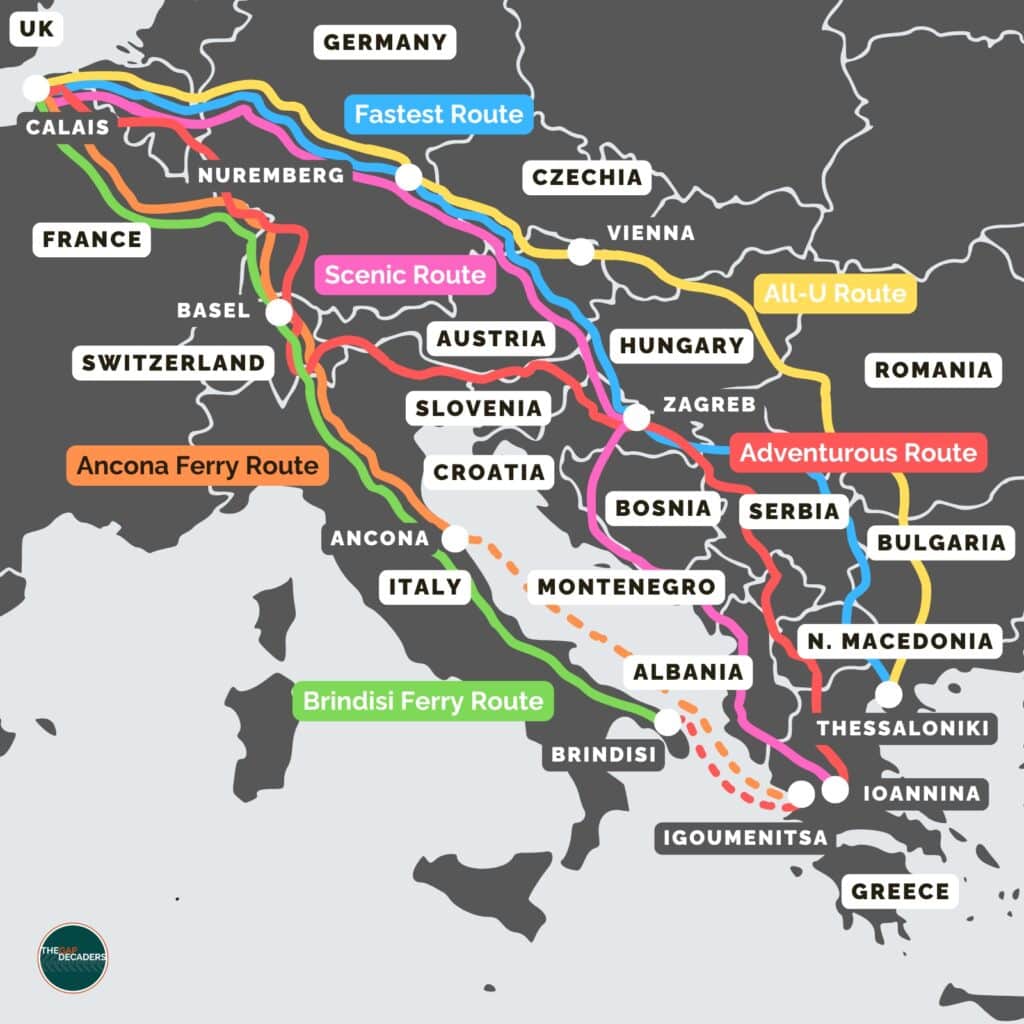
Our UK to Greece driving routes map shows the main routes compared in this guide, from the fastest and cheapest overland route to the Adriatic, ferry and adventurous alternatives.
Summary of the best routes to Greece from UK
Fastest and cheapest route: Via Serbia and North Macedonia for the quickest and lowest-cost drive to Greece.
Best scenic route: Via Croatia, Montenegro and Albania for a slower, more scenic journey along the Adriatic.
Best all-EU route: Via Hungary, Romania and Bulgaria to reach Greece without leaving the EU.
Best ferry route: Drive to Ancona and ferry to Igoumenitsa for fewer driving kilometres and a break at sea.
Best adventurous route: Travel via the Alps, Dolomites and western Balkans, allowing at least a week for the journey.
Best winter option: Drive through Italy and take an Adriatic ferry to reduce winter driving through the Balkans.
Planning Your Drive from the UK to Greece
Driving from the UK to Greece is a serious European road trip, and there is no single best route. Your choice will depend on how quickly you want to get there, the time of year, your vehicle and how much of the journey you want to spend sightseeing.
The biggest decision is whether to drive all the way overland through Central Europe and the Balkans or head south through France and Italy before taking an Adriatic ferry to Greece.
The overland routes generally involve more driving and several countries, with tolls, vignettes and, on some routes, non-EU border crossings to consider. They can also be fantastic road trips in their own right, particularly if you have time to stop in Austria, Slovenia, Croatia or the Balkans along the way.
Taking a ferry from Italy reduces the amount of driving and gives you a proper break before arriving in Greece. This can be particularly appealing in a motorhome or campervan, although ferry prices vary considerably according to the route, season, vehicle size and accommodation you choose.
TOP TIP: If you’re splitting the journey over two or more days, book overnight accommodation well ahead during the summer holidays and other busy travel periods.
RELATED POST: 19 Helpful Long Distance Driving Tips
Make sure you have travel insurance you can trust when driving to Italy. We recommend True Traveller for their 5-star TrustPilot reviews, variety of cover options, best activities cover as standard, great prices, and excellent service.
Crossing the Channel to Europe
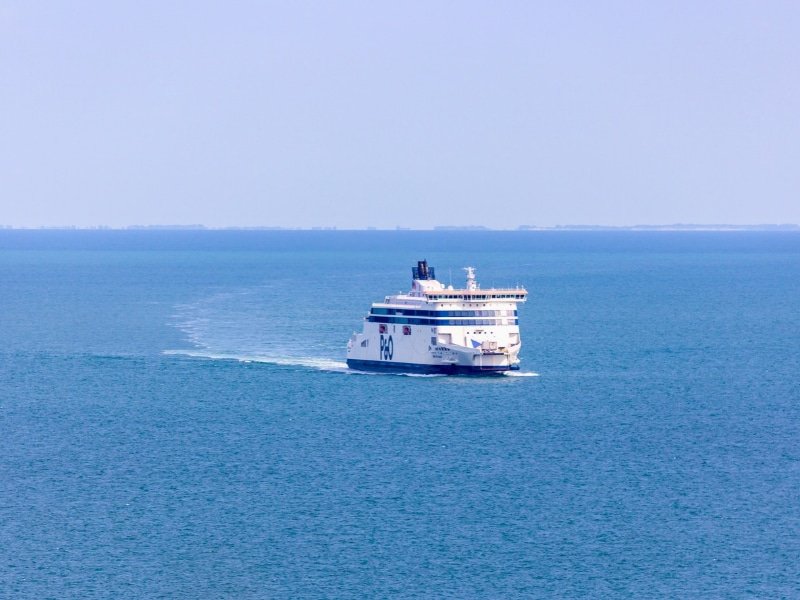
Before you start the drive to Greece, you first need to get across the Channel. For most travellers driving from the UK, the choice comes down to the Eurotunnel from Folkestone or one of several ferry routes from southern and eastern England.
For comparing routes, sailing times and prices, we recommend checking Direct Ferries, which lets you compare multiple operators and crossings in one place before booking.
Eurotunnel: Folkestone to Calais
The Eurotunnel is usually the fastest way to get a car, campervan or motorhome from the UK to France. The crossing itself takes around 35 minutes, and you remain with your vehicle throughout the journey.
Services run frequently throughout the day and night, making this a particularly flexible option if you’re covering a long distance before or after the crossing.
Calais is also the ideal starting point for most of the overland routes to Greece in this guide, with quick access to the French and Belgian motorway networks.
For us, the biggest advantage of the tunnel is its simplicity. There are no worries about rough seas, and getting on and off is generally quick and straightforward.
Dover to Calais Ferry
The Dover to Calais ferry is the classic Channel crossing and generally takes around 90 minutes.
DFDS, P&O Ferries and Irish Ferries operate services on the route, giving you plenty of choice throughout the day.
The ferry can sometimes be cheaper than the tunnel, particularly if you book well ahead or travel at less popular times. It also gives you a chance to get out of the vehicle, have something to eat and take a break before starting the long drive across Europe.
For motorhomes, remember to enter the correct vehicle dimensions when booking, including bike racks, storage boxes or anything else that increases the overall length or height.
Dover to Dunkirk Ferry
DFDS operates between Dover and Dunkirk, with the crossing taking around two hours.
Dunkirk is slightly further east than Calais, so it can work particularly well for the routes to Greece that head through Belgium and Germany. You join the European motorway network without needing to backtrack towards Calais.
It’s worth comparing Dover to Dunkirk with Dover to Calais rather than automatically choosing the shortest crossing. Depending on sailing prices and timings, Dunkirk can be a very practical option.
Harwich to Hook of Holland
If you’re travelling from the Midlands, northern England or eastern England, the overnight Stena Line ferry from Harwich to Hook of Holland is another option worth considering.
It’s a much longer crossing than Dover to Calais, but arriving in the Netherlands puts you considerably further east and avoids the drive to Kent.
An overnight sailing can also replace a night’s accommodation or campsite stop and allows you to start the following morning already on the continent.
For some of the faster routes towards Germany and Austria, this can make more sense than driving south to Dover simply to drive north-east again once you’re in France.
Hull to Rotterdam
Travellers starting in northern England can also consider the overnight Hull to Rotterdam ferry.
Again, the crossing itself is considerably longer and usually more expensive than Dover or the Eurotunnel, but it can save a substantial amount of UK driving. You also arrive well positioned to continue through the Netherlands into Germany.
When comparing prices, look at the whole journey rather than the ferry fare alone. Fuel, UK motorway mileage, an overnight stop and the value of arriving rested can all change which crossing offers the best value.
Which Channel Crossing Is Best for Driving to Greece?
For travellers coming from southern England, the Eurotunnel or Dover ferries will usually be the most straightforward options, particularly as our driving routes can easily be picked up from Calais or Dunkirk.
If you’re travelling from further north, don’t automatically head for Dover. Harwich to Hook of Holland or Hull to Rotterdam can remove hundreds of miles of UK driving and leave you much better positioned for the journey across Germany.
Whichever crossing you choose, compare the total journey time and cost rather than the ticket price alone. For a journey as long as the drive from the UK to Greece, starting the continental leg in the right place can make a significant difference.
Route 1: The Fastest Route via Central Europe and the Balkans
Calais → Liège → Nuremberg → Graz → Zagreb → Belgrade → Skopje → Thessaloniki
Distance: 2,563km
Driving time: 26.5 hours
Toll costs: €76
Fuel costs: €353
This is the route for travellers who want to cover the distance between the UK and Greece as efficiently as possible. After crossing Belgium, the journey is largely fast motorway driving through Germany, Austria and Slovenia before heading south through Croatia, Serbia and North Macedonia.
The big advantage is that you keep moving south-east towards Greece without the long detour around the Adriatic or the expense of a ferry. The trade-off is a succession of tolls, vignettes and border crossings, particularly once you leave the EU for Serbia and North Macedonia.
For us, this is very much a getting-there route rather than the one we’d choose for sightseeing. It works particularly well if northern Greece or Thessaloniki is your first destination and you want to put in some long driving days.
Route 2: The Croatia, Montenegro and Albania Route
Calais → Liège → Nuremberg → Graz → Zagreb → Split → Podgorica → Shkodër → Ioannina
Distance: 2,821km
Driving time: 35.5 hours
Toll costs: €88
Fuel costs: €391
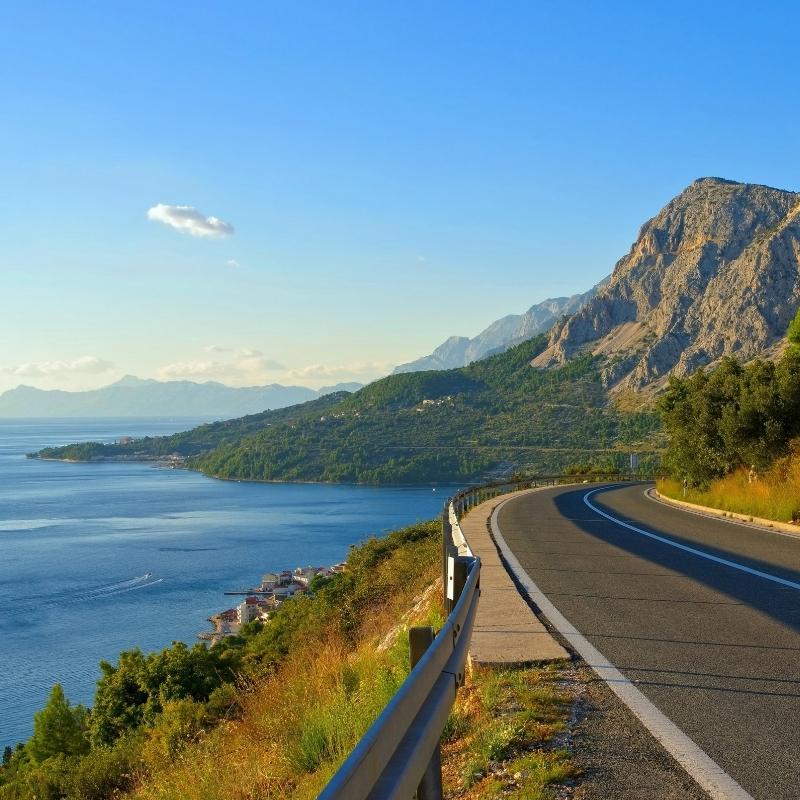
This is the most scenic of our overland routes to Greece, trading some of the speed of the main motorway routes for a journey down the Adriatic and through the western Balkans.
From Calais, the route heads through Belgium and Germany before crossing Austria and Slovenia to reach Zagreb. From here, you travel south through Croatia towards Split before continuing through Montenegro, passing Podgorica and crossing into Albania near Shkodër.
The final section takes you south through Albania before crossing into north-western Greece and finishing at Ioannina.
This route makes particular sense if the journey is part of your holiday rather than simply a way of getting to Greece. Croatia, Montenegro and Albania all offer excellent opportunities to break the drive for a few days, and you could easily turn the route into a road trip in its own right.
It’s not the route we’d choose if getting to Greece as quickly as possible was the priority. Once you leave the faster motorway network, progress can be slower, particularly through Montenegro and Albania, and border crossings can add unpredictable delays during busy periods.
For a motorhome trip with time to spare, though, this is one of the most interesting ways to drive from the UK to Greece.
Route 3: The All-EU Route via Romania and Bulgaria
Calais → Liège → Nuremberg → Vienna → Budapest → Timișoara → Sofia → Thessaloniki
Distance: 2,672km
Driving time: 29.5 hours
Toll costs: €50
Fuel costs: €420
This route swings much further east, travelling through Hungary, Romania and Bulgaria before entering Greece from the north.
Its main attraction is simplicity at the borders. Every country on the route is in the EU and, since Romania and Bulgaria became full members of the Schengen Area, you can travel all the way from Calais to Greece without leaving Schengen.
It is a substantial detour compared with cutting through Serbia and North Macedonia, so it makes little sense if your only aim is to reach Greece as quickly as possible. However, it becomes much more appealing if you want to avoid the non-EU Western Balkan countries or are planning to include Romania or Bulgaria in the trip.
It’s also worth considering for vehicles where insurance cover outside the EU becomes complicated or expensive, although you’ll still need to deal with the different road charging systems along the way.
Route 4: Italy and Ferry via Ancona
Calais → Reims → Basel → Milan → Bologna → Ancona → ferry to Igoumenitsa
Distance: 1,451km
Driving time: 16.5 hours
Ferry: Ancona → Igoumenitsa 22.5 hours
Total journey time: 39 hours including ferry crossing
Tolls/vignettes: €118
Ferry cost: from around €550 one way for two people and a 6–8m motorhome
Fuel: €200
This route combines a relatively fast drive across France, Switzerland and northern Italy with an overnight ferry from Ancona to Igoumenitsa on Greece’s west coast.
From Calais, the quickest route heads south-east through France to Basel, before crossing Switzerland and continuing through northern Italy via Milan and Bologna to the Adriatic port of Ancona.
From Ancona, the ferry to Igoumenitsa takes around 22½ hours outside the peak summer period, with slightly shorter scheduled crossings during summer. The current timetable has departures at 19:30 and arrival at 18:00 the following day for much of the year.
For two people travelling with a 6–8 metre motorhome, expect fares to start at around €550 one way with basic deck accommodation. Prices vary considerably according to season, vehicle dimensions and the accommodation you choose, and a cabin will increase the overall cost.
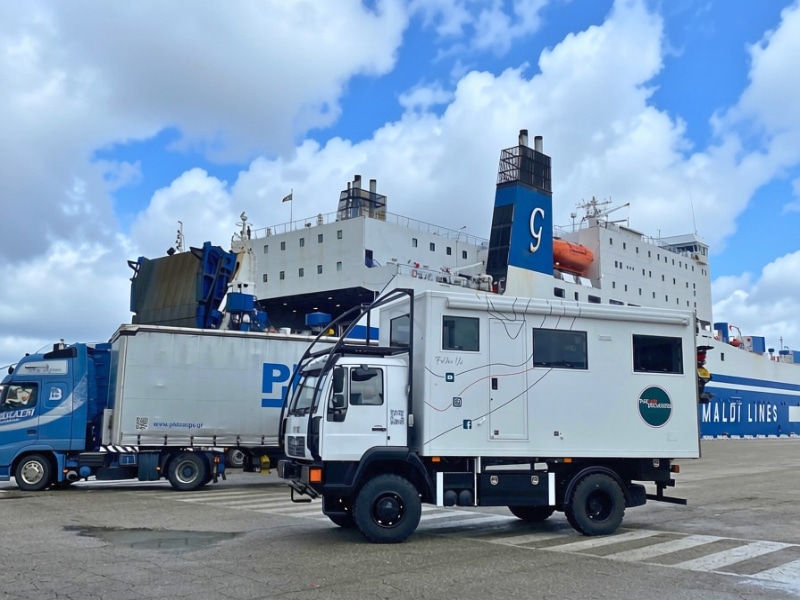
One important change for motorhome travellers is that you can no longer sleep in your motorhome during the crossing. Camping on board, which once allowed motorhomers to remain in their vehicles and could save a considerable amount compared with booking a cabin, is no longer an option. Vehicles remain on the closed garage deck, which passengers cannot access while the ship is at sea. You’ll therefore need to book deck passage, a reclining seat or a cabin for the crossing.
Despite the additional ferry cost, this route dramatically reduces the amount of driving needed to reach Greece. Instead of continuing overland through the Balkans and negotiating several borders, you can stop driving at Ancona, spend the night travelling south across the Adriatic and arrive directly on Greece’s west coast.
It’s particularly attractive if you’re heading for north-western Greece, the Ionian coast or the Peloponnese, and for anyone who would rather spend a night on a ferry than another couple of days behind the wheel.
The downside is cost. Once you’ve added the motorhome fare and accommodation, the ferry can make this one of the more expensive routes. But the reduction in driving distance, fuel, tolls and overnight stops means it’s worth comparing the total journey cost rather than looking at the ferry fare in isolation.
Route 5: Southern Italy and Shorter Ferry
Calais → Reims → Basel → Milan → Bologna → Bari → Brindisi → ferry to Igoumenitsa
Distance: 2,014km
Driving time: 22 hours
Ferry: Brindisi → Igoumenitsa 10 hours
Total journey time: 32 hours including ferry crossing
Tolls/vignettes: €156
Ferry cost: from around €300 one way for two people and a motorhome
Fuel: €277
This route involves considerably more driving through Italy than the Ancona option, but rewards you with a much shorter ferry crossing to Greece.
From Calais, the fastest route heads through France to Basel, crosses Switzerland and northern Italy, then follows the Italian motorway network south past Milan and Bologna and along the Adriatic coast to Brindisi.
From Brindisi, ferries sail directly to Igoumenitsa on Greece’s west coast. Crossing times are typically around 9 hours on the daytime sailing and around 10½ hours overnight, making this one of the shortest ferry crossings between Italy and mainland Greece.
The advantage is simple: you spend more time driving and much less time at sea. For anyone who doesn’t particularly enjoy long ferry crossings, or who would prefer to cover the distance under their own steam, Brindisi can be a good compromise between driving all the way through the Balkans and taking the much longer ferry from Ancona.
There are also ferries from Bari to Igoumenitsa, so it’s worth comparing both ports before booking. Bari is around 115km north of Brindisi, reducing the driving distance, although the ferry crossing is longer. Sailing times, availability and fares can make Bari the better option on a particular date, especially if the timetable fits your journey more conveniently.
As with the Ancona route, motorhome passengers should be aware that sleeping in your vehicle on the ferry is no longer permitted. Camping on board was once a particularly attractive option for motorhomers because it could substantially reduce accommodation costs, but you’ll now need to use the passenger areas and book deck passage, a reclining seat or a cabin depending on the service.
The downside of Route 5 is the additional drive through Italy, together with the extra motorway tolls and fuel. The upside is arriving in Igoumenitsa after a relatively short sea crossing, with none of the additional Balkan border crossings required by the completely overland routes.
If you’re deciding between the Italian ferry options, Ancona generally means less driving and more time at sea, while Brindisi means more driving and considerably less time on the ferry. Bari sits neatly between the two.
Insider Tip: Greek Ferry Ports Can Be Chaotic
Don’t expect boarding a ferry to or from Greece to work quite like it does in the UK. In our experience, the process can feel surprisingly informal, with limited signage and instructions and nobody necessarily calling you forward when it’s time to board.
On one crossing, we waited for around an hour expecting someone to tell us when to move. Eventually, after watching other vehicles simply driving towards the ferry, we did the same and were waved straight on.
Disembarking can be equally chaotic. Once the vehicle deck opens, it can feel like a free-for-all as cars, motorhomes and lorries manoeuvre to get off. Stay with your vehicle when instructed, keep an eye on what the vehicles around you are doing and be prepared to move when directed.
Arrive at the port in plenty of time, complete check-in as instructed by your ferry operator and then pay attention to what’s happening around you rather than assuming you’ll be individually called forward. If you’re unsure, ask one of the port or ferry staff.
Route 6: The Adventurous Route via the Dolomites & Balkans
Calais → Luxembourg → Black Forest → Swiss Alps → Dolomites → Ljubljana → Plitvice Lakes → Sarajevo → Mostar → Kotor → Shkodër → Ioannina
Distance: 2,919km
Driving time: 41 hours
Toll costs: €112
Fuel costs: €403
If getting to Greece as quickly as possible isn’t the priority, this is the route we’d choose.
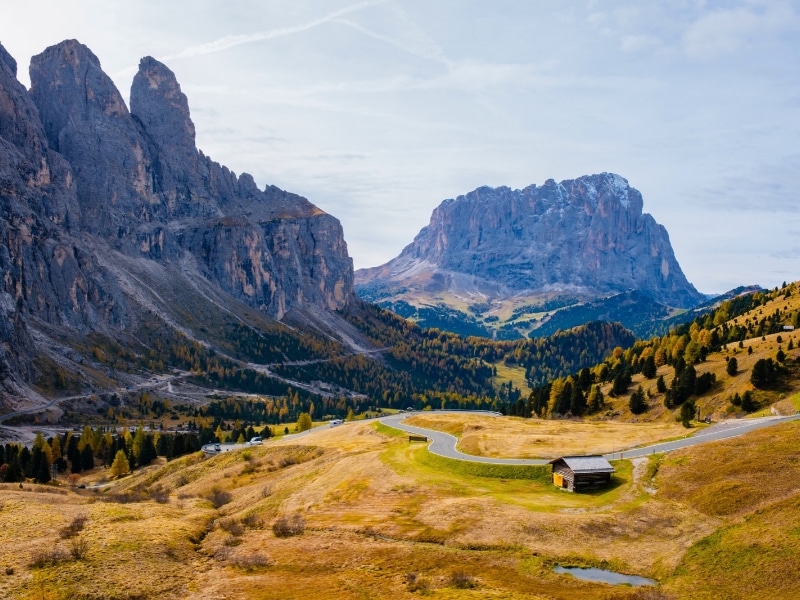
Rather than following the fastest motorways across Europe, the adventurous route turns the journey itself into a road trip, taking you through the Alps and some of the most spectacular landscapes of the western Balkans before entering Greece from Albania.
From Calais, head through Luxembourg and into Switzerland, where you can spend some time exploring the Alps before crossing into northern Italy and the Dolomites. From here, continue east through Slovenia and Croatia, stopping at Plitvice Lakes before turning south into Bosnia and Herzegovina.
Sarajevo makes a fascinating stop before the route continues through the mountains to Mostar and on towards the Adriatic. From there, head into Montenegro and around the Bay of Kotor before continuing south through Albania and crossing into north-western Greece towards Ioannina.
This isn’t a route to rush. Mountain roads, border crossings and slower sections through the Balkans mean driving times can be unpredictable, and trying to cover it in the same timeframe as the faster routes would rather miss the point.
Allow at least a week, and preferably 10 days or more. That gives you time to actually stop and explore, with plenty of scope to spend longer in the Swiss Alps, Dolomites, Bosnia and Herzegovina, Montenegro or Albania along the way.
We’ve travelled extensively through this part of Europe, and it’s a journey we’d happily make again. If you’ve got the time, we’d choose this route over simply racing down the motorways to Greece.
Onward Travel in Greece
Greece is a much bigger country than it can appear on the map, so reaching the border or stepping off the ferry doesn’t necessarily mean the long driving days are over.
If you’re following one of the overland routes through North Macedonia, you’ll usually enter Greece north of Thessaloniki. This is ideal for exploring northern Greece, including Thessaloniki, Halkidiki and the surrounding region, and gives you straightforward motorway connections towards Meteora and the south.
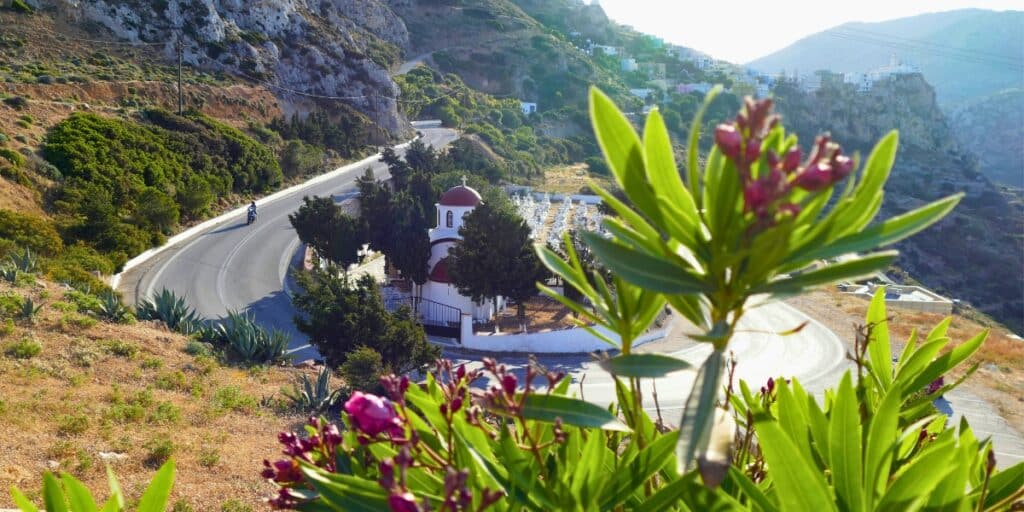
Arriving from Albania brings you into north-western Greece, making Ioannina, the Zagori region and the Pindus Mountains natural first stops. From here, you can continue east towards Meteora and Thessaloniki or head south towards the Ionian coast.
If you take the ferry from Italy to Igoumenitsa, you’re particularly well placed for western and northern Greece. The A2 Egnatia Odos provides a fast motorway route east towards Ioannina, Meteora and Thessaloniki, while heading south takes you towards Lefkada and the western mainland.
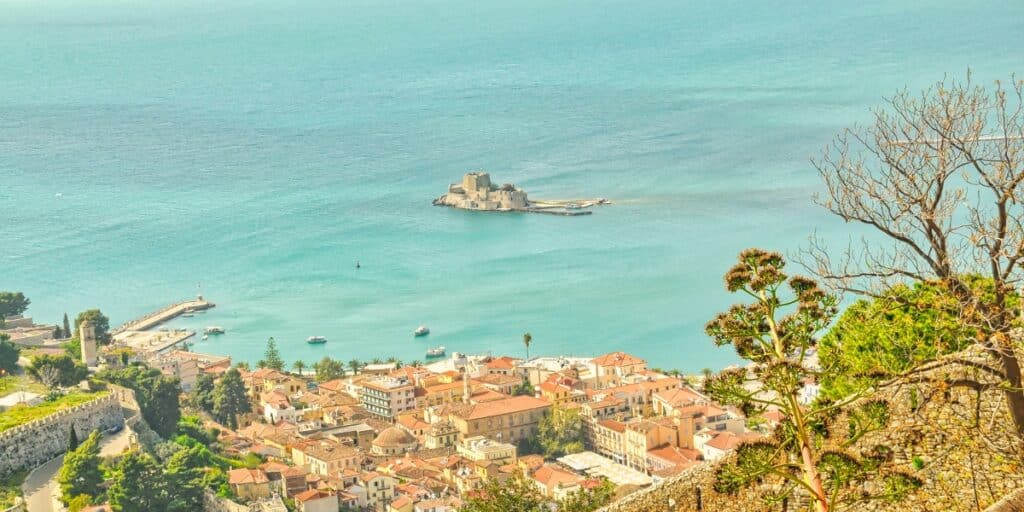
Patras is the more useful ferry arrival if your plans focus on the Peloponnese, Athens or southern Greece. From Patras, you can head east along the Gulf of Corinth towards Athens or turn south into the Peloponnese for destinations including Olympia, Kalamata, Mystras and the Mani Peninsula.
If you’re ultimately heading for Athens, don’t automatically assume that arriving as far south as possible is the best option. Compare the complete journey, including the European drive, ferry crossing and onward drive in Greece, before deciding between an overland route, Igoumenitsa and Patras.
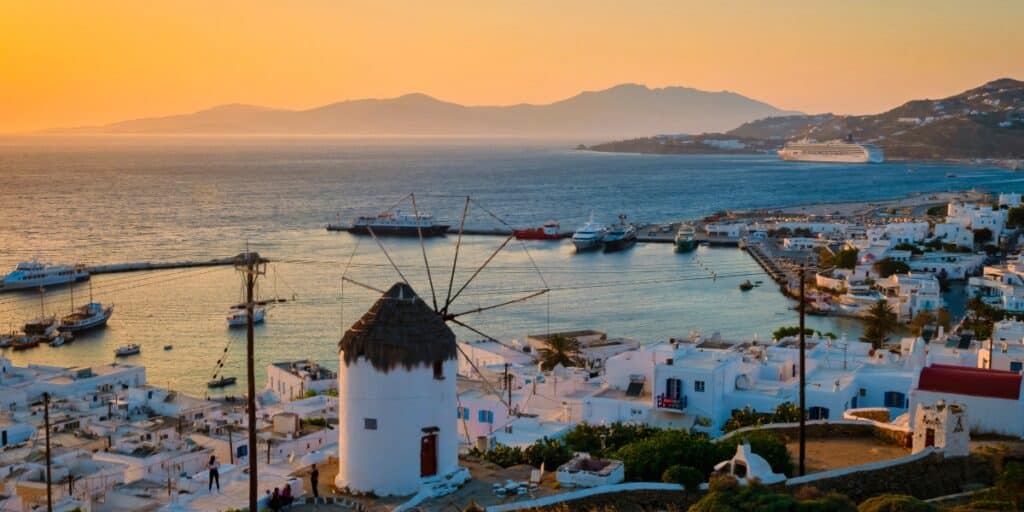
And if the Greek islands are your final destination, Athens isn’t your only option. Ferries leave from a number of mainland ports, so the most convenient UK-to-Greece route may depend on which island group you’re planning to visit.

Driving on the Continent
Every driving route from the UK to Greece crosses at least two European countries, so make sure you understand the rules for each country on your chosen route before leaving home.
For UK drivers taking their own vehicle, you should carry:
UK vehicle insurance provides the minimum third-party cover required in the EU and Switzerland, and you don’t normally need a green card for these countries. Check your own policy before travelling, as the level of cover provided outside the UK can vary.
A UK photocard driving licence can be used in Italy without an International Driving Permit. Different rules can apply if you hold a paper licence or a licence issued in Gibraltar, Guernsey, Jersey or the Isle of Man, so check the current requirements before travelling.
If you’re taking your own UK-registered vehicle abroad for less than 12 months, carry the original V5C. Your vehicle must also remain taxed, insured and, where applicable, have a valid MOT while you’re away.
You may need a UK sticker on the rear of your vehicle. You don’t need a separate sticker if your number plate already displays the UK identifier with the Union flag, but plates showing GB, an EU flag or no national identifier require a UK sticker.
You’ll be driving on the right throughout mainland Europe, so take extra care at junctions and roundabouts and when pulling away after stopping. Headlight converters may also be necessary if your vehicle cannot adjust its headlights for driving on the right.
Many of the countries crossed by these routes are within the Schengen Area, but that doesn’t guarantee an uninterrupted border crossing. Temporary border controls can be introduced, so keep your passports and vehicle documents accessible throughout the journey.
Safety equipment requirements vary between countries. A reflective hi-vis jacket and warning triangle are sensible essentials, but check the individual rules for every country on your chosen route before you travel.
If you have an accident, move to a safe place where possible, use your hazard lights and follow the local rules for warning other traffic. Exchange details with the other driver, take photographs and contact the emergency services on 112 if anyone is injured or police assistance is required.
RELATED POST: Driving in Europe: Everything You Need to Know
Driving Through the Balkans to Greece
Several of the overland routes to Greece pass through countries outside the EU, including Serbia, North Macedonia, Montenegro, Albania and Bosnia & Herzegovina. Driving through these countries is generally straightforward, but there are a few extra things to check before you leave the EU.
Vehicle Insurance
Don’t assume your UK motor insurance automatically covers every country on your route. Before travelling, check your policy specifically for Serbia, North Macedonia, Montenegro, Albania and Bosnia & Herzegovina, depending on the route you’re taking.
Your insurer may provide full comprehensive cover, reduce your cover to third-party only or exclude some countries altogether.
You no longer need a Green Card to drive in the EU, Serbia, Montenegro or Bosnia & Herzegovina with UK insurance, but that doesn’t mean your own policy necessarily provides the level of cover you expect. Albania and North Macedonia should be checked particularly carefully with your insurer before travelling.
If your UK policy doesn’t cover a country, you may be able to buy local third-party insurance at or near the border. This only provides the legally required minimum cover and won’t normally cover damage to your own vehicle.
We always recommend getting written confirmation from your insurer of exactly where you’re covered and at what level before setting off.
Border Crossings
Unlike travelling entirely within the Schengen Area, some Balkan routes involve controlled international borders. Keep your passport, V5C and insurance documents somewhere easily accessible rather than buried in the back of the motorhome.
Border crossings can be quick and uneventful, but queues can become lengthy during summer weekends and holiday periods. Allow some flexibility in your schedule rather than planning an onward stop around an exact border-crossing time.
Tolls and Road Charges
There is no single Balkan road-charging system. Serbia and North Macedonia use motorway toll booths, while other countries use different toll, vignette or road-charging arrangements.
Check the current requirements for every country on your chosen route before leaving home, particularly if you’re driving a motorhome over 3.5 tonnes, as vehicle classifications and charges can be very different from those for a car.
Mobile Data & Roaming
Remember that travelling outside the EU can also affect your mobile roaming.
Serbia, North Macedonia, Montenegro, Albania and Bosnia & Herzegovina are not covered by EU roaming rules. Check what your UK mobile provider charges before using data, making calls or allowing your phone to connect automatically after crossing the border.
An eSIM or local SIM can be considerably cheaper if you’re spending more than a day or two travelling through the Balkans.
Driving in Greece
Once you arrive in Greece, the main motorway network makes covering long distances relatively straightforward. The A1 connects Thessaloniki with Athens, the A2 Egnatia Odos crosses northern Greece from Igoumenitsa towards Thessaloniki and the Turkish border, and the major routes around Athens and through the Peloponnese are generally modern and well maintained.
Away from the motorways, driving can be much slower. Mountain roads are often narrow and winding, village streets can be extremely tight and road surfaces vary considerably, particularly in rural areas. If you’re travelling in a large motorhome, don’t blindly follow your sat nav through old towns and mountain villages without checking the route first.
Drive on the right and overtake on the left. UK driving licences are accepted for visitors, and you should carry your V5C, insurance documents and passport along with the usual safety equipment required for driving in Europe.
Toll Roads in Greece
Most of Greece’s main motorways are tolled, including sections of the A1 between Thessaloniki and Athens, the A2 Egnatia Odos, the A5 Ionia Odos and motorways around Athens and the Peloponnese.
Unlike countries that use a national vignette, Greece operates individual toll plazas. You pay as you travel, with the amount determined by the road, distance and vehicle category.
This is particularly important for motorhomes. Vehicle classification is not simply based on whether your vehicle is registered as a motorhome. Height and number of axles can move larger vehicles into a considerably more expensive toll category. On the Aegean Motorway, for example, vehicles up to 2.2 metres high fall into Category 2, while two or three-axle vehicles over 2.2 metres are Category 3 and pay substantially more.
Most toll plazas accept cash and cards, and electronic toll tags are also available. If you’re only visiting Greece for a road trip, paying at the toll booths is generally the simplest option.
If you’re travelling in a large motorhome or overland vehicle, allow a healthy amount in your budget for Greek motorway tolls. They can add up surprisingly quickly.
Parking in Greece
Parking is generally straightforward outside the larger towns, cities and major tourist destinations, but finding somewhere suitable for a motorhome can be much harder in historic centres and on the islands.
Look carefully at local signs and road markings before leaving your vehicle. Restrictions and residents’ parking zones are common in larger towns, while popular coastal destinations may introduce additional controls during the summer.
In Athens and Thessaloniki, we’d avoid driving into the centre unless you have a good reason to. Traffic is busy, parking spaces are tight and a large motorhome can quickly become more of a liability than a convenience. A campsite or motorhome stop outside the centre combined with public transport is usually a much easier option.
Don’t assume that being able to park a motorhome also means you can camp there. Putting out awnings, tables, chairs or other camping equipment can bring you into conflict with local restrictions, particularly in popular coastal areas.
Low Emission Zones and Athens Driving Restrictions
Greece doesn’t currently have the widespread network of low emission zones you’ll encounter in countries such as France or Germany, but Athens has its own traffic restriction zone, known as the Daktylios.
The system restricts vehicles entering central Athens and traditionally operates on an odd-and-even registration number system on weekdays. Certain lower-emission vehicles can qualify for unrestricted access, including eligible electric, hybrid, factory LPG/CNG and qualifying Euro 6 vehicles.
The scheme is seasonal rather than permanent. For example, the 2025-26 restrictions ran from 20 October 2025 until 24 July 2026.
For visitors in foreign-registered vehicles, we’d check the current rules before driving into central Athens rather than relying on older information online. The scheme, exemptions and operating dates can change from one season to the next.
For most motorhome travellers, the simplest solution is to stay outside the restricted central area and use public transport to explore Athens.
Winter Driving in Greece
It’s easy to think of Greece as a year-round warm-weather destination, but winter conditions can be very different in the north and in mountainous areas.
Snow and ice are common enough in northern and central Greece and at higher elevations that you need to plan accordingly if you’re driving to Greece during winter. Routes around the Pindus Mountains, Meteora and northern Greece can experience proper winter conditions, and snow can occasionally affect roads much further south.
Greece does not simply impose a blanket requirement for winter tyres on every vehicle throughout winter. Instead, the authorities can make anti-skid equipment compulsory when weather conditions require it. When such measures are in force, vehicles without suitable winter tyres may be required to carry and use snow chains or another approved anti-skid device. Greek police issued exactly these requirements across several northern regions during snow in January 2026.
Greek road law also requires chains or equivalent equipment on at least two driven wheels when driving on snow without appropriate tyres, and they may be required during icy conditions when instructed by signs or the authorities.
If you’re driving to Greece between autumn and spring, we’d carry suitable snow chains or snow socks and make sure you know how to fit them before you need them. Check the weather and road conditions before heading into the mountains, particularly after heavy snowfall. Greek Civil Protection specifically advises drivers travelling in snow and frost to carry chains and check road conditions in advance.
Driving from the UK to Greece FAQs
How long does it take to drive from the UK to Greece?
The fastest routes from Calais to northern Greece involve around 25 to 30 hours of driving before you add fuel, food, rest and border stops.
Although it is possible to cover the distance in a few very long days with two drivers, we would allow at least four days for a comfortable journey in a motorhome or campervan, and longer if you want to explore along the way.
What is the fastest driving route from the UK to Greece?
The fastest overland route generally runs from Calais through Belgium, Germany, Austria, Slovenia and Croatia before continuing through Serbia and North Macedonia into northern Greece.
It is predominantly motorway and avoids the slower coastal roads through Montenegro and Albania, making it the best choice if reaching Greece quickly is your priority.
Can you drive from the UK to Greece without taking a ferry?
Yes. There are several completely overland routes from the UK to Greece.
The most direct passes through Central Europe, Serbia and North Macedonia, while alternatives take you through Montenegro and Albania or further east through Hungary, Romania and Bulgaria.
You’ll still need to cross the English Channel from the UK by ferry or Eurotunnel, but no further ferry crossing is necessary.
Is it cheaper to drive through the Balkans or take a ferry from Italy to Greece?
It depends on your vehicle, fuel consumption, time of year and the ferry fare available for your dates.
Driving all the way through the Balkans avoids the cost of an Adriatic ferry, but you’ll spend more on fuel, motorway tolls and vignettes and add considerable mileage to your vehicle.
For a large motorhome, compare the complete cost of both options rather than looking at the ferry price alone. The saving in fuel, tolls and mileage can offset a significant part of the fare.
Can I drive through Serbia, North Macedonia and Albania with UK motor insurance?
Possibly, but you need to check your individual policy before travelling.
UK policies don’t necessarily provide the same level of cover in every non-EU country. Your insurer may provide comprehensive cover, reduce your protection to third-party cover or exclude a country altogether.
Ask your insurer to confirm in writing which Balkan countries are covered and at what level. If your policy doesn’t cover a particular country, local third-party insurance may be available at the border.
Can I drive from the UK to Greece without leaving the EU?
Yes. You can travel through Belgium, Germany, Austria, Hungary, Romania and Bulgaria before entering Greece.
All of these countries are EU members, and Romania and Bulgaria are now full members of the Schengen Area, making this a straightforward option if you prefer to avoid the non-EU Balkan countries.
It is a considerably longer route than driving through Serbia and North Macedonia, so we wouldn’t choose it purely for speed.
What is the best route from the UK to Greece in winter?
The best winter route will depend on current weather and road conditions.
The direct overland routes cross areas of Central Europe and the Balkans where snow and ice are common in winter, and winter tyres or other winter equipment may be compulsory along parts of your journey.
Driving through Italy and taking an Adriatic ferry can reduce the amount of winter driving through the Balkans, although you’ll still need to cross the Alps to reach Italy on many routes.
Whichever route you choose, check the weather forecast, mountain passes and winter-equipment requirements for every country before setting off.
More Road Trip Resources to Explore

Driving to Türkiye from the UK: Routes and Practical Tips
Driving to Portugal from the UK: Best Routes, Ferries and Driving Tips
Heart 200 Road Trip? 5 Reasons to Check Tyres in Stirling Before Going
Driving to Spain from the UK: Best Routes & Driving Tips
Driving to Italy from the UK: Best Routes & Driving Tips
Driving to Norway from the UK: Best Routes & Top Tips
Love it? Pin it!


