
This post may contain affiliate links, from which we earn an income. Click here to read our affiliate policy.
The south of France is one of the most rewarding regions in Europe for a road trip. From Mediterranean coastlines and vineyard-covered hills to Roman cities, medieval villages, and market towns, the landscape changes constantly, but the distances remain manageable. Travelling east to west by car lets you experience that variety without rushing, following a natural flow from the Riviera into Provence and onward to Occitanie.
This south of France road trip is designed as a 10-day journey, moving at a realistic pace that allows time to explore, not just drive. It follows a logical east-to-west route from the French Riviera to Toulouse, balancing iconic coastal stops with inland Provence, the Verdon Gorge, and historic towns in Occitanie. Distances are manageable, scenery changes constantly, and the structure avoids unnecessary backtracking or rushed days.
It works equally well as a standalone trip or as part of a longer France road trip, and it’s built for travellers who want to explore properly rather than hop between disconnected stops.
South of France Road Trip: Key Facts
Route: The Gap Decaders’ 10-day South of France road trip travels from Nice to Toulouse, covering around 1,000km through the French Riviera, Provence and Occitanie.
Itinerary: The route includes the Verdon Gorge, Saint-Tropez, Marseille, Aix-en-Provence, the Luberon, Arles, Montpellier, Narbonne and Carcassonne before finishing in Toulouse.
Time needed: Allow 10 days for the complete route, with May to June and September to October offering some of the best conditions for driving and sightseeing.
First-hand experience: The Gap Decaders’ recommendations are based on years of travelling and road tripping throughout France, including extensive time exploring Provence and southern France.
Enjoy The Gap Decaders? Add us as a preferred source on Google.
Planning tools we actually use for France road trips
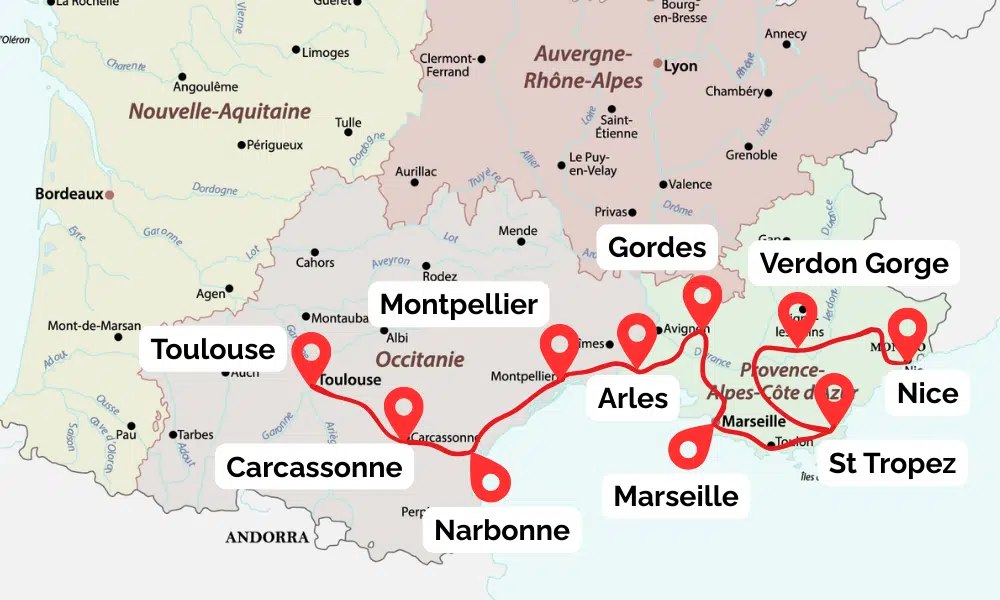
South of France Itinerary and Map
Route: Nice – Gorge du Verdon – Saint-Tropez – Marseille – Gordes – Arles – Montpellier – Narbonne – Carcassonne – Toulouse
Distance: ~1000 km
Duration: 10 days
Best time to go: May–June, September–October, with lavender peaking mid-June to mid-July
Best for: Coastal scenery, Provençal villages, Roman history, food and wine
This map shows the full route and main bases for the trip. You can save it to Google Maps for planning or offline use while driving.
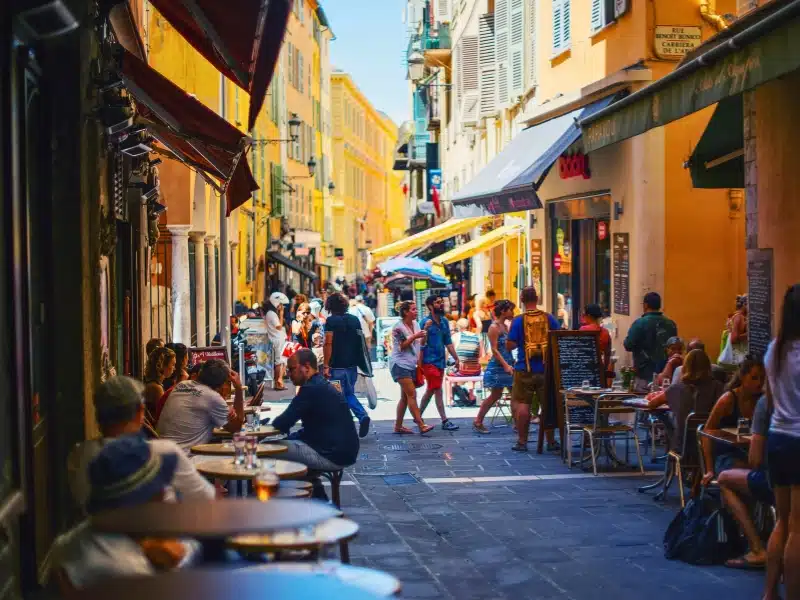
Day 1: Nice: Riviera Arrival and Coastal Warm-Up
Nice is the natural starting point for a south of France road trip, especially if you’re flying in. It’s well connected, easy to collect a hire car from, and gives you a gentle introduction before the longer inland drives begin.
If possible, arrive at least one day before the road trip officially starts. Nice rewards unstructured wandering. Walk the length of the Promenade des Anglais early in the morning when the light is soft and the city feels local rather than touristic. In the old town, browse the Cours Saleya market for fruit, olives, and socca, a chickpea flatbread that’s a local staple and ideal road-trip fuel.
For a broader sense of place, head up to Castle Hill for panoramic views over the Baie des Anges. Although the castle itself no longer stands, the viewpoint helps frame the geography of the journey ahead, with the Alps rising faintly inland and the coast stretching east and west.
Spend the afternoon keeping things light. This is not a day for overplanning. Pick up groceries, familiarise yourself with the car, and enjoy an unhurried dinner. Tomorrow is the longest and most transformative drive of the trip, and an early start makes a noticeable difference.
Where to Stay in Nice
If you’re flying in, it’s worth staying one night in Nice so you can start the inland drive early and avoid doing a long first day straight off a flight.
Luxury: Hotel Le Negresco is an iconic Belle Époque stay on the Promenade des Anglais, best if you want a statement first night before heading inland.
Mid-range: Hôtel La Pérouse is tucked into the castle hill area with sea views and a calmer feel than the main strip, still walkable for dinner.
Budget: ibis Nice Centre Gare is straightforward, well located for an early start, and practical for drivers.
Day 2: Nice to Verdon Gorge via Entrevaux and Valensole
This is one of the most important days of the itinerary. It’s where the road trip truly begins, leaving the Mediterranean behind and cutting inland through landscapes that feel increasingly remote and rural.
Leave Nice early and follow the Var valley north. The road traces the river through narrowing gorges and mountain foothills, with the scenery changing quickly as urban density drops away. After around 1 hour 45 minutes, you’ll reach Entrevaux, a fortified medieval town dramatically wedged beneath a rocky outcrop.
Enter Entrevaux via the stone drawbridge and take time to wander the old town. Its compact size makes it easy to explore on foot, with narrow lanes, vaulted passages, and a Gothic cathedral tucked inside the walls. If you’re feeling energetic, the climb up to the citadel is steep but rewarding, offering wide views over the valley and a clear sense of why this position mattered strategically.
From Entrevaux, the route climbs steadily toward the Valensole Plateau. This stretch feels expansive and exposed, with long straight roads and big skies. In June and early July, the lavender fields are the obvious draw, but even outside bloom season the plateau has a quiet, agricultural beauty that contrasts sharply with the coast. Roadside stops are informal and frequent, allowing you to pull over without committing to specific viewpoints.
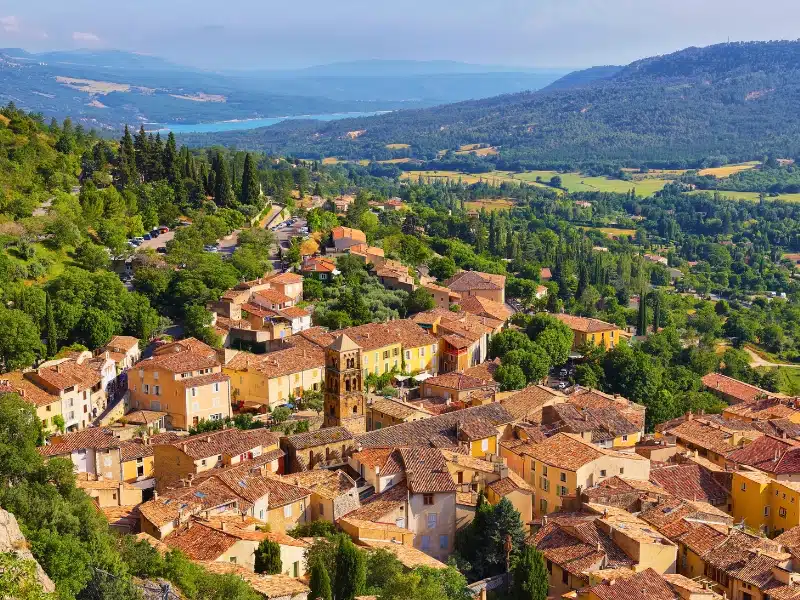
Continue south of Valensole toward the Verdon Gorge in the afternoon. As you approach, the landscape tightens again, with limestone cliffs beginning to close in and the sense of scale increasing. If time allows, detour briefly to Moustiers-Sainte-Marie. It’s undeniably popular, but well placed for a late lunch or coffee, and its setting beneath a sheer cliff crowned by a tiny chapel is genuinely striking.
Arrive at the Verdon Gorge by late afternoon. Even if you’re tired, a short drive to one of the nearby viewpoints is worth it. The canyon’s depth is most impressive in softer evening light, when shadows emphasise the sheer drop to the river below.
After a long inland drive from Nice, staying close to the gorge keeps the day manageable and allows for an early start the following morning.
Where to Stay in the Verdon Gorge Area
Luxury: Hotel & Spa des Gorges du Verdon offers dramatic views, spa facilities, and easy access to the canyon roads.
Mid-range: Hôtel Le Colombier is a comfortable and characterful option with parking and a relaxed setting.
Budget: Lou Paradou is a simple, well-located choice for a practical overnight stop.
Day 3: Verdon Gorge to Saint-Tropez via Grasse
After the drama of the canyon, today’s drive shifts tone again, trading raw nature for culture, craft, and a gradual return to the coast. The distances are manageable, but the variety makes it a full and satisfying day.
Leave the Verdon region heading east toward Grasse, passing through small Provençal villages and forested hills. Grasse sits above the coast and feels distinctly separate from the Riviera despite its proximity. Known worldwide as the perfume capital of France, it has UNESCO Intangible Cultural Heritage status for its long-standing perfume traditions.
Visiting one of the historic perfume houses, Fragonard, Galimard, or Molinard, adds depth rather than feeling gimmicky, particularly if you’re interested in how scent is produced and blended. Beyond perfume, Grasse’s old town is worth unhurried exploration. Steep lanes, shaded squares, and viewpoints across the surrounding hills give the town a lived-in, slightly rough-edged charm.
From Grasse, continue southeast toward the coast. Traffic increases noticeably as you descend, especially in summer, so patience helps here. Rather than heading straight to Saint-Tropez, skirt the busiest coastal stretches where possible and aim to arrive in the late afternoon or early evening.
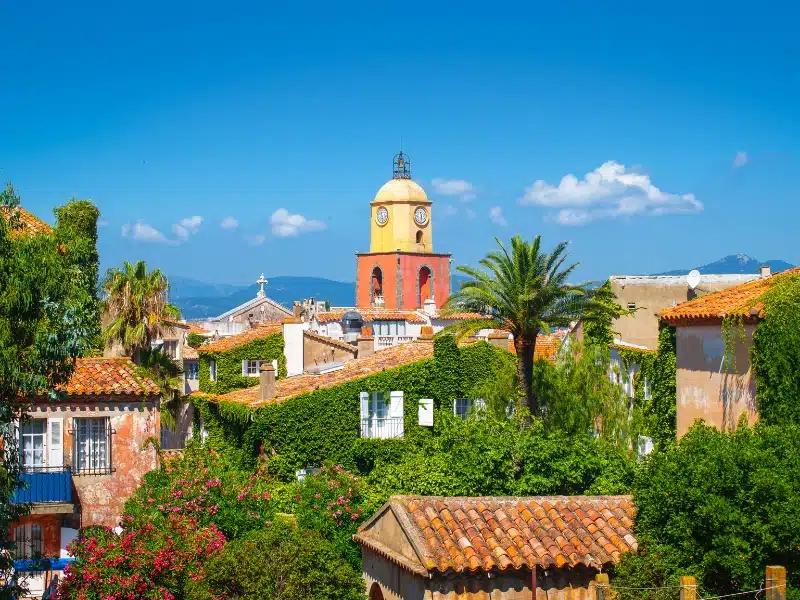
Saint-Tropez is best experienced slowly and with adjusted expectations. Yes, it’s glamorous and busy, but beneath the yachts and boutiques there’s still a compact old town with narrow streets, a small citadel, and quieter corners if you wander beyond the port. An evening walk along the harbour, once the day-trippers have left, offers a more relaxed introduction.
If energy allows, consider driving a short distance up to Gassin for sunset. The hilltop views over the gulf provide context for the coastline you’ll continue to follow over the coming days.
Where to Stay in Saint-Tropez
This night places you directly on the coast after a full day moving back toward the Mediterranean.
Luxury: Villa Cosy Hotel & Spa is a refined hideaway just outside the busiest areas, with parking and a calm atmosphere.
Mid-range: Hotel le Mandala is well positioned for both town access and a quieter night’s sleep.
Budget: Lou Cagnard is a straightforward option within reach of the old town and beaches.
Day 4: Saint-Tropez to Marseille via Toulon, Bandol, and Cassis
Today continues along the Mediterranean but with a noticeable shift in character. The glossy Riviera gives way to a more working coastline, where naval ports, fishing towns, and limestone cliffs replace beach clubs and boutiques.
Leave Saint-Tropez early if possible. Coastal traffic builds quickly, especially in summer, and getting a head start makes the drive far more pleasant. The road toward Toulon hugs the shoreline in places before cutting inland, offering flashes of sea between wooded hills.
Toulon is France’s principal naval port and feels more functional than glamorous. That’s part of its appeal. Take the cable car up Mount Faron for panoramic views over the harbour and surrounding islands. At the summit, the Musée du Débarquement provides context on the Allied landings in Provence during World War II, grounding the journey in a different layer of history.
From Toulon, continue west to Bandol, a smaller seaside town known as much for its wine as its waterfront. Bandol reds and rosés are among the most respected in the region, and vineyards sit just inland from the coast. This is a good place for lunch, ideally near the port, where restaurants focus on seafood and Provençal classics rather than spectacle.
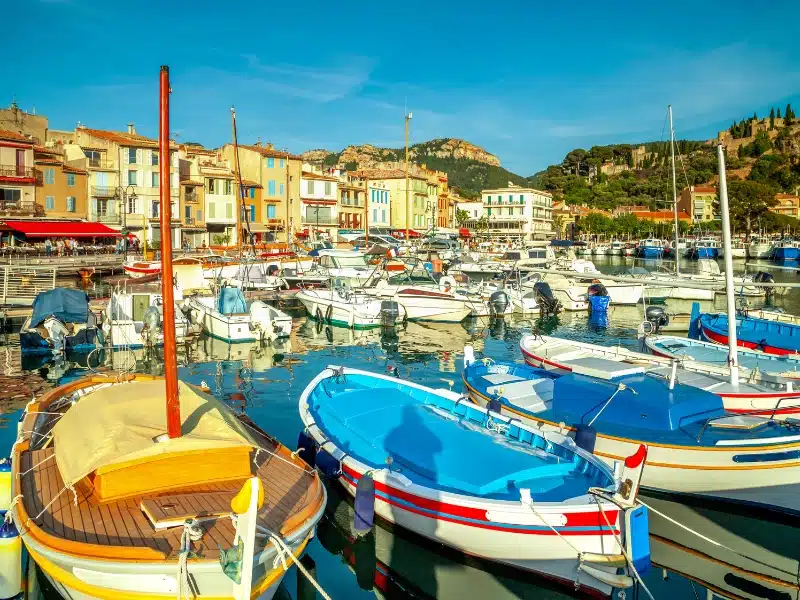
The afternoon drive to Cassis is short but scenic. Cassis itself is compact, pastel-toned, and framed by dramatic white cliffs. It’s the gateway to Calanques National Park, where narrow fjord-like inlets cut deep into the limestone coastline. If time allows, take a short boat trip to see the calanques from the water. It’s the most efficient way to appreciate their scale without committing to long hikes.
Arrive in Marseille in the early evening. As France’s oldest city, Marseille feels raw, energetic, and unapologetically urban after days of villages and coastlines. Settle near the Vieux-Port and enjoy dinner overlooking the harbour, where fishing boats and ferries still dominate the scene.
Where to Stay in Marseille
Staying centrally makes it easy to explore the city on foot after arrival.
Luxury: Suite Privée du Balcon du Vieux-Port Marseille offers a prime location and memorable views.
Mid-range: Maisons du Monde Hôtel & Suites Marseille Vieux Port is stylish, central, and practical for a one-night stay.
Budget: Les Appartements du Vieux Port are flexible, affordable, and well located.
Day 5: Marseille to Arles via Aix-en-Provence and the Luberon
Leave Marseille heading inland toward Aix-en-Provence, trading the port’s intensity for refined streets and shaded boulevards. Aix has long been associated with artists, writers, and students, and its atmosphere is relaxed without feeling sleepy.
Spend the morning strolling the Cours Mirabeau, browsing markets, and visiting the Cathedral of Saint-Sauveur, which layers Roman, medieval, and Baroque architecture in one compact site. If you’re interested in art history, a visit to Cézanne’s studio adds context to the landscapes you’ve been driving through.
From Aix, continue north and then west into the Luberon. The countryside here feels archetypally Provençal: vineyards, olive groves, dry-stone walls, and pale limestone villages perched above the valleys. Gordes is the most famous stop, and while it draws crowds, its position above the plain makes it worth seeing. Even a brief stop for photos and a short walk through the upper streets gives a sense of its scale.
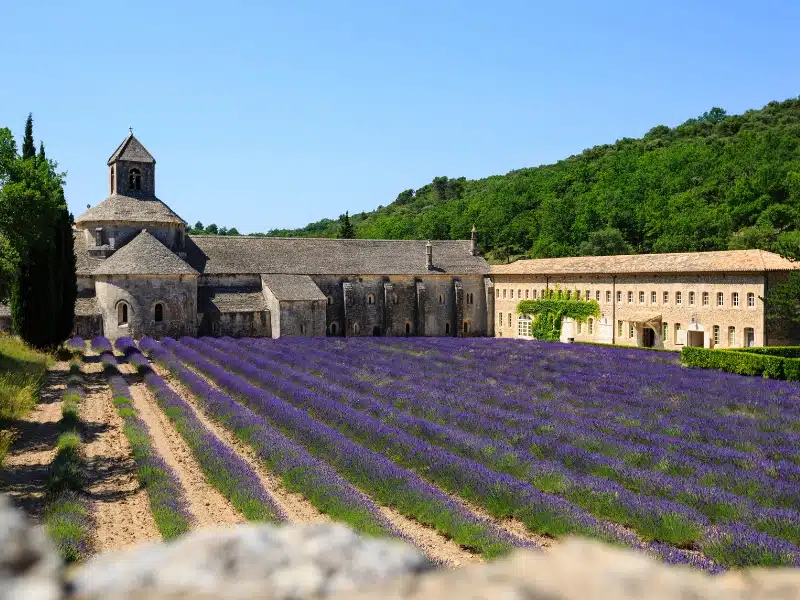
Nearby, the Sénanque Abbey sits quietly in a shallow valley. In summer, lavender frames the abbey, but outside bloom season the simplicity of the setting is just as striking. This is a good place to slow the pace before continuing west.
In the afternoon, cross the Rhône into Arles. The town is inseparable from Vincent van Gogh, and a self-guided walk linking the locations he painted adds meaning without requiring deep art knowledge. Beyond Van Gogh, Arles is rich in Roman heritage. The amphitheatre, theatre, and cryptoporticus underline how important this city once was.
If time allows, detour briefly into the Camargue before evening. Even a short drive south reveals a different landscape altogether, flat, marshy, and alive with birds.
Where to Stay in Arles
Arles works well as a compact overnight stop with good onward access the next morning.
Luxury: L’Hôtel Particulier is a refined townhouse stay inside the historic centre.
Mid-range: Mas de la Chapelle offers space, parking, and a quieter setting just outside town.
Budget: Hostellerie De La Source is practical, affordable, and easy to reach by car.
Day 6: Arles to Montpellier via Nîmes and Roman Languedoc
Today focuses on Roman France, moving west through towns that still carry the imprint of empire in their street plans and monuments.
Start the day in Arles if you didn’t fully explore the amphitheatre or old town the previous evening. From here, drive south toward Saint-Gilles-du-Gard, where the Abbey of Saint-Gilles stands as one of the most important Romanesque pilgrimage sites in southern France. Its sculpted façade and subterranean crypt make it a worthwhile stop even for those not usually drawn to religious architecture.
Continue on to Nîmes, one of the best-preserved Roman cities in Europe. The Arena dominates the centre and remains in use today, while the nearby Maison Carrée is one of the finest surviving Roman temples anywhere. The Jardins de la Fontaine provide a gentler contrast, blending formal landscaping with Roman ruins and shaded walking paths.
Just outside Nîmes lies the Pont du Gard. This three-tiered aqueduct spans the Gardon River and is as impressive for its engineering as for its setting. Walking across and beneath it gives a strong sense of Roman ambition and scale.
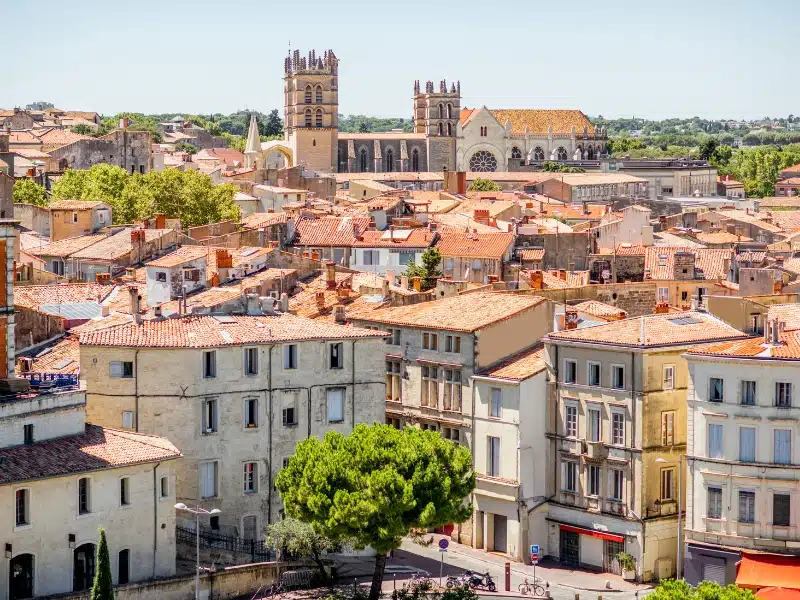
Arrive in Montpellier by late afternoon. Unlike the older towns you’ve passed through, Montpellier feels youthful and forward-looking, driven by its large student population. The historic centre is a tangle of narrow streets and hidden squares, while the Promenade du Peyrou offers elevated views back toward the Cévennes.
Where to Stay in Montpellier
This stop marks the transition from Provence into the historic Languedoc region, now known as Occitanie.
Luxury: Mas de Lafeuillade provides a peaceful countryside feel close to the city.
Mid-range: Hotel Oceania Le Métropole Montpellier is well-rated, centrally located and within easy walking distance of Montpellier’s historic centre.
Budget: Hotel d’Aragon is simple, well located, and good value.
Day 7: Montpellier to Narbonne via Saint-Guilhem-le-Désert and the Haut-Languedoc
Leave Montpellier heading northwest toward Saint-Guilhem-le-Désert, one of the most beautifully set villages in southern France. The drive itself is part of the appeal, passing vineyards and low hills before narrowing as you approach the Hérault valley.
Stop at the Pont du Diable for a short walk or swim if the weather allows. The clear river and dramatic gorge setting make this a refreshing pause before continuing to the village.
Saint-Guilhem-le-Désert is small but dense with history. The abbey is the focal point, its Romanesque architecture and quiet cloister contrasting with the rugged landscape around it. Even at busy times, it’s easy to find quieter corners by wandering beyond the main square.
From here, continue west through the Haut-Languedoc. This is wine country, but less polished than Provence, with a stronger agricultural feel. If time allows, detour into the Orb valley or pause at one of the smaller villages that dot the route.
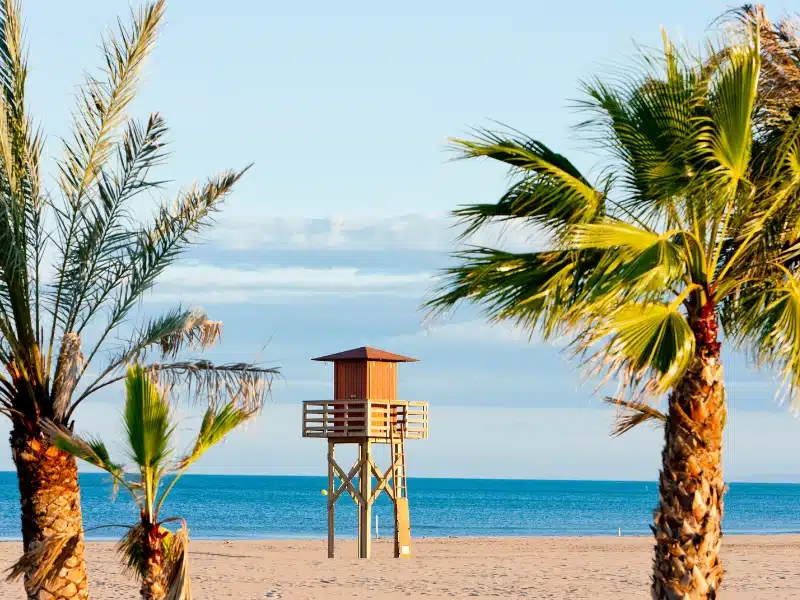
Arrive in Narbonne in the evening. Once a major Roman port, it now feels understated compared to its history. The Archbishop’s Palace and cathedral dominate the centre, while the Canal de la Robine provides a relaxed setting for an evening walk and dinner.
Where to Stay in Narbonne
Narbonne is a natural overnight stop before heading inland toward Carcassonne and Toulouse.
Luxury: Hôtel Le Mosaïque is elegant and well positioned near the historic centre.
Mid-range: Hôtel Le C Boutique Hôtel offers modern comfort and easy access.
Budget: Fasthotel Narbonne is car-friendly and efficient for a short stay.
Day 8: Narbonne to Carcassonne via the Minervois
Leave Narbonne heading west into the Minervois, one of southern France’s most quietly compelling wine regions. This is a landscape of low limestone hills, vineyards, and understated villages that feel far removed from the Mediterranean coast you left behind the day before.
If you enjoy wine, this is an ideal morning to slow the pace. Small domaines are scattered throughout the countryside, many offering informal tastings without the crowds you’ll find closer to Provence. Even without stopping, the drive itself gives a strong sense of the agricultural backbone of the region.
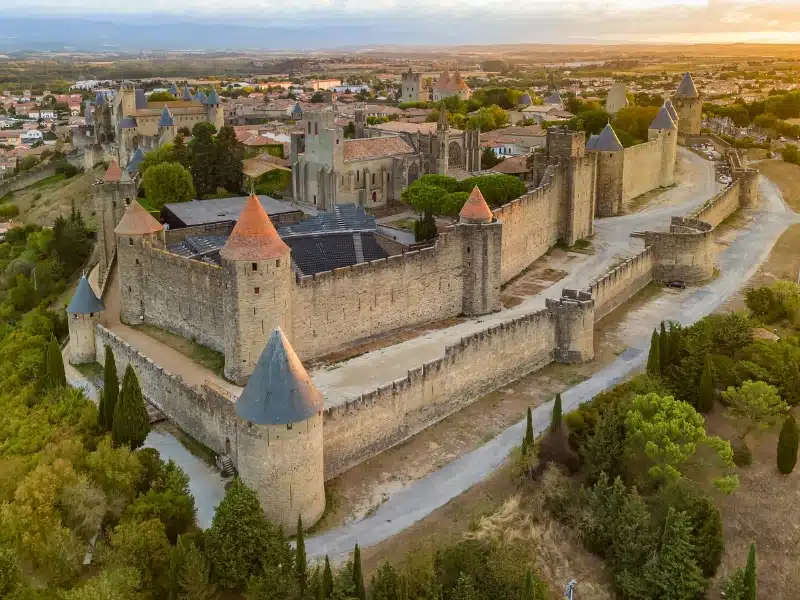
Approaching Carcassonne, the terrain flattens and the fortified silhouette of La Cité becomes visible from miles away. The sudden appearance of its double walls and towers feels deliberately theatrical, and arriving by road enhances that effect.
Spend the afternoon exploring the medieval citadel. Walking the ramparts gives a clear sense of the city’s defensive scale, while the Basilica of Saints Nazarius and Celsus offers a quieter interior contrast to the busy streets below. Even if you’ve seen many fortified towns in France, Carcassonne stands apart for its sheer completeness.
If crowds peak mid-afternoon, step outside the walls into the lower town (Bastide Saint-Louis). The atmosphere here is calmer, with tree-lined squares and good restaurants that are often overlooked by day-trippers.
Carcassonne is worth an overnight stay. Seeing the citadel illuminated after dark and again early in the morning, before tour buses arrive, gives a very different impression.
Where to Stay in Carcassonne
Carcassonne works best as an overnight stop so you can visit La Cité late afternoon and early morning, when it feels far less theme-park busy.
Luxury: Hôtel de la Cité Carcassonne MGallery is the classic splurge inside the medieval walls, ideal for atmosphere and an early wander.
Mid-range: Hôtel Le Donjon sits inside La Cité too, giving you the location without the full luxury price point.
Budget: ibis Carcassonne Est La Cité is an easy, car-friendly option with simple access and a short drive to the citadel.
Day 9: Carcassonne to Toulouse via the Canal du Midi
Today’s drive is shorter and gentler, designed to ease you out of medieval strongholds and into southwestern France’s relaxed rhythm.
Leave Carcassonne following the Canal du Midi, a UNESCO-listed engineering achievement that links the Atlantic to the Mediterranean. Even brief stops along the canal reveal its quiet charm: shaded towpaths, slow-moving barges, and locks that still operate much as they did centuries ago.
A good midway pause is at one of the smaller canal villages such as Castelnaudary, traditionally associated with cassoulet. This is an ideal lunch stop if you want something regional and unpretentious, especially if you’re travelling outside peak summer.
Continue west toward Toulouse, passing open farmland and river valleys rather than dramatic scenery. The landscape here feels broader and more open, signalling a shift away from coastal France and toward the Garonne basin.
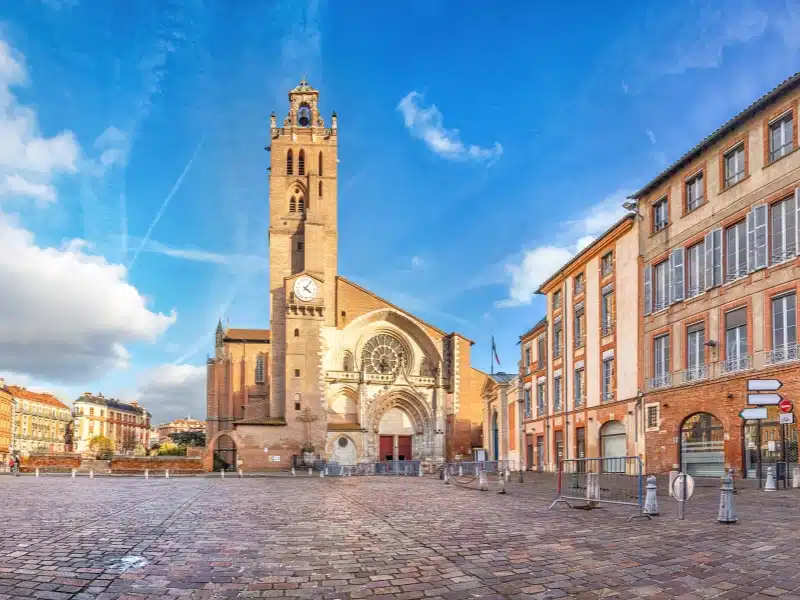
Arrive in Toulouse mid-afternoon. Known as La Ville Rose for its terracotta buildings, the city feels spacious and welcoming. The historic centre is walkable, with the Capitole Square acting as a natural focal point. Take time to wander along the Garonne River or explore the quieter backstreets where cafés spill onto small squares.
Where to Stay in Toulouse
End the road trip in Toulouse, with easy onward travel connections.
Luxury: Appart Hôtel Clément Ader combines space, comfort, and central access.
Mid-range: The Social Hub Toulouse is modern, well connected, and practical for a final stop.
Budget: Residhome Toulouse Ponts Jumeaux offers good value with straightforward road access.
Day 10: Toulouse and Optional Extensions
Your core south of France road trip officially ends in Toulouse, but how long you stay depends on your overall timeline.
Spend the morning exploring the city properly. The Basilica of Saint-Sernin is one of the largest Romanesque churches in Europe and well worth visiting. The Couvent des Jacobins offers a calmer, more contemplative stop, known for its distinctive palm-tree column.
If you enjoy museums, the Musée des Augustins provides a strong overview of southern French art, while aviation enthusiasts may want to visit Aeroscopia or the Airbus site just outside the city.
From here, the route naturally opens up into several optional extensions if you have more time:
If you’re flying home, Toulouse Airport is close and easy to reach by car, making this a practical endpoint without backtracking.
Booking Tips for the South of France Road Trip
This itinerary moves steadily west, so accommodation works best when booked as one stop per night, rather than regional bases.
Road Trip Tips for the South of France
This is an easy, well-paced road trip, but a few realities make it far more enjoyable.
More France Road Trips to Explore

Portugal Road Trip: The Ultimate 10 Day Itinerary

Europe Road Trip: 28 Epic Routes You Can Actually Drive

European Road Trip: Six Countries in 90 Days
Germany Road Trip: 12 Unmissable Routes

France Road Trip: 13 Amazing Itineraries

Driving in the Alps: Top Tips & Best Routes
Love it? Pin it!


