This post may contain affiliate links, from which we earn an income. Click here to read our affiliate policy.
France is a delightful bundle of fabulous landscapes, delicious food, historic cities and a love of motorhomes. That love has led to, without doubt, the best infrastructure in Europe for anyone travelling in a van. With a vast network of aires, great roads and a tolerance of wild camping not found anywhere else on the continent, why wouldn’t you want to take your motorhome to France?
In our seven years of full-timing, we have spent many months in France, visiting all four corners and every single department, in our quest to share as much information as possible, but also because we love it so much!
In this guide, we’re aiming to give you a quick reference point for your next trip and provide you with all the information you need to organise an epic motorhome holiday in France. Bon Voyage!
Documents You Need to Travel & Drive in France
Optional Documents
Make sure you have travel insurance you can trust when motorhoming France. We recommend True Traveller for their 5-star TrustPilot reviews, variety of cover options, best activities cover as standard, great prices and excellent service.
Vehicle Safety Equipment in France
Angles Morts Stickers
From 1st January 2021, all vehicles over 3,500kg are required to display infographic angles morts or blind spot stickers. Stickers must be visible on both sides and at the back of the vehicle and must be placed between 0.90m and 1.50m above the ground.
Stickers must be placed in such a way that they don’t cover the vehicle’s regulatory plates and inscriptions, or any of the lights or signals, and don’t hinder the driver’s field of view.
Mountain Law II
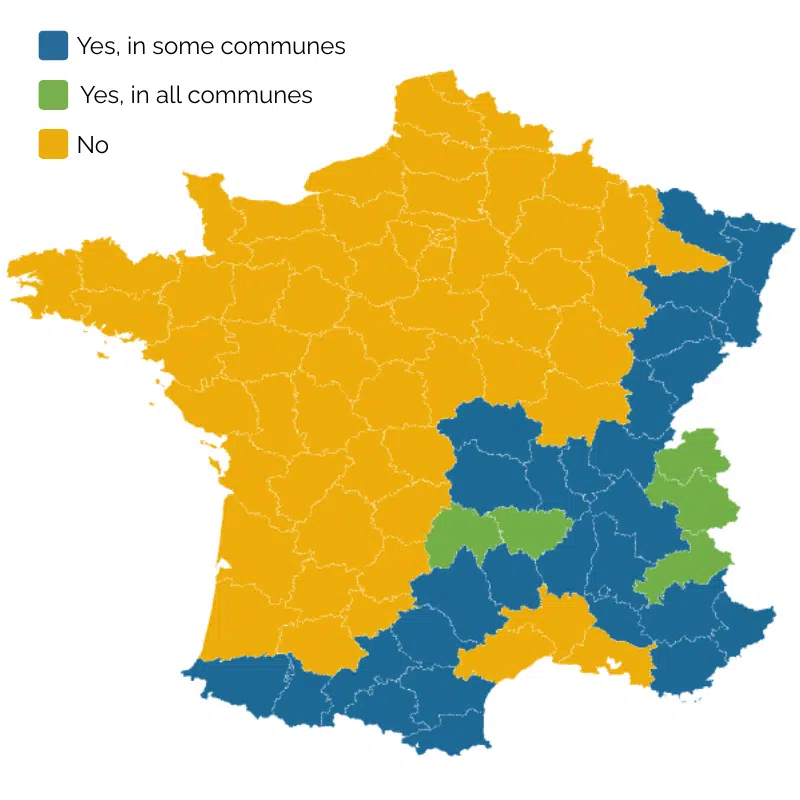
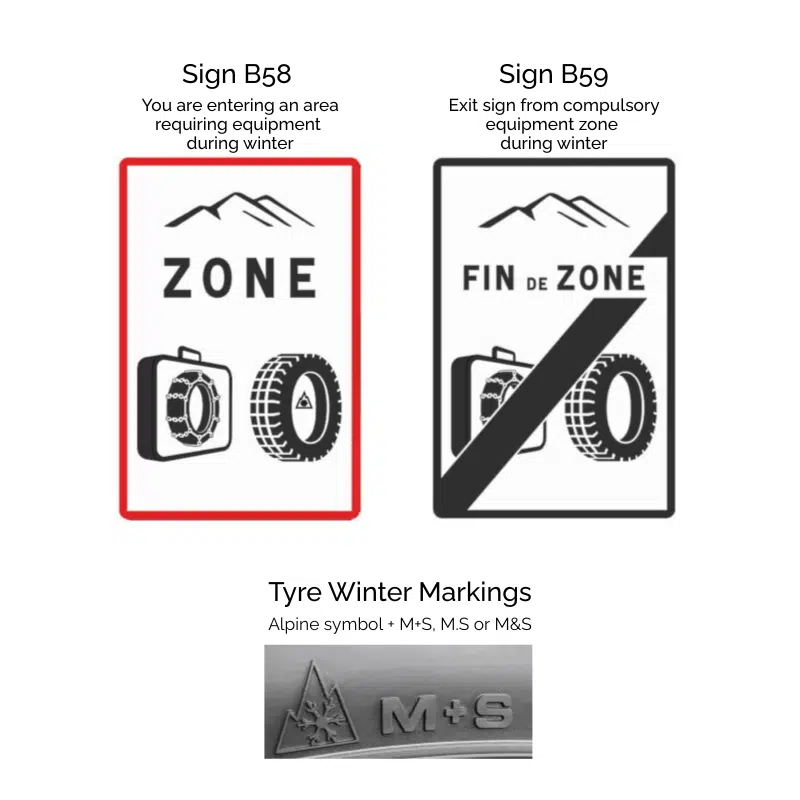
Loi Montage II or ‘mountain law II’ is in force in 48 French mountainous departments within the Alpes, Massif Central, Jura, Pyrenees, and Vosges regions. The law is designed to improve winter road safety and reduce traffic jams within specific zones and applies to cars, vans, motorhomes, and heavy goods vehicles.
Anyone travelling through the designated areas shown on the map between 1 November and 31 March will be required to fit four approved winter tyres or carry at least two snow chains or socks in the vehicle.
Speed Stickers
You may have read that speed stickers with 80, 100 and 110 are required on the rear of campervans and motorhomes heavier than 3500kg. Feedback from fellow motorhomers and our observations suggest that few (including the French) are complying with the speed sticker requirement, and we are unaware of anyone being fined for non-compliance.
If you do want to attach stickers, they can be bought from most petrol stations in France.
Low Emission Zones
France’s Crit’Air vignette windscreen stickers are a legal requirement to enter low-emission zones (ZFEs) in over 45 French cities and their peripheries, and are expected to include another 40 cities in 2026.
The sticker identifies a vehicle’s emissions levels and restricts access in order to improve air quality. The system identifies what emissions vehicles produce, and your motorhome is categorised based on your vehicle’s Euro emissions standard.
If you intend to travel close to a city or use its ring road, it’s worth getting the crit’air sticker or using a sat nav or mapping app to help you avoid the ZFEs. Systems we know of which offer this are Waze, where you can set your vehicle as non-compliant, Sygic Professional, Co-Pilot GPS, Garmin Camper and TomTom.
The sticker costs only €5.11, including postage, from the official website. We recommend ordering at least 6 weeks in advance of your trip and only purchasing Crit’Air stickers from the official certificat-air.gouv.fr website, or you risk being ripped off.
Toll Roads in France
Touring France can be expensive if you only use autoroutes with tolls, but they do allow you to travel through the country to your destination quickly. Try using this European route planner with tolls to get an idea of toll costs for your route, or just set your sat nav for the scenic route.
The technical measurement that French toll roads use to determine whether your motorhome is Category 2 or 3 is height and weight, with anything over 3m or 3,500kg being Category 3. Often, the system will classify a larger motorhome or RV as Cat 3. If you press the telecoms button at the booth and simply say “je suis un camping-car” (I am a camping car), the operator may change your category to 2, which will be significantly cheaper.
An electronic toll tag, like Bip&Go, Fulli, or EMovis (which also covers you in Spain and Portugal), deducts toll fees from a credit card automatically, meaning you don’t have to stop at a booth or barrier.
Data Roaming
If you’re travelling to France for a couple of weeks, or even a month or two, you’ll be able to use your data there, although there is likely to be a cap and/or cost if you do. The amount varies by provider, so it’s best to check before you leave.
The only UK provider we’re aware of that does not cap or charge Extra for data roaming is Tesco Mobile, but this is only ever guaranteed ona. year-to-year basis.
Otherwise, the options include buying a local SIM card and using either a travel router or swapping the SIM card from your phone, downloading an eSIM, which allows you to also keep your own SIM card or using a Starlink device. If you’re heading to a campsite, you’ll also be able to access their WiFi, but many sites charge extra for this, and often the signal, shared amongst many others, is weak.
RELATED POST: An Easy Guide to Motorhome WiFi & Internet
Camping Cards
Neither of these cards is compulsory, but we would recommend having both because they are easy to obtain and can save you time and hassle once you arrive in France.
ACSI Camping Card
The ACSI camping card provides low-season discounts on thousands of campsites across France, with savings of up to 60%. The card with a book or app costs €20.95 for members and a euro more for non-members.
If you buy the app, which also works without internet, the card is loaded with a QR code online, so you don’t need to carry the ACSI book. If you do want the book, order well in advance as delivery can take weeks.
Camping-Car Park
The largest commercial aire provider in France is Camping-Car Park, and they run over 500 commercial aires in France, many with facilities like showers and electric hook up. The average cost of a night’s stay is €10-12.
The first time you stay in one of their aires, you’ll need to download the app and top up your account. You can either arrive and take your chances that there will be space, or reserve using their Pack’Privileges, which costs €29 a year. The average cost of a night’s stay is €10-12.
France Motorhome Checklist
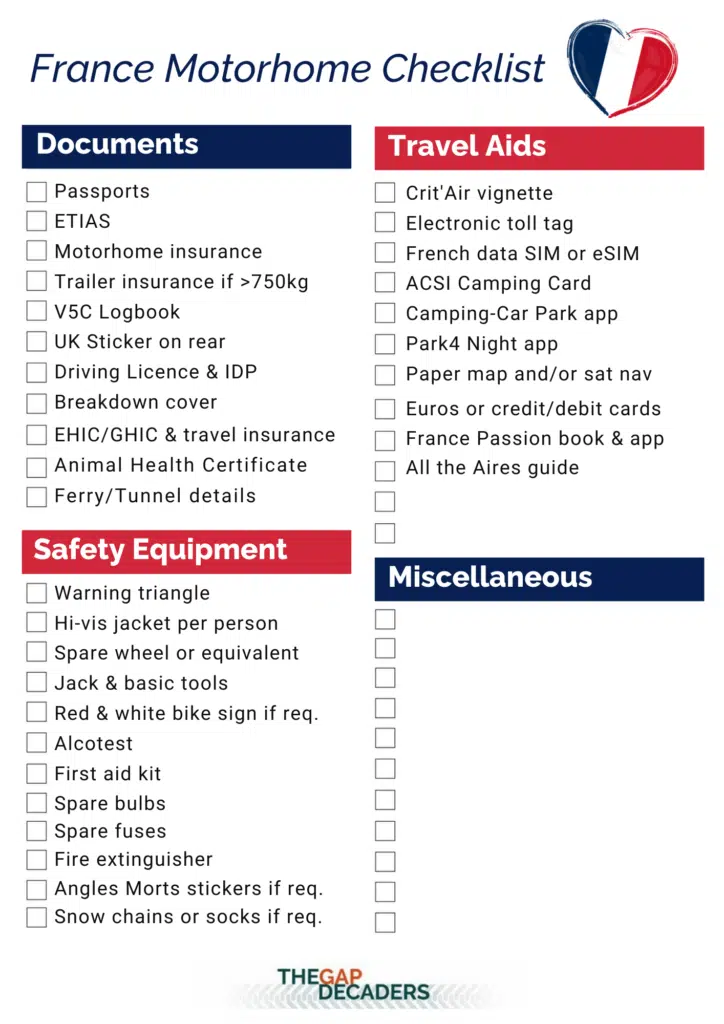
This checklist covers all the essentials you need for a motorhome trip to France.
Looking for more France motorhome resources? Check out these top posts…

Motorhoming in France: Your Complete Touring Guide

The Best Destinations for Motorhome & Campervan Holidays in France
Motorhome Aires in France – All You Need to Know
Wild Camping in France for Motorhomes – All You Need to Know

Driving to France from UK: Absolutely Everything You Need to Know

20 Best Cities In France To Visit & Fall In Love With!
Love it? Pin it!