This post may contain affiliate links, from which we earn an income. Click here to read our affiliate policy.
For British travellers planning a long European road trip, the Schengen 90/180 rule can feel painfully restrictive.
Ninety days sounds generous when you are booking a two-week holiday. It feels very different when you are travelling slowly in a motorhome, spending winter in southern Europe or setting off on an extended overland journey.
It is also surprisingly easy to misunderstand. The rule does not give you three months in every Schengen country, and your allowance does not automatically reset when you leave. A weekend in Morocco will not give you another 90 days, and travelling from Spain into France makes no difference because both countries are part of the same Schengen Area.
The good news is that the 90-day rule does not mean British travellers can spend only three months of every six in Europe as a whole.
There are several legal ways to stay in Europe for much longer. You can travel through non-Schengen countries, obtain a long-stay visa, establish residency, qualify for an EU passport or, in some circumstances, exercise rights as the family member of an EU citizen.
We have used several of these routes ourselves, including travelling under Phil’s Irish citizenship and building longer journeys around Morocco, Turkey and the Balkans.
This guide explains the options, how the rolling calculation works and what long-term travellers need to consider before setting off.
Immigration rules change frequently, so always confirm the requirements with the relevant government, embassy or consulate before relying on them.
Enjoy The Gap Decaders? Add us as a preferred source on Google.

TL;DR: How to Beat the Schengen 90/180 Rule
British passport holders can normally spend up to 90 days in the Schengen Area during any rolling 180-day period. The allowance covers the whole Schengen Area, so you cannot spend 90 days in Spain followed by another 90 days in France. You can legally extend your travels by:
What Is the Schengen 90/180 Rule?
British passport holders can normally visit the Schengen Area without a visa for a maximum of 90 days in any rolling 180-day period.
The allowance applies across the whole Schengen Area, not separately to each country. You can divide your 90 days between Spain, France, Germany, Italy and other Schengen countries, but the total must remain within the limit.
The important points are:
This means it is not simply a case of spending 90 days in Europe, leaving for 90 days and then returning. That pattern works when the dates are exact, but shorter trips and previous visits can affect the calculation.
How Does the Rolling 180-Day Calculation Work?
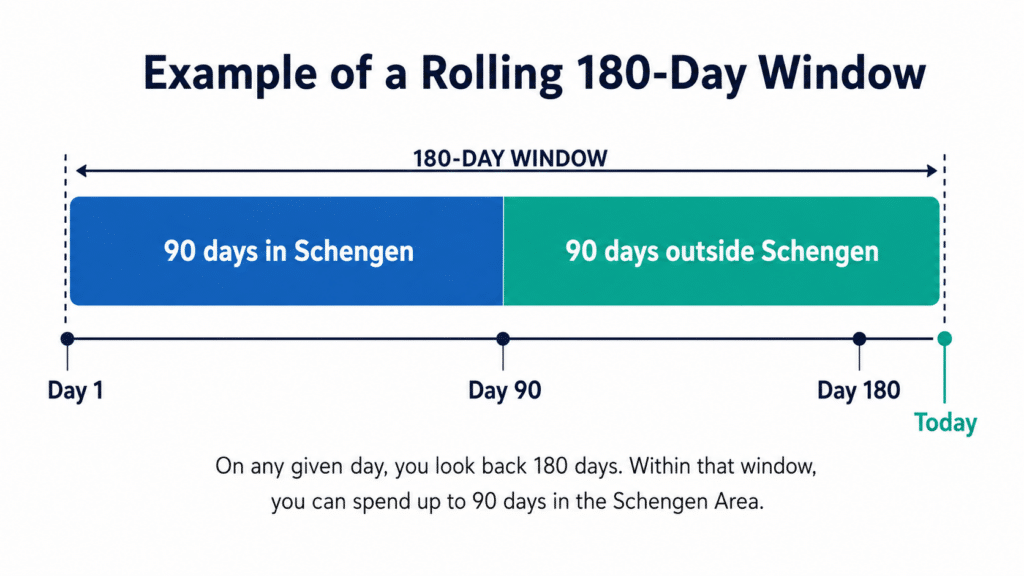
On every day you are inside Schengen, look back over the previous 180 days, including the current day.
Within that period, you must not have spent more than 90 days in the Schengen Area.
The UK government suggests calculating your allowance by choosing the date on which you intend to leave Schengen, counting backwards 180 days and adding together every day spent in Schengen during that period. You then add the days planned for your next trip and check that the total does not exceed 90.
A simple example
Imagine you enter France on 1 January and stay continuously in Schengen until 31 March.
That uses 90 days.
You cannot return on 1 April with a fresh allowance. Your January, February and March days are all still visible within the rolling 180-day window.
As each old day gradually drops out of the calculation, a new day becomes available. If you remain outside Schengen for a complete 90 days, you will normally have regained the full 90-day allowance.
Example of a split trip
You spend:
You have now used 90 Schengen days. The 20 days in Morocco did not count towards your Schengen allowance, but they did not erase the 30 days already used in Spain.
The European Commission provides an official short-stay calculator, although it describes the result as a planning tool rather than a legally binding decision.
Which Countries Are in the Schengen Area?
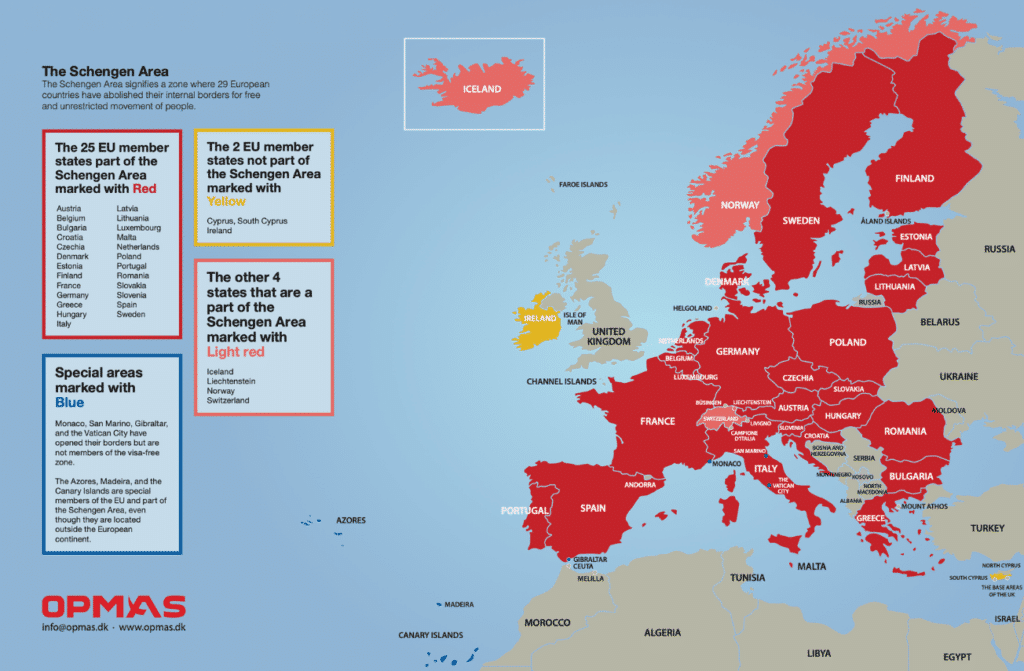
The Schengen Area now contains 29 countries: 25 EU member states and four non-EU countries.
Bulgaria and Romania became full members on 1 January 2025. Time spent in either country now counts towards your Schengen allowance, including when entering by land.
The 29 Schengen countries are:
Austria, Belgium, Bulgaria, Croatia, Czechia, Denmark, Estonia, Finland, France, Germany, Greece, Hungary, Iceland, Italy, Latvia, Liechtenstein, Lithuania, Luxembourg, Malta, the Netherlands, Norway, Poland, Portugal, Romania, Slovakia, Slovenia, Spain, Sweden and Switzerland.
Not every EU country is in Schengen. Ireland and Cyprus remain outside it. Cyprus has its own separate 90 days in any 180-day allowance for British visitors, and time there does not reduce your Schengen allowance.
Option 1: Spend Time Outside the Schengen Area
For motorhome travellers and overlanders, the simplest solution is often to alternate between Schengen and non-Schengen countries.
This does not reset your allowance immediately, but it allows older Schengen days to fall outside the rolling 180-day window.
Some of the best non-Schengen destinations for an extended road trip include:
Each country has its own entry rules, permitted length of stay, vehicle requirements and insurance arrangements. Some may allow British visitors to stay longer than 90 days, while others operate their own 90-in-180 calculation.
Always check the current entry requirements for every country individually. Being outside Schengen does not automatically mean you have an unlimited right to remain there.
Do Europe’s microstates stop the Schengen clock?
Do not plan your trip around using Andorra, Monaco, San Marino or Vatican City to preserve your allowance.
Although these states are not all formally part of Schengen, they have open or tightly integrated borders with neighbouring Schengen countries. Entry and exit may not be recorded in a way that proves you left Schengen, and accessing them generally involves travelling through Schengen territory.
They may be enjoyable destinations, but they are not a reliable way to pause your Schengen calculation.
Does Gibraltar stop the Schengen clock?
No. Gibraltar should not be used as a place to preserve or rebuild your Schengen allowance.
Since 15 July 2026, Gibraltar’s entry conditions for short-stay visitors have been aligned with Schengen requirements. For British passport holders, days spent in Gibraltar count alongside days spent elsewhere in the Schengen Area towards the same 90 days in any rolling 180-day period.
This means you cannot spend 90 days in Spain and then cross into Gibraltar to wait for your allowance to reset. Your Schengen clock continues to run while you are there.
British and Irish dual nationals travelling on an Irish passport are treated as EU citizens and are not subject to the 90-day limit.
Our approach to non-Schengen travel
Although Phil’s Irish passport means we are not personally limited by the Schengen 90/180 rule in the same way as two British passport holders, we have still spent significant periods travelling in Morocco, Turkey and the Balkans.
For travellers managing their Schengen allowance, these countries can make longer European journeys much easier to plan. But they are far more than convenient places to spend time while Schengen days become available again.
Albania, Montenegro, Bosnia and Herzegovina, Serbia, North Macedonia, Turkey, Georgia and Morocco are outstanding overland destinations in their own right.
Including them in a longer itinerary creates a richer and more varied journey than spending 90 days in Spain and then rushing to the nearest border simply to stop the clock.
Option 2: Travel as the Spouse of an EU Citizen
British nationals travelling with an EU citizen spouse may have additional rights under EU freedom of movement law.
This is how we currently travel. Phil holds an Irish passport, making him an EU citizen, and I travel with him as his British spouse.
The European Commission’s representation in Ireland states that, in its interpretation of the Schengen Borders Code, the standard 90/180 rule does not apply to a non-EU family member travelling with an EU citizen who is exercising freedom of movement rights. It says the couple can travel through consecutive Schengen states, remaining for up to three months in each one.
However, this is more nuanced than saying that anyone married to an EU citizen has unlimited access to Schengen.
The rights generally apply when:
If you remain in a single host country for longer than three months, you will normally need to register your residence or apply for a residence card.
National immigration rules may apply when an EU citizen and their non-EU spouse are in the EU citizen’s own country of nationality rather than another EU country. Ireland is also outside Schengen and applies its own entry arrangements.
Documents to carry
The marriage certificate may need to be legalised, apostilled or translated in some circumstances.
This remains a specialist and sometimes inconsistently understood area at borders. Couples planning to rely on EU family rights should obtain current guidance from the relevant embassies and consider carrying printed copies of the applicable EU information.
Simply being married to an EU citizen does not remove every immigration formality.
RELATED POST: EU Travel Made Easy: The Schengen Advantage of Your Irish Passport for Your British Spouse
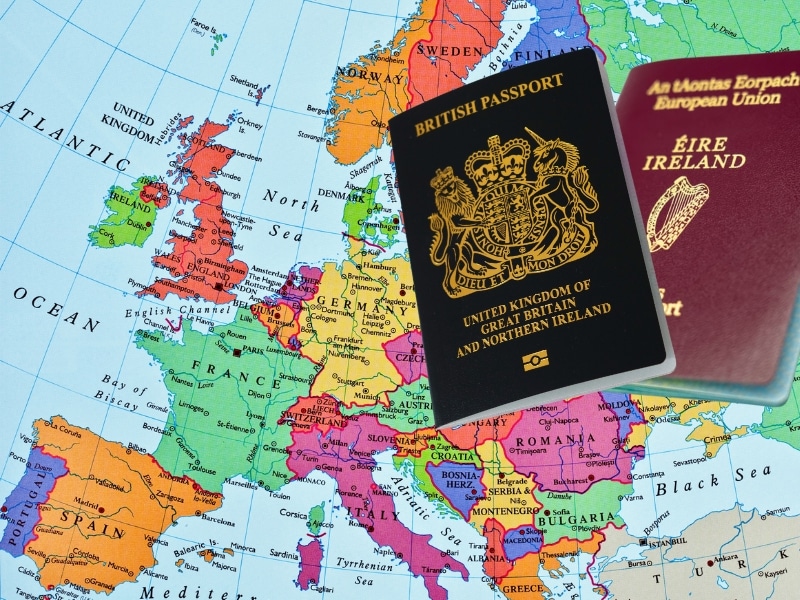
Option 3: Obtain an EU Passport
Before planning your life around the Schengen clock, check whether you are entitled to citizenship of an EU country.
Many British people qualify through a parent, grandparent or, in some cases, more distant ancestry.
Potential routes include:
The exact rules vary enormously. Some countries limit how many generations you can go back. Others require proof that an ancestor did not lose or renounce their citizenship before the next generation was born.
An EU passport gives its holder freedom of movement rights across the EU, although registration and residence conditions can still apply when living in another country for more than three months.
Irish citizenship is particularly relevant to British travellers because Ireland is an EU member and Irish citizens also retain rights in the UK through the Common Travel Area.
Phil has an Irish passport, and that has transformed how we can travel in Europe together.
Do not assume you are ineligible because you were born in Britain. Investigating your family history may uncover an option you did not know existed.
Option 4: Apply for a Long-Stay Visitor or Retirement Visa
Several European countries offer national visas for people who want to live there for longer than 90 days without taking local employment.
These are commonly aimed at retirees, people with savings, those with passive income and visitors who can support themselves without working.
Popular examples include:
France long-stay visitor visa
Anyone planning to stay in France for more than 90 days generally needs a long-stay visa.
France offers a long-stay visitor route for people staying for tourism or personal reasons. Depending on the visa issued, it may need to be validated online after arrival and can serve as a residence permit for up to one year.
Applicants normally need to demonstrate appropriate accommodation, financial resources and medical insurance, and agree not to undertake unauthorised work.
Spain non-lucrative visa
Spain’s non-lucrative visa allows applicants with sufficient guaranteed means to reside in Spain without carrying out work or professional activity.
It is widely used by retirees and financially independent people, but it is a residence route rather than an extended touring visa. Applicants must meet financial, health insurance and documentation requirements.
It should not be confused with Spain’s digital nomad visa, which is intended for qualifying remote workers.
Italy elective residence visa
Italy’s elective residence visa is aimed at people who intend to establish residence in Italy and can support themselves through substantial, stable resources without working.
Official Italian guidance makes clear that this is intended for people moving to Italy and does not permit employment.
Portugal passive-income residence visa
Portugal provides a residence visa route for retirees and people living from their own income, commonly known as the D7.
The visa is normally the first stage of applying for a Portuguese residence permit rather than permission to tour continuously around Europe.
Greece financially independent person route
Greece offers a national visa and residence route for financially independent applicants who can demonstrate sufficient resources.
Official Greek guidance states that qualifying British citizens may obtain a national visa and then apply for a residence permit, but this route does not confer the right to work.
What a national long-stay visa actually allows
A long-stay visa normally gives you the right to remain in the country that issued it and requires you to establish a genuine base in the issuing country, with suitable accommodation and evidence that you meet its residence conditions.
It does not automatically give you the right to spend the entire visa period touring other Schengen countries, but it is possible to use the 90 days at either end of the visa to extend your time in the Schengen to 18 months.
Option 5: Apply for a Digital Nomad Visa
Digital nomad visas are designed for people who earn money remotely from overseas employers or clients.
Countries offering a digital nomad or remote-worker route include:
Spain’s digital nomad visa, for example, is intended for foreigners planning to live in Spain while working remotely for an overseas employer or as a qualifying self-employed person.
Digital nomad visa requirements commonly include:
The income thresholds, tax consequences and rules for dependants vary by country.
These visas can be an excellent option for remote workers who genuinely want to base themselves in one country. They are less suitable for people intending to move constantly without establishing a home or meeting local registration requirements.
Remote working while physically present in another country can also create immigration, tax, social security and employment law issues. A tourist allowance should not automatically be treated as permission to work from anywhere in Europe.
RELATED POST: The Best Countries for Digital Nomads in 2026

Option 6: Establish Residency in a European Country
Residency can provide a longer-term solution for people who want a permanent or semi-permanent European base.
Possible routes include:
The requirements depend on the country and type of permit.
Residency usually gives you the right to live in the country that issued your permit. It may also allow short visits to other Schengen states, normally within the 90-in-180 limit.
It does not automatically give a non-EU citizen unrestricted residence rights across the entire EU. Moving to another EU country for more than 90 days generally requires a visa or residence permit for that second country.
Residency can also bring obligations involving:
Before applying, consider much more than the right to stay. The cheapest or easiest visa is not always the most suitable long-term arrangement.
Option 7: Use a Student, Work or Volunteering Visa
A national visa may also be available when the main purpose of your stay is:
The visa must match what you genuinely intend to do.
A student visa is not simply an inexpensive way to extend a holiday, and volunteering can still be legally classed as work in some countries.
National visas are normally tied to the issuing country and may restrict the number of hours you can work, the employer you can work for or the activities you can undertake.
For stays longer than 90 days, or for employment and longer-term study, the relevant country’s national visa rules apply.
Option 8: Combine a Long-Stay Visa With Schengen Travel
A carefully planned combination of a national long-stay visa and your ordinary Schengen allowance can allow you to remain in Europe for a substantial period.
For example:
90 days touring several Schengen countries
↓
Up to 12 months living primarily in France under an appropriate French long-stay visa
↓
A further period of Schengen travel once sufficient earlier days have dropped out of the rolling calculation
In theory, this could support a European stay approaching 18 months.
However, this example must not be interpreted as permission to tour freely throughout Schengen for 18 months.
During the French visa period, your right to remain beyond the normal allowance is primarily a right to remain in France. Visits to other Schengen countries remain subject to their applicable short-stay limits. France confirms that holders of its long-stay visas can generally travel elsewhere in Schengen for no more than 90 days in any 180-day period.
You would also need to comply with the French visa’s validation, accommodation, insurance and residence conditions.
This strategy is best suited to travellers happy to establish a proper base in one country and use it as the centre of a wider journey.
Which Option Is Best for You?
The right solution depends on how you travel, where you want to spend your time and what ties you are prepared to establish.
Retired couple
A French visitor visa, Spanish non-lucrative visa, Italian elective residence visa, Portuguese passive-income route or Greek financially independent route may be suitable.
The main decision is where you genuinely want to live. Compare income requirements, taxation, healthcare, accommodation rules and renewal conditions rather than choosing solely on application cost.
Digital nomads
Look at digital nomad or self-employment visas in countries where you would be happy to establish a real base.
Check the rules governing overseas clients, local clients, tax residence, social security and dependants.
Motorhome travellers
A combination of Schengen and non-Schengen countries is usually the most flexible option when you want to keep moving.
A long-stay visa may help, but only when you are comfortable spending much of the year in the country issuing it and meeting its accommodation requirements.
Slow travellers
Choose a national visa for a country where you genuinely want to spend six or twelve months. Use your Schengen allowance for shorter journeys elsewhere and include non-Schengen destinations in your route.
People married to EU citizens
Investigate your rights as an EU family member carefully. Travel together, carry evidence of your relationship and understand when national registration becomes necessary.
Do not rely only on a passport stamp or a verbal explanation given at a previous border.
People with Irish parents or grandparents
Investigate Irish citizenship before applying for a visa elsewhere.
An Irish passport may provide a much more permanent solution than repeatedly applying for national visas.
Frequently Asked Questions
Can I Reset My Schengen Allowance by Going to Morocco?
No. Visiting Morocco stops you from using more Schengen days, but it does not immediately reset the days already used.
As you remain outside Schengen, your previous Schengen days gradually move beyond the rolling 180-day window.
After 90 continuous days outside Schengen, someone who had previously used their full allowance will normally have regained the full 90 days.
Does Romania Count Towards the Schengen Allowance?
Yes.
Romania became a full member of the Schengen Area on 1 January 2025. Days spent there now count towards the shared Schengen 90-day allowance.
Does Bulgaria Count Towards the Schengen Allowance?
Yes.
Bulgaria also became a full Schengen member on 1 January 2025, including the removal of internal land-border checks.
Can I Spend 90 Days in Spain and Then 90 Days in France?
Not as an ordinary British visitor.
Spain and France are both in Schengen, so the days are added together. After 90 consecutive days in Spain, you would normally have no remaining short-stay allowance for France.
Can I Spend Six Months in Europe?
Yes, but not necessarily six months in the Schengen Area.
You could spend approximately 90 days in Schengen followed by 90 days in non-Schengen countries such as Albania, Montenegro, Bosnia and Herzegovina, Serbia, Turkey, Morocco or Cyprus.
You could also stay longer under an appropriate national visa, residence permit or EU family right.
Can I Work Remotely During My 90-Day Visit?
Do not assume visa-free tourist status gives you permission to work remotely.
Immigration rules distinguish between tourism, business activities and employment. Tax, social security and employment rules may also apply even when your employer or clients are abroad.
Check the official rules for each country in which you plan to work. For regular or long-term remote work, a digital nomad, employment or self-employment visa may be more appropriate.
Can I Buy a House and Stay for Longer?
Buying property does not usually give you an automatic right to remain beyond your immigration allowance.
You may own a house in Spain, France or another Schengen country and still be limited to 90 days in any rolling 180-day period.
Some countries have investment-based residence programmes, but these are separate applications with specific financial and legal requirements.
Do Nights on Campsites Count?
Yes.
Your immigration allowance is based on your physical presence in the Schengen Area, not where you sleep.
Days spent on campsites, aires, wild camping spots, in hotels, at friends’ homes or driving between countries all count.
What Happens if I Overstay?
Consequences vary between countries and depend on the circumstances and length of the overstay.
They can include:
UK government travel guidance warns that overstaying may result in a Schengen entry ban of up to three years in some circumstances.
The Entry/Exit System is intended to create a digital record of entries, exits and overstays, making it increasingly risky to rely on missing passport stamps or inconsistent checks.
If illness, an accident, vehicle breakdown or another serious event prevents you from leaving on time, contact the relevant immigration authority before your allowance expires. Keep evidence of the circumstances and do not assume an emergency extension will happen automatically.
Our Experience of Staying Longer in Europe
We began travelling full-time before the end of the Brexit transition period, so the way we move around Europe has changed considerably over the years.
Today, Phil travels on his Irish passport and I travel with him as his British spouse. We carry our marriage certificate and supporting documents because border officials may need evidence that we are travelling together and exercising EU family rights.
We also spend significant periods outside Schengen.
Morocco has become one of our favourite winter destinations, while Turkey and the Balkans have given us some of our most memorable overland journeys. Albania alone kept us occupied for four months, and we have travelled extensively through Montenegro, Bosnia and Herzegovina, Serbia, North Macedonia, Georgia and Armenia.
These countries are not inconvenient gaps between trips to France, Spain or Italy. They offer dramatic landscapes, excellent roads for touring, fascinating cities, welcoming communities and some of the best-value travel in the wider European region.
Once you stop viewing non-Schengen countries as waiting rooms, the 90-day rule becomes much easier to work around.
It can encourage slower, more imaginative journeys rather than restricting them.
Planning a Longer European Trip
Start by deciding what you actually want from the journey.
Do you want to tour continuously, establish a base, work remotely, retire abroad or spend winter in one place?
Then:
A spreadsheet or travel calendar can be invaluable, particularly when you make several short trips to Schengen throughout the year.
The 90-Day Rule Does Not Have to End Your European Travels
The Schengen 90/180 rule has made spontaneous long-term travel more complicated for British citizens, but it has not made it impossible.
You can spend time in Europe’s many non-Schengen countries, apply for a national visa, establish residency, qualify through work or study, exercise EU family rights or investigate whether you are entitled to another passport.
The best option is not about finding a clever loophole.
It is about choosing a legal arrangement that genuinely fits the way you want to travel.
With good records, realistic planning and a willingness to look beyond the most familiar destinations, Europe still offers years of extraordinary road trips.
The 90-day limit may shape your route, but it does not have to define it.
More Nomadic Life Tips to Explore

Gap Year for Over 50s: How to Take Time Out and Make It Count
Gap Decade Travel: How to Take a Later Life Break

5 Reasons Digital Nomads Prefer Thailand

Travelling in Europe With an Irish Passport and British Spouse: Schengen Rules Explained

How Remote Work and the Internet Are Redefining Nomadic Living

Best EU SIM Card for Long Term Travel & Digital Nomads in 2026
Love it? Pin it!