
This post may contain affiliate links, from which we earn an income. Click here to read our affiliate policy.
When we started planning the electrical system for our expedition truck, we knew one thing for certain: we didn’t want to compromise.
Our truck isn’t used for the occasional weekend away. It’s our home, our office and the thing that enables us to travel full-time and run our business on the road. If the power goes down, we can’t work, we can’t cook or stay warm properly, and many of the comforts that make long-term travel enjoyable disappear very quickly.
Eighteen months after the build was completed, we can confidently say that choosing Energy Monkey to specify our solar and electrical system was one of the best decisions we made.
Enjoy The Gap Decaders? Add us as a preferred source on Google.

Why We Chose Energy Monkey
Our relationship with Energy Monkey started long before this truck. We’d met Paul at the Overland Show in Stratford while trying to get to the bottom of some issues with the Victron system in our previous vehicle. After a quick chat, he immediately offered to meet us the next day, a Sunday, in a supermarket car park to have a look at it for us.
In the end, we couldn’t make the timing work, but we never forgot the gesture. He didn’t know us, there was no guarantee of any future business, and yet he was willing to spend his own time helping out fellow travellers. So when we eventually needed someone to design the electrical system for this truck, Energy Monkey was the first company we called.
What impressed us even more, though, was that the same attitude carried through into the entire design process. There was no hard sell and no attempt to steer us towards an off-the-shelf package. Instead, Energy Monkey took the time to understand exactly how we lived and travelled before recommending a single component.
There are plenty of companies willing to sell you boxes. What set Energy Monkey apart was that they started by asking questions.
Before recommending a single piece of equipment, they wanted to understand how we actually lived. What appliances would we use? How long did we want to stay off-grid? Did we travel in winter? Would we visit North America? How important was remote working?
Rather than building a system around a budget or a generic package, they built it around our lifestyle.
That consultation process meant we ended up with a system designed specifically for us, not simply the biggest collection of blue Victron boxes they could sell.
We also liked that they recommended and worked closely with Auto Elec Wiltshire, an authorised Victron installer, who did a great job with our installation and layout.
What Our System Needed to Power
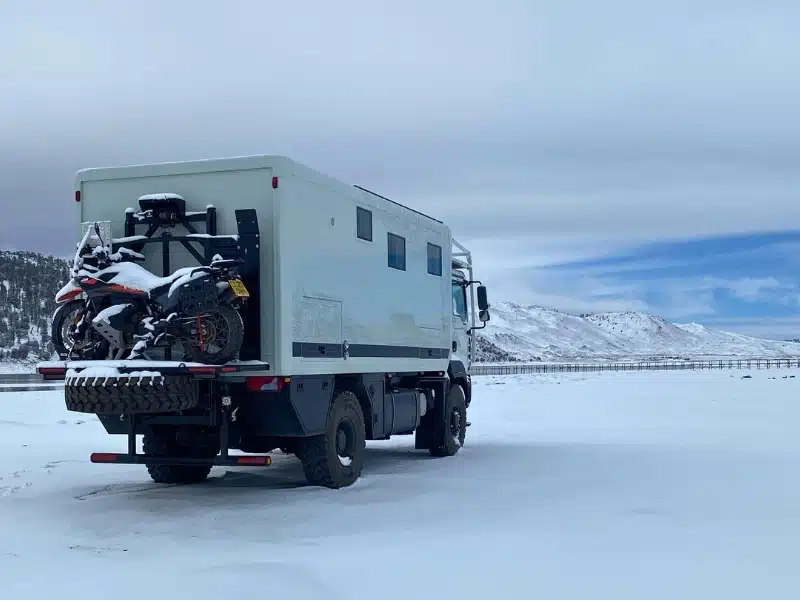
Our truck camper’s electrical demands are probably higher than the average motorhome or campervan.
On a daily basis, our system supports induction cooking, Starlink internet, laptops and devices, our television, washing machine, habitation air conditioning, and the truck’s 230V ring main.
It also powers all of the less glamorous essentials that keep life comfortable: lighting, geared water pumps, diesel heater components, ventilation fans, USB charging points, routers and various background systems that quietly do their jobs every day.
Because our income relies on staying connected, reliability wasn’t negotiable.

The Main Components Energy Monkey Specified
Energy Monkey specified a fully integrated Victron system that works together as one ecosystem.
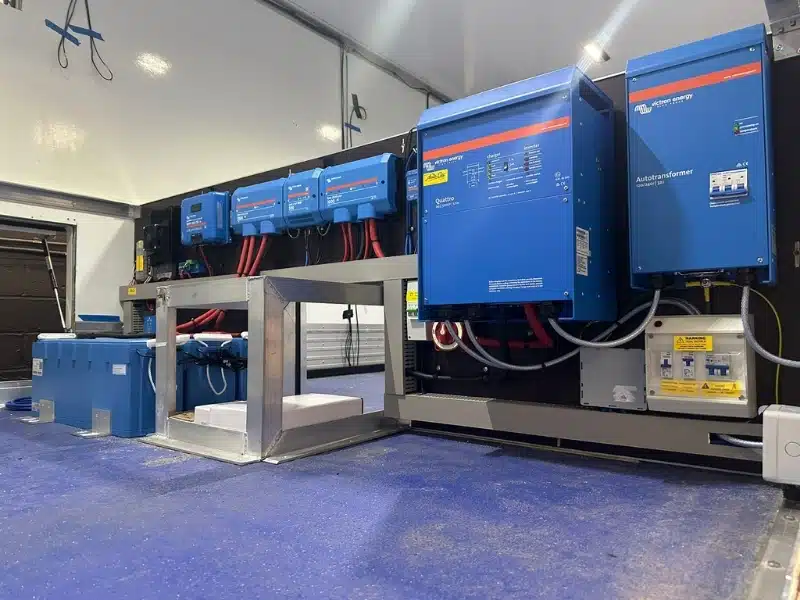
Victron Quattro 24/5000
The Quattro is the heart of the system.
This 5,000W inverter/charger converts battery power into usable household electricity and allows us to run high-demand appliances simultaneously, such as the induction hob and washing machine.
Energy Monkey chose the Quattro instead of the more common MultiPlus because of our travel plans. The Quattro has dual AC inputs, allowing us to connect to both European 230V shore power and North American 120V supplies.
That future-proofing wasn’t something we’d even considered initially, but it means our truck is genuinely set up for worldwide travel.
Victron LiFePO4 Batteries
Our battery bank consists of three Victron 24V 200Ah lithium batteries, giving us a substantial amount of usable energy storage.
These batteries allow us to remain off-grid for extended periods and cope with heavy electrical loads without constantly worrying about power consumption.
There are certainly cheaper batteries available, and we questioned the cost at the time.
One of the biggest advantages Energy Monkey highlighted was the worldwide Victron support network. If something goes wrong while you’re travelling abroad with a Victron system, having access to dealers and technical support across multiple countries offers enormous peace of mind.
Thankfully, we’ve never needed it, but it’s reassuring to know it’s there.
Solar Array and MPPT
Our roof carries five 405W solar panels, delivering just over 2kW of generating capacity.
Energy Monkey paired these with a Victron SmartSolar MPPT controller, which maximises the energy harvested from the panels and efficiently converts it into battery charging.
In summer, the amount of energy generated can be remarkable. Even in shoulder seasons, the solar array provides us with all the power we need. In 18 months, we have never needed to hook up to mains electricity.
Buck-Boost DC-DC Charging
The truck also charges the house batteries while the engine is running. Driving delivers more power, but idling also works, with the truck engine acting like a generator.
The Buck-Boost converter manages the power coming from the alternator and delivers it safely to the lithium batteries. Alternator output naturally fluctuates, whereas lithium batteries require carefully controlled charging.
This component bridges that gap, ensuring efficient charging while protecting the battery bank.
Cerbo GX and GX Touch
The Cerbo GX is effectively the brain of the operation.
Combined with the GX Touch display, it gives us a complete overview of the entire system. We can monitor battery levels, charging sources, consumption, tank levels, and system performance in real time.
More importantly, because the Cerbo GX is connected via Starlink or local internet connections, Energy Monkey can remotely access the system if we ever need support.
Being able to troubleshoot from thousands of miles away is invaluable when your home is constantly moving.
Autotransformer
This isn’t the most exciting component, but it’s one we’re very glad Energy Monkey thought about.
The autotransformer allows us to utilise North American 120V shore power by converting it for use within our 230V system. We have two input sockets on the side of the truck, one for the UK and Europe and the other for America.
It’s another example of the way they planned not just for how we travelled at the time, but how we might travel in the future.
How Has It Performed After 18 Months?
In a word: brilliantly.
Before moving into the truck, one of our biggest concerns was running out of power. We were used to rationing electricity and constantly checking battery levels in our previous vehicle.
That anxiety about losing power has disappeared.
The system comfortably handles the realities of full-time travel, from dark winter days with heating running and very little solar input, to scorching summer temperatures when the air conditioning works hard for extended periods.
We’ve never found ourselves wishing we’d specified a smaller system.
If anything, having the confidence to simply use the truck as intended has been one of the greatest luxuries.
What We’ve Appreciated Most
Beyond the equipment itself, we’ve valued knowing that support is only a phone call away.
Energy Monkey didn’t disappear once the invoice was paid.
The ability for them to remotely log in, monitor performance, update settings and diagnose issues means we’re not left trying to solve problems alone in another country.
When your truck is your home, and your livelihood depends on staying online, that level of backup matters.

Would We Recommend Energy Monkey?
Absolutely.
Their approach wasn’t about selling us the most expensive setup possible. It was about understanding how we travel and designing a system capable of supporting that lifestyle.
Eighteen months later, the specification still feels right.
The system has exceeded our expectations, we’ve never regretted investing in quality components, and the confidence that comes from knowing your power needs are covered is difficult to put a price on.
If you’re building an expedition truck, overland vehicle or high-demand off-grid setup, we’d happily recommend speaking to Energy Monkey.